AI Call Handling ROI for Restaurants: Key Metrics

How AI phone systems recover missed calls, cut labor costs, boost order value, and deliver fast ROI for restaurants.

AI Call Handling ROI for Restaurants: Key Metrics

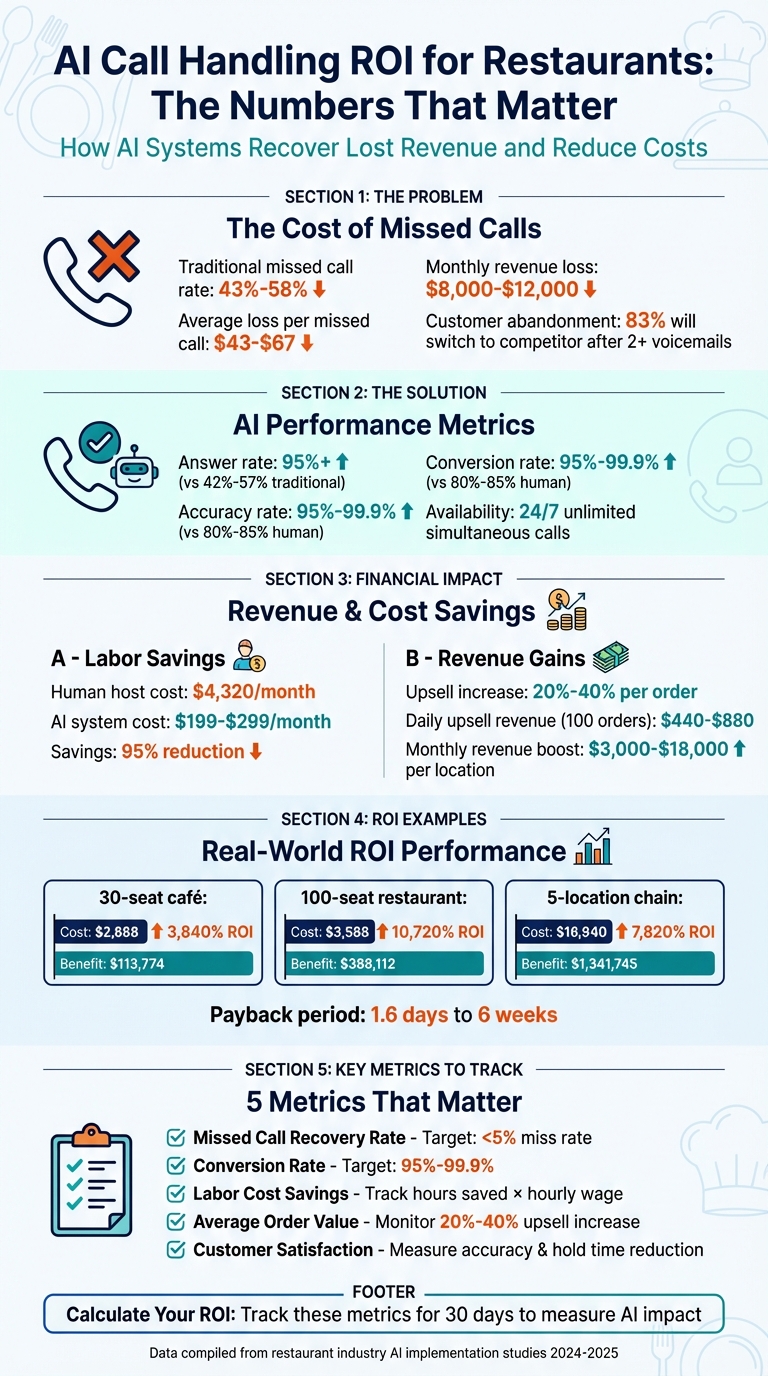
Missed calls are costing restaurants thousands of dollars every month. On average, every missed call can result in a loss of $43 to $67, and with 30% to 58% of calls going unanswered, restaurants are losing an estimated $8,000 to $12,000 monthly. AI call handling systems solve this issue by answering over 95% of calls, reducing labor costs, and increasing revenue through upselling and improved accuracy.

Here’s why AI call systems are a smart investment for restaurants:

  • Missed Call Recovery: AI reduces missed calls from 43%–58% to less than 5%, recovering thousands in lost revenue.
  • Cost Savings: Replacing a human host ($4,320/month) with AI ($199/month) slashes labor costs by 95%.
  • Upselling: AI increases average order value by 20%–40%, adding $440–$880 daily for 100 orders.
  • Accuracy: AI maintains 95%–99.9% accuracy, reducing errors and improving customer satisfaction.
  • Fast ROI: Most restaurants recover their AI investment in 1.6 days to 6 weeks.

With AI call routing for restaurants and integration into tools like OpenTable and Square, AI systems handle tasks like reservations, orders, and answering FAQs, freeing staff to focus on in-person guests. Restaurants that adopt AI call handling see improved efficiency, higher revenue, and happier customers.

AI Call Handling ROI Calculator for Restaurants: Key Metrics and Savings

AI Call Handling ROI Calculator for Restaurants: Key Metrics and Savings

I Built a Restaurant Automation System That Makes $2k Per Location

Metrics for Measuring AI Call Handling ROI

Measuring the return on investment (ROI) for AI call handling requires tracking specific metrics. Here are five key areas that highlight the financial impact of using AI to manage calls in restaurants.

Missed Call Recovery Rate

During peak hours, traditional restaurants miss between 43% and 58% of calls. In contrast, AI systems typically achieve answer rates exceeding 95%. For example, a fast-casual restaurant receiving 150 calls daily would miss 65 calls at a 43% miss rate. With AI, that number drops to just 7 missed calls. At an average order value of $22, this improvement could recover about $1,274 in daily revenue.

Take Café Lumière in San Francisco. In 2025, they faced a 40% missed call rate during busy periods, losing around $28,000 monthly. After implementing Hostie AI, their missed call rate plummeted to 3%, allowing them to recover nearly all of that lost revenue. Similarly, Burma Food Group saw a 141% increase in phone reservations after adopting a virtual concierge service.

Reservation and Order Conversion Rates

Answering calls is only part of the equation - those calls need to convert into orders or reservations. AI systems boast conversion rates of 95% to 99.9%, compared to the 80% to 85% range typically achieved by human staff during peak times. Additionally, AI excels at upselling for restaurants, with an 88% offer rate and 46% of callers accepting the upsell. This consistent approach ensures that answered calls contribute directly to revenue growth.

Labor Cost Savings and Staff Efficiency

AI not only reduces labor costs but also improves staff productivity by handling routine inquiries, such as questions about hours or parking, freeing employees to focus on in-person service. For instance, Dos Salsas, a restaurant group in Texas, used Kea AI to manage 41,000 calls in 2026. This saved them 308 staff hours while generating $440,000 in online sales.

Average Order Value and Upsell Revenue

AI-driven call handling often increases ticket sizes by 20% to 40%. For example, an average order of $22 can rise to $26.40 or even $30.80 - an additional $4.40 to $8.80 per order. For a restaurant handling 100 phone orders daily, this translates to an extra $440 to $880 in daily revenue from upselling alone. Beyond revenue, AI also enhances customer satisfaction by reducing errors in orders.

Customer Satisfaction and Error Reduction

Accuracy is crucial in call handling, especially during busy hours. AI systems maintain 95% to 99.9% accuracy, compared to the 80% to 85% accuracy typical of human staff under heavy workloads. This reduces mistakes, minimizes food waste, and improves customer satisfaction. Studies show that 83% of customers will turn to a competitor if their call goes to voicemail more than once. AI can also cut hold times by 91% and handle unlimited simultaneous calls. For example, Answering Agent has managed over 17,724 scored calls with 99.93% accuracy, ensuring every customer receives prompt and accurate service, regardless of call volume.

How to Calculate ROI for Restaurant AI Call Systems

To calculate the ROI for AI call systems in restaurants, focus on four main components: recovered revenue from missed calls, labor cost savings, upsell income, and the monthly cost of the AI system. Start by gathering baseline metrics over 2–4 weeks, including total incoming calls, peak hour volumes, and your current missed call percentage.

Recovered Revenue

The formula for calculating recovered revenue is:

(Monthly missed calls × 80% recovery rate × conversion rate [35%–45%] × average order value).

For example, Bella Vista Bistro managed to reduce its missed call rate from 30% to 6%, recovering $8,709 per month in revenue that would have otherwise been lost.

Labor Cost Savings

Labor savings are calculated by multiplying the hours saved daily by the hourly wage. Include additional factors like payroll taxes (22%–28%), employee benefits, and turnover costs, which typically range from $1,200 to $2,000 per new hire.

Upsell Income

AI systems can consistently suggest add-ons like appetizers or wine pairings. This generates upsell income, which can be estimated as a 3% to 8% increase in the total revenue handled by the AI system.

ROI Formula

Break down your ROI calculation using the following formula:

Net ROI = (Net Monthly Benefit – Monthly AI Cost) / Monthly AI Cost × 100.

Here are some real-world examples:

  • A 30-seat café that spends $2,888 annually on AI and gains $113,774 in benefits achieves an ROI of 3,840%.
  • A 100-seat restaurant with a $3,588 annual AI cost and $388,112 in benefits reaches a 10,720% ROI.
  • A five-location operation spending $16,940 annually can generate $1,341,745 in benefits, resulting in a 7,820% ROI.

Payback Period and Costs

Most restaurants see full payback within 1.6 days to 6 weeks. When projecting your own ROI, use conservative estimates - assume an 80% recovery rate instead of 95% to factor in complex requests that may still require human staff.

Setup Fees and Monthly Costs

  • One-time setup fees: $500 to $3,500, depending on menu complexity and POS integration.
  • Monthly costs:
    • $199 to $299 for basic systems
    • $300 to $799 for systems with professional features like 24/7 multi-language support
    • $600 to $1,200+ for enterprise-level solutions with multi-location management.

Case Studies and Industry Benchmarks

Let’s dive into some real-world examples that showcase how AI call systems are transforming the restaurant industry. These case studies highlight measurable gains in revenue, efficiency, and customer satisfaction.

In San Francisco, Burma Love saw dramatic results with Hostie AI between May 2024 and July 2025. The restaurant slashed its missed call rate from 47% to just 9%. Monthly phone reservations jumped from 89 to 156, translating to an extra $4,200 in revenue each month. On top of that, phone-related labor hours dropped by 75%. These results perfectly align with the missed call recovery and labor savings metrics discussed earlier, proving how AI can directly impact a restaurant’s bottom line.

Fine dining establishments have also reaped the benefits. Nisei, a Michelin-starred restaurant, used AI from May to December 2024 to reduce service interruptions by 83%, cutting evening disruptions from 23 to just 4. Revenue from phone bookings rose by 44%, growing from $8,400 to $12,100 per month. Hold times plummeted from 3.2 minutes to just 0.4 minutes. David Park, Operations Director at Nisei, explained:

"Our guests demand precision in every interaction, both in our cuisine and our communication. When we couldn't answer calls promptly or had to put people on hold during service, it didn't align with our standards".

For multi-location restaurants, the results are just as impressive. Coastal Kitchen, a three-location chain in Southern California, implemented NeverClosed.AI in November 2024. Within just 90 days, they saved $3,200 per month in staffing costs by eliminating part-time phone hosts and overtime. They also captured $1,880 in after-hours bookings and saw catering inquiries skyrocket by 188%. Owner Marcus Chen reflected on the impact:

"I realized we weren't losing $50 orders here and there. We were losing five-figure catering contracts because our phone system assumed humans could do everything".

High-volume operations see similar gains. China Live, another San Francisco-based restaurant, made significant improvements between May 2024 and January 2025. Call handling rates rose from 64% to 95% of their 220 daily calls, while missed calls dropped by 82%. Takeout order accuracy improved from 87% to 96%, resulting in a $10,700 monthly revenue increase. Labor hours dedicated to phone management fell from 25 hours per week to just 6. Michael Wong, Director of Operations, summed it up:

"We went from running a call center to running a restaurant. Our hosts can focus on greeting guests and managing the floor, while Hostie handles the constant stream of calls".

These stories reveal how AI-powered systems can deliver measurable financial and operational benefits, making them a game-changer for restaurants of all types and sizes.

Answering Agent: AI Call Handling Built for Restaurants
Answering Agent

When selecting an AI phone system for your restaurant, it’s all about results you can measure. Answering Agent delivers with over 17,724 scored calls, achieving an impressive 99.93% accuracy rate and a minimal 0.07% hallucination rate. This precision helps avoid costly remake errors, which can run $15–$25 per order.

The system’s reliability shines in real-world restaurant operations. Available 24/7, Answering Agent handles unlimited calls simultaneously, addressing key challenges like the 43% of calls that go unanswered during peak times and the 62% of reservations that happen outside regular business hours. Unlike human staff, who can only juggle one or two calls at once, this system ensures customers never face a busy signal - whether it’s a Friday night dinner rush or a late-night craving.

Answering Agent doesn’t just answer calls; it adds value. With 20,375 offers presented and 6,820 accepted, it has increased average order values by 15–25% while cutting staff phone time by up to 90%. By taking over repetitive tasks, your team can focus more on creating memorable in-person experiences for your guests.

The system integrates effortlessly with your existing tools, including POS and reservation platforms like OpenTable and Square, often going live in just a few hours. Its flat-rate pricing, starting at $199 per month, eliminates the unpredictability of per-minute billing. Plus, with potential monthly revenue boosts of $3,000–$18,000 per location - thanks to recovering missed calls, handling after-hours inquiries, and strategic upselling - the return on investment is easy to track. A real-time dashboard keeps you informed on key metrics like answer rates, booking conversions, and upsell performance. Whether you run a single restaurant or a multi-location chain, Answering Agent’s unlimited call capacity scales seamlessly without adding extra costs.

Conclusion

The numbers tell a clear story: AI call handling systems can significantly impact your bottom line. They slash missed calls from 58% to less than 5%, boost monthly revenue potential, and drastically reduce costs tied to manual call handling.

But there’s more to it than just answering calls. Proactive call analytics take things up a notch, giving you insights into customer behavior - like peak call times, top-selling menu items, and upsell opportunities. This data can help fine-tune staffing, adjust menus, and make marketing efforts more targeted. With Answering Agent’s 99.93% accuracy, round-the-clock availability, and ability to handle unlimited calls simultaneously, operational hurdles that drain revenue become a thing of the past. Every customer opportunity is captured, giving thriving venues a competitive edge.

To maintain and grow this success, start by setting a 30-day benchmark for key metrics like missed calls, average order value, and staff time spent on the phone. Following a setup checklist ensures a smooth transition. After implementing the system, track these numbers monthly to ensure progress and aim for a first-year ROI surpassing 700%.

Turn your phone line into a revenue-generating machine: track, refine, and amplify your results.

FAQs

What numbers do I need to calculate AI call handling ROI?

To figure out the ROI of using AI for call handling, you'll need to gather a few important metrics:

  • Call volume: How many calls your restaurant receives.
  • Missed-call rate: The percentage of calls that go unanswered.
  • Average revenue per call or reservation: How much each call typically brings in.
  • Labor costs saved: The amount saved by reducing staff time spent managing calls.
  • SaaS fees for the AI system: The cost of the AI service you're using.

These numbers will provide a clear picture of how much money you can save and how much additional revenue the AI system could bring to your restaurant.

How can I estimate revenue recovered from missed calls?

To figure out how much revenue you could recover from missed calls, start by determining the total number of missed calls. Then, multiply that number by your average order value. Finally, apply the percentage of answered calls that typically convert into orders. This formula is a common approach used by ROI calculators in the restaurant industry to highlight potential revenue recovery.

What should I track in the first 30 days after setup?

In the first 30 days, focus on tracking these key metrics to evaluate performance:

  • Missed Call Recovery Rate: Compare the rate of missed calls before and after implementing the system to see how much it has improved.
  • Revenue Recovery: Calculate the additional revenue generated from calls that would have been missed previously.
  • Call Volume and Capacity: Assess how well the system manages peak call times to ensure it can handle high demand.
  • Customer Satisfaction: Review call accuracy and customer feedback to confirm the system is meeting expectations.

These metrics will give you a clear picture of the system's initial effectiveness.

Related Blog Posts

Try it yourself

See how AI handles calls for your business

Enter your business name and we'll build a personalized AI receptionist demo in under 2 minutes. Talk to it right in your browser.

No signup required · Free to try · Works for any business

Answering Agent