AI Answering Services for Education: ROI Analysis
AI answering services are transforming how schools handle inquiries while saving money. These systems operate 24/7, resolving up to 98% of routine questions like admissions deadlines or financial aid details. Schools save on staffing costs (up to $150,000 annually for 24/7 coverage) and avoid missed call losses, which cost institutions thousands in potential enrollment revenue. For example, Florida International University achieved a 340% ROI in 14 months, and Bakersfield College saved over $2.2 million while re-enrolling 3,000 students.
Key Takeaways:
- Cost Savings: AI reduces staffing expenses by 95–97% compared to human-operated systems.
- Efficiency Gains: Response times drop to under 5 seconds, handling unlimited inquiries simultaneously.
- Increased Revenue: Better engagement boosts enrollment and retention, recovering millions in tuition.
- Real Results: Schools like Arizona State University and Chapman University report reduced workloads and improved student satisfaction.
AI answering services not only cut costs but also improve communication and student outcomes, making them a smart investment for schools.
82% of Companies Are Seeing Positive AI ROI
sbb-itb-abfc69c
The Costs of Traditional Phone Support in Education
Understanding the costs tied to traditional phone support is crucial when weighing the benefits of AI-based answering solutions. Running a phone support system in an educational setting involves more than just paying a receptionist's salary. For instance, the median hourly wage for a receptionist is around $17.90, which totals approximately $37,232 annually based on a standard 40-hour work week. However, this figure only scratches the surface.
Breaking Down Baseline Costs
The real cost of maintaining phone support includes the "fully loaded" cost - a figure about 1.35 times the base salary. This accounts for payroll taxes, workers' compensation, and mandatory benefits.
| Cost Component | Annual Cost (Per Staff) | Monthly Cost |
|---|---|---|
| Base Median Wage | $37,232 | $3,103 |
| Fully Loaded Cost (1.35×) | ~$50,200 | ~$4,183 |
| Recruitment & Training | $3,000–$5,000 | One-time expense |
| 24/7 Coverage (3 Staff) | ~$150,000 | ~$12,500 |
Recruitment and training costs add another $3,000–$5,000 per hire, and with an annual turnover rate of 37.5%, these expenses quickly pile up. New hires also take 2–4 weeks to reach full productivity during training. On top of this, institutions face infrastructure costs for desk space, computers, headsets, CRM software licenses, and phone systems.
Coverage gaps are another challenge. Staff breaks and time off mean fewer available hours to handle calls. A single receptionist can only manage one call at a time, leading to busy signals or voicemails during peak hours. Around 31% of calls are missed during peak times, typically between 3:00 PM and 6:00 PM, when parents often call after work. To offer true 24/7 coverage, institutions would need three full-time staff members, pushing costs to roughly $150,000 annually.
The Hidden Costs of Missed Calls
Missed calls come with serious hidden expenses. For example, 67% of parents who reach a voicemail will immediately contact a competitor instead of leaving a message. This is especially damaging since phone inquiries convert to enrollments 4.2 times more often than web form submissions.
On average, tutoring centers lose $127,000 annually due to missed calls. With the average lifetime value of a tutoring student at around $3,200, every missed call represents a substantial loss. Research shows that 85% of callers who fail to connect on their first attempt won’t try again. Additionally, each missed call costs about $12.15 in combined administrative and opportunity losses. When prospective parents or students can’t reach someone promptly during the enrollment period, they often move on to another institution.
First impressions matter: 73% of parents base their opinion of an educational business on their initial phone interaction.
These challenges highlight the importance of finding efficient, always-available solutions to address both staffing limitations and the financial toll of missed opportunities.
Benefits of AI Answering Services for Educational Institutions
AI answering services bring significant advantages to educational institutions, reshaping how they handle communication, allocate resources, and connect with students and parents.
Cost Savings Through Automation
Automating routine tasks with AI can lead to major financial benefits. These systems handle 60–98% of common inquiries, such as questions about application deadlines, financial aid, and course registration. By taking over these repetitive tasks, institutions can cut administrative workloads by 42–60%, allowing staff to focus on more complex student needs. For example, Arizona State University saw a 64% drop in escalations to financial aid counselors after adopting AI tools.
Here’s a practical example: Automating 60% of 1,000 weekly inquiries, each taking about five minutes, saves approximately 2,600 hours annually. That translates to a cost savings of around $65,000.
When comparing AI vs. human staffing costs, AI eliminates the expense of maintaining 24/7 coverage. While traditional staffing for round-the-clock support might cost around $150,000 annually, AI voice agents can provide the same service for just $6,000 to $9,000 per year. This results in a staggering 95–97% cost reduction. Institutions also avoid the extra expense of hiring temporary staff during busy enrollment seasons.
Beyond cost reductions, these systems enhance efficiency and accuracy in daily operations.
Improving Efficiency and Accuracy
AI answering services can manage unlimited simultaneous calls, cutting down on busy signals and long wait times. For example, Bay Community College implemented an AI call center that handled 83% of incoming calls without human assistance, reducing wait times from 18 minutes to under 30 seconds. This improvement contributed to a 23% increase in successful course registrations.
Accuracy is another standout benefit. At California State University, an AI platform managed 78% of student record inquiries independently, delivering 97% accurate responses. Integration with systems like Slate, Banner, and Canvas allows these platforms to provide personalized, real-time answers. This capability is especially critical during emergencies. For instance, Florida State University used its AI system to handle over 15,000 parent calls in just three hours during a campus weather crisis.
With cost savings and operational improvements in place, AI services also enhance engagement with students and parents.
Better Student and Parent Engagement
AI systems’ 24/7 availability addresses a critical gap left by traditional office hours. They ensure that inquiries from busy students or working parents - often made during evenings or weekends - don’t go unanswered.
Multilingual support is another game-changer. These systems can detect and respond in over 14 languages, making them highly accessible to international students without requiring additional bilingual staff. This feature has helped institutions increase international application completion rates by 47%.
Case Studies: ROI Results in Action
These examples showcase how institutions have achieved measurable financial and operational benefits by using AI-powered answering services. The results highlight the potential for transformative outcomes.
Empire State University

Empire State University, part of the SUNY system, implemented Gravyty's AI virtual assistant (Ivy & Ocelot) to offer round-the-clock support. The results? A 25% boost in student engagement, a 50% drop in inbound call volume, and a 4% increase in student retention. By easing administrative burdens and improving student outcomes, the university saw clear benefits on multiple levels. This case underscores the value of AI in enhancing both efficiency and student satisfaction.
Bakersfield College

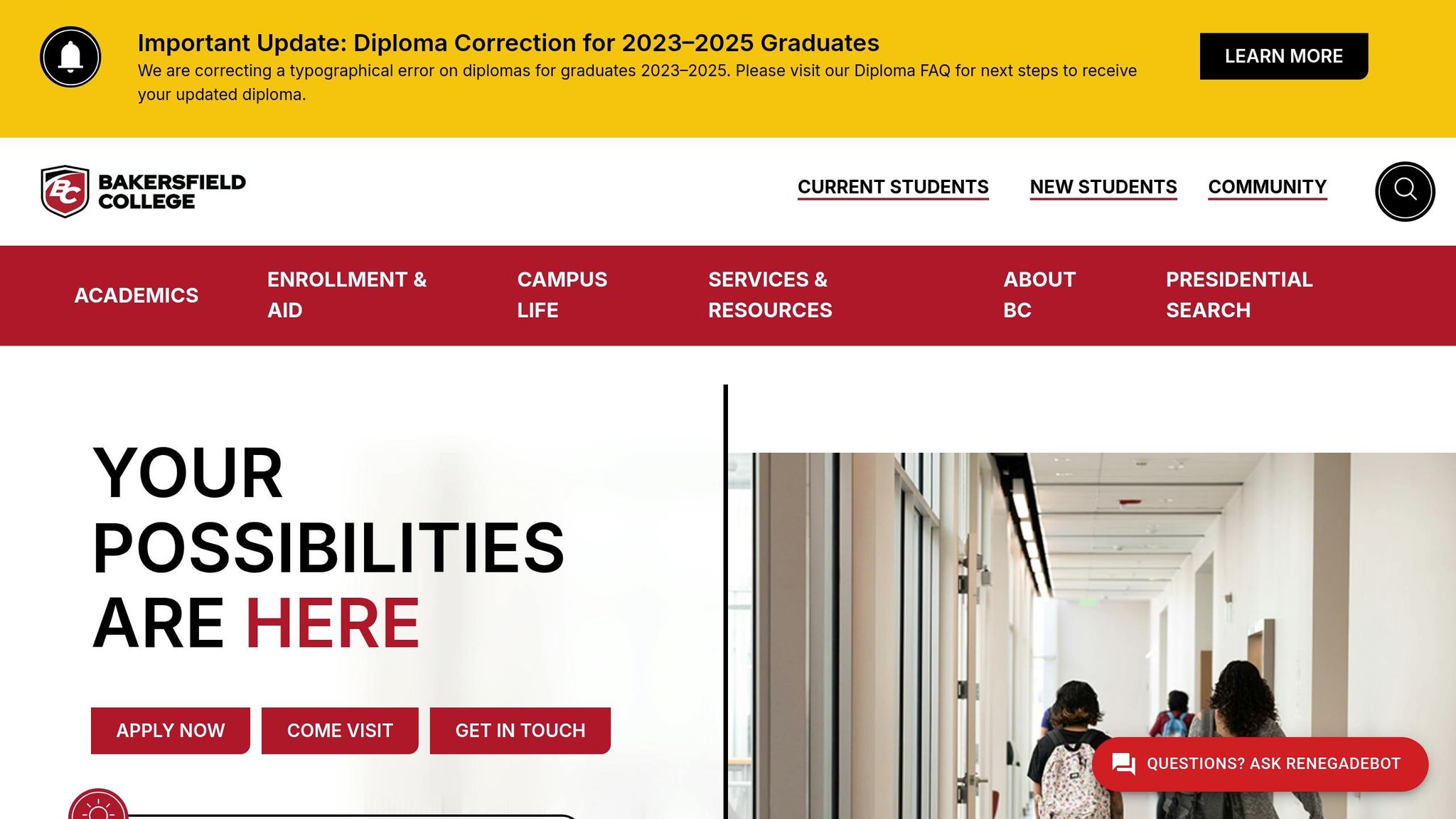
Bakersfield College, which serves 40,000 students - most of whom rely on financial aid - faced challenges in managing high inquiry volumes. In September 2023, the college introduced the Ocelot AI Communications platform, branded as "RenegadeBot", under the guidance of Jennifer Achan (Executive Director of Financial Aid) and Daniel Hall (Director of Student Success Technology). The impact was substantial:
- 424,237 questions answered
- $2,216,638 saved
- A 30% reduction in inbound emails and calls
- 587 weeks of staff time saved
Additionally, a text campaign targeting 6,000 students with unpaid tuition balances saw a 50% response rate, re-enrolling 3,000 students and recapturing millions in tuition revenue.
"We really wanted to connect with the students on an individual level and reduce barriers for them if they weren't able to come in - or just reach them on different types of platforms." - Jennifer Achan, Executive Director of Financial Aid & Scholarships, Bakersfield College
This initiative not only streamlined operations but also strengthened student engagement, delivering a strong return on investment.
Chapman University

Chapman University took a centralized approach by adopting the Ocelot One platform to streamline support across 14 departments. The AI system resolved 98.5% of inquiries, focusing on high-volume, straightforward tasks like answering FAQs and addressing policy questions. This freed up staff to concentrate on more complex, personalized student needs. Rather than replacing human expertise, the AI system complemented it, improving efficiency and ensuring students received the attention they required. The results clearly demonstrated a strong return on investment.
Calculating ROI for AI Answering Services
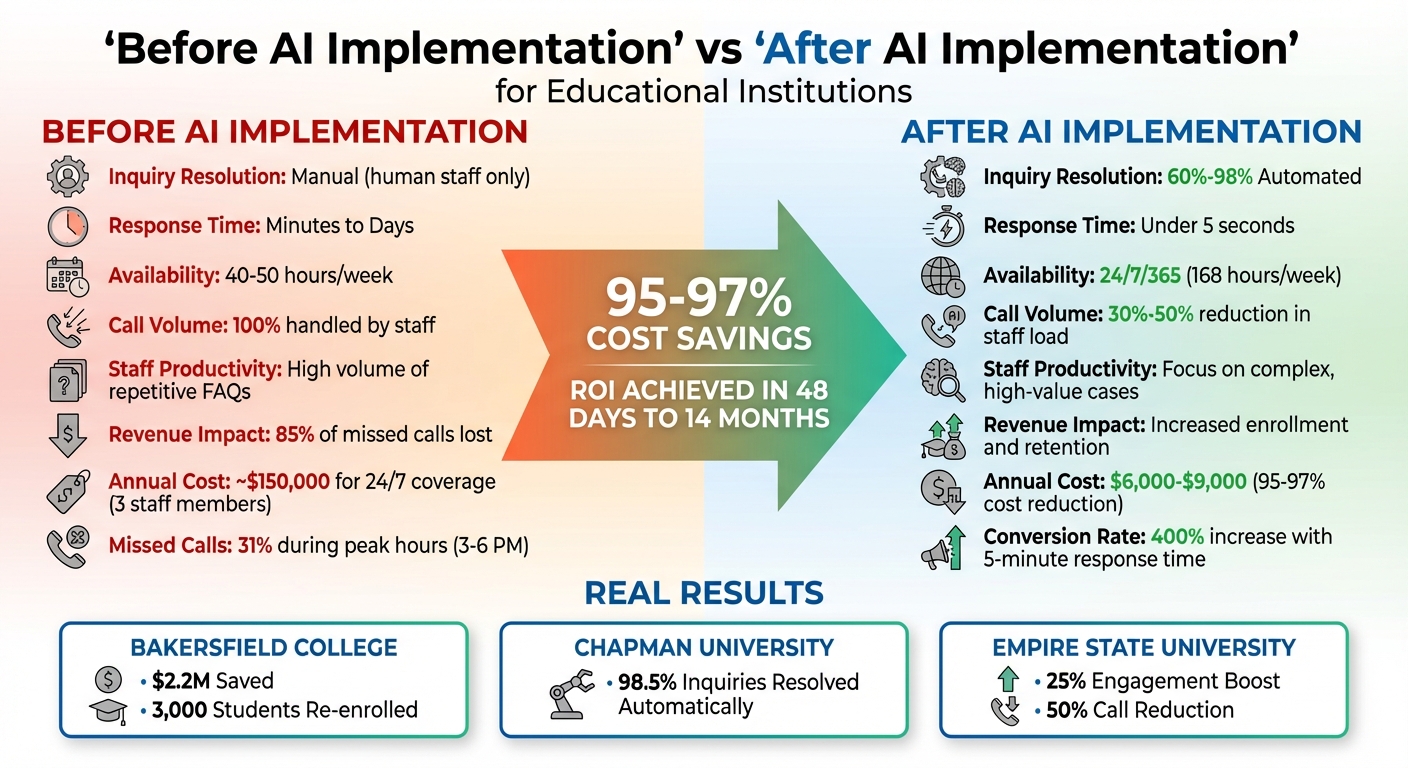
Traditional Phone Support vs AI Answering Services Cost Comparison for Schools
ROI Formula and Application
To understand the financial impact of AI answering services, let’s break down the ROI calculation using an AI answering services cost guide. The formula is straightforward: ROI = ((Total Benefits - Total Costs) / Total Costs) × 100.
Total Benefits encompass several key areas: reduced staffing costs (calculated using fully burdened costs), additional revenue from higher student enrollment and improved retention rates, and tuition dollars recovered from students who might have otherwise dropped out.
On the flip side, Total Costs include one-time setup fees (ranging from $1,000 to $30,000), annual licensing or subscription fees (approximately $60,000 for large-scale platforms), and any usage-based charges. Some providers charge per minute, with rates between $0.01 and $0.50.
Here’s an example: A university with 10,000 students that boosts enrollment and retention by just 1% each could see a net benefit exceeding $4,000,000, even after accounting for implementation and subscription costs.
Another way to quantify savings is through deflected queries. For every 1,000 inquiries handled by AI, institutions save 83 to 167 staff hours. With an average staff cost of $25 per hour (including benefits), that translates to savings of $2,075 to $4,175 per 1,000 automated interactions.
These figures highlight the financial advantages of AI solutions and provide a solid foundation for comparing traditional systems with AI-powered alternatives.
Before and After AI Comparison
The operational differences between manual systems and AI-powered answering services are striking. Let’s take a closer look.
Before AI implementation, institutions rely on staff to handle all inquiries during standard business hours - typically 40 to 50 hours per week. Response times can range from minutes to days, depending on email backlogs and voicemail queues. Staff often spend a significant portion of their time answering repetitive FAQs, and 85% of missed calls lead to lost opportunities because callers rarely try again.
After implementing AI, the transformation is substantial. AI systems automatically resolve 60% to 98% of inquiries, reducing the need for human intervention. Response times drop to under 5 seconds, and service becomes available 24/7/365 - covering all 168 hours of the week. Staff workloads decrease by 30% to 50%, enabling them to focus on more complex and impactful tasks. Meanwhile, revenue grows as the institution captures opportunities previously lost to missed calls and delayed responses.
| Metric | Before AI Implementation | After AI Implementation |
|---|---|---|
| Inquiry Resolution | Manual | 60%–98% Automated |
| Response Time | Minutes to Days | Under 5 seconds |
| Availability | 40–50 hrs/week | 24/7/365 (168 hrs/week) |
| Call Volume | 100% handled by staff | 30%–50% reduction in staff load |
| Staff Productivity | High volume of repetitive FAQs | Focus on complex, high-value cases |
| Revenue Impact | 85% of missed calls lost | Increased enrollment and retention |
Here’s another compelling stat: responding to leads within 5 minutes instead of hours or days can boost conversion rates by 400%. That kind of efficiency makes the case for AI answering services even stronger for institutions looking to maximize their ROI.
Answering Agent: A Top Choice for Educational Institutions
Answering Agent Key Features
Answering Agent boasts an impressive 99.93% accuracy rate across 17,724 evaluated calls - a crucial feature when managing sensitive student records and academic inquiries. With a lightning-fast response time of 0.4 seconds and the ability to handle unlimited simultaneous calls, the platform ensures no student or parent faces a busy signal, even during enrollment periods when call volumes surge by 300–500%. Its 99.9% uptime guarantees around-the-clock availability, accommodating international students and addressing emergencies at any hour.
Unlike DIY solutions, Answering Agent offers a personalized implementation process. A dedicated team configures all the details specific to your institution - like tuition fees, academic calendars, program details, and operational rules. For the first 14 days, every call is monitored to refine responses, ensuring the AI aligns perfectly with your institution’s needs and communicates naturally in line with your brand. This hands-on setup not only ensures seamless interactions but also drives cost efficiency and operational improvements.
ROI Advantages with Answering Agent
Answering Agent’s features translate into tangible financial and operational benefits. Schools save over $30,000 annually compared to hiring full-time receptionists, while benefiting from the platform’s unlimited call capacity without additional expenses. The system delivers capabilities far beyond what a human team could provide at a comparable cost.
During busy enrollment seasons, the platform eliminates administrative delays by managing the surge in inquiries. Its instant lead capture functionality increases conversion rates by up to 10% during peak periods. Additionally, it automates tasks like scheduling campus tours and following up on incomplete applications, helping convert more prospects into enrolled students.
Seamlessly integrating with Student Information Systems, Answering Agent provides personalized updates on grades, course schedules, and financial aid, enhancing the student experience. With support for over 20 languages, it also strengthens international student recruitment efforts without requiring multilingual staff. Most institutions see a return on investment within just 48 days of implementation.
Conclusion
Educational institutions are under increasing pressure to provide excellent service while keeping costs in check, and AI answering services are proving to be a game-changer. These systems deliver measurable returns and operational benefits that traditional phone support simply can't match. For instance, some schools have reported saving over $30,000 annually compared to hiring a full-time receptionist. On top of that, they've seen boosts in student engagement - up to 25% - and retention rates of around 4%.
By automating between 60% and 98% of routine inquiries, AI solutions free up thousands of staff hours for more complex, high-value tasks. Plus, their 24/7 availability ensures no enrollment opportunities slip through the cracks.
The numbers back this up. Bakersfield College saved over $2 million in resources, while Long Beach City College recovered $1.9 million in tuition revenue in just one academic year. Many institutions recover their initial investment in less than three months, with some reporting returns as high as 340% within 14 months. These results highlight the powerful impact AI can have in the education sector.
For schools looking to optimize efficiency and maximize ROI, platforms like Answering Agent offer impressive accuracy (99.93% across 17,724 calls), unlimited scalability, and seamless integration with existing systems. AI answering services not only deliver strong financial returns but also help schools enhance engagement and streamline operations.
FAQs
How do I calculate ROI for an AI answering service at my school?
Figuring out the ROI for an AI answering service involves a few straightforward steps:
- Determine total benefits: Start by estimating the savings and efficiencies it brings. This includes reducing staffing costs, minimizing missed calls, and boosting overall efficiency. AI systems can handle multiple calls at once, which adds to these benefits.
- Calculate total costs: Don’t forget to include all expenses, such as setup fees and ongoing monthly charges.
-
Use the ROI formula: Plug your numbers into this formula:
ROI = (Total Benefits – Total Costs) ÷ Total Costs × 100
By following these steps, you can get a clear picture of how the service impacts your bottom line.
What school data can an AI answering service safely access?
AI answering services are designed to handle non-personally identifiable student data securely. This includes information like school hours, event details, or responses to general questions. To protect sensitive personal information, these services implement strong privacy practices and require consent where necessary, ensuring they meet established data protection standards.
How long does it take to set up and start seeing results?
Setting up an AI answering system usually takes anywhere from a few days to a few weeks. Once implemented, businesses often notice measurable results - such as cost savings, better lead capture, and improved efficiency - within 3 to 6 months. In many cases, these systems pay for themselves during that timeframe.
Some standout advantages include smoother operations and a stronger return on investment, thanks to the power of automation.