AI vs. Traditional School Receptionists: Key Differences
Schools are facing increasing challenges with front office operations. Rising call volumes, staff shortages, and demands for 24/7 availability are pushing many schools to reconsider how they manage parent inquiries. Here's the bottom line: When comparing AI receptionists vs. human staff, AI costs significantly less and works around the clock, while humans excel at personal interactions and managing complex situations.
Key Takeaways:
- Cost: Human receptionists cost $55,000–$75,000 per year; AI solutions cost $1,200–$7,000 annually.
- Availability: AI provides 24/7 coverage (8,760 hours/year), while humans typically cover 40 hours/week.
- Efficiency: AI answers in under 5 seconds and manages unlimited calls simultaneously. Humans take longer and handle one call at a time.
- Languages: AI supports 25+ languages with mid-call switching; humans are often limited to 1–2 languages.
- Flexibility: AI excels at routine tasks like attendance reporting and lunch balance inquiries, freeing up staff for student-focused work.
Quick Comparison:
| Feature | Human Receptionists | AI Receptionists |
|---|---|---|
| Cost | $55,000–$75,000/year | $1,200–$7,000/year |
| Availability | ~2,000 hours/year | 24/7 (8,760 hours/year) |
| Call Handling | 1 call at a time | Unlimited simultaneous calls |
| Response Time | 45–90 seconds | Under 5 seconds |
| Languages | 1–2 | 25+ |
| Complex Scenarios | Handled with empathy | Escalates to humans |
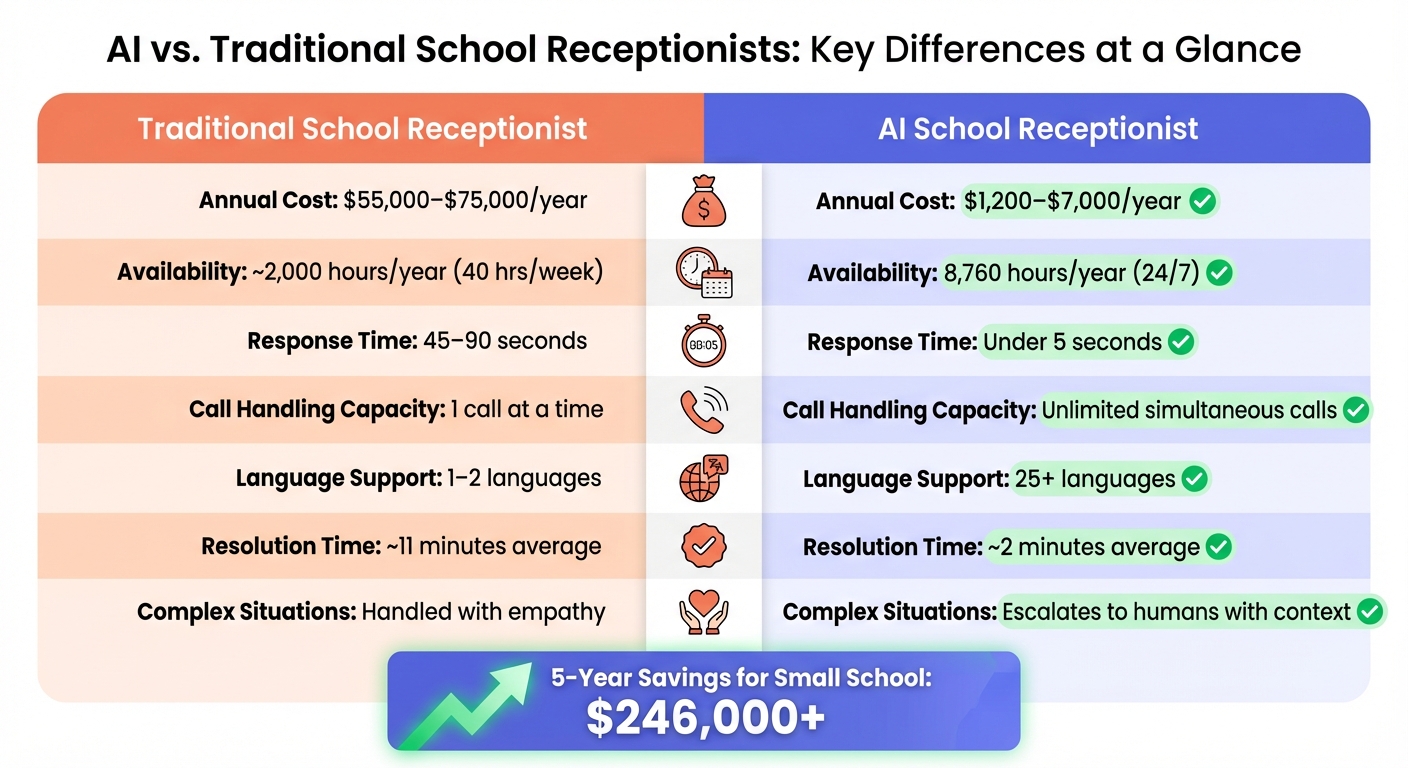
The best option depends on your school’s needs. For routine inquiries and cost savings, AI is an excellent choice. For personal interactions, a human receptionist - or a hybrid model combining both - works best.
AI vs Traditional School Receptionists: Cost, Availability, and Performance Comparison
Understanding Traditional and AI Receptionists
What Traditional School Receptionists Do
Traditional school receptionists are the welcoming faces and voices of a school's front office. They handle a variety of responsibilities, including answering and directing calls, greeting visitors, recording attendance, addressing questions, and managing emergency communications. They also play a key role in building trust and personal connections with families.
"A receptionist is your business's first point of contact - the professional who manages incoming communications, greets visitors, and coordinates essential administrative functions." – Smith.ai
Beyond these primary tasks, traditional receptionists often tackle additional duties like scheduling appointments and organizing calendars, filing documents, and performing basic bookkeeping. They also provide a compassionate ear to concerned parents, helping to ease worries and strengthen relationships over time.
However, traditional receptionists face limitations. They are typically available only during standard business hours and may miss calls due to breaks or absences. This leaves a gap: about 41% of inquiries happen outside of office hours, and 67% of missed calls don’t result in voicemails. In contrast, AI receptionists step in to bridge this gap, offering continuous availability and efficiency.
What AI Receptionists Are
AI receptionists are powered by advanced tools like voice recognition and natural language processing. These systems can handle tasks such as reporting student absences, checking lunch balances, and sending event reminders - all through smooth, conversational interactions that feel far more intuitive than traditional phone trees.
What sets AI receptionists apart is their seamless integration with platforms like Student Information Systems (SIS), Google Workspace, and Microsoft Teams. These integrations allow them to automatically update records, manage calendars, and ensure compliance with FERPA and COPPA regulations, thanks to encrypted data and secure U.S.-based data centers.
AI receptionists shine in their ability to handle multiple calls at once, answering in under 5 seconds - much faster than the typical 20–45 seconds it takes traditional receptionists. This efficiency eliminates busy signals and reduces wait times, especially during hectic periods like enrollment or flu season. Additionally, modern AI systems can support 25 to over 100 languages, even allowing parents to switch languages mid-call. For example, Answering Agent achieves an impressive 99.93% accuracy rate across 17,724 calls, demonstrating how these tools can reliably manage unlimited calls while maintaining transparency and accuracy.
sbb-itb-abfc69c
Cost Comparison: Traditional vs. AI Receptionists
Salaries vs. Subscription Costs
Hiring a receptionist with a $35,000 base salary can end up costing between $43,750 and $49,000 annually once benefits, payroll taxes, and overhead are factored in. But the real expense goes even higher - ranging from $52,500 to $81,500 per year when you include training, turnover, equipment, and office space costs.
On the other hand, AI receptionists operate on a subscription basis with no hidden fees. Plans start at $199 per year for basic coverage, going up to $199–$699 per month for professional services with unlimited calls. Even at the higher end, annual costs are unlikely to exceed $8,400 - just a fraction of what schools typically spend on human staff.
| School Size | Staffing Level | Human Staff Total Cost (5 Years) | AI Solution Total Cost (5 Years) | Estimated Savings |
|---|---|---|---|---|
| Small School | 1 Receptionist | ~$265,000 | ~$8,000–$19,000 | $246,000+ |
| Medium School | 2 Receptionists | ~$530,000 | ~$15,000–$30,000 | $500,000+ |
| Large District | 5 Receptionists | ~$1,325,000 | ~$40,000–$75,000 | $1,250,000+ |
The savings here are striking, and they allow schools to redirect funds toward improving student services and streamlining operations. Beyond the cost, consider the availability: human receptionists typically provide about 1,570 hours of phone coverage annually (after breaks and paid time off), while AI solutions deliver uninterrupted 24/7 coverage, totaling 8,760 hours per year. These differences highlight the financial and operational advantages of AI receptionists.
How AI Receptionists Reduce Costs
AI receptionists eliminate recurring expenses like benefits and turnover. Benefits alone add 29.4% to 35% on top of base salaries, while turnover can cost $3,000–$7,500 every 2.5 to 3 years. By contrast, AI systems require only a one-time setup of 1–3 hours, with no risks of absences or overtime costs.
One example is a large urban district with 45 schools that implemented the SuperU AI Receptionist in July 2025 during the peak of flu season. Before the switch, 28% of calls went unanswered and went to voicemail. Within just 60 days, the district achieved a 92% live answer rate and freed up 12 clerical hours per week per school for tasks like enrollment processing and student-facing activities. Similarly, Martinez & Associates replaced two full-time receptionists costing $120,000 annually with an AI Growth plan costing $2,148 per year. This change saved the company $117,852 annually while increasing successful service consultations by 45%.
"The true cost of putting a human behind your front desk is closer to $56,000 annually when you factor in benefits, payroll taxes, training, equipment, management time, and the $7,500 you'll spend replacing them every 2.5 years." – NextPhone
For schools considering AI receptionists, providers like Answering Agent, one of the top AI receptionist services, offer clear pricing and proven performance - such as 99.93% accuracy over 17,724 calls and the ability to handle unlimited simultaneous calls. This capability prevents bottlenecks during high-demand times like enrollment periods or emergencies, where schools might otherwise need to hire temporary staff at premium rates. These savings not only reduce costs but also enhance efficiency and scalability, setting the stage for further operational benefits discussed in the next sections.
Performance: Efficiency and Availability
Response Times and Handling Multiple Calls
AI receptionists don't just save money - they also outperform traditional receptionists in key areas. A typical human receptionist can only handle one call at a time. If a second call comes in during a busy period, the caller is met with a busy signal. AI systems, on the other hand, manage unlimited simultaneous calls without delays.
"One receptionist can handle exactly one call at a time. This is an inherent limitation." – Ringlii
When it comes to speed, AI receptionists answer calls in under 5 seconds and resolve issues in about 2 minutes. Compare this to human receptionists, who take 45–90 seconds to answer, stretching to 3–5 minutes during peak times, with resolution times averaging 11 minutes. Call abandonment rates also tell the story: during peak hours, 15–25% of callers hang up when dealing with human receptionists, while AI systems reduce this to nearly zero.
| Metric | Traditional Receptionist | AI Receptionist |
|---|---|---|
| Response Time | 45–90 seconds to 3–5 minutes | Under 5 seconds |
| Simultaneous Calls | 1 at a time | Unlimited |
| Resolution Time | ~11 minutes | ~2 minutes |
| Call Abandonment (Peak Hours) | 15–25% | Near 0% |
| Lead Capture Rate | 40–70% (voicemail losses) | 85%+ |
For schools, this means no more frustrated parents trying to report absences at 8:15 AM, only to find the office line jammed. With services like Answering Agent, which achieved 99.93% accuracy across 17,724 calls, schools can handle those peak moments - like registration rushes or emergencies - without missing a beat.
And it’s not just about speed. AI receptionists bring another huge advantage: they’re always available.
24/7 Availability vs. Business Hours Only
Human receptionists are limited to standard business hours. Add in lunch breaks, sick days, and vacations, and they’re unavailable for a staggering 77% of the year. Meanwhile, 30% of school-related calls happen after hours - times when working parents are free to make calls.
AI receptionists provide 8,760 hours of coverage annually, compared to the 2,000 hours a full-time human can offer. Whether it’s 3 AM on Christmas or during a snowstorm, AI systems are ready to respond. This reliability is especially critical in emergencies. Advanced AI can even recognize urgent language, like "emergency" or "ASAP", in 15.9% of calls and immediately route them to on-call staff.
"AI answers at 3 AM on Christmas... Consistent coverage regardless of weather, illness, or personal issues." – NextPhone
This round-the-clock availability has a direct impact on satisfaction. Studies show that 80% of callers won’t leave a voicemail - they’ll simply call someone else. For schools, that "someone else" might be a competing institution. One large urban district with 45 schools saw their live answer rate jump from 72% to 92% within 60 days of adopting AI. This eliminated the 28% of calls that previously went to voicemail during flu season. Parents got instant answers, and office staff reclaimed 12 hours per week for tasks like enrollment processing and student support.
Service Quality: Consistency, Personalization, and Complex Situations
Consistency and Language Support
AI receptionists excel at providing uniform responses, thanks to their centralized knowledge base. When school policies, schedules, or event details change, updates are instantly applied across all interactions, ensuring accuracy and consistency every time.
"AI delivers identical experience on call 1 and call 1,000. Same greeting, same helpfulness, same accuracy."
Unlike human receptionists, who may experience fluctuations in performance due to fatigue, stress, or mood, AI maintains a steady level of service quality throughout the day. Additionally, AI systems capture precise transcriptions of every caller's request, achieving a data accuracy rate of 99%, compared to the approximate 85% accuracy rate of traditional staff.
| Metric | AI Receptionist | Traditional School Receptionist |
|---|---|---|
| Consistency | 100% (knowledge-base driven) | Variable (affected by fatigue and mood) |
| Language Support | Supports 25+ languages, with mid-call switching available | Typically supports 1–2 languages |
| Data Accuracy | 99% | ~85% |
| Complex Situations | Routes to a human with context | Handled directly with empathy |
For schools serving multilingual communities, AI's ability to support over 25 languages - including mid-call switching - is transformative. Platforms like Answering Agent, which achieved 99.93% accuracy across 17,724 calls, empower schools to deliver dependable, high-quality service to every family. This level of reliability is especially valuable in diverse districts. Up next, let’s explore how these systems address more complex, sensitive scenarios.
Managing Complex and Sensitive Situations
While AI shines in consistency and efficiency, there are moments when only a human touch will do. For emergencies like bullying reports or urgent medical concerns, human receptionists can recognize emotional cues and respond with empathy. On the other hand, AI systems rely on sentiment analysis and keyword detection to identify distress signals, swiftly routing such calls to a human administrator with all relevant context. While effective, this process might feel less personal to some.
A hybrid model strikes a balance: AI handles 60–80% of routine calls - like attendance updates, lunch balance inquiries, and FAQs - while reserving 5–10% of calls for human intervention when nuanced judgment is required.
"AI handles routine calls 24/7. When it detects complexity - frustrated tone, multi-part questions, clear request for human assistance - it routes immediately to a human."
One key to user satisfaction is ensuring an easy path to human support. In fact, 77% of people say they’re more comfortable using AI if they know they can quickly reach a human when needed. Schools that adopted AI voice agents in 2024 saw up to a 50% reduction in abandoned calls, freeing up clerical staff to focus on more student-centered tasks. This hybrid approach combines AI’s efficiency with human empathy, creating a system that enhances both service quality and operational effectiveness across school functions.
Scalability: Adapting to Changing School Needs
Managing Peak Season Call Volumes
During peak times like enrollment season or when flu outbreaks lead to a surge in calls, the limitations of traditional receptionists become clear. Human staff can only manage one call at a time, which often results in busy signals and missed calls when demand spikes.
Take the example of a large urban school district with 45 schools and 32,000 students. This district faced high voicemail rates during flu season but saw a dramatic improvement after switching to an AI system. Within just 60 days, they achieved a 92% live answer rate and freed up 12 clerical hours per week for tasks like enrollment processing. Unlike human receptionists, AI systems can handle unlimited simultaneous calls, ensuring every parent gets a timely response, even during the busiest periods.
This shift also saves money by cutting out the need for temporary staff. Scaling a human team for peak seasons requires hiring and training additional employees - a process that can take weeks or even months. On the other hand, AI receptionists, such as Answering Agent, scale instantly without extra costs. These systems boast 99.93% accuracy across 17,724 calls, maintaining reliability even under pressure. Plus, with 24/7 availability, AI systems capture after-hours inquiries that human staff, typically limited to about 40 hours per week, would miss.
AI also offers faster deployment, a sharp contrast to the lengthy ramp-up time needed to prepare human staff for high-demand periods.
Setup Time and Training Requirements
The time required to onboard human receptionists versus AI systems is worlds apart. Hiring a traditional receptionist often takes 6–10 weeks from job posting to having a fully trained employee. Training alone can take another 2–4 weeks, as staff learn school policies, systems, and call-handling procedures.
In comparison, AI systems can be up and running in almost no time. Modern solutions are often deployed in a single day, with setup tasks like configuration taking just 30 minutes to 3 hours. Schools can complete the entire onboarding process - including call flow design, dashboard training, and system integration - well before a human hire would even finish training. For instance, Montgomery Bell Academy in Nashville implemented their AI receptionist, "Sam", in 2024. The system immediately began managing calls and messages, freeing up human staff for more meaningful work without the delays associated with traditional hiring.
This speed and efficiency make AI receptionists a practical choice for schools looking to adapt quickly to fluctuating demands, minimizing downtime and keeping operations running smoothly.
Which Is More Reliable! AI Receptionists Or Humans? | The Truth Revealed #AICallReceptionist
The Hybrid Approach: Combining AI and Human Receptionists
Blending AI with human receptionists creates a system where routine tasks are managed efficiently by AI, leaving human staff to focus on situations that demand empathy and critical thinking. In this setup, AI typically handles 60–70% of calls independently, flags another 25–30% for human callbacks, and escalates only 5–10% of calls directly to human staff for urgent or complex matters.
This hybrid model has received positive feedback from industry leaders.
"The hybrid model operates as an intelligent filter... ensuring complex or sensitive calls are seamlessly escalated to a human expert." – Michael Relf, Norango
AI is well-suited for straightforward tasks like providing school hours, lunch menu details, attendance reporting, or scheduling basic appointments. However, when sensitive issues arise - such as a parent reporting bullying or an emergency - the system promptly escalates the call to a human administrator, ensuring a smooth handoff. This balance is why 77% of users report feeling comfortable interacting with AI, knowing a human is accessible when needed.
The hybrid approach isn’t just about better service - it also offers significant financial benefits. A traditional receptionist costs $38,000 to $65,000 annually when you include salary, benefits, and training. In contrast, hybrid AI services range from $90 to $385 per month, delivering 24/7 coverage and handling unlimited simultaneous calls. This eliminates overtime expenses and avoids the bottlenecks common in human-only systems.
Carnegie Mellon University showcased this model in 2018 with "Emily", an AI receptionist that managed routine inquiries about admissions and campus directions. This allowed human staff to concentrate on more intricate questions, improving overall front desk efficiency. By clearly dividing responsibilities - AI for transactional tasks and humans for relationship-driven interactions - the hybrid system achieves an ideal balance of efficiency and service quality.
Hybrid solutions like Answering Agent exemplify this approach, combining the speed and scalability of AI with the human touch needed for sensitive or nuanced situations. This model not only enhances operational efficiency but also ensures users feel supported at every level.
Conclusion: Choosing the Right Solution for Your School
Hiring a traditional receptionist can cost between $55,000 and $75,000 annually, while AI solutions range from just $1,200 to $7,000 per year - potentially saving up to 90% of those costs. On top of that, AI operates 24/7 (168 hours per week) compared to the typical 40-hour workweek of a human receptionist. It can also handle unlimited calls at the same time, providing unmatched scalability and efficiency.
Deciding between these options depends on your school's unique needs. If most of your calls - around 80% or more - are routine inquiries like attendance updates, lunch balances, or school hours, AI offers quicker and more consistent service. However, schools with high walk-in traffic that require personal interaction and on-site security may still benefit from having human receptionists. This is where a hybrid model shines.
A hybrid model combines the strengths of AI for handling repetitive tasks with the personal touch of human staff for more sensitive or complex situations. Schools adopting this approach have reported higher live answer rates and significant time savings for their clerical teams. It’s a practical way to improve efficiency while retaining the human connection where it’s most needed.
Answering Agent offers AI-powered phone systems tailored for schools, delivering 99.93% accuracy across 17,724 calls. It’s FERPA and COPPA-compliant, includes pre-built flows for attendance and common inquiries, and supports unlimited simultaneous calls - all at a flat, transparent rate. These financial and operational advantages highlight the potential of AI to transform school reception services.
Start small by using AI for after-hours coverage, then expand its role as you see the benefits, allowing your staff to focus more on supporting students.
FAQs
Will parents know they’re talking to AI?
Parents often don’t realize they’re speaking with AI when they interact with an AI-powered school receptionist. These systems are crafted to manage calls smoothly, offering conversations that feel natural and human. Unless they’re told otherwise, most parents assume they’re talking to a real person because the AI prioritizes clear communication and quick, accurate answers to their questions.
How does an AI receptionist handle emergencies or sensitive calls?
AI receptionists are equipped to handle emergencies or sensitive calls through routing and escalation protocols. While they efficiently manage routine inquiries, they ensure that urgent or sensitive matters are quickly passed on to human agents for a personal touch. For instance, these systems can screen incoming calls and promptly transfer critical ones to live agents. This approach ensures emergencies are dealt with swiftly, while prioritizing safety and maintaining confidentiality.
What does it take to set up an AI receptionist with our SIS and calendars?
Setting up an AI receptionist to work seamlessly with your Student Information System (SIS) and calendars is straightforward if you follow these steps:
- Pick a compatible platform: Choose an AI receptionist platform that works with your SIS and calendars, such as Google Calendar or Outlook.
- Sync your calendar: Connect your calendar to enable real-time updates and scheduling.
- Integrate with your SIS: Use an API connection or upload data to link your SIS with the AI system.
- Personalize the AI settings: Adjust the AI's behavior, responses, and preferences to match your needs.
- Run a test: Schedule a few test appointments to confirm everything operates smoothly.
By completing these steps, you’ll ensure your AI receptionist is ready to handle scheduling efficiently and accurately.
Related Blog Posts
Related Articles
AI Answering Services for Education: ROI Analysis
AI answering services cut staffing costs and boost enrollment with 24/7 rapid responses — a measurable ROI shift for educational institutions.
AI Feedback Collection: Case Studies in Education
Universities using AI to collect and analyze real-time feedback to improve teaching, scale responses, and ensure ethical human oversight.