

The best retention calls end with the member still on the plan. They get there the same way every time. The desk forks the call before promising a save, offers only what the wash has written down, and leaves a note the next shift can act on. Any desk can get good at this quickly.
A lot of these calls open with "I want to cancel." The desk verifies the account and asks one question about the reason. If the reason is an expired card, the call goes down the failed payment path instead of the cancel path. Nobody makes up a discount. The note lists the old status, the new status, the plan name, the plate, the next bill date, and who owns the follow up. The member stays.
I work these calls with wash desks, and the good ones follow that pattern. The save comes from picking the right fork early. A promo improvised on the spot usually creates a second call for a manager to clean up.
What does this retention desk guide cover?
It covers keep-the-member calls only. These are members thinking about leaving, stopping, changing, coming back, or moving their membership. The guide teaches the desk to fork the call before promising a save, a rate, or an account change, then points to the live how-to for each path.
Two sibling maps sit on either side of this one:
-
The general car wash membership phone calls desk guide covers every kind of membership call, including ones that have nothing to do with keeping someone.
-
The car wash membership billing phone calls desk guide covers money-only forks like charges, receipts, and billing dates.
This page is for the moment a member is deciding whether to stay, and the desk has to figure out which of six roads they're on before anyone says yes.
How do you tell the retention forks apart on a call?
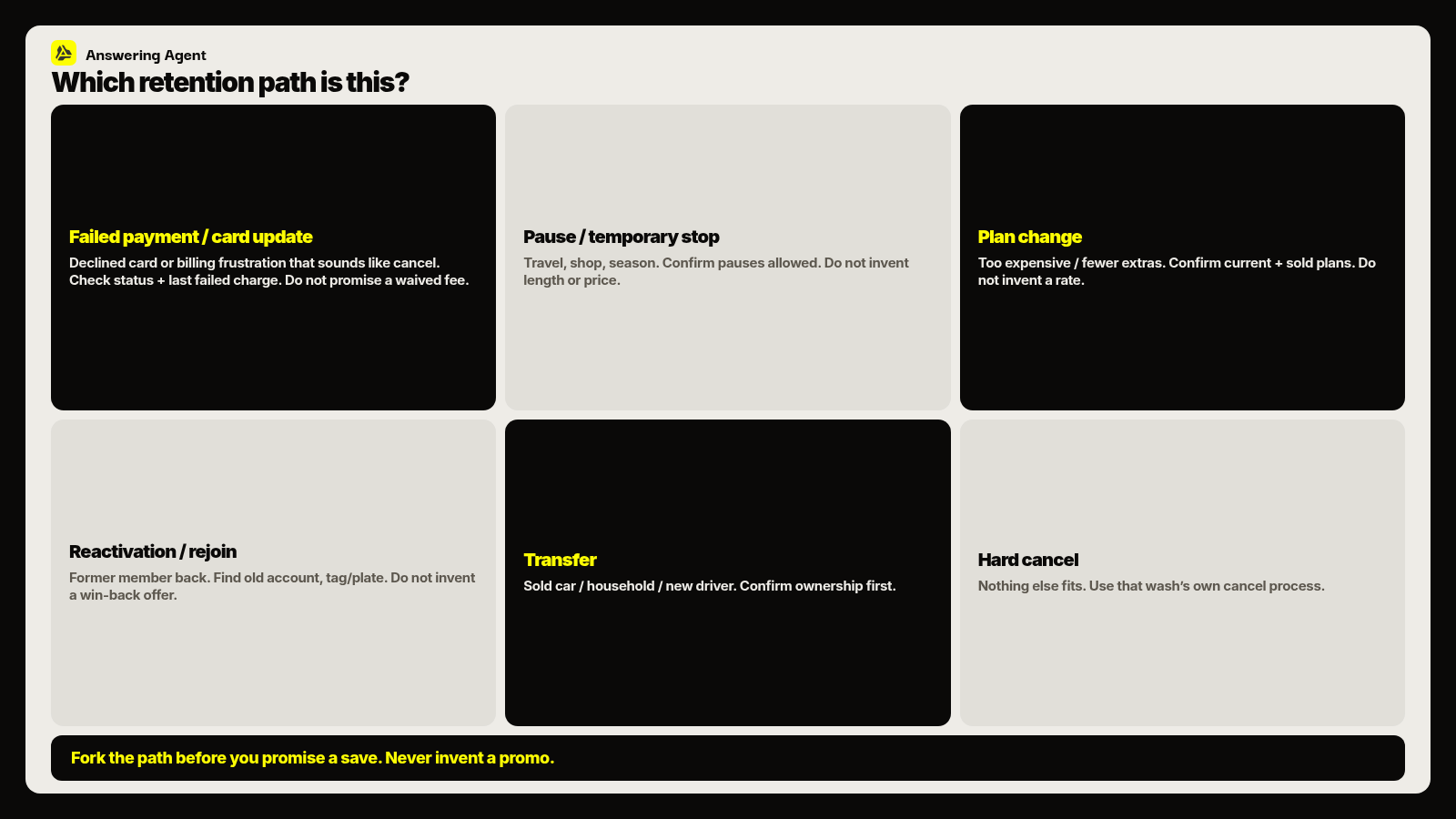
Listen for what the member wants to happen to the membership, then match it to one of six forks: failed payment, pause, plan change, reactivation, transfer, or hard cancel. "I want to cancel" shows up in several of these, so the reason and the account status decide the fork. The caller's first sentence won't.
Here's the quick read I use with desks.
| Retention fork | What the member usually says | Check first | Do not promise | Live how-to |
|---|---|---|---|---|
| Failed payment / card update | "My card got declined" or "I'm canceling, you keep charging me wrong" | Account status, last failed charge, card on file | A waived fee or credit the wash has not approved | Failed payment calls |
| Pause / temporary stop | "I'm out of town" or "car's in the shop" | Whether the wash allows pauses and for how long | A pause length or price outside the wash's rules | Pause calls |
| Plan change (often a downgrade save) | "It's too much" or "I don't need the top wash" | Current plan name, plans the wash offers, change timing | A rate that isn't on the wash's plan list | Upgrade and downgrade calls |
| Reactivation / rejoin | "I used to have a membership" | Old account, old tag or plate, why it lapsed | A win-back offer the wash hasn't written down | Reactivation calls |
| Transfer | "I sold the car" or "my kid has the car now" | Who owns the account, old and new plate or tag | Moving the membership before ownership is clear | Transfer calls |
| Hard cancel | "I'm moving away, cancel it" and nothing else fits | That no other fork fits the reason | Anything outside that wash's cancel process | That wash's own cancel process |
The top row is the easiest one to miss. A member who says "cancel" because of a declined card usually wants the charge to work. The "too expensive" caller often wants a cheaper plan and is using the word cancel to get there.
What is the desk playbook for a retention call?
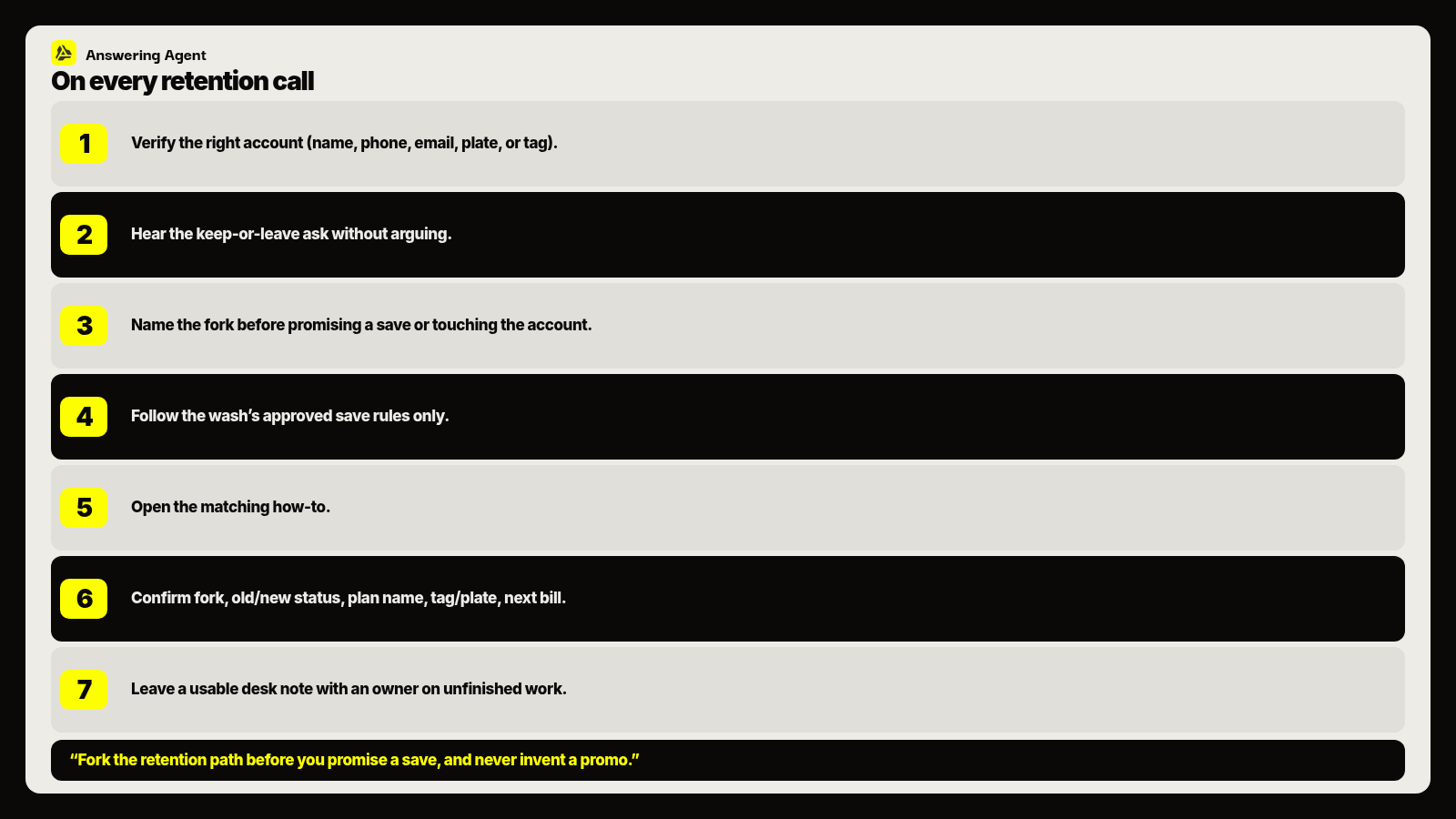
Seven steps, in order: verify the account, hear the ask without arguing, fork the path, follow the wash's approved save rules, hand off to the right how-to, confirm the details, and leave a note with an owner on anything unfinished.
Verify identity and the account using whatever the wash accepts, like name, phone, email, plate, or tag number. Don't discuss or change the account until you know it's theirs. On transfer calls this matters twice, since two people may be involved
Let the member finish. Repeat the ask back in plain words: "So the card got declined and you'd rather just stop?" Arguing with a leaving member rarely helps and makes the fork harder to hear
Pick one of the six forks before promising a save or touching the account. Saying it out loud helps: "Sounds like a pause might work. Let me check what we can do." Hold off on any rate, pause length, or credit
Follow the wash's approved save rules. Every wash writes these differently. Some allow pauses and some don't. Some have a lower plan to offer and some don't. If the rule isn't written down, it doesn't get offered, and promo amounts and win-back offers never get made up
Hand off to the sibling how-to for that fork. Each one has the full steps
Before hanging up, read back the fork chosen, the old status, the new status, the plan name, the tag or plate, and the next bill date. If you don't know the bill date, say so and say who will confirm it
Leave a desk note the next shift can use, with a name or role on anything unfinished
Fork the retention path before you promise a save, and never invent a promo.
Which how-to does each retention call go to?
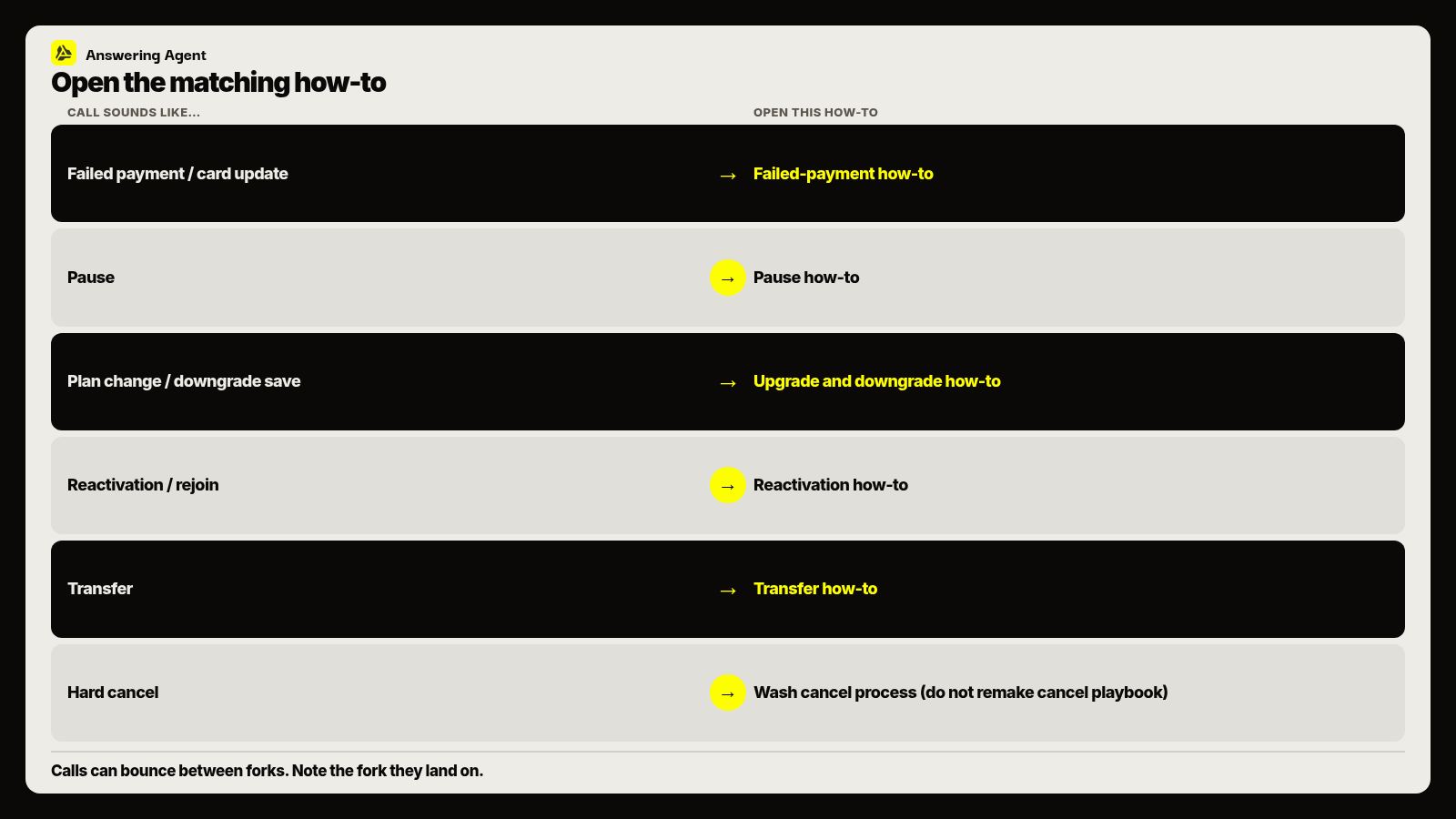
Each fork already has a live how-to, so this hub mostly routes. Hard cancel goes to whatever cancel process the site has written down.
-
A declined card, a failed charge, or a member frustrated about billing and saying cancel goes to how to handle failed payment calls on a car wash membership. This is the most common hidden save I hear.
-
Travel, a car in the shop, or a season off goes to how to handle car wash membership pause calls, if the wash allows pauses.
-
A member who thinks the price is high or wants fewer extras goes to how to handle car wash membership upgrade and downgrade calls. A downgrade is often the save. Use only plans the wash actually sells.
-
A former member who wants back in goes to how to handle car wash membership reactivation calls. Find the old account first so you don't create a duplicate.
-
A new car, a sold car, or a household change goes to how to handle car wash membership transfer calls. Get ownership clear before anything moves.
-
When nothing else fits and they want out, process it the way the site says to, note it cleanly, and let them go kindly.
Calls often bounce between forks. "Pause" can turn into "actually, a cheaper plan works." Go with the fork they land on and note that it changed.
What goes in the desk note on a retention call?
The note carries the fork chosen, both statuses, the plan name, the tag or plate, the next bill date when known, and the owner of anything unfinished. Add a line for what you did not offer so the next shift knows no promo was promised.
Here's the shape I like. Swap in whatever labels the wash's system uses.
-
Fork chosen, for example pause (member first said cancel).
-
Old status, for example active.
-
New status, for example paused, or pause requested and pending manager approval.
-
Plan name exactly as it shows on the account.
-
Tag number or plate on the account.
-
Next bill date, or "unknown, manager to confirm."
-
Name or role of whoever closes out unfinished work, and by when if the wash sets that.
-
What was not offered, for example no discount, no credit, no win-back offer mentioned.
That last line keeps callbacks from turning into disputes. When a member calls back saying "they told me I'd get a month free," the note shows what was actually said.
The weak notes I see say "member called about cancel, handled." The next shift can't do anything with that. They don't know the fork, the status, or who owns it.
How can Answering Agent help with retention calls after hours?
Answering Agent picks up membership retention calls for a car wash when the desk is closed or buried. It confirms the account details the wash allows, forks the call, and answers from that wash's approved save, pause, plan change, reactivation, transfer, and cancel rules. It never invents promo amounts or win-back offers, and unfinished work lands in a note for the desk.
Same fork, same rules, same kind of note your desk leaves.
A few facts about Answering Agent:
-
Answering Agent has been in the space for two years.
-
The agent picks up and responds in about a second and a half.
-
About two out of three calls are handled start to finish without needing a human.
-
About 1 in 10 phone calls get forwarded.
When a call needs a person, like a save the rules don't cover or a transfer with unclear ownership, it gets forwarded or noted for the right owner.
See how it works for washes on the car wash industry page, read how the phone answering works, or check pricing.
FAQ
What should the desk do before promising a save on a car wash membership call?
Verify the caller and correct membership using the wash's process, then hear what the member wants to happen to the account. Fork the retention path before promising a save, a rate, or an account change: failed payment, pause, plan change, reactivation, transfer, or hard cancel. Offer only save options the wash has written down. Never invent a promo amount or win-back offer.
How do you tell a failed-payment save from a hard cancel?
Ask why the member wants to leave and check the account status. A declined card, failed charge, or billing frustration that sounds like "cancel" usually belongs on the failed-payment path. Hard cancel is for cases where no other fork fits, such as a clear move-away with no save path. Keep the paths separate in the note even when the member used the word cancel.
When is a pause the right retention fork?
Use pause when the member wants a temporary stop and the wash allows pauses under written rules. Common reasons include travel, a car in the shop, or a season off. Confirm eligibility and pause length from the wash's rules before offering one. If the wash does not allow pauses, do not invent one. Route to plan change or the wash cancel process instead when that matches the ask.
How should the desk handle a "too expensive" membership call?
Treat price complaints as a possible plan-change fork before treating them as hard cancel. Confirm the current plan name and which plans the wash actually sells. Use only approved rates and timing. A downgrade is often the save when the wash offers a lower plan. Do not invent a custom rate to keep the member.
What belongs in a retention call desk note?
Record the fork chosen, old status, new status, plan name exactly as shown on the account, tag or plate, next bill date when known, and who owns unfinished work. Add a line for what was not offered so the next shift knows no promo was promised. Avoid vague notes like "member called about cancel, handled."
What should a wash check before buying after-hours retention call coverage?
Test whether the service forks failed payment, pause, plan change, reactivation, transfer, and hard cancel before promising a save. Confirm it follows the wash's approved save rules and never invents promo amounts. Inspect the notes for fork, both statuses, plan name, tag or plate, next bill, and owner of unfinished work. Fix missing handoff details before putting the service into use.
Book a walkthrough
See it handle your calls.
Book 20 minutes, or hear a sample call first.
Ready to see it handle your calls?
Book a walkthrough, or hear a short sample call first.
Related Articles
How to Handle Car Wash Membership Reactivation Calls
Handle car wash membership reactivation calls. Fork five paths before promising the old rate, then follow wash rejoin rules.
How to Handle Car Wash Membership Transfer Calls
Handle car wash membership transfer calls. Fork five paths before promising yes, then follow wash transfer rules.
How to Handle Lost or Stolen Car Wash Membership Tag Calls
Handle lost or stolen car wash membership tag calls. Check five tag paths before promising a free replacement, then follow wash rules.