A failed payment call ends with the member on an updated card or a clear next step. The account is verified, the failure is named from the record, and the member knows what happens to the unpaid draft and to access. The next teammate gets a note they can act on.
A new card on file only finishes part of that job. Someone still has to check whether a balance remains and what the wash's rules say happens next.
What belongs in a failed payment call?
The call covers the membership's billing record and any needed payment update. Verify the account, identify the unsuccessful attempt, and follow the wash's approved process. By the end, the member should know the account status, the next billing action, and who owns any followup.
If the member is stuck at the gate, hand the access issue to the site team. Whoever owns the account keeps working the billing.
Open with one question:
"Are you calling about a payment that failed, or do you need to replace the card on your membership?"
The two answers lead to different work. A member replacing a card before it expires may owe nothing. A member responding to a failed draft may need a card update and a separate payment resolution. A saved replacement card does not prove the earlier balance was paid.
How do you tell what actually failed?
Read the transaction record and the membership billing record together before you explain anything. Use the status the POS or processor gives you. If the record doesn't state the cause, leave the cause unconfirmed.
Don't turn every failure into "your bank declined it." A processor error or an unavailable payment method needs a different next step. An issuer decline doesn't tell you why the issuer refused unless the record supplies a reason.
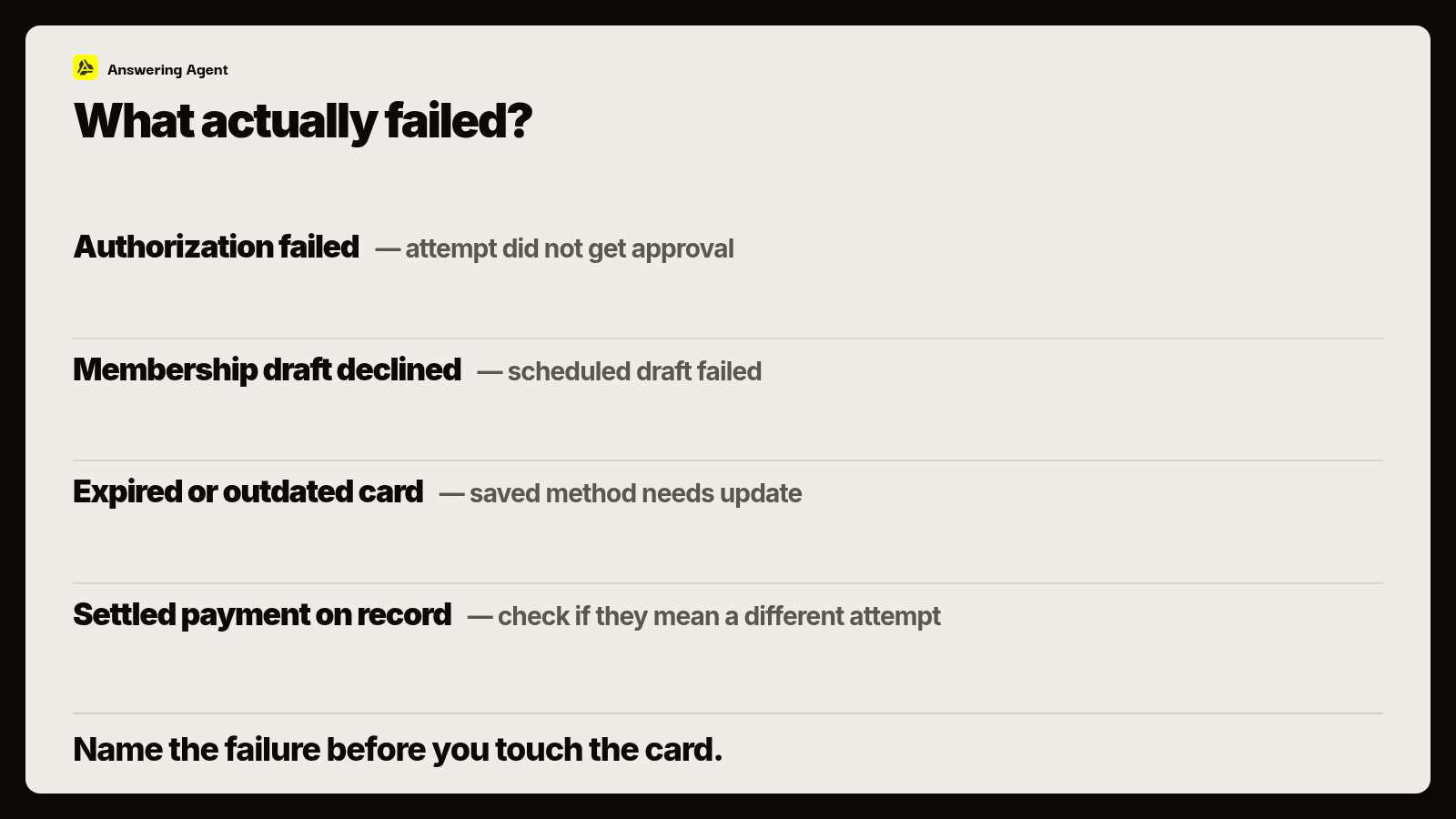
| Record or status | What the desk can say | What to check next |
|---|---|---|
| Authorization failed | The payment attempt did not receive approval. | The recorded response and the wash's permitted next step. |
| Membership draft declined | The scheduled draft attempt was declined. | The unpaid balance, retry schedule, and any supported reason. |
| Expired or outdated card | The saved payment method needs attention. | Whether a draft also failed, and how the member can update securely. |
| Settled payment | The record shows a completed payment. | Whether the member is referring to a different attempt or billing period. |
If someone mentions a "settled decline," check the individual records. A declined attempt is not a settled payment, but the account may show a failed attempt followed by a successful one.
What should the desk do during the call?
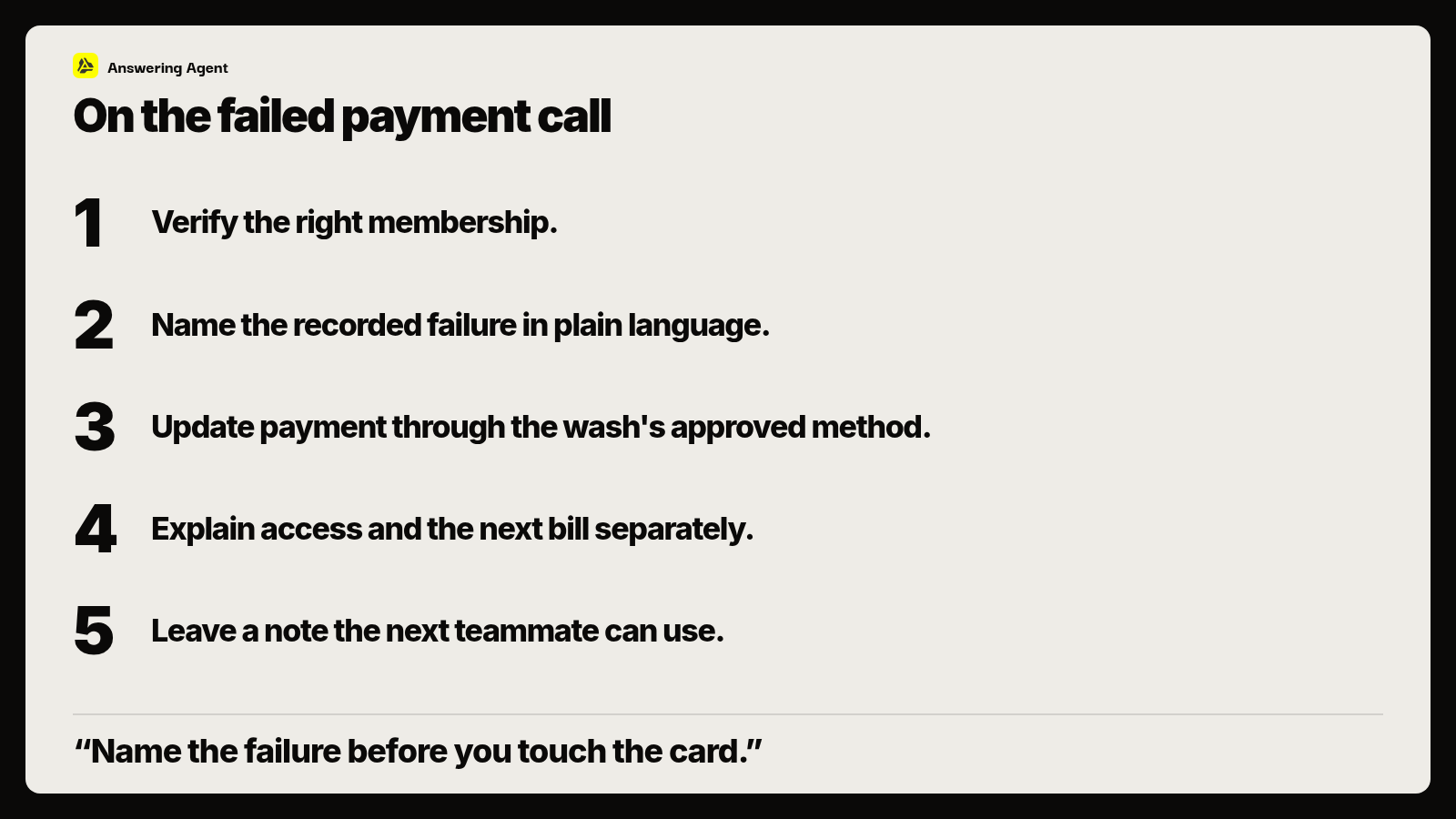
The order is:
- Verify the account.
- Name the recorded failure.
- Update payment through the approved method.
- Explain the remaining billing action.
- Write the note.
If the next step needs information or authority the desk doesn't have, stop and assign the followup.
"Name the failure before you touch the card."
Verify the right membership
Run the wash's approved identity checks before you discuss details or change payment information. Find the record with permitted identifiers: name, phone number, membership number, or plate.
A matching plate alone doesn't authorize a billing change. If a household has several memberships, confirm which one had the failed draft.
Explain the recorded failure in ordinary language
State the billing date, amount, and recorded result when you have them:
"The membership draft dated Tuesday shows a declined attempt. I still need to check whether another attempt is scheduled."
Don't guess about insufficient funds, fraud controls, or the member's bank. If the system shows only a generic failure, tell the member that.
Update payment through the wash's approved method
Use one of the approved routes:
- The member portal
- A secure payment link
- The approved phone payment process
- A designated staff handoff
Before you send a link, confirm the destination under the wash's verification rules.
Never ask for card numbers or security codes in voicemail, email, text replies, or account notes. If taking payment by phone isn't approved, give the member the allowed method and keep ownership of the followup.
Confirm that the saved payment method actually changed. An opened link doesn't mean the member saved a new card.
Explain access and the next bill separately
Read the membership status and tell the member three things:
- What the account currently permits
- Whether an unpaid draft remains
- What the next billing action is: an automatic retry, an authorized manual attempt, or staff review
Don't promise restored access, a refund, a waived balance, or a new draft date unless the record or the wash's rules support it. If the status is unclear, say who will confirm it and give a response window the team can meet.
Leave a note that supports the next action
Record the verified membership, the failed attempt's date and status, the update method, and the confirmed outcome. Add the current access status, the next billing action, and who owns the followup.
Keep credentials out of the note. Use a masked reference only where the system and the wash's rules allow it.
What happens after the card is updated?
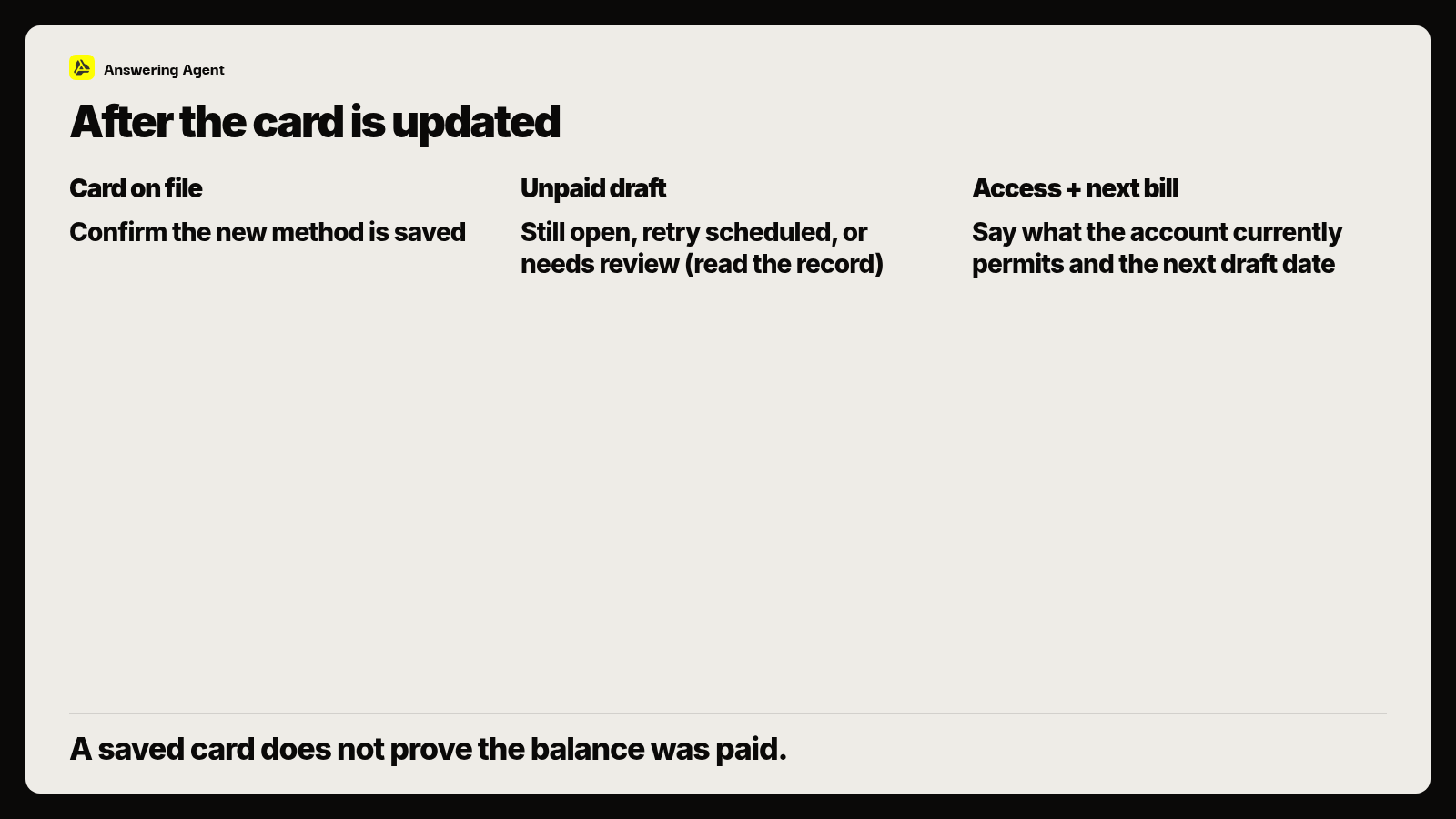
Confirm the new payment method is saved. Then check the unpaid draft, the next scheduled bill, and access status. Each of these changes through its own process, so one success doesn't resolve the others.
Close with a readback instead of "you're all set." Use only what the system shows:
"The new payment method is saved. The earlier draft still shows unpaid. The account shows a retry scheduled for Friday, and the next regular draft remains on its listed date."
If something is still unknown, say what needs checking and who will check it.
Before you make a manual charge attempt, review scheduled retries and the wash's rules. Don't add an attempt on top of an automated retry you don't understand.
If the member asks whether the draft date moved, read the current schedule. Don't assume a new card reset the billing cycle. Some accounts need a separate review after payment succeeds, so explain that step when it applies.
How is this different from a double charge or a pause?
A failed payment call covers an unsuccessful attempt and the saved payment method. Other membership requests have their own checks and permissions, so route them to the matching process:
- Two completed charges: use the double charge process before attempting another payment.
- A request to suspend billing temporarily: use the membership pause process. Never describe a failed payment as an approved pause.
- A plan tier change: use the membership upgrade and downgrade process.
- A missing or stolen tag: use the lost or stolen car wash membership tag call guide.
- A canceled member rejoining: use the car wash membership reactivation call guide.
The membership billing phone calls desk guide covers failed payments, double charges, plan changes, and pause versus cancel in one place. The membership phone calls desk guide covers other membership requests.
What should phone coverage be able to capture?
Coverage should capture enough verified context for the next person to act, without collecting credentials anywhere unsafe. The handoff needs the membership reference, the member's request, the known billing issue, the permitted update method, and an owner for unresolved work.
Voicemail can take a callback request. The greeting should tell members not to leave card details.
Messages should keep "my draft failed" separate from "I have a replacement card." Both involve the saved payment method, but they need different followup.
The handoff test: can member services act on the note without making the caller repeat the problem?
What should you review before buying phone coverage?
Check whether the service follows the wash's verification, payment update, and escalation rules. Ask for demonstrations of three cases: an expired card, an unexplained declined draft, and a card update that leaves a balance unpaid. Compare each note with what the member was told.
Read the unpaid-balance note most closely. It should record that the card changed without implying the balance was paid. It should also show the next billing action, what the member heard about access and the next draft, and who owns anything still open.
To run that test on Answering Agent, see Answering Agent for express car washes, the phone answering feature, and pricing.
FAQ
What is a failed payment call on a car wash membership?
It is a billing and account-update request. The desk verifies the membership, identifies the unsuccessful attempt or outdated card, and follows the wash's approved update process. The member leaves knowing the account status, the next billing step, and who owns followup.
How do you tell an authorization failure from a declined draft or an expired card?
Read the transaction record and the membership billing record together. An authorization failure means the attempt wasn't approved. A declined draft means a scheduled membership charge failed. An expired card means the saved payment method needs attention. Leave the bank's reason unconfirmed unless the record states it.
What should the desk do on the call?
Verify the right membership and name the recorded failure in plain language. Update payment only through the approved method, then explain access and the next bill separately and leave a usable note. Stop when the next step needs authority or information the desk doesn't have.
Does updating the card clear an unpaid draft?
Not by itself. Confirm the new method is saved, then check whether an unpaid draft remains and what the next billing action is. A card update doesn't prove the balance was paid or that access changed.
What belongs in the account note after a failed payment call?
Record the verified membership, failed attempt date and status, update method, and confirmed outcome. Add the access status, next billing action, and assigned followup. Keep card numbers and security codes out of free-text notes.
How should a wash evaluate phone coverage for failed payment calls?
Test an expired card, an unexplained declined draft, and a card update that leaves a balance unpaid under the wash's current rules. Check verification, update routes, and what the member was told. Then confirm member services can act on the note without the caller repeating the problem.
Book a walkthrough
See it handle your calls.
Book 20 minutes, or hear a sample call first.