
A pause call has four parts. Confirm whether your wash offers a pause or freeze, set the dates from your written rule, and tell the member what happens to billing and their plate during the hold. Then leave a record the next shift can use.
When the member wants a pause because the monthly amount went up, read the old amount, new amount, and start date before you open the pause form. The car wash membership price increase call playbook covers that intake.
If you do that, the member has a clean path back and the site avoids turning a temporary hold into an accidental cancel.
What counts as a membership pause call at a car wash?
A pause call means the member wants to stop washing for a set window without ending the account. Common reasons are vacation, seasonal travel, medical leave, or a temporary move. A pause is different from a cancel, a card update, or an add-vehicle request.
Some callers ask about a pause because the site is closed for a holiday or an outage. I confirm the hours or closure first, using the car wash holiday hours and closure call playbook.
Start with intent, because the word the caller uses may not match the account action. A vacation hold usually comes with departure and return dates. A snowbird may know the leave date and not the return date. For a medical break, capture the scheduling need and skip the health details.
Two versions of this call need one extra question:
- They say freeze, and they mean they are done paying and do not plan to return.
- They say cancel, and they mean they want a temporary hold while they are away.
Ask whether they want to come back to this membership after a break or end it. Ending it is a cancel, with its own effective date and billing conversation. Coming back is a pause.
On an express car wash, this distinction shows up at the tunnel entrance. The plate needs a defined status.
What should you actually do when the pause call comes in?
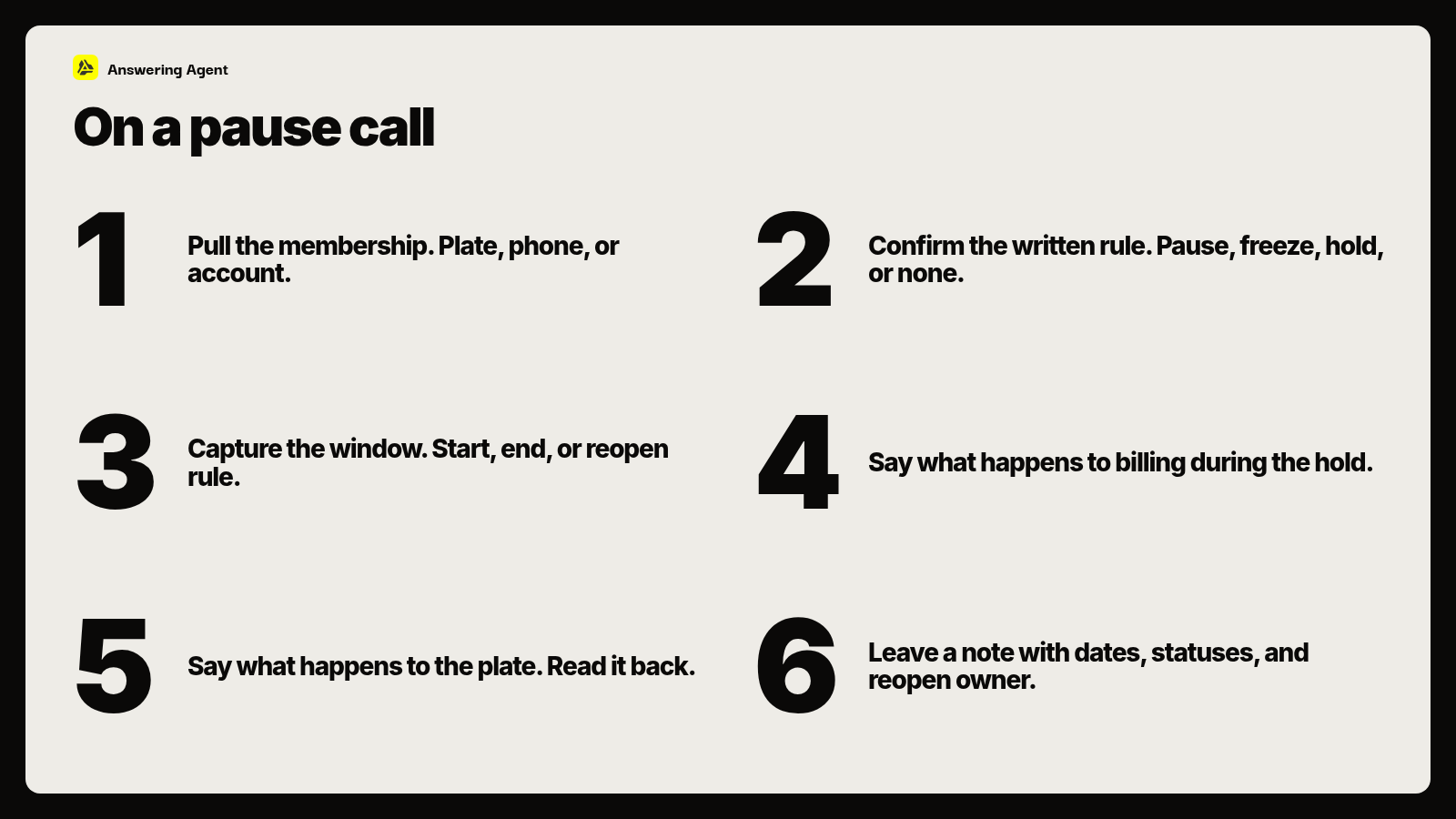
- Pull the membership by plate, phone, or account. Follow your verification rules before you change anything. If one phone number is on more than one plan, confirm which vehicle they mean.
- Confirm the written rule. Your policy may offer a pause, a freeze, a hold, or no temporary stop. Use the real terms and eligibility. If the rule is missing, send the question to member services and make no promise.
- Capture the window. Get the start date, the end date, or the reopen rule your policy uses. Read the calendar dates back to the member. "Next Friday" will cause a dispute on the next shift.
- Explain billing during the hold. Cover when drafts stop, when they resume, and any hold fee your rule sets. A requested hold does not prove billing has already changed.
- Explain plate access. Access is off until reopen, or limited, depending on the rule. Say whether the hold is applied now or waiting on approval, and who owns the follow-up.
- Leave a note with the dates, billing status, plate status, what you told the member, and who owns the reopen. Mark the hold pending or completed accurately. Only assume an automatic reopen if the rule says so.
Confirm the hold before you cancel the account.
To check a note, ask whether the next shift could explain this hold without replaying the call. "Wants freeze" fails that test. Dates, statuses, and an owner pass it.
Pause, cancel, or update the card: how do you tell them apart?
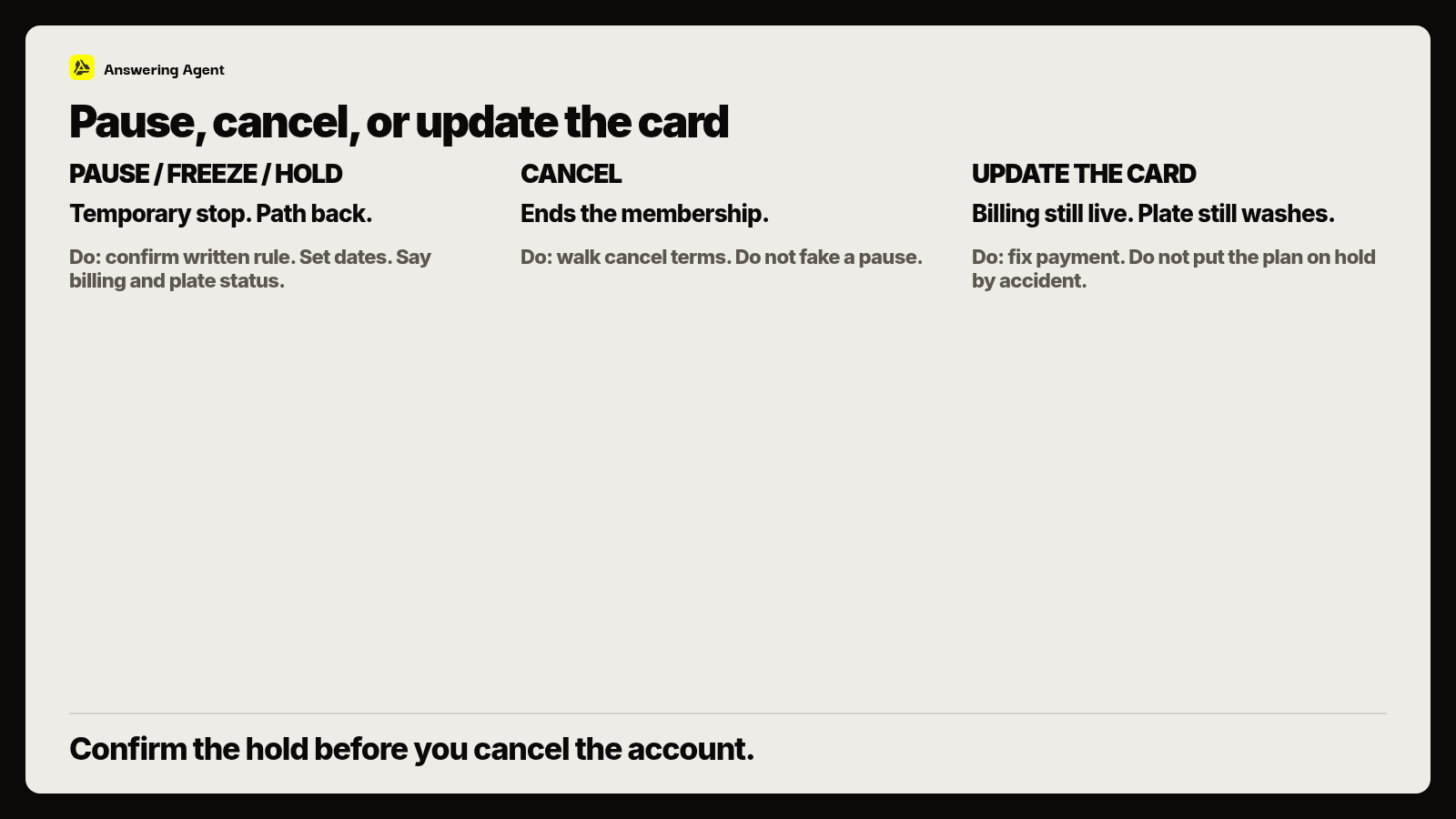
Each request leads to a different account state:
- Pause is a temporary stop with a path back.
- Cancel ends the membership.
- Card update keeps billing live and the plate eligible, subject to account status.
If you pick the wrong one, a vacation becomes a churn, or a dead plate keeps drafting.
Pause: Check whether your policy has a temporary hold, then set the dates, billing treatment, and access. Do not promise the member keeps their current rate unless the policy says so.
Cancel: Walk through the effective date and final billing under your written cancel rule. If they chose cancel only because no hold exists, note that. It keeps the next person from arguing about a freeze that was never offered. If the member is still on the plan, work the save step from the membership retention desk guide before you set an end date.
Card update: Confirm the account status, then use the failed payment process. A disputed duplicate draft goes to the double-charge workflow. Do not handle it as a hold request.
These calls often look like a pause but belong to a different process:
- Changing which vehicle is on the plan goes through the add-vehicle process.
- Moving the membership to a new name or primary holder goes through the membership transfer guide.
- Changing to a different plan tier goes through the upgrade and downgrade process.
The full desk map is in the membership phone calls desk guide.
Two rules always apply. Never cancel an account to fake a pause. Never let billing keep drafting through a hold the member thinks is frozen. If billing continues under the actual rule, tell the member before they agree.
What if your wash does not offer a pause?
State the written rule plainly: "Our membership policy doesn't offer a temporary hold." Then name the options that actually exist. Keeping the plan active means normal billing continues. Canceling requires the member's explicit agreement. "No pause" does not give you permission to cancel on their behalf.
Do not invent a freeze your POS cannot apply. A clear no with real options is better than a yes that fails in the lane next month.
If reopening means a new enrollment, say so. Do not promise preserved pricing, waived fees, or automatic reactivation without a written basis. Callers who already canceled and want to rejoin go through the reactivation call guide.
Pause eligibility, hold windows, fees, and reopen rules belong in the phone's knowledge base. Train the phone on your actual policies and answer from those facts. When a policy is missing, assign it an owner instead of guessing.
How is this different from taking a voicemail?
Voicemail cannot set a hold or confirm billing status. A message-taking service writes "pause, please call back," and the draft may still run. Coverage trained on your pause intake can complete an authorized hold on the call. If it can't, it hands member services a clean task with the dates and the open items.
| Check | Voicemail | Message-taking service | Coverage that can run your pause intake |
|---|---|---|---|
| Who answers | A recording | A generalist with a notepad | Coverage trained on your hold rules |
| Confirm pause policy | No | Only if handed the script | Yes, from your written rule |
| Capture hold dates | Whatever they leave | Can jot requested dates | Captures and reads back required dates |
| Billing per rule | No | Usually an action request | Changes only with access, else assigns the task |
| Plate access status | Cannot verify | Records the question | Explains the rule, verifies only with access |
| Reopen note | Unstructured message | Depends on the template | Dates, statuses, and reopen owner |
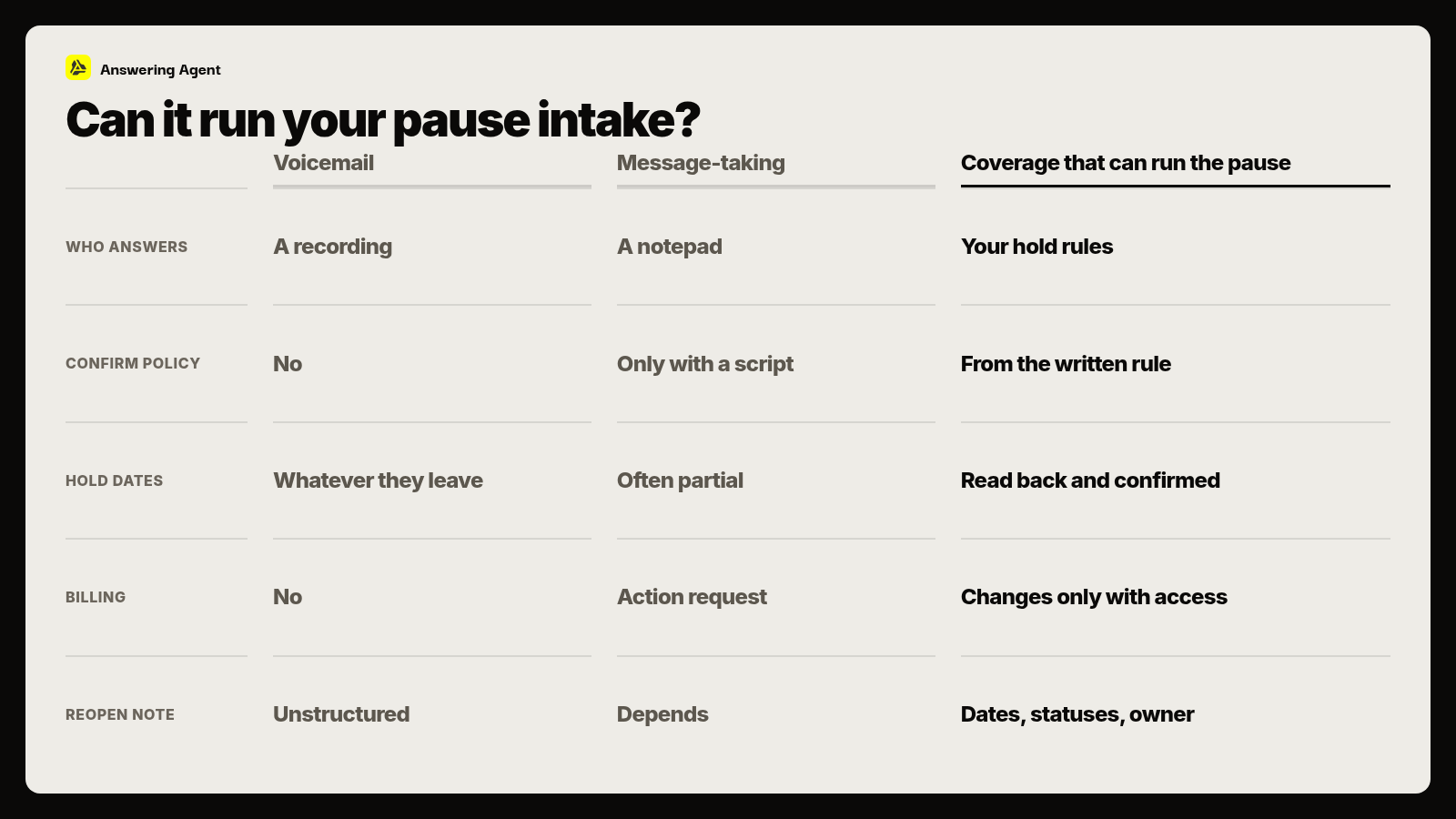
When member services owns the change, a clean handoff is a good outcome. The caller still has to hear whether the hold is pending or complete. "I sent your request for review" and "Your hold is active" describe different account states.
What should you check before software takes that call?
Before software answers pause calls, run the same test you would give a new cashier. It should be able to:
- tell a pause from a cancel from a card update
- read your written hold windows and fees
- say what happens to the plate
- hand a no-pause call to a human instead of inventing a freeze
If it fails any of these, it will cancel members by accident.
Test it at a site that allows holds and at a site that does not. Include a start date that conflicts with the written rule. Judge it by the transcript and the task it creates, not by how helpful the voice sounded.
Answering Agent can take the pause inquiry and capture the account identifiers and dates. It follows your written pause or no-pause rule, then creates a task with a transcript for member services. If you flag pause calls as manager-owned, it transfers them live. Setup details are on the phone answering feature page, and the wider wash approach is in the car wash phone playbook.
Check pricing, put it on the line, and call as a member asking to freeze for two weeks. It passes if it confirms the real rule, captures the dates, and leaves a reopen note. It fails if it cancels the account.
Frequently Asked Questions
What is a membership pause at a car wash?
A temporary hold on an existing plan, if your written rules allow one. Confirm the dates, billing treatment, and plate status before you promise it.
How is a pause different from a cancel?
A pause holds the membership for a set window with a path back. A cancel ends it under your cancel terms.
What should I capture on a pause call?
Capture the name, callback number, account or plate, and pause and return dates. Record the rule you used, billing during the hold, and plate status. Add a reopen note with an owner and a date.
What if our wash does not offer a freeze or hold?
Say so plainly and explain only the options your rules support. Route exception requests for review without promising approval.
Who should own pause calls, the window or member services?
Give one team ownership of policy checks, account changes, and follow-up. Usually that is member services. The window can collect the request and hand it off without promising dates or billing changes.
Can phone coverage handle membership pause intake?
Yes. It can collect account details and dates under your written rules. It should keep intake separate from approval and route the record to the authorized team with a reopen note.
Book a walkthrough
See it handle your calls.
Book 20 minutes, or hear a sample call first.