
Get the right person on the membership, confirm who pays, and leave a note the desk can use. That's the goal of a transfer call when the wash allows the change. When it doesn't, the caller should leave knowing the approved next step and who remains responsible for any bill.
I work through these calls with wash CX teams, member services, and site managers. I start by finding out what the caller wants changed. A spouse correcting their surname and a parent giving a membership to a child might both call it a transfer. They need different handling.
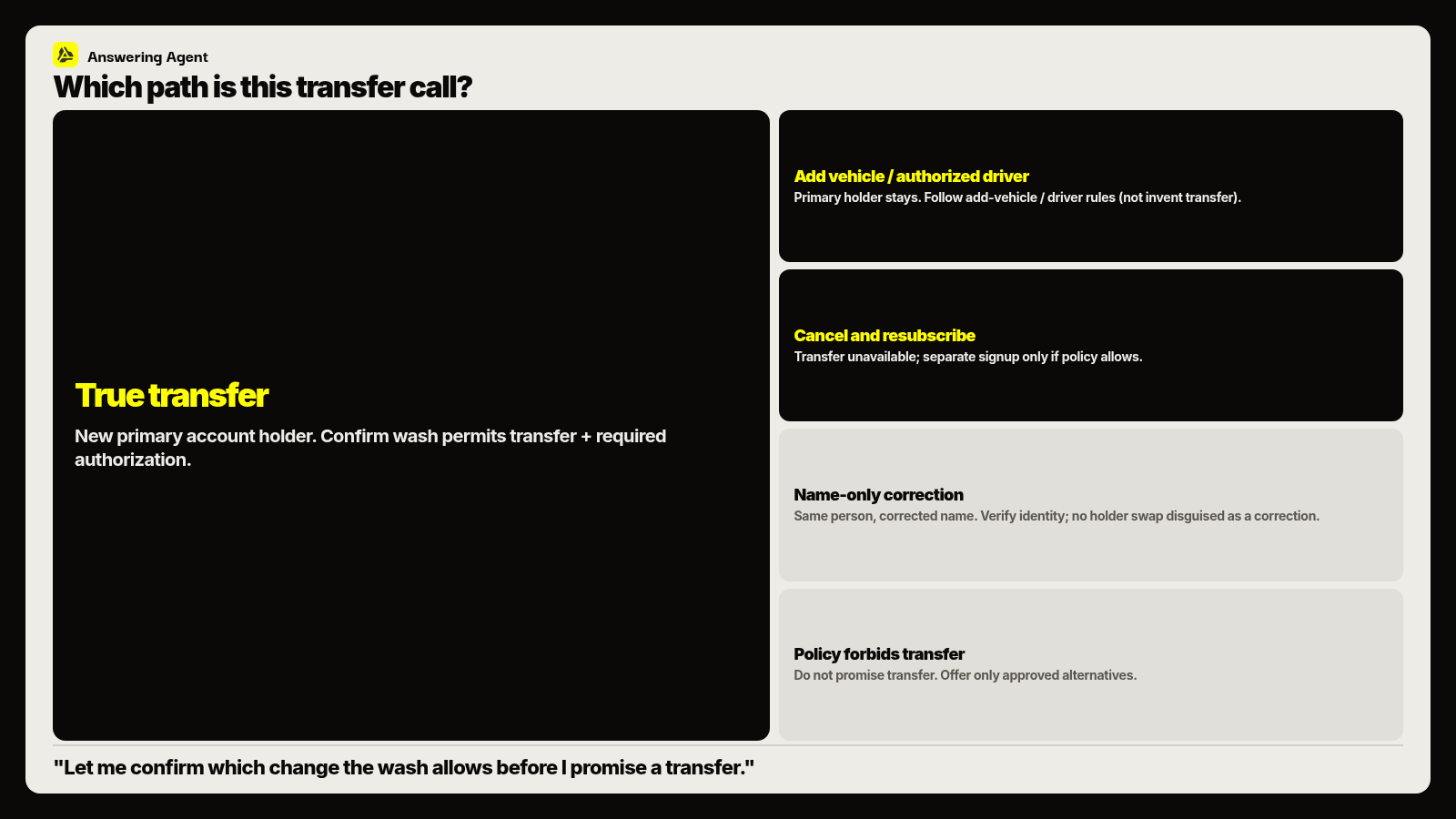
Which of the five paths does this caller need?
I sort membership transfer requests into five paths before offering an outcome. The right path depends on who will hold the account, who will pay, and whether the requested change is allowed. I verify the caller's authority first, then check the wash's rules before promising any account change.
A plain question usually gets us started:
"Are you changing who holds the membership, correcting the current holder's name, or keeping the account holder and changing who uses the vehicle?"
I also ask whether the person responsible for payment is changing. A different payer needs review under the wash's rules, even when the primary account holder stays the same.
| Path | What the caller needs | What I establish before promising anything |
|---|---|---|
| True transfer | A new primary account holder takes over | The wash permits the transfer and the required authorization is available. |
| Add a vehicle or authorized driver | The primary holder stays the same | The wash permits that vehicle or driver arrangement. |
| Cancel and resubscribe | A transfer is unavailable, but a separate new signup is an approved option | The old membership and new signup will be handled separately under policy. |
| Name-only correction | The same person needs their account name corrected | Identity is verified and the request does not change the primary holder. |
| Policy forbids transfer | The requested move is prohibited | No transfer is promised, and only approved alternatives are offered. |
A transfer prohibition doesn't automatically authorize canceling the account or creating a replacement membership. I explain the restriction, then check whether a separate signup is allowed.
What should the desk do in order?
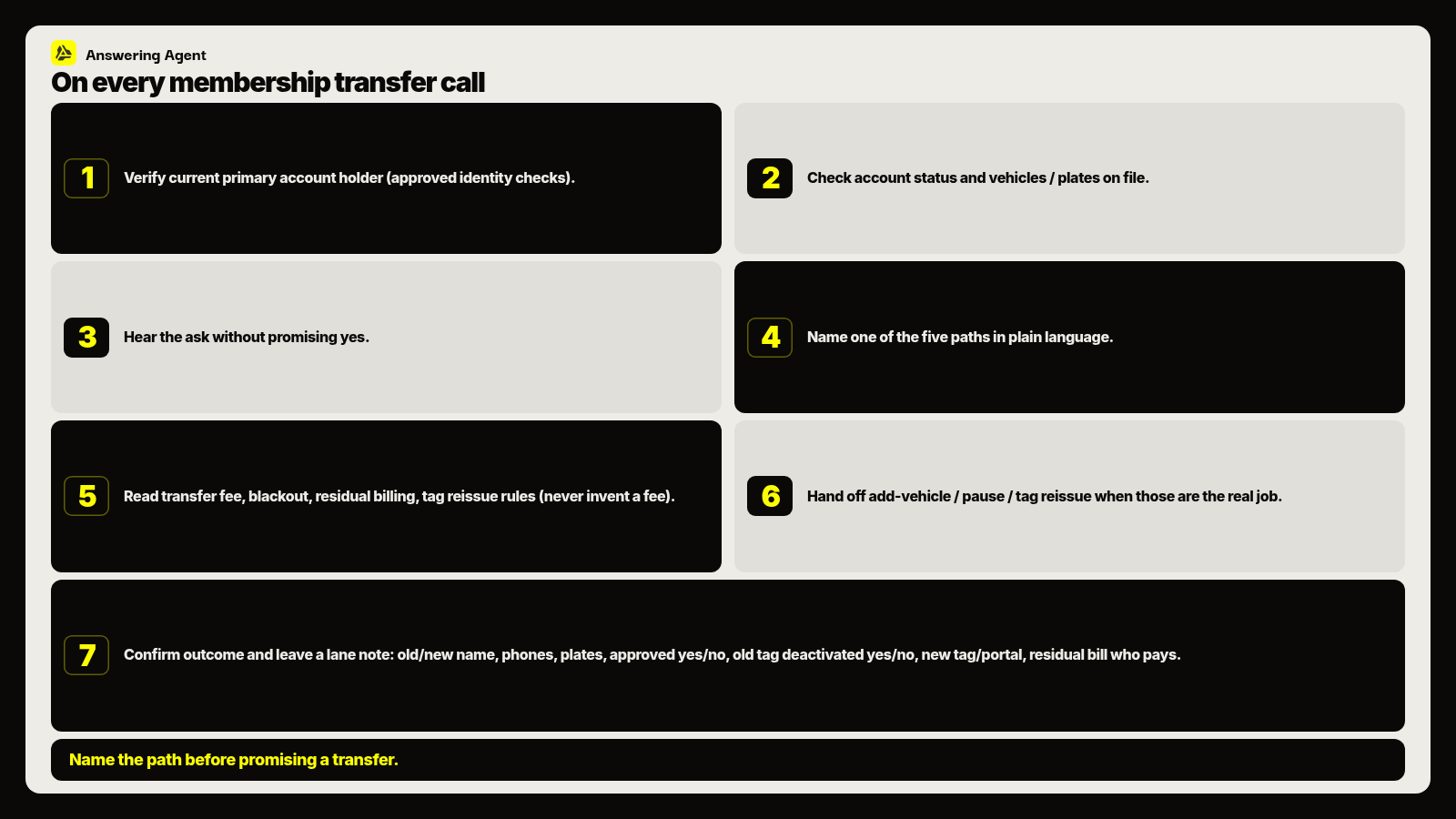
I verify the account and clarify the request before checking the transfer rules. Once the permitted path is clear, I confirm approval, payment responsibility, and any access changes with the caller. The final step is a usable note so the desk and lane staff can follow through without repeating the intake.
Verify the current primary account holder using the wash's approved identity checks before disclosing account details or accepting changes. Knowing a plate number doesn't replace authorization. If the proposed new holder is calling, establish how the current holder must authorize the request. A family relationship alone isn't permission
Check the account status and vehicles on file. Confirm whether the account is active, paused, or has a failed payment, and check its vehicles and plates. An active account isn't necessarily transferable. Changing the holder also doesn't clear an unresolved balance
Ask what should change and what should stay. Who will hold the membership afterward, and who will pay? Which vehicle will use it? I say, "I can check which path the wash allows for that change." That gives the caller a next step without approving the request early
Choose a path and describe it plainly. "You want your child to become the primary account holder" identifies a transfer request. If the holder is staying and another driver will use the vehicle, record that instead. Keep the request separate from its approval status
Read the wash's transfer rules. Check the transfer fee, any blackout, residual billing responsibility, and tag reissue requirements. Quote only an approved fee. Get confirmation when a rule or amount is missing. Establish when the change can take effect and who remains responsible for any residual bill
Hand off requests that need another process. If the holder stays and the request concerns another car, use the steps to add a vehicle to a car wash membership. Route an actual pause request through the guide for membership pause calls. After an approved transfer, use the applicable reissue steps in lost or stolen membership tag calls when needed, without labeling a tag lost or stolen unless it is
Read back the outcome and write the note. Confirm the approved path, holder, payment responsibility, effective timing, and remaining tag or portal steps. Say clearly when approval is pending. Ask the caller to confirm their understanding, then record what was explained and what remains open
"Let me confirm which change the wash allows before I promise a transfer."
How do transfer, add a vehicle, and cancel and resubscribe differ?
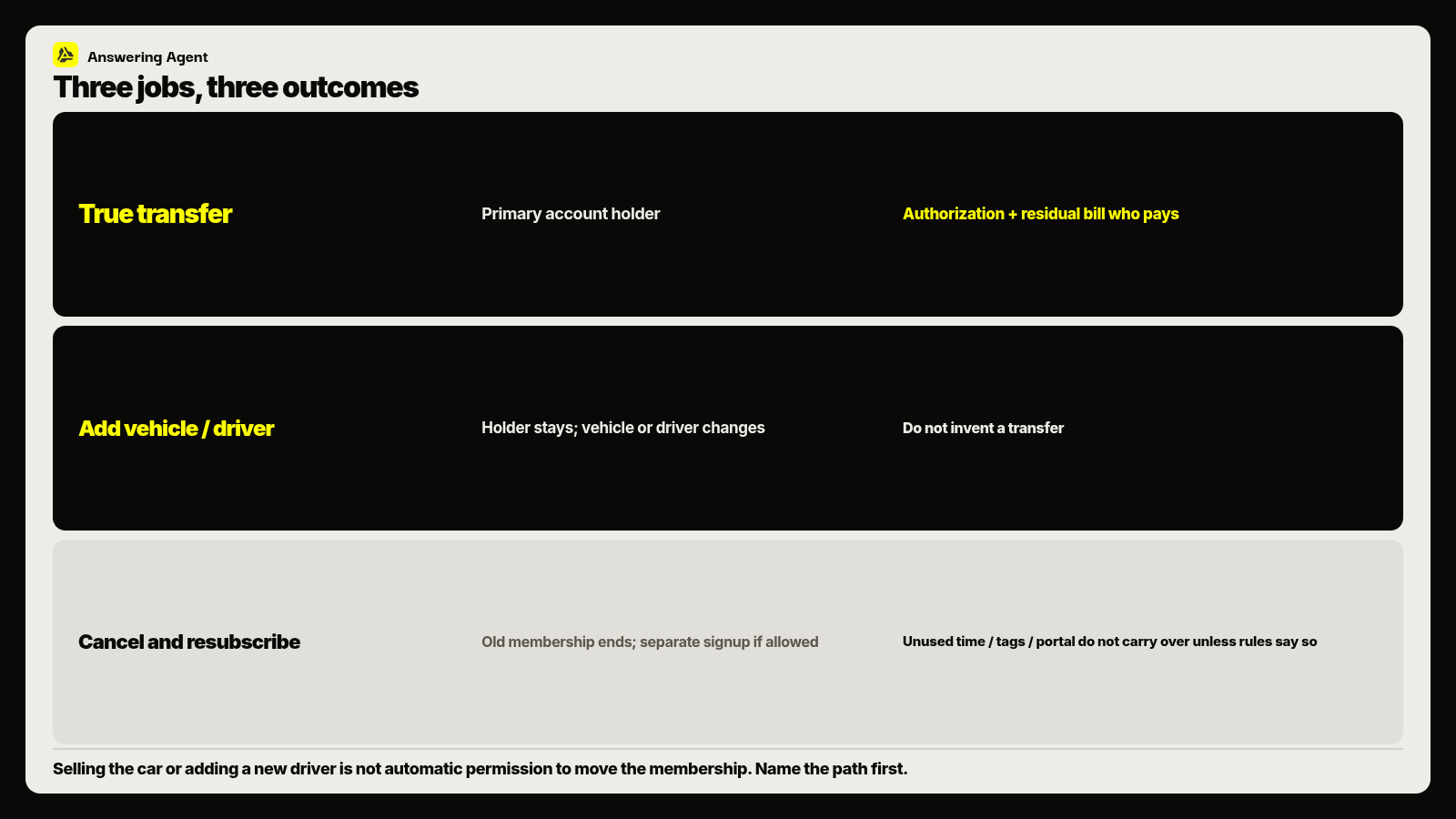
A transfer changes the primary account holder through the wash's approved process. Adding a vehicle keeps that holder in place. Canceling and resubscribing involves separate membership actions when policy permits them. I explain the difference before the caller agrees, including what each permitted option means for billing and access.
When someone is selling a car, I ask whether they want the buyer to take over the membership. That's a transfer request. The sale itself doesn't authorize leaving the existing tag and billing attached.
A new driver using the same car raises a different question. If the primary holder will remain unchanged, check the approved driver arrangement rather than changing ownership to match the person behind the wheel.
When the wash permits a new signup instead of a transfer, explain that it's a separate account action. Unused time, account terms, tags, and portal access should only carry over when the wash's rules explicitly allow it.
How should the desk handle spouse, estate, and business requests?
For spouse, estate, and business requests, I establish whether the holder is changing and who has authority to approve it. The questions should stay respectful and limited to what the wash needs. A relationship to the current holder doesn't settle authorization, so unclear cases go through the designated approval process.
A spouse or partner correcting their surname can use the name-correction path after verification if they're the same account holder. Replacing one spouse with the other as primary holder is a transfer request, even when the phone number and plate stay the same.
For an estate or death-related request, I acknowledge the loss briefly, then follow the wash's process for establishing who may act for the account. I don't improvise document requirements or promise a transfer because the caller is a relative. An unclear authorization question belongs with the designated approver.
For a business-to-personal request, establish who currently holds the account and who can authorize the change. Check whether the wash treats it as a transfer, a correction, or a separate signup. A familiar driver using the same car doesn't answer the ownership question.
What belongs in the desk and lane note?
A transfer note should identify the account, distinguish the requested change from the approved outcome, and explain any remaining work. I record old and new details separately, with clear status for billing and access. Another staff member should be able to tell what happened without asking the caller to start over.
Use the wash's approved account fields for these details. Sensitive verification material should stay out of a general lane note.
Here's what I include:
-
The old and new names, distinguishing a change of holder from a correction for the same person.
-
The relevant current and new contact numbers.
-
The vehicles and plates on file, plus any approved change.
-
The chosen path and verified account status, including whether it's active, paused, or has a failed payment.
-
Whether the transfer is approved, denied, or awaiting review.
-
Whether the old tag has actually been deactivated. An intended action shouldn't be recorded as complete.
-
What's complete or pending for the new tag and portal access, with the next required step.
-
Who is responsible for the residual bill, as confirmed under policy.
-
The caller's confirmation and the fee, blackout, timing, and next steps explained to them.
"Transfer handled" leaves too much unanswered. If a rule still needs confirmation, name who must follow up. An unresolved billing question should remain visible as open work.
What should a wash check before buying phone coverage?
Before buying phone coverage for busy desk hours or after closing, test how it handles membership transfers against the wash's approved rules. It should verify authority, distinguish requests from approvals, and leave a clear record. Unresolved fees or permission questions should reach the right person rather than receive a guessed answer.
Answering Agent has been in the space for two years. The agent picks up and responds in about a second and a half.
About two out of three calls are handled start to finish without needing a human. About 1 in 10 phone calls get forwarded.
I would review the car wash coverage, AI phone answering features, and pricing against the wash's transfer requirements.
For testing, I'd include a name correction and a prohibited transfer, then check an approved transfer with residual billing. I'd read the resulting notes before using the coverage. Each should match the policy, make approval status clear, and tell the desk exactly what still needs doing.
FAQ
How should membership transfer calls be sorted?
Check five paths before promising yes: true transfer to a new primary account holder, add a vehicle or authorized driver, cancel and resubscribe when transfer is not allowed, name-only correction on the same person, or site policy forbids transfer. Verify the current owner's identity, account status, and vehicles or plates first. The wash's approved transfer fee, blackout, residual billing, and tag reissue rules determine the answer.
What is a true membership transfer versus adding a vehicle?
A true transfer changes the primary account holder under the wash's approved process. Adding a vehicle or authorized driver leaves the primary holder in place. If the holder stays the same and another car or driver is the request, use the add-vehicle process instead of inventing a transfer.
What should I verify before promising a transfer?
Verify the current primary account holder with the wash's approved identity checks, confirm account status (active, pause, or failed payment), and check vehicles and plates on file. A family relationship alone is not permission. Do not promise yes before naming the path and reading the wash's rules.
When should I refuse or offer cancel and resubscribe instead?
When site policy forbids transfer, do not promise a transfer. Explain the restriction first. Only offer cancel and a separate new signup when that wash's rules explicitly allow those as separate actions. Do not invent that unused time, tags, or portal access carry over.
How do spouse name changes, estate requests, and business-to-personal requests differ?
A surname correction for the same person is a name-only path after verification. Replacing one spouse with another as primary holder is a transfer request. Estate and death-related calls need the wash's process for who may act. Business-to-personal needs who holds the account and who can authorize the change. Do not improvise document requirements.
What belongs in the desk or lane note?
Include old and new names, phone numbers, plates, chosen path and account status, transfer approved yes or no (or awaiting review), old tag deactivated yes or no, new tag and portal access status, residual bill who pays, and what was confirmed with the caller. Distinguish intended actions from completed ones.
What should a wash check before buying phone coverage for transfer calls?
Evaluate coverage against the wash's approved transfer fees, blackout, residual billing, and tag reissue rules. Coverage should distinguish requests from approvals, capture a usable note, and send unresolved fees or permission questions to authorized staff rather than inventing answers.
Book a walkthrough
See it handle your calls.
Book 20 minutes, or hear a sample call first.
Ready to see it handle your calls?
Book a walkthrough, or hear a short sample call first.
Related Articles
How to Handle Lost or Stolen Car Wash Membership Tag Calls
Handle lost or stolen car wash membership tag calls. Check five tag paths before promising a free replacement, then follow wash rules.

How to Handle Pickleball After-Hours and Door Access Calls
Handle pickleball after-hours door access calls by forking member fob, guest, hours, and booking asks before you promise entry.

Car Wash Membership Billing Phone Calls: A Desk Guide
Desk guide for car wash membership billing calls: fork failed payment, double charge, plan change, and pause vs cancel before you process.