
Give the member a clear next step: verify the caller, confirm the account and plate, and check the old tag's status. Then handle temporary access and replacement under the wash's rules. Leave a note that the lane can use without repeating the call.
When I work through these calls with wash CX, member services, and site managers, I want the caller's understanding to match the account record. If a replacement is only requested, the member should know it is still pending. If access is approved, the lane needs the approved instructions.
Whether the missing tag is an RFID sticker, hangtag, or fob, start by finding out what happened before promising a free replacement.
Which tag problem are we actually handling?
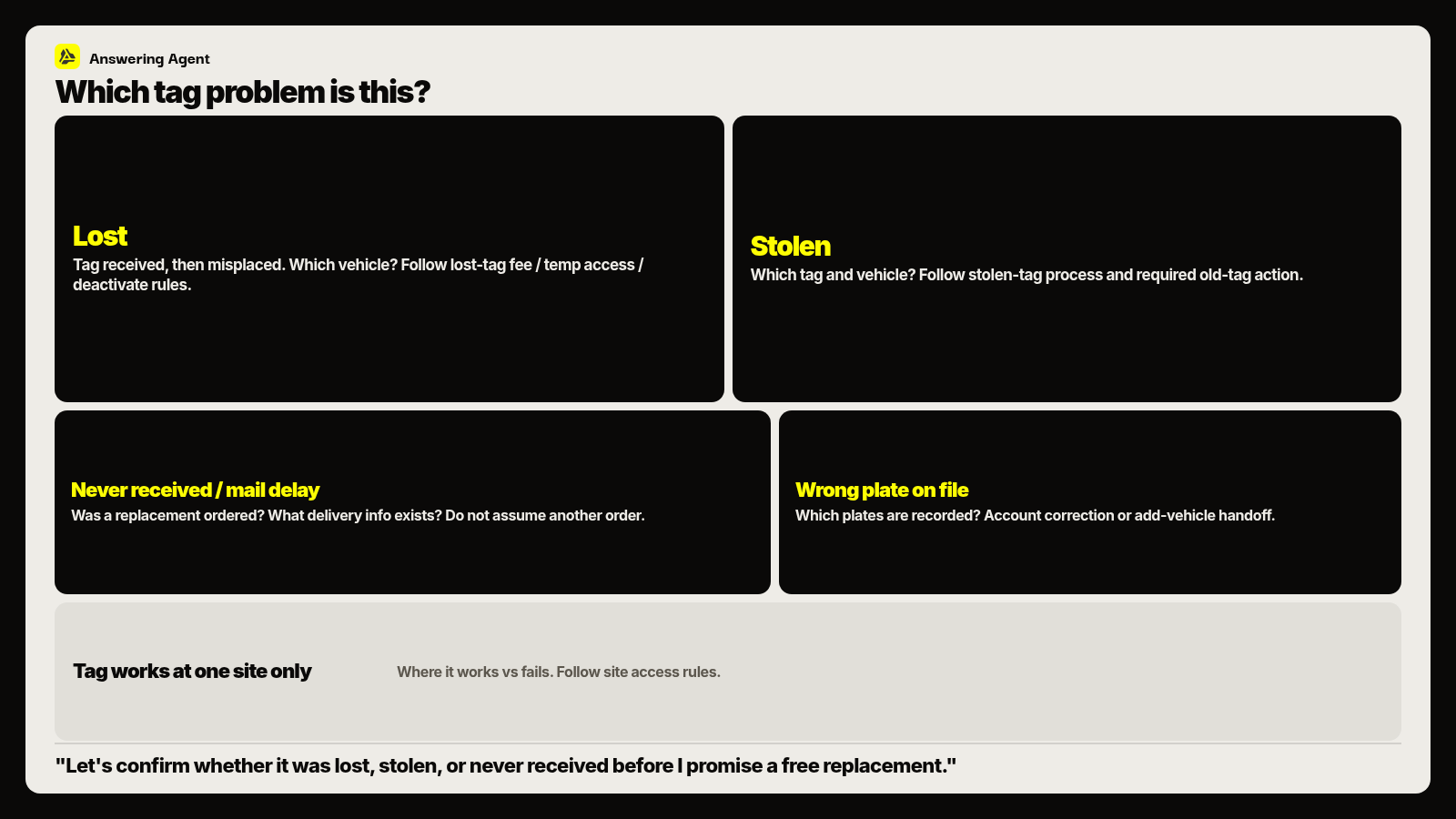
Check five possible tag problems before promising a replacement: lost, stolen, never received, connected to the wrong plate, or working at only one site. Verify the caller and account, then clarify what happened to the original tag. Use the wash's approved rules to choose the next action.
"I need another tag" leaves a lot unanswered. Ask whether the member received the original, whether they still have it, and which vehicle it belongs to.
A missing hangtag needs different handling from a fob that still works at another location. An RFID sticker that never arrived may need a delivery check before anyone orders another. Those distinctions help the desk avoid promises it cannot keep.
| Caller reports | What I clarify | What determines the next step |
|---|---|---|
| Lost | Was the tag received and then misplaced, and which vehicle is involved? | The wash's lost tag replacement fee, temporary access, and old tag deactivation rules. |
| Stolen | Which tag and vehicle are involved, and what does the account show? | The wash's stolen tag process, including required old tag handling. |
| Never received or mail delay | Was a replacement ordered, and what delivery information is available? | The wash's delivery and replacement rules. Do not assume another order is needed. |
| Wrong plate on file | Which plates are recorded, and is this an existing vehicle or another vehicle? | The approved account correction process or an add vehicle handoff. |
| Tag works at one site only | Where does it work, and where does it fail? | The wash's site access rules and appropriate site support path. |
None of these reports establishes whether a replacement is free or carries a charge. The caller's explanation identifies the problem; the approved policy determines what the desk can offer.
"Let's confirm whether it was lost, stolen, or never received before I promise a free replacement."
What steps should the desk follow on the call?
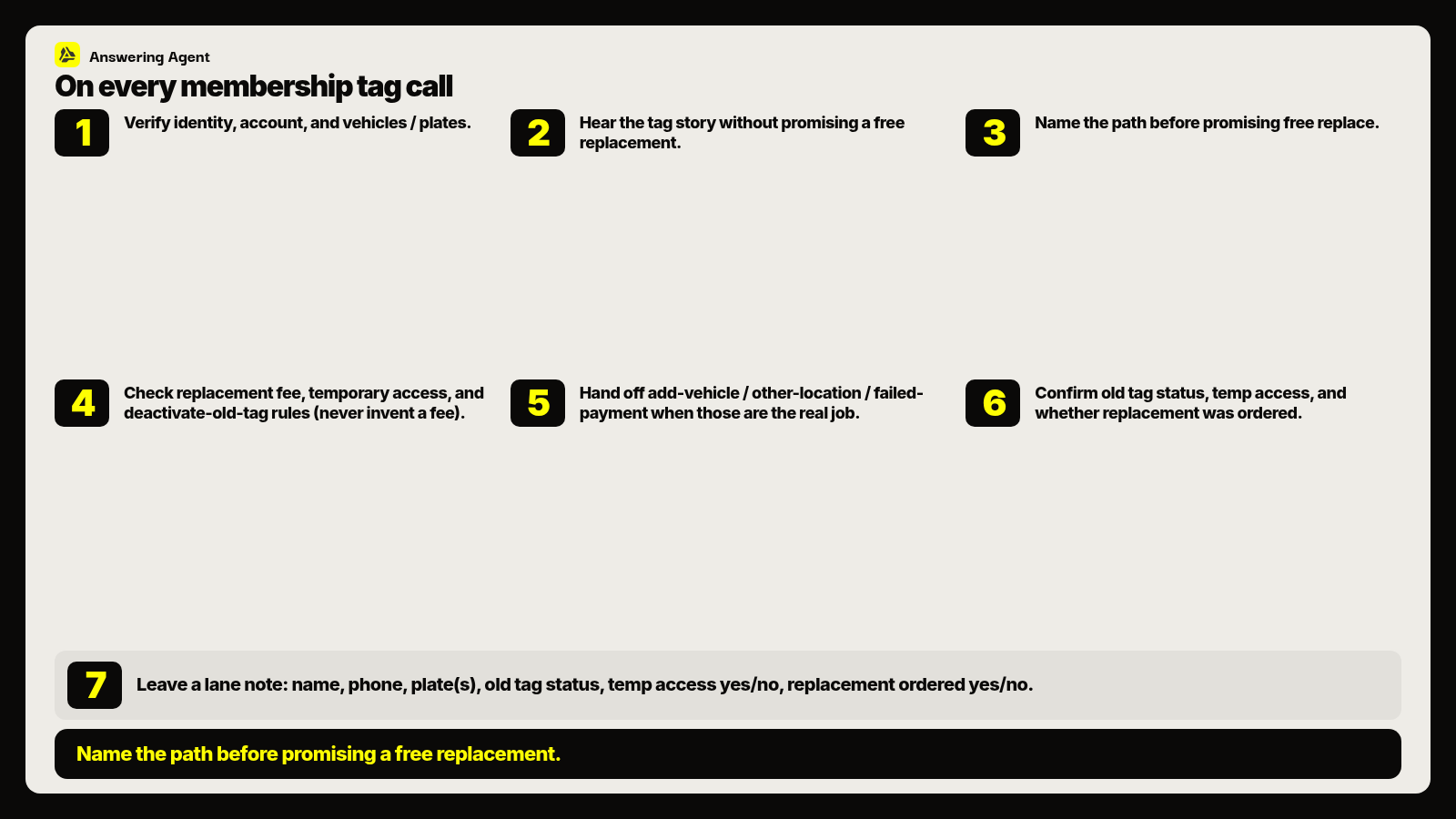
Follow a consistent sequence: verify the caller and account, establish what happened to the tag, and check the approved rules for that problem. Complete only authorized actions. Before ending the call, explain what is done and what remains pending, then record the same outcome for the lane.
Follow the wash's identity checks before sharing account details or making changes. Confirm the member account and the vehicles and plates on file. Ask which vehicle the missing RFID sticker, hangtag, or fob belongs to. A familiar name alone does not establish the right account or vehicle
Let the member explain what happened. Was the tag lost, stolen, never received, or still present but not working where expected? Acknowledge the hassle without promising a fee waiver, replacement, or access before checking the rules
Repeat the relevant facts so the member can correct anything you misunderstood. "You received the hangtag, and now it is missing." Or, "You still have the fob, and it works at another location." This check helps keep the call on the right process
Read the approved rules for replacement fees, temporary access, and old tag deactivation. Confirm any applicable fee before proceeding as policy requires. Do not invent an amount or assume that stolen tags, first replacements, or delayed mail qualify for free replacement. Get an authorized decision when the rule is unclear
Hand off requests that need another process. For another vehicle, use the process to add a vehicle to a car wash membership. For location eligibility, use the member from another car wash location process. If the account check identifies a failed payment on a car wash membership, hand that work over rather than treating tag replacement as the fix
Tell the caller the old tag's confirmed status, whether temporary access is approved, and whether a replacement was ordered. Explain the applicable fee and approved next step. Keep completed actions separate from pending requests. "Replacement requested" and "replacement ordered" make different promises
Record the member's name, confirmed phone number, affected plate or plates, and the status of each action. Include unresolved work and who needs to handle it. The note needs to match what the caller was told, including anything still awaiting approval
How should temporary access and old tag deactivation be handled?
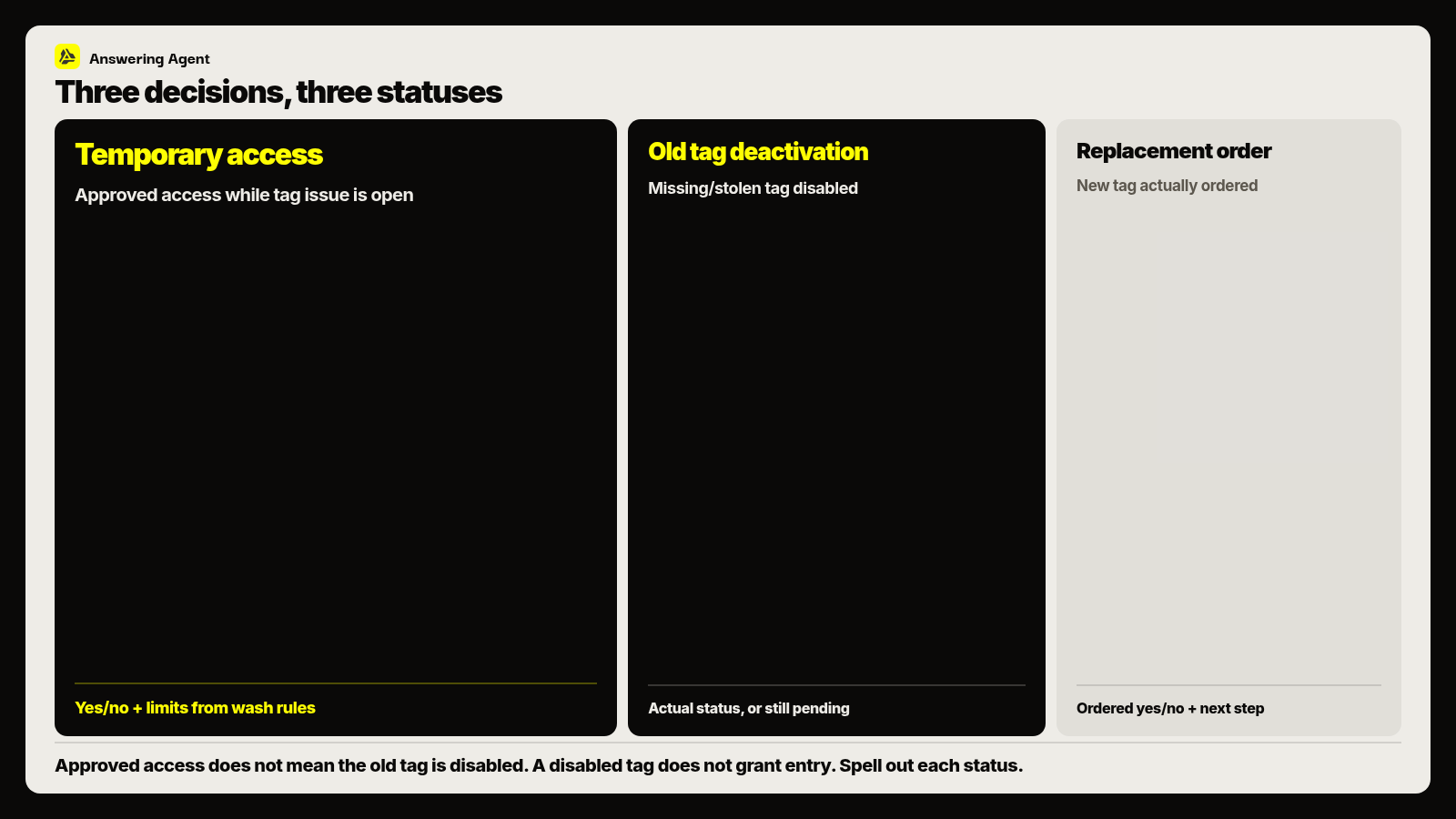
Treat temporary access and old tag deactivation as separate decisions under the wash's written rules. Approved access does not confirm that the old tag is disabled, and a disabled tag does not grant permission to enter. Check and document each action, including whether a replacement has actually been ordered.
I would rather spell out those statuses than end with "you're all set." The caller may hear permission to wash when the desk means only that a replacement request has been sent. A little precision here gives both the member and the lane something they can use.
| Decision | What it settles | What to confirm |
|---|---|---|
| Temporary access | Whether the member can use an approved access process while the tag issue is unresolved. | Approval yes or no, plus any limits or instructions in the wash's rules. |
| Old tag deactivation | Whether the missing or stolen tag has been disabled under the wash's process. | The actual status, including whether action remains pending. |
| Replacement order | Whether the new tag has actually been ordered. | Ordered yes or no, plus the approved next step. |
For a stolen tag, check the required old tag action. Do not assume that ordering a replacement also completes deactivation.
For a lost tag, explain the approved access decision without suggesting a workaround. If temporary access requires authorization, get it before telling the member they can enter. The desk note should record that permission only after it has been granted.
What belongs in the desk or lane note?
A useful tag note identifies the member, the affected vehicle, what happened to the tag, and the status of each promised action. Include the fee and instructions communicated to the caller. State unresolved work and who handles it, so the next employee can understand the outcome without replaying the conversation.
"Tag issue handled" leaves the lane guessing. I want someone reading the note to see whether the member has permission to wash and whether the replacement still needs attention.
Use a compact checklist with verified facts:
Record the account name and confirmed phone number.
Identify the affected vehicle and plate or plates.
Record whether the tag is an RFID sticker, hangtag, or fob, along with the reported problem.
State the confirmed old tag status. Note when deactivation is pending or the status could not be confirmed.
Record temporary access as yes or no, with approved instructions or a note that authorization remains pending.
Record replacement ordered as yes or no. Distinguish a completed order from a request awaiting action.
Include the fee, access decision, and next step communicated to the caller.
Identify remaining work and the responsible desk or manager under the wash's process.
A required yes or no field should not hide uncertainty. If approval is pending, record that no approval has been granted and explain what remains open.
Read back the outcome before ending the call. That gives the member a chance to flag a mismatch between what they heard and what the desk recorded.
What should a wash check before buying phone coverage for tag calls?
Evaluate phone coverage against the wash's approved replacement fees, temporary access rules, and old tag deactivation process. Coverage during busy desk periods or after hours should follow those rules, capture a usable note, and send unresolved approvals to authorized staff. Check that it can distinguish completed actions from pending requests.
Answering Agent has been in the space for two years. The agent picks up and responds in about a second and a half. About two out of three calls are handled start to finish without needing a human.
Review Answering Agent for car washes, the phone answering features, and pricing. Bring the wash's actual tag rules to that evaluation and check how each of the five tag problems would be handled.
I would also review the note fields and confirm where staff can find the approved rules. Ask how the coverage records an unconfirmed old tag status, access awaiting approval, or a replacement that has been requested but not ordered. Those are details the lane needs before it can act.
FAQ
How should lost or stolen membership tag calls be sorted?
Check five paths before promising a free replacement: lost, stolen, never received or mail delay, wrong plate on file, or tag works at one site only. Verify identity, account, and vehicles or plates first. The caller's story identifies the path. The wash's approved replacement fee, temporary access, and deactivate-old-tag rules determine the answer.
What should I do when a member says their RFID sticker, hangtag, or fob is lost?
Verify the caller and account, confirm which vehicle and plate are involved, and establish that the tag was received and then misplaced. Check the wash's lost-tag rules for replacement fee, temporary access, and old tag deactivation. Do not invent a fee amount. Confirm the outcome and leave a lane note with name, phone, plate or plates, old tag status, temp access yes or no, and replacement ordered yes or no.
How is a stolen tag different from a lost tag on the phone?
A stolen report still needs identity, account, and vehicle checks, then the wash's stolen-tag process. That process often requires a specific old-tag action. Do not assume ordering a replacement also completes deactivation. Record the confirmed old tag status separately from temporary access and from whether a replacement was actually ordered.
What if the member says the tag never arrived?
Treat never received or mail delay as its own path. Ask whether a replacement was already ordered and what delivery information is available. Follow the wash's delivery and replacement rules. Do not assume another order is needed. Confirm what you told the caller and leave the pending delivery or order status in the desk note.
When should I hand off instead of replacing a tag?
Hand off when the real job is another vehicle, location eligibility, or a failed payment. Use the add-vehicle process for another vehicle, the other-location process for site eligibility, and the failed-payment process when the account check shows that problem. Tag replacement does not fix those jobs.
What belongs in the desk or lane note?
Include member name, phone, plate or plates, tag type and path, old tag status, temporary access yes or no, replacement ordered yes or no, the fee and instructions told to the caller, and remaining work with who handles it. Distinguish requested from ordered. If approval is pending, record that no approval has been granted.
What should a wash check before buying phone coverage for tag calls?
Evaluate coverage against the wash's approved replacement fees, temporary access rules, and old tag deactivation process. Coverage should follow those rules, capture a usable note, distinguish completed actions from pending requests, and send unresolved approvals to authorized staff rather than inventing fees.
Book a walkthrough
See it handle your calls.
Book 20 minutes, or hear a sample call first.
Ready to see it handle your calls?
Book a walkthrough, or hear a short sample call first.
Related Articles
How to Handle Pickleball After-Hours and Door Access Calls
Handle pickleball after-hours door access calls by forking member fob, guest, hours, and booking asks before you promise entry.
Car Wash Membership Billing Phone Calls: A Desk Guide
Desk guide for car wash membership billing calls: fork failed payment, double charge, plan change, and pause vs cancel before you process.

How to Handle Pickleball Membership Cancellation Calls
How pickleball club desks handle membership cancellation calls without inventing policy or fighting the member.