

Finish a membership plan-change call with a verified account and an agreed plan. The member should know when the change takes effect, when the new rate starts, and whether their tag, plate, or vehicle list needs an update. Leave the next desk shift a note it can use.
When I work through these calls with wash CX, member services, and site managers, I keep the member's requested change at the center of the conversation. That means using approved billing rules and respecting a clear request for a lower tier.
What should a plan-change call accomplish?
A plan-change call should move a verified member from their current plan to an available requested plan under the wash's approved rules. Confirm the effective date and explain how the current billing period will be treated. The member should also know whether any tag or plate work remains.
The reason for the change helps you explain the relevant options. "I'm washing less often" can explain a downgrade. "I want the services on the higher plan" can explain an upgrade. Neither needs a sales speech.
I start with one question: "What would you like to change about your current membership?"
Listen long enough to understand what "change" means. A different tier belongs in this workflow. A temporary break or a request to end the membership needs its own process. So does a payment problem; changing tiers should not become a workaround for an unresolved billing issue. For card-on-file problems, use the failed payment call playbook.
How do I separate an upgrade from a downgrade, pause, or cancel?
The member's intended outcome determines the call path. An upgrade or downgrade changes the membership tier, while a pause or cancellation needs the wash's corresponding process. Explain the options the wash actually offers, then confirm which outcome the member wants before making any account change.
| Member's intended outcome | Call path | What I confirm |
|---|---|---|
| More services through a higher available tier | Upgrade | Requested plan and approved change timing |
| A lower available tier | Downgrade | Requested plan and approved change timing |
| A temporary break | Pause handoff | That a temporary break is the actual request |
| End the membership | Cancel handoff | That ending the membership is the actual request |
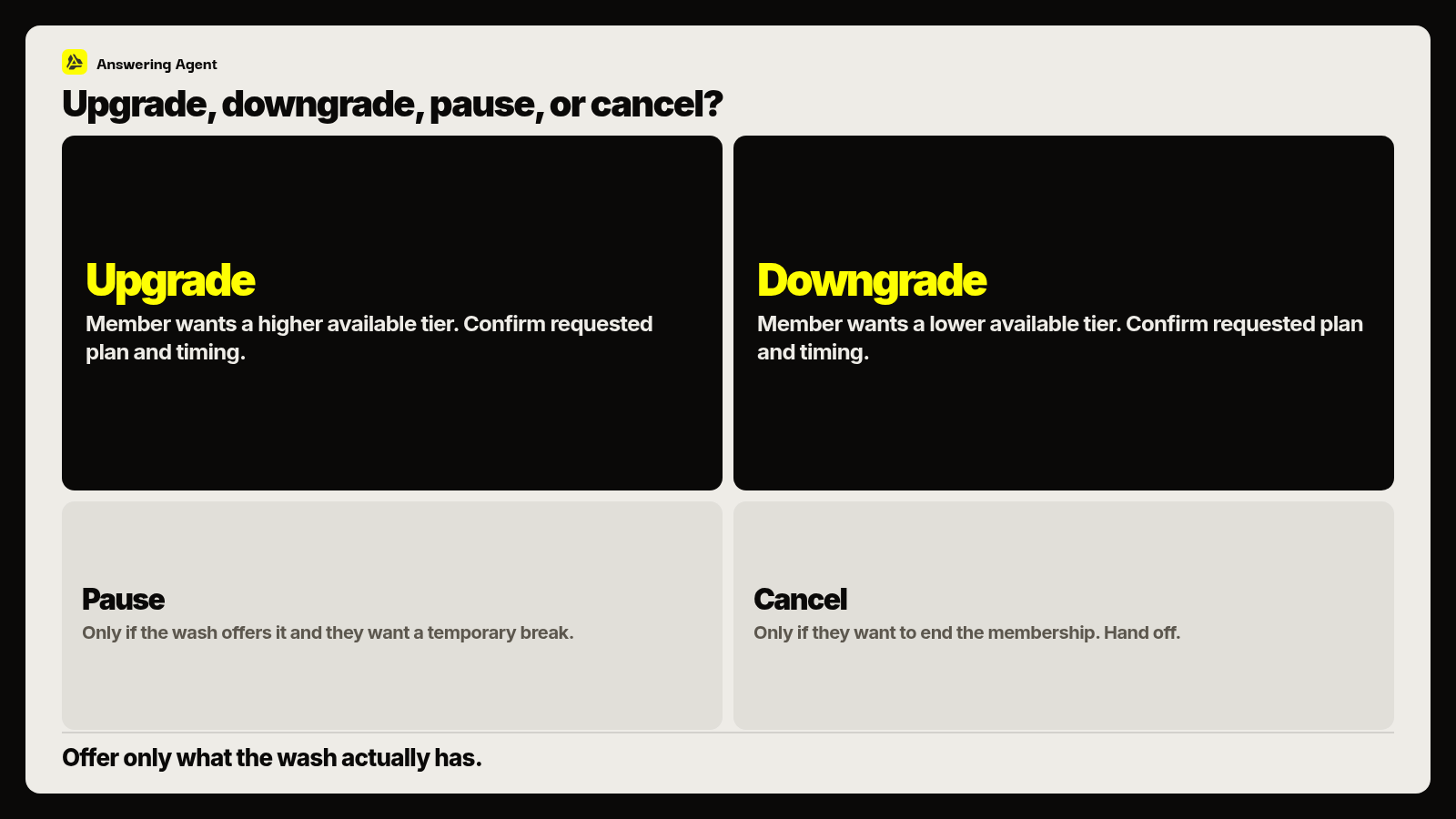
For a pause, hand off to the membership pause call process. For cancellation, use the appropriate route in the membership phone desk guide.
"I need this to cost less" doesn't authorize you to select the cheapest tier. Explain the available lower-plan option using approved plan information. Ask whether its included services meet the member's needs.
If that option doesn't work for them, listen to the next request. Let the member choose the outcome, then use the wash's rules to determine what you can process.
What steps should I follow during the call?
Use the same sequence for upgrades and downgrades, with the wash's rules governing each step. Verify the account before discussing a change, and explain the terms before submitting it. Check the resulting status so the member and the next shift know what is complete and what remains pending.
Verify identity and find the right account
Follow the wash's approved verification procedure before discussing or changing the membership. Match the member to the account and relevant vehicle record. A familiar name in the POS doesn't verify authorization. If verification is incomplete, leave the account unchanged and follow the approved handoff.
Name the current plan
Read the current plan name from the account instead of relying on the member's memory. Ask, "I have your current plan open. Is this the membership you want to change?" Resolve any mismatch before discussing a new tier.
Hear the requested change and the reason
Ask which plan they want, or what they want to be different. Someone asking for fewer included services needs the available downgrade options. Someone asking for more needs the relevant upgrade explained. Record a useful member-stated reason without debating their washing habits.
Confirm the correct path
Say back the request so the member can confirm whether they want a tier change or a different membership action. Continue with this playbook only when they want an upgrade or downgrade that the wash allows. Use the approved plan list. Don't offer an unpublished tier or promise a restricted change as a favor.
Explain the terms and get agreement
Name the requested plan and use approved information for its rate and included services. Explain when the plan takes effect and when the new rate begins, along with the treatment of the current billing period. Get agreement before processing. If a rule is unclear, seek an authorized answer instead of supplying your own proration or refund policy.
Process the permitted change and check its status
Use the authorized workflow, then check the account. A completed change, a scheduled change, and a request awaiting approval have different outcomes. Tell the member which applies. If you've left a request for someone else, explain the remaining step and who handles it.
Check the tag, plate, and vehicle list
Determine whether the tier change requires an update to the existing tag, registered plate, or vehicle list. A billing change may leave those details unresolved. If adding another vehicle becomes a separate request, use the add-vehicle call playbook.
Read back the outcome and leave the note
Confirm the new plan name and effective date, then the new rate start. Include any required tag or plate work and say what remains pending. Document the same outcome for the desk, including any action needed at the site. The note should agree with what you told the member.
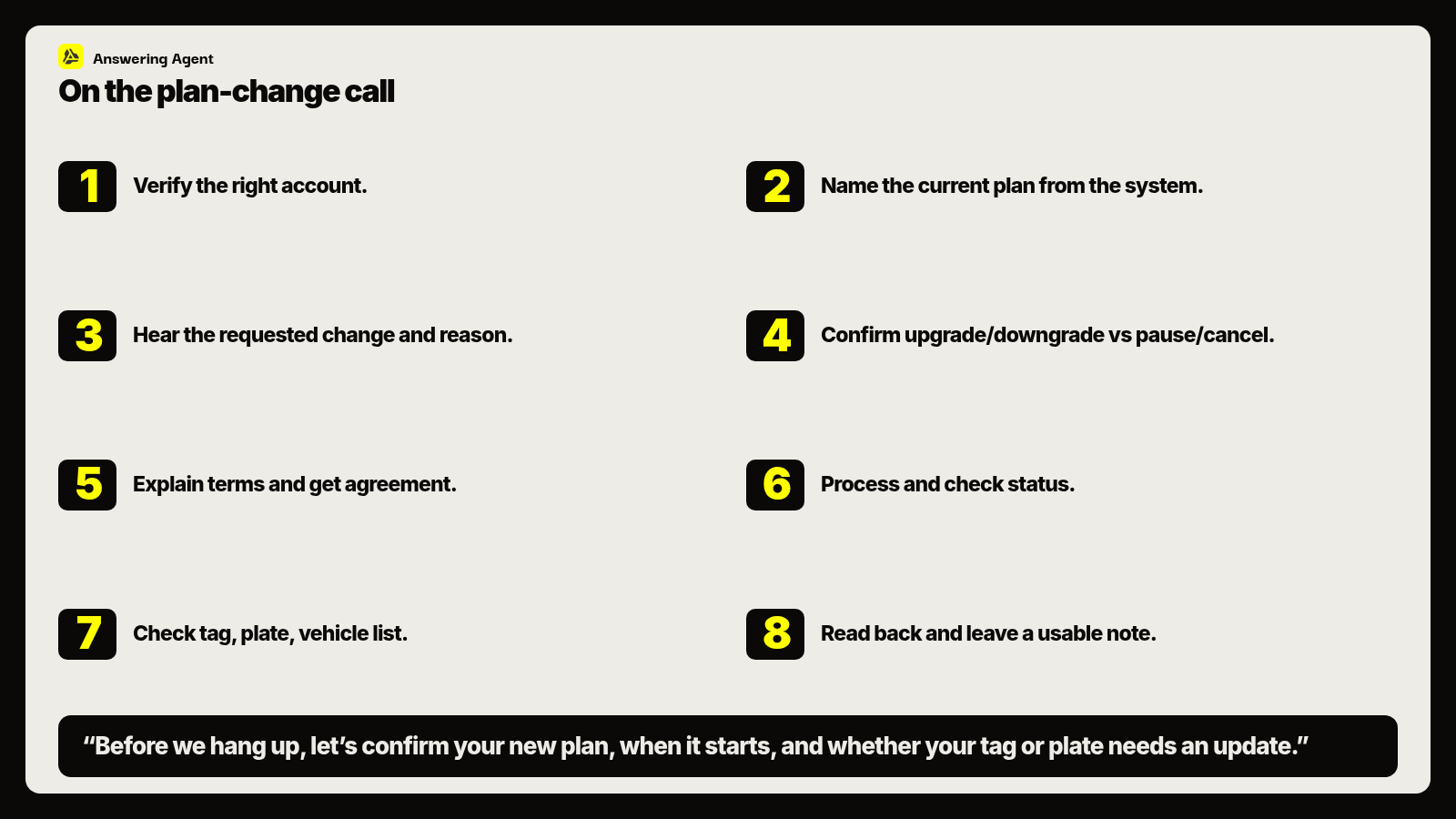
"Before we hang up, let's confirm your new plan, when it starts, and whether your tag or plate needs an update."
What needs a separate check before hanging up?
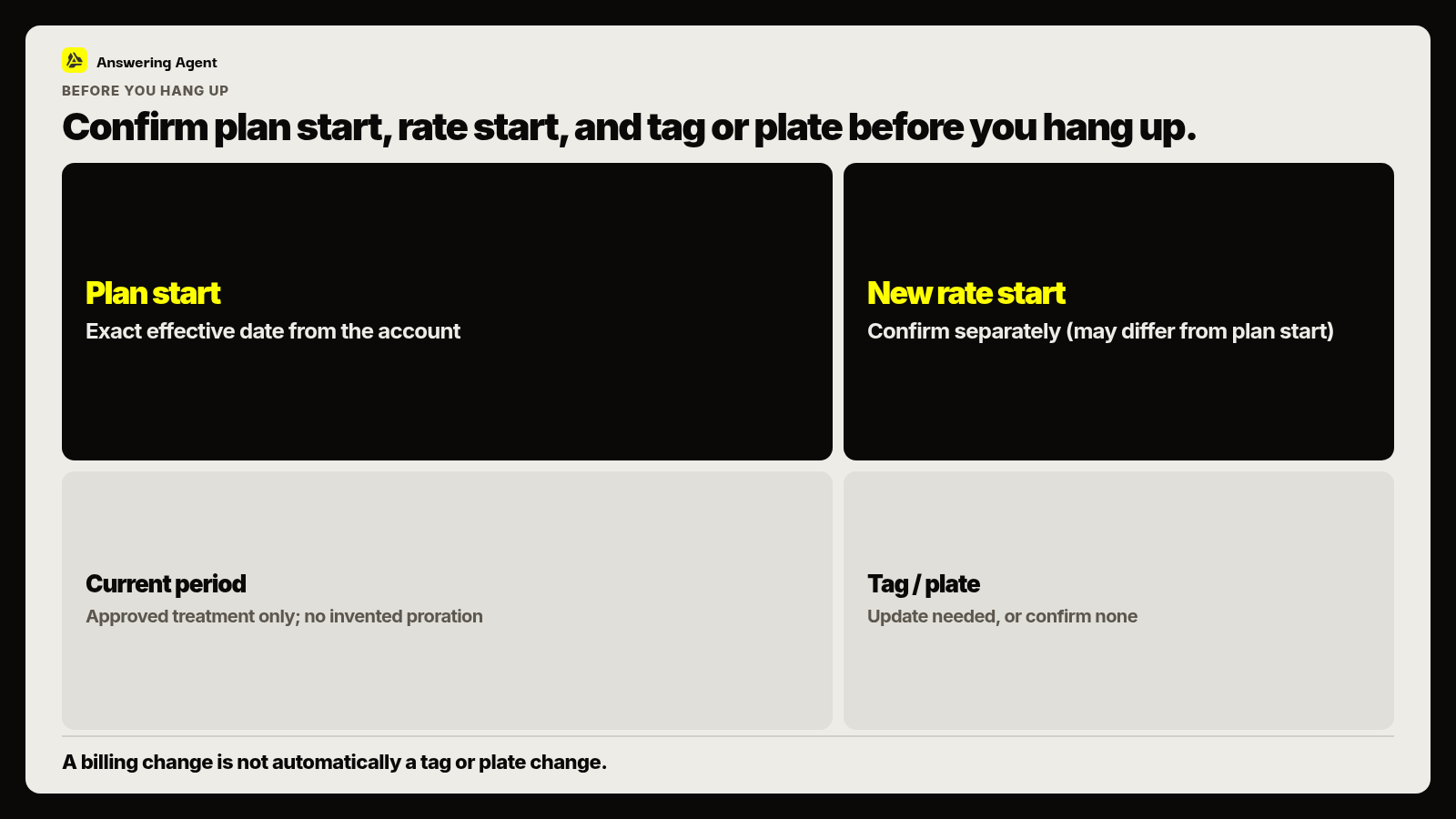
Check the plan start, new rate start, current billing period, and tag or plate requirements separately. One confirmed date doesn't settle every detail. The readback should tell the member and the tunnel desk what is effective now, what is scheduled, and whether anyone still needs to take action.
Use the exact plan name and approved effective date. "Next time" or "next month" leaves room for confusion when the account provides a specific date. Say whether the plan is active, scheduled, or awaiting action.
Check the new rate start against approved account information. Don't assume it matches either the call date or the plan's effective date. State it explicitly, even when the dates are the same.
For the current billing period, explain what happens to the period already underway. Don't calculate an adjustment from memory or borrow another wash's policy. Any unresolved billing-period question needs an authorized answer before you make a promise.
Confirm whether the tag, plate, or vehicle list needs an update. If the desk has a task, tell the member what remains and record who is responsible. When no update is required, include that in the readback too.
What belongs in a useful desk note?
A useful desk note records the verified account and the member's requested change, along with the approved outcome and any unfinished work. Put it in the approved account system. The next shift should be able to understand the membership's status without reconstructing the conversation or guessing who needs to act.
I use a repeatable layout so the details are easy to find:
- Record that required verification was completed without copying unnecessary sensitive information.
- Include the exact current plan name shown on the account.
- Name the requested approved plan and specify upgrade or downgrade.
- Add a brief member-stated reason when relevant.
- Record the plan effective date and new rate start date.
- Describe the current-period treatment explained under the wash's approved rules.
- Note any required tag, plate, or vehicle list update, or that none is needed.
- State whether the change is completed, scheduled, or pending.
- Identify the team responsible for the next action and the expectation given to the member.
"Member changed plan" leaves the next person without the details. "Manager will handle" also needs an explanation of what requires approval.
Keep judgment out of the note. "Requested lower tier" helps someone understand the request. A complaint about the member's attitude won't help the tunnel desk confirm the membership.
What should I check before buying after-hours phone coverage?
For after-hours plan-change coverage, check whether the phone workflow follows the wash's approved rules and distinguishes a completed change from intake awaiting review. Ask what the member will be told and what the desk will receive. Establish who resolves exceptions before approving the workflow for use.
Answering Agent has been in the space for two years. The agent picks up and responds in about a second and a half. About two out of three calls are handled start to finish without needing a human.
Bring this upgrade and downgrade checklist to a review of Answering Agent for car washes. Check the phone answering features against the wash's permissions, plan rules, and handoff requirements. Review pricing against the coverage being considered.
Before approving a workflow, ask it to handle an unclear effective date and a change requiring desk action. Check whether the response follows the wash's rules and identifies what remains unresolved. Read the resulting note, too: the next shift needs enough information to finish the work and honor the expectation given to the member.
FAQ
What should a membership upgrade or downgrade call accomplish?
The call should end with a verified account, an agreed available plan, and a clear explanation of the outcome. Confirm when the plan takes effect, when the new rate starts, and how the current billing period is treated. Check whether the tag, plate, or vehicle list needs updating, then document anything that remains pending.
How should staff handle a member who wants a lower-cost plan?
Explain the available lower-plan option using approved rates and service information, then ask whether its included services meet the member's needs. A request to spend less does not authorize staff to choose a tier for the member. Respect the requested downgrade without turning it into a sales argument. If the member instead wants a pause or cancellation, follow that separate process.
What must be verified before changing a membership tier?
Follow the wash's approved identity-verification procedure and match the member to the correct account and relevant vehicle record. Read the current plan name from the account and confirm that it is the membership the caller wants to change. A familiar name in the POS does not establish authorization. If verification is incomplete, leave the account unchanged and use the approved handoff.
When should the new plan and rate take effect?
Use the wash's approved account information to confirm each date separately. The plan's effective date and the new rate's start date should not be assumed to match each other or the call date. Explain the current billing period's treatment before processing the change. If timing, proration, or refund rules are unclear, seek an authorized answer rather than promising an adjustment.
What should staff record after a plan-change call?
Record completed verification without unnecessary sensitive information, the exact current and requested plan names, and whether the request is an upgrade or downgrade. Include the effective date, new rate start, and approved current-period treatment. Note any tag, plate, or vehicle work, whether the change is completed, scheduled, or pending, and who handles the next action. The note should match the member's readback.
What should a wash check before buying after-hours plan-change coverage?
Check whether the workflow follows approved plan rules and permissions, distinguishes completed changes from requests awaiting review, and explains unresolved work clearly. Test an unclear effective date and a change requiring desk action. Review what the member hears and what the next shift receives, including who handles exceptions. Compare features and pricing with the coverage being considered.
Book a walkthrough
See it handle your calls.
Book 20 minutes, or hear a sample call first.
Ready to see it handle your calls?
Book a walkthrough, or hear a short sample call first.
Related Articles

How to Handle Pickleball Membership Cancellation Calls
How pickleball club desks handle membership cancellation calls without inventing policy or fighting the member.

How to Handle Failed Payment Calls on a Car Wash Membership
How wash desks handle failed payment and card-update calls on a membership without turning the call into a gate lockout.

Car Wash Membership Phone Calls: A Desk Guide
A desk guide to the membership phone calls car washes take, with links to the deep how-tos.