How AI Handles High-Volume Appointment Calls
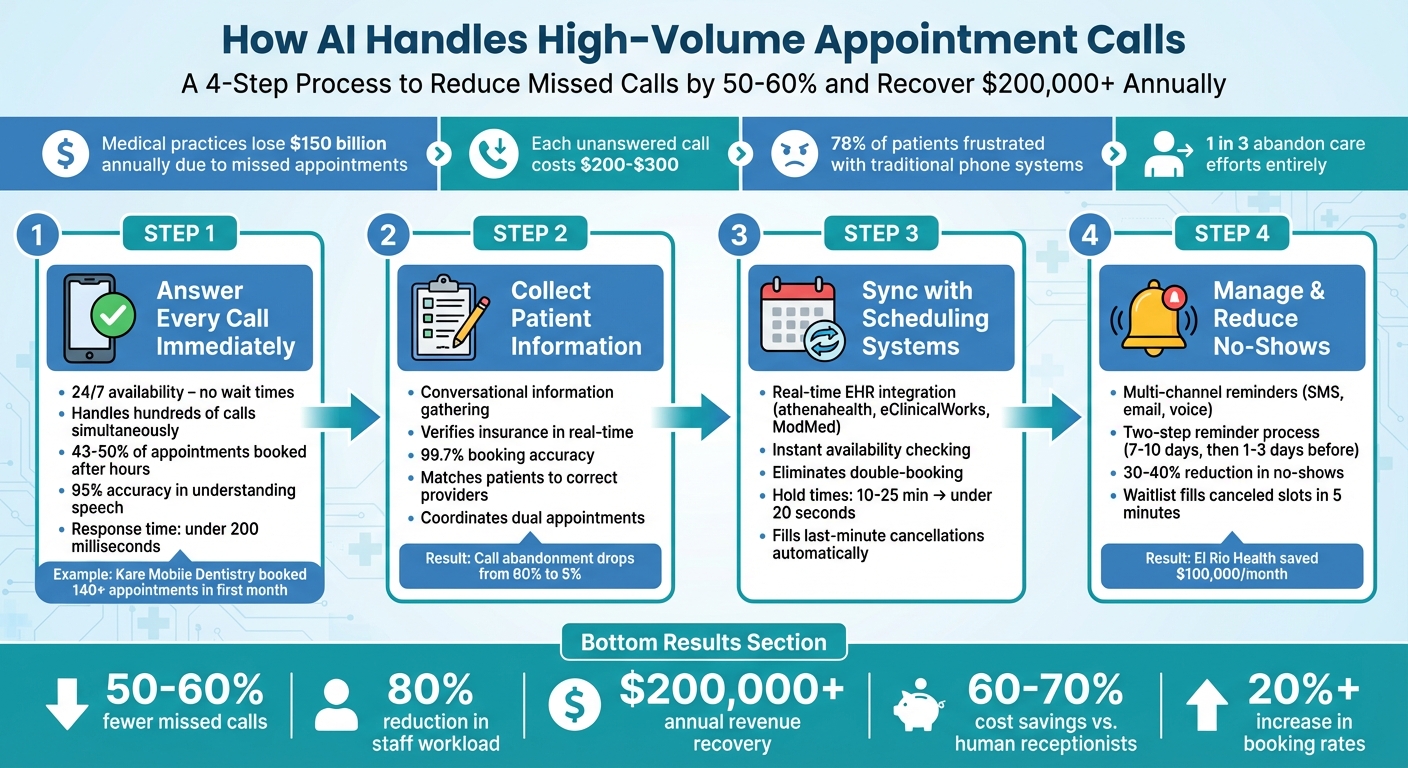
Medical practices lose up to $150 billion annually due to missed appointments, with each unanswered call costing between $200 and $300. Traditional phone systems often fail to handle high call volumes, leaving 78% of patients frustrated and 1 in 3 abandoning care efforts entirely. AI-powered systems like Answering Agent solve this by:
- Answering calls instantly, 24/7, without wait times.
- Scheduling appointments directly into calendars with 99.7% accuracy.
- Reducing missed calls, no-shows, and staff workload by up to 80%.
- Sending automated reminders and filling canceled slots in minutes.
Practices using AI report 50-60% fewer missed calls, improves appointment scheduling, and $200,000+ annual revenue recovery. AI reshapes patient care and practice efficiency, offering a reliable, cost-effective solution to overwhelmed phone systems.
4-Step AI Appointment Handling Process for Medical Practices
Step 1: Answer Every Call Immediately with AI
24/7 Availability and Instant Response
AI systems have tackled one of the biggest challenges in medical practices: limited phone capacity. Unlike a human receptionist who can only handle one call at a time, AI platforms like Answering Agent can juggle hundreds - or even thousands - of calls simultaneously. This means no more busy signals, no endless hold music, and no frustrated patients waiting for someone to pick up.
Here’s a key stat: 43%–50% of appointments are booked after hours, times when most offices are closed and calls would typically go to voicemail. Every missed call isn’t just an inconvenience - it’s about $200 to $300 in lost revenue per call. AI systems, however, answer immediately, 24/7, without requiring shift changes or expensive on-site hardware. With a cloud-based setup, these systems stay operational around the clock, ensuring no appointment opportunities are missed.
Take Kare Mobile Dentistry, for example. By using the Arini AI platform, they booked over 140 new patient appointments in just their first month. This kind of instant response doesn’t just improve efficiency - it also creates a better experience for patients.
Creating Natural, Human-Like Conversations
These AI systems are more than just robotic menus. Thanks to Natural Language Processing (NLP), they can understand conversational speech, regional accents, and even medical jargon with about 95% accuracy. Sentiment analysis adds another layer, detecting urgency or frustration in a caller’s tone with 88% accuracy. And it’s not just about understanding - advanced speech synthesis ensures responses sound natural, with realistic pauses and pacing, all while responding in under 200 milliseconds.
"Zo understands different accents, dialects, and speech patterns, making conversations feel natural and effortless." – Zocdoc
The system is smart enough to spot keywords like "emergency" or recognize distress, escalating the call to human staff when needed. For routine tasks like scheduling, it handles everything autonomously. Practices can even tweak the AI’s voice, tone, and speed to align with their branding. And for those who prefer speaking to a person, saying "agent" instantly connects them to human support.
Step 2: Collect and Manage Patient Information
Gathering Appointment Details
Once a call is answered, the AI gets to work collecting key patient information. Whether someone says, "I think I broke my finger", or "my son hurt his hand", the system immediately identifies the need for orthopedic care and gathers the required details seamlessly. Instead of using rigid menus, it interacts in a conversational way, making it easier to handle multiple calls at once without sacrificing quality.
Medical practices can tailor the type of information the AI collects. This includes details like appointment type, preferred provider, location, and contact information. For example, if a patient asks to see Dr. Smith at the downtown office, the system matches this request to the correct provider and clinic in the database. It’s also smart enough to coordinate dual appointments, such as scheduling an annual exam alongside a mammogram.
Thanks to real-time API integration, the AI can verify insurance details and provider availability immediately. This eliminates the need for follow-up calls to confirm information or resolve scheduling conflicts. By capturing all the details upfront, the system ensures everything is accurate, even during the busiest times.
Maintaining Accuracy During Peak Call Times
When call volumes spike, the AI keeps things running smoothly by sticking to a standardized process. Unlike human receptionists who might get overwhelmed, AI systems maintain consistency, achieving up to 99.7% booking accuracy.
One practice saw dramatic results with this approach. Their AI system slashed call abandonment rates from 60% to just 5%, and hold times dropped from 10–25 minutes to under 20 seconds.
To maintain this level of accuracy, the AI uses confidence scoring. If it’s unsure about any detail, it asks for clarification or escalates the call to a human with a full summary of the conversation. Integration with Electronic Health Records (EHR) further reduces errors by eliminating the need for manual data entry. These combined efforts not only reduce call abandonment but also improve the patient experience, proving how AI can handle appointment scheduling efficiently, even during peak times.
Step 3: Connect with Scheduling Systems in Real Time
Syncing with Practice Calendars
Once patient details are handled, the next step is syncing appointment scheduling with your practice's systems. Using real-time data, the AI directly updates appointments in your EHR system - whether that's athenahealth, eClinicalWorks, ModMed, or another trusted platform.
The system relies on standards-based APIs like FHIR and secure credentials to access and update schedules. When a patient calls, the AI instantly reviews provider availability and applies your practice's specific rules. These include visit types, provider preferences, buffer times, and eligibility requirements. This setup helps optimize scheduling by filling last-minute cancellations and making those slots available to callers.
"If your EHR should remain the source of truth... Think of your EHR as the kitchen, if orders are called out somewhere else, meals get lost. Keep the orders in the kitchen." - Solum Health
This integration sets the stage for the next step: recommending the best appointment times.
Suggesting and Confirming Appointment Times
With access to real-time calendar data, the AI suggests appointment slots that align with the patient’s needs and your practice's schedule. Once a match is found, the AI confirms the appointment and logs it directly into your EHR. This process eliminates common scheduling problems like double-booking and ensures appointments are immediately visible on the provider's calendar.
At Women's Health Connecticut, integrating directly with athenahealth produced dramatic results. Hold times dropped from 10–25 minutes to under 20 seconds, and call abandonment rates plummeted from 50–60% to just 5%. Their practice manager shared:
"90% of self-scheduled patients make mistakes. But the EliseAI appointments? They're all perfect."
Step 4: Manage Appointments and Reduce No-Shows
Automated Confirmations and Reminders
Once an appointment is scheduled, AI takes over to ensure patients stay on track. It sends reminders and confirmations through multiple channels - like SMS, email, and voice calls - making sure the message gets delivered. The system uses a two-step reminder process: an initial notification 7–10 days before the appointment, giving patients time to reschedule if necessary, followed by a final confirmation 1–3 days before the visit.
What makes this system stand out is its two-way communication. Patients can reply to confirm or reschedule, and AI instantly updates the electronic health record (EHR). If a patient doesn’t respond to an SMS, the system automatically follows up with a voice call.
The results speak for themselves. For example, El Rio Health in Arizona saw a 32% drop in no-show rates after introducing AI-driven reminders, which boosted their monthly revenue by approximately $100,000. Similarly, the Family Health Center of San Diego reduced pediatric no-shows by 29% within six months. On average, practices using automated reminders report 30% to 40% fewer missed appointments. Considering each no-show costs a practice $200 to $300, these savings quickly add up.
"About 90% of U.S. patients are happy to receive automated communications from their providers." - The Prosper Team
AI doesn’t just help patients confirm or reschedule; it also ensures empty slots are filled efficiently, turning potential revenue losses into secured income.
Waitlist Management and Rescheduling
When a patient cancels, AI steps in to make sure that time isn’t wasted. Within five minutes, the system reaches out to patients on the waitlist via text or call to offer the newly available slot. Patients receive a message with a direct link, allowing them to claim the spot with a single tap, streamlining the process.
This approach has delivered impressive results. One practice reported a 54% call deflection rate and cut its no-show rate in half by quickly filling canceled slots. Another saw its no-show rate drop from 15.2% to 6.5% in just one year, creating over 145,000 additional appointments and saving $10.8 million. Additionally, a medical group used AI to predict which patients were most likely to miss their appointments. By strategically double-booking those high-risk slots, they added 168 patient encounters per week - an annual total of 7,800 appointments - resulting in $1.4 million in net revenue.
AI also handles same-day follow-ups. If a patient misses their appointment, the system reaches out within hours to offer a chance to reschedule right away. This proactive approach keeps patients engaged and recovers revenue that might have been lost.
sbb-itb-abfc69c
Human-Like AI Voice Agent: Demo Tour of Medical Appointment Scheduling
Benefits of Using Answering Agent for Medical Practices
AI-powered answering systems can transform how medical practices handle calls, delivering both operational and financial advantages.
Cost Savings and Scalability
Switching to an AI answering service can dramatically cut front-desk costs. A human receptionist typically costs between $50,000 and $60,000 annually when you consider salary, benefits, taxes, and training. In contrast, AI receptionist services range from $100 to $1,500 per month - adding up to $1,200 to $18,000 per year. That’s a potential 60% to 70% reduction in expenses.
For example, in March 2025, Metropolitan Multispecialty Group reported a 43% drop in administrative labor costs just six months after adopting an AI receptionist. Traditional answering services, which charge $0.85 to $1.50 per minute, often cost between $800 and $3,000 monthly. Meanwhile, Answering Agent offers a fixed monthly rate, handling unlimited simultaneous calls - making it particularly cost-effective during high-demand periods.
Better Patient Experience and Staff Productivity
Patients today expect quick responses - 67% say they’ll switch providers if their call isn’t answered. AI-powered systems ensure every call is answered on the first ring, even during off-hours, creating a reliable, frustration-free experience that builds patient loyalty.
Take Clinique Mutualiste de Bretagne Occidentale as an example. In March 2024, they introduced the AI agent "Donna" to manage anesthesia consultation calls. Within a short time, the system achieved a 100% pickup rate and a 78% call-handling success rate, freeing up 2.5 hours of staff time daily.
"Sully handles the volume while my team handles the relationships. We finally have enough capacity without actually hiring anyone." – Office Manager, Medical Practice
AI systems also use natural language processing, allowing patients to speak naturally instead of navigating complex menus. These systems can verify insurance, answer routine questions, and schedule appointments without putting anyone on hold. This frees up your staff to focus on providing care and addressing more intricate tasks.
Converting Missed Calls into Revenue
Beyond improving patient satisfaction, AI systems can directly impact your bottom line by recovering lost opportunities.
On average, medical practices miss 42% of incoming calls during business hours. Each missed call represents a potential revenue loss of $200 to $300, adding up to $200,000 to $500,000 annually. Answering Agent solves this by capturing every call, 24/7. With 43% of self-scheduled appointments happening after regular business hours, it’s crucial to be available when patients are ready to book.
In 2025, Dr. Jansen's practice saved over 30 hours per week on administrative phone tasks thanks to AI automation. Another practice saw a 47% jump in digitally booked appointments after implementing AI. By ensuring no call goes unanswered and streamlining scheduling, Answering Agent helps turn your phone system into a powerful revenue driver.
Conclusion
Handling high call volumes no longer means hiring extra staff or leaving patients frustrated. Thanks to AI phone scheduling systems, the entire appointment scheduling process now operates in real time. This technology eliminates bottlenecks for busy practices, ensuring every call is answered immediately while cutting staff workloads by as much as 80%.
The financial impact is just as impressive. Practices using AI scheduling solutions report reduced hold times and a 20% or higher increase in booking rates [48, 51]. With each missed call potentially costing $200 to $300 in lost revenue [4, 5], capturing those calls translates directly into growth.
Answering Agent turns your phone system into a tool for revenue generation. It provides 24/7 availability, natural-sounding conversations, and seamless calendar integration, guaranteeing no patient call goes unanswered - even during the busiest hours or after office hours. This system handles unlimited calls simultaneously, all for a predictable monthly cost.
By automating routine tasks like scheduling, confirmations, and FAQs, AI gives your staff the freedom to focus entirely on patient care. As a practice manager from Women's Health Connecticut shared:
"My staff is able to concentrate on patients in the office rather than juggling calls. They don't have to worry about picking up the phone because Elise is already answering".
FAQs
How does AI enhance the patient experience during busy call times?
AI transforms the patient experience during high call volumes by offering quick, dependable, and round-the-clock support, cutting down on long wait times and frustration. With the ability to handle an unlimited number of calls simultaneously, AI ensures that no patient gets stuck waiting or redirected to voicemail. Patients can effortlessly book appointments, find answers to frequently asked questions, or access crucial information - all without needing to rely on a human representative.
On top of that, AI takes care of routine tasks like sending appointment reminders and managing follow-ups, reducing the chances of errors and simplifying workflows. This approach not only makes things more convenient for patients but also lightens the load for staff, helping medical practices run more smoothly while ensuring every patient enjoys a hassle-free experience.
How can AI help medical practices save money on appointment scheduling?
AI-powered appointment scheduling can be a game-changer for medical practices, especially when it comes to cutting costs. By automating tasks that staff traditionally handle - like managing high call volumes, booking appointments, sending reminders, and handling cancellations - these systems eliminate the need for hiring extra employees. This means practices can save on salaries, benefits, and training expenses.
Another major advantage is the reduction of errors. AI systems help avoid issues like double bookings, keeping operations smooth and efficient. The result? Time and money saved. In fact, many healthcare providers have reported saving thousands of dollars each month after adopting AI scheduling tools.
But the benefits don’t stop at cost savings. AI also improves patient satisfaction by offering 24/7 availability and fast, hassle-free service. It’s a win-win for both practices and their patients.
How does AI accurately schedule appointments and manage patient information?
AI helps keep scheduling and patient information accurate by using natural language processing (NLP) to interpret requests clearly, cutting down on errors caused by miscommunication. These tools connect directly with calendars and Electronic Medical Record (EMR) systems, offering real-time updates on availability and patient data. This not only prevents double-bookings but also ensures patient records are always current.
On top of that, AI systems verify patient details during interactions, confirm appointment times, and send automated reminders to reduce scheduling errors. They can even adjust schedules on the fly, like filling last-minute cancellations with patients from a waiting list. Together, these features improve efficiency, reliability, and the overall experience for both patients and medical staff.
Related Blog Posts
Related Articles
How AI Enhances Patient Engagement in Telehealth Scheduling
AI scheduling cuts no-shows, shortens wait times, and boosts patient engagement with 24/7 personalized booking, predictive reminders, and waitlist automation.
Call Routing Analytics for Medical Practices
Cut wait times and no-shows with call routing analytics—prioritize urgent calls, boost first-call resolution, and use HIPAA-compliant AI for 24/7 handling.
Multilingual AI Telehealth: ROI for Medical Practices
Multilingual AI telehealth enhances patient care and reduces costs by overcoming language barriers, transforming healthcare practices financially and operationally.