AI scheduling does three jobs for a telehealth program. It predicts which patients will miss and reminds them in the way they respond to. It backfills cancellations from a waitlist in real time. It lets patients book after hours. When it works, you see fewer empty slots, shorter time to appointment, and fewer scheduling calls reaching your staff.
The figures below come from published health system results. Use them to decide where to start. They are not a promise of what you will get.
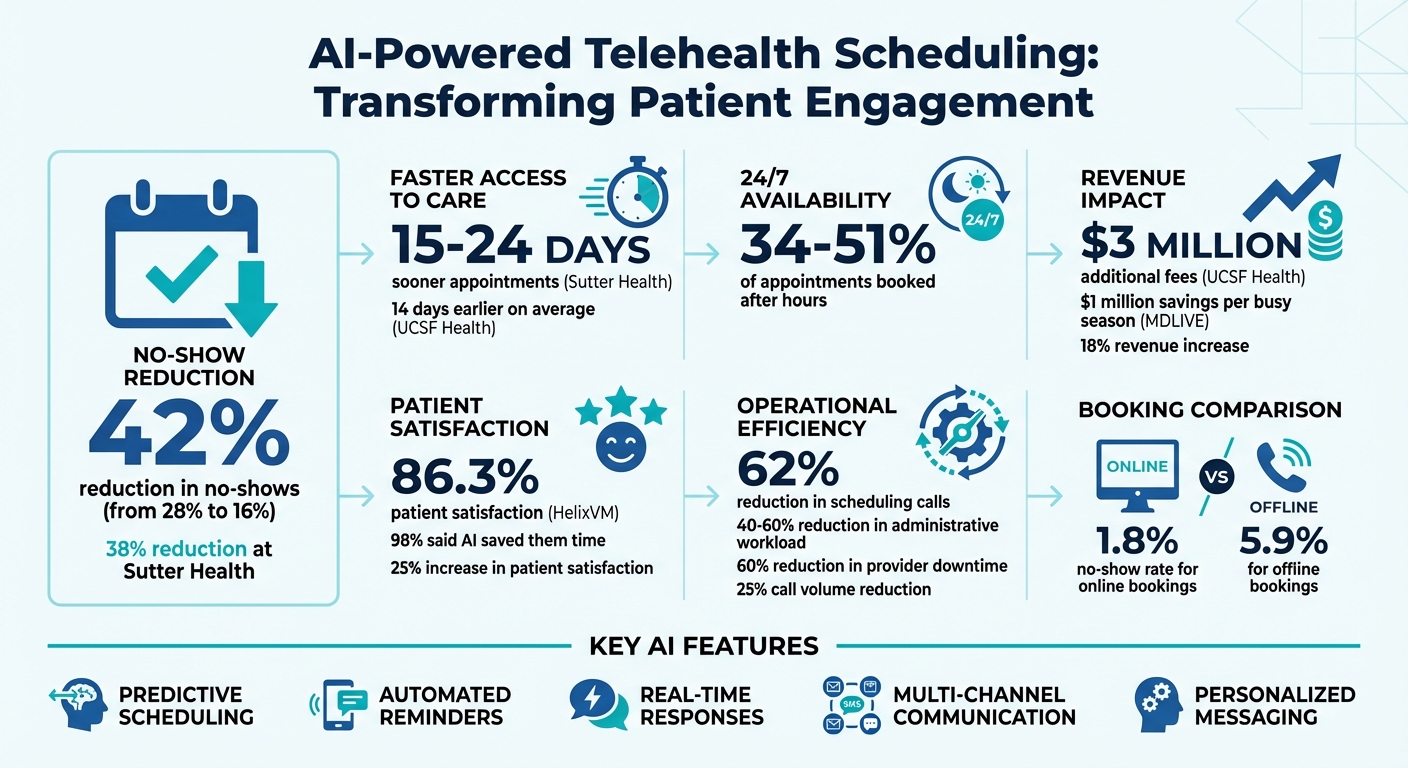
AI Telehealth Scheduling Impact: Key Statistics and Benefits
How AI Improves Patient Engagement in Telehealth Scheduling
Personalized Scheduling Experiences
The system learns each patient's preferred times, channel, and provider. Machine learning flags patients likely to miss and sends them targeted reminders. Track how well those predictions hold up with appointment accuracy metrics. If a patient keeps missing in-person visits, offer telehealth instead, because a video visit needs no ride to the clinic.
The wording of each message matters as much as its timing. One mental health practice raised appointment adherence 34% by replacing generic reminders with empathetic ones. A primary care network raised response rates 47% with tailored messages. Some teams also send "micro-nudges," short medication reminders or health tips between visits.
24/7 Availability and Real-Time Responses
Self-scheduling lets patients book and reschedule while the office is closed. When it is available, 34–51% of bookings happen after hours.
Real-time backfill is where most of the revenue comes from. From June 2022 to March 2023, UCSF Health used Fast Pass to watch schedules for cancellations and text open slots to waitlisted patients. It sent 60,660 offers for 21,978 open slots. That produced 5,399 completed visits, held an average of 14 days earlier than originally booked, and about $3 million in professional fees. Tandem Health reported a $450,000 return within six months of automating its waitlist.
Human-Like Conversations That Build Trust
With natural language processing, voice and chat agents can handle scheduling in plain language and notice when a patient sounds confused or upset. Write the escalation rules before launch. Clinical questions, distressed patients, and anything the agent can't resolve should go to a person.
Multilingual support extends access to patients your front desk can't always serve. AI phone assistants for scheduling take routine booking calls off the desk, so staff can spend that time on the harder cases.
AI-Enabled Tele- and Voice Appointment Booking
Case Studies: AI-Powered Telehealth Scheduling Success Stories
These examples show what AI-driven scheduling changed at each site.
Case Study: Cutting Down Appointment No-Shows with AI
Between 2023 and 2024, eight multi-specialty clinics were running a 28% no-show rate that cost about $180,000 a month. They deployed a predictive scheduling agent that identified likely no-shows with 89% accuracy. It sent SMS, email, or voice reminders based on each patient's preferred channel.
Within three months, the no-show rate fell from 28% to 16%, a 42% reduction. Provider downtime dropped 60% and revenue rose 18%. The system also overbooked high-risk slots and protected slots for reliable patients, which lifted schedule utilization 25%.
Jefferson Healthcare adopted Artera's communication platform in June 2022. The platform flags cancellations as they happen and offers the open slots to waitlisted patients. Rachel Barbieto, Business Applications Analyst at Jefferson Healthcare:
"What would have been a possible no-show – We're able to see that cancellation immediately and try and refill that spot. We're able to utilize provider schedules more efficiently now."
No-shows at their largest primary care clinic fell 40%, and overall call volume dropped 25%.
Case Study: MDLIVE & CIGNA's AI Scheduling Solution
MDLIVE, working with CIGNA, needed to absorb about 40,000 extra patients a month during peak seasons without overloading telehealth staff. They deployed the AIDAN AI Control Tower on Azure Machine Learning to forecast demand and match patients to available providers in real time. Wait times fell by more than half. Keith Bergquist, Chief Operations Officer at MDLIVE for CIGNA:
"We're saving about $1 million each busy season with our Azure Machine Learning models."
Research Findings: AI Features and Patient Engagement
What Research Shows About AI Features
Studies of AI scheduling tools keep landing on the same practical details:
- SMS gets better responses than email, especially when the message offers an earlier slot.
- SMS sent between 6:00 PM and 8:30 PM gets more acceptances than morning email.
- Patients with acute conditions take offered slots more often than patients with chronic conditions.
- At scale, Sutter Health's Fast Pass sent 177,311 appointment offers.
- HelixVM's AI symptom questionnaire routes patients to either asynchronous "FastTrack Rx" prescriptions or a video visit.
Comparison Table: AI Features in Patient Engagement Studies
| Study/Source | AI Feature | Engagement Metric Improved | Outcomes |
|---|---|---|---|
| Sutter Health | Fast Pass (Automated Rescheduling) | No-Show Rate | 38% reduction in no-shows; wait times cut by 15–24 days |
| UCSF Health | EHR-Integrated Self-Rescheduling | Wait Time & Revenue | Median wait time reduced by 14 days; $3M in additional fees captured |
| HelixVM | AI Triage & Asynchronous Rx | Patient Satisfaction | 86.3% satisfaction; 98% agreed it saved time |
| JMIR Scoping Review | Automated Self-Scheduling | After-Hours Access | 34–51% of bookings made outside office hours |
| Betancor et al. | Online Appointment Scheduling | No-Show Rate | 1.8% no-show rate for online bookings vs. 5.9% for offline bookings |
Conclusion: AI-Powered Scheduling and Patient Engagement
What Service Business Operators Should Know
- Start with the clinics or providers that have the highest no-show rates or longest waits.
- Measure no-shows, time to appointment, and scheduling call volume before and after launch.
- Default to SMS, and test evening send times.
- Scale to other sites only after the pilot numbers move.
Bring your longest-tenured schedulers in early. Dr. Jonathan Teich calls this the "Mabel" factor:
"Before you can successfully implement self-scheduling, you have to implement 'Mabel.' Mabel is the generic scheduling administrator who has been working for Dr. Smith for 35 years, and knows a thousand nuances and idiosyncrasies and preferences... it's extremely difficult to find out what Mabel really knows, let alone try and put it into an algorithm".
Before launch, write down the booking rules those schedulers carry in their heads. Leave room for provider-specific preferences.
Long-Term Benefits of AI in Healthcare
Automating routine booking reduces repetitive work for staff and gives them more time for complex patient needs. Self-scheduling also helps patients who work nonstandard hours. It does not reach everyone. Older adults and non-English speakers may need phone or in-person support to use it.
If you want calls answered and appointments booked by voice, Answering Agent handles that.
FAQs
How can AI help reduce missed appointments in telehealth scheduling?
Predictive models flag patients likely to miss, so staff can send them tailored reminders or offer rescheduling early. Automated SMS or voice reminders go out a few days before the visit and again 24 hours ahead, and each one asks the patient to confirm or reschedule.
How does 24/7 AI-powered scheduling benefit patients in telehealth?
Patients can book, reschedule, or cancel without waiting for office hours. When self-scheduling is available, 34–51% of bookings happen after hours. Cancellations made at night can also be backfilled from the waitlist before morning.
How does AI make telehealth scheduling more personalized for patients?
It learns each patient's preferred times, channel, and provider, then shapes reminders around them. It can also suggest telehealth to patients who often miss in-person visits.
Related Blog Posts
Book a walkthrough
See it handle your calls.
Book 20 minutes, or hear a sample call first.