Medical NLP has to map many surface forms to a single concept, in whatever language the patient or clinician used. "Paracetamol" and "acetaminophen" are the same drug. "Neoplasm" and "tumor" are the same finding. "Infarto de miocardio," "infarctus du myocarde," and "heart attack" are the same event. Abbreviations like "PCR" change meaning with context.
False cognates make mistakes costly. Spanish intoxicado points to poisoning, not drunkenness. Data is the main constraint. English makes up about 42% of medical training data and Russian about 7%. Non-English clinical datasets are scarce and expensive to annotate, and terminology keeps moving, so resources like SNOMED CT need constant updates. Four techniques close most of the gap:
| Problem | Technique | What it does |
|---|---|---|
| Tokenizers split medical words at meaningless points | Morpheme-enriched tokenization | Splits at Greek and Latin roots, such as céphal- for "head" |
| General models miss domain terms | Medical fine-tuned multilingual models | MMed-Llama 3 beats its base model on multilingual medical tasks |
| Same concept, different words per language | Knowledge bases (UMLS, SNOMED CT) | Link every variant to one concept ID |
| Little annotated data outside English | Translation pipelines | Route text through English tools, then map results back |
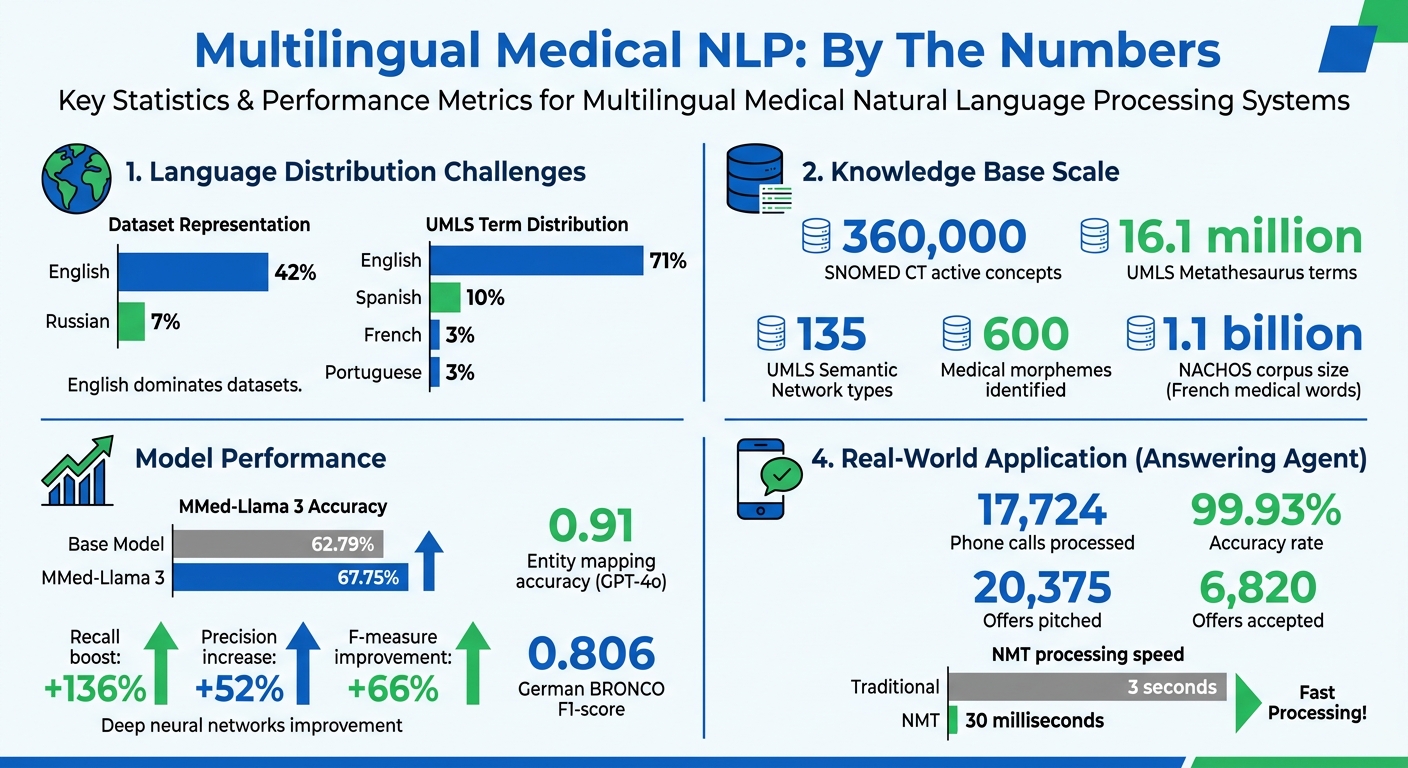
Multilingual Medical NLP: Key Statistics and Performance Metrics
Introduction to Healthcare NLP/LLMs
Core NLP Techniques for Medical Terminology
Tokenization and Lemmatization for Medical Terms
Standard tokenizers such as Byte-Pair Encoding and SentencePiece split words by frequency, not meaning. A term like "cephalalgia" can end up in fragments that ignore its roots.
"Despite the agglutinative nature of biomedical terminology, existing language models do not explicitly incorporate this knowledge, leading to inconsistent tokenization strategies for common terms." - Yanis Labrak et al.
Morpheme-enriched tokenization fixes this with a predefined list of roots and affixes. Researchers identified about 600 common medical morphemes, including céphal- ("head") and -algie ("pain"), to guide the splits. Work on the NACHOS corpus, which holds 1.1 billion French medical words, shows domain-specific training tokenizes more accurately than general-purpose approaches.
Normalization comes next. Tools like xMEN map different forms of a term to one UMLS concept ID. They generate candidates from English aliases, which lets them normalize entities in languages with little labeled data.
Multilingual Models for Medical Texts
General multilingual models stumble on medical terminology until they get domain training. The Multilingual Medical Corpus (MMedC) supplies more than 25.5 billion medical tokens across six languages for that purpose.
Cross-lingual transfer is the usual method. You fine-tune on medical tasks in one language, usually English, and apply the model to other languages without further training. MMed-Llama 3, an 8-billion-parameter model, scored 67.75% on the MMedBench multilingual benchmark. Base Llama 3 scored 62.79%.
Entity linking in these systems typically has two stages:
- Hybrid candidate generation: TF-IDF handles string matches, and SAPBERT, a multilingual biomedical model, handles semantic matches through embeddings.
- Cross-encoder ranking: The model scores the term together with its context. This is how it tells "Paget's disease of the bone" from "Paget's disease of the breast."
Some languages have no labeled medical data at all. For these, teams machine-translate English datasets and project the entity annotations onto the translation. The results are imperfect, but they create training data that did not exist before. That matters for any practice offering 24/7 global coverage to patients who speak many languages.
Using Medical Ontologies and Knowledge Bases
Standardizing Medical Terminology Across Languages
UMLS and SNOMED CT standardize concepts, not words. Each concept gets a Concept Unique Identifier (CUI), and every language's variants link to it.
"The principle of concept-based translation must be applied: Translations should never be literal (i.e. should not start from the term to be translated), but should always be based on the Fully Specified Name (FSN), which describes the meaning of the term in natural language." - SNOMED International
SNOMED CT's international edition has about 360,000 active concepts, and the UMLS Metathesaurus holds more than 16.1 million terms. Coverage is lopsided. English accounts for 71% of UMLS terms, Spanish for 10%, and French and Portuguese for 3% each. Linking through English aliases is the practical workaround for everything else.
The UMLS Semantic Network sorts concepts into 135 semantic types. A system can therefore tag a term as "Disease or Syndrome" whether the input is German, Dutch, or Italian.
Improving NLP Accuracy with Knowledge Integration
In January 2026, Sara Mazzucato and colleagues at EPFL tested GPT-4o on the ShARe/CLEF eHealth corpus for named entity recognition (NER) and biomedical entity linking. They translated the English-annotated corpus into Dutch and Italian with a method that preserves annotations. Accuracy in mapping entities to UMLS CUIs reached 0.91.
"Prompt-based LLMs can effectively perform NER and BEL in languages with less annotated resources, even with limited annotated training data." - Sara Mazzucato, EPFL
A technique called "UMLS injection" feeds knowledge-base synonyms into the model. The model then learns that terms with different spellings from translation or regional usage mean the same thing. Studies of deep neural networks for cross-lingual concept normalization report gains over plain string matching of 136% in recall, 52% in precision, and 66% in F-measure.
Translation and Cross-Lingual NLP Pipelines
Round-trip translation uses English as the hub. You translate non-English clinical text into English, run English medical NLP tools on it, and translate the extracted entities back. It works because English has far more annotated medical resources than any other language.
Machine Translation for Medical Texts
Amazon Web Services offers a reference pipeline. A clinical note lands in Amazon S3 and triggers a Lambda function. Amazon Translate converts the note to English, and Amazon Comprehend Medical extracts medications, dosages, and diagnoses. The entities are then translated back. Results go to Amazon Athena and Amazon QuickSight, and automatic language detection handles mixed-language datasets.
Domain fine-tuning matters more than model size. After fine-tuning on medical bilingual corpora, Marian (7.6 million parameters) outperformed NLLB (1.3 billion+ parameters).
"Extra-large MMPLM does not necessarily win over the small-sized MPLM on clinical domain MT via fine-tuning." - Lifeng Han et al.
Cross-Lingual Entity Detection and Validation
Translation is only half the job. Every extracted term also has to land back in the right place in the source text. Cross-lingual span alignment tracks each term's position in both versions and re-anchors it. On the German BRONCO dataset, this approach reached an F1 of 0.806 for medication entities.
The two techniques covered above handle the rest. Context-aware cross-encoders resolve ambiguous terms, and annotation projection with tools like xMEN supplies training data where none exists.
Answering Agent's Multilingual Medical NLP Capabilities
High-Accuracy NLP for Phone Interactions
On patient calls, the same principles apply in real time. Answering Agent detects the caller's language and follows them if they switch mid-call. It keeps names, symptoms, and appointment details intact, and it recognizes both "hypertension" and "high blood pressure." More detail is in multilingual medical phone interactions.
How Medical Practices Use Answering Agent
Practices use it to book appointments and send confirmations in the patient's language, around the clock. If a call happens in Spanish or French, the internal notes still arrive in English for staff. See the medical case studies for how that plays out.
Conclusion: The Future of Multilingual Medical NLP
The field is moving from English-only models to domain-trained multilingual ones built on corpora like MMedC. Prompt-based methods already deliver accurate clinical NER in Dutch, Italian, and Catalan with little annotated data.
"The development of open-source, multilingual medical language models can benefit a wide, linguistically diverse audience from different regions." - Nature Communications
Most of the gains come from better tokenization, concept-level ontologies, and careful translation pipelines working together. For practices, the payoff is patient access to care that doesn't depend on which language the patient speaks.
FAQs
How do NLP models avoid mistranslating medical false cognates?
They translate by concept, not by word. Context-aware translation reads the surrounding text, controlled terminology limits the allowed outputs, and ontologies like UMLS and SNOMED CT tie each term to a concept ID. Fuzzy matching surfaces candidate terms, and context decides which one is correct.
What’s the best approach for medical NLP in low-resource languages?
Combine two methods. Machine-translate annotated clinical text from a well-resourced language and project the annotations onto the target language. Then use cross-lingual transfer: fine-tune a multilingual model in one language and apply it to others. English aliases from UMLS fill the remaining gaps without heavy manual annotation.
How are medical terms mapped to the same concept across languages?
Knowledge bases assign each concept a unique ID and link every language's variants to it. Multilingual embeddings, such as SAPBERT, place equivalent terms close together so the system can find candidates. A context-aware ranker then picks the right concept.
Related Blog Posts
Book a walkthrough
See it handle your calls.
Book 20 minutes, or hear a sample call first.