Healthcare AI Phone Systems: Cost Breakdown
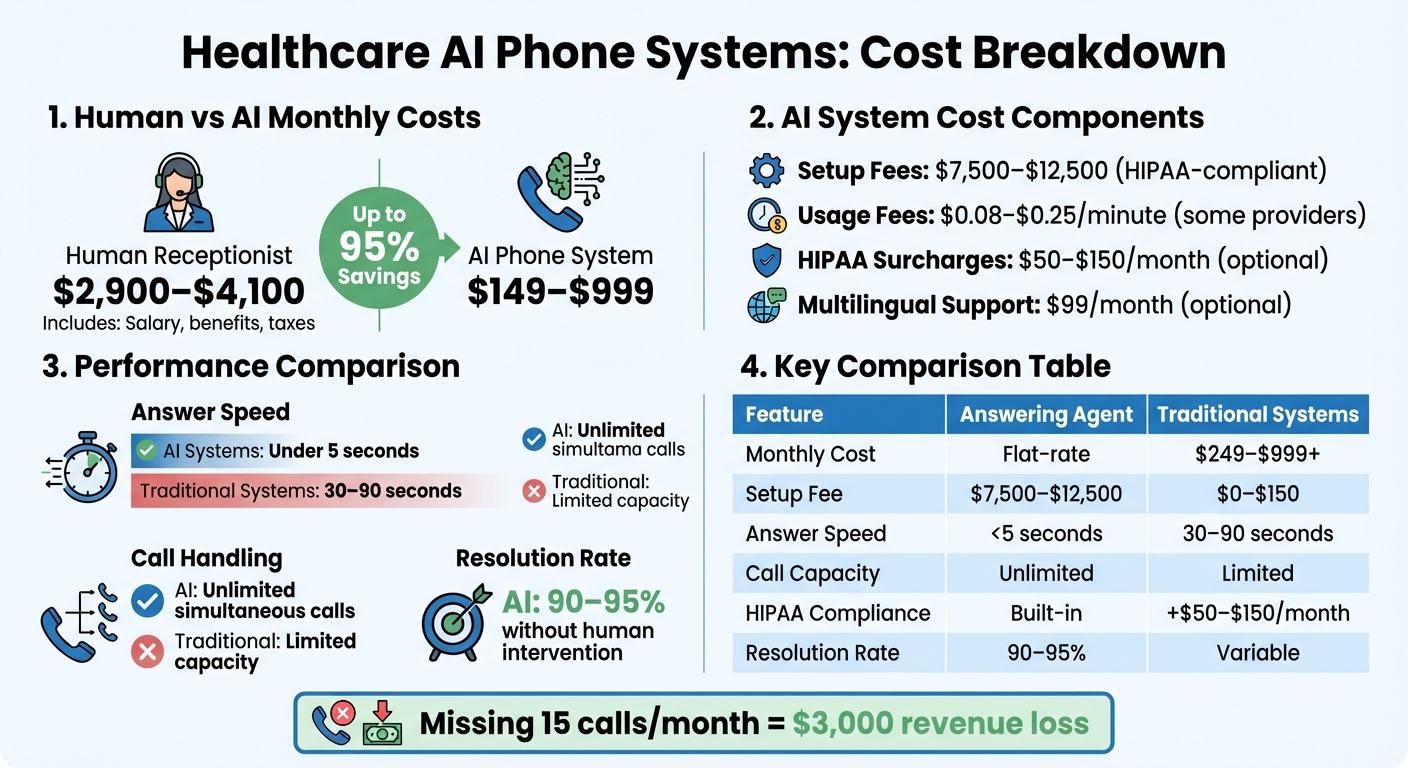
AI phone systems in healthcare are designed to streamline patient communication while significantly reducing costs. These systems handle tasks like appointment scheduling, payment processing, and emergency call routing, all while integrating with EHR systems. Here's the cost breakdown:
- Human Receptionist Costs: $2,900–$4,100/month (salary, benefits, taxes).
- AI Phone System Costs: $149–$999/month, saving up to 95%.
- Setup Fees: $7,500–$12,500 for HIPAA-compliant setups.
- Usage Fees: $0.08–$0.25/minute for some providers.
- Optional Features: HIPAA surcharges ($50–$150/month), multilingual support ($99/month).
Key Benefits:
- AI systems answer calls in under 5 seconds, compared to 30–90 seconds for older systems.
- They manage unlimited calls simultaneously, reducing missed calls and increasing patient retention.
- Resolution rates of 90–95% reduce the need for human intervention.
Best Choice: Flat-rate systems like Answering Agent avoid unpredictable fees, offer HIPAA compliance at no extra cost, and include features like multilingual support and emergency routing, making them ideal for medical practices of all sizes.
AI vs Human Receptionist Cost Comparison for Healthcare Practices
1. Answering Agent

Cost Structure
Answering Agent provides a flat-rate subscription, removing the unpredictability of per-minute charges often seen with other healthcare AI providers, which typically add $0.08–$0.25 per minute on top of base fees. The platform has already processed over 17,724 scored calls with an impressive 99.93% accuracy rate and facilitated 20,375 offers, 6,820 of which were accepted. These results highlight its ability to deliver measurable returns for medical practices.
While many competitors charge hefty implementation fees - ranging from $7,500 to $12,500 - for HIPAA-compliant setups, Answering Agent takes a more accessible approach. Every plan includes HIPAA-aligned infrastructure, such as Business Associate Agreements (BAA) and encrypted audit trails, at no additional cost. This pricing model ensures affordability while offering features tailored specifically for healthcare providers.
Healthcare-Specific Features
Beyond its straightforward pricing, Answering Agent includes tools designed to lower staffing expenses. One standout feature is real-time appointment booking, which reduces the need for additional administrative staff. The platform also offers emergency routing, which identifies critical calls and seamlessly transfers them to on-call medical staff, ensuring urgent needs are addressed immediately.
Another key feature is multilingual support in over 20 languages, removing the necessity for hiring specialized bilingual staff. For practices serving diverse patient populations, this can save $2,500 to $4,000 per month in additional receptionist costs.
Operational Efficiency
The platform enhances efficiency by ensuring effective call management, which reduces the risk of missed patient interactions. It can handle unlimited simultaneous calls, eliminating busy signals and long wait times. Additionally, Answering Agent resolves 90% to 95% of calls without needing human intervention, freeing up staff to focus on patient care. It also captures after-hours appointment requests and manages emergency calls seamlessly. With an exceptionally low hallucination rate of just 0.07%, the system maintains high accuracy, contributing to reduced overhead costs and better patient satisfaction.
sbb-itb-abfc69c
2. Traditional AI Phone Systems
Cost Structure
Traditional AI phone systems in healthcare often rely on tiered subscription models, which can quickly become pricey. Basic plans typically range from $249 to $499 per month, while professional or enterprise-level systems can cost $999 per month or more, depending on the number of users and workflow requirements. Unlike flat-rate options that simplify budgeting, these systems often tack on tiered fees and usage surcharges, making costs unpredictable.
Implementation costs are another factor to consider. Basic setup fees start at $7,500 and can climb to over $12,500 for enterprise-grade setups that include full EHR integration and HIPAA compliance. On top of that, many systems charge per-minute usage fees, which range from $0.08 to $0.25 per minute. Some even round up to the nearest full minute, potentially inflating costs by 20–30% [1,2,12].
Additional features like HIPAA compliance often come with extra monthly charges of $50 to $150, and EHR/CRM integrations may require setup fees of $50 to $300, along with ongoing maintenance fees of $30 to $100 per month [2,12]. These layered costs highlight the need to carefully assess the value of each system's healthcare-specific features.
Healthcare-Specific Features
When it comes to functionality, traditional systems often include AI phone assistants for appointment scheduling but charge extra for advanced features. For example, Hello.ai requires a $2,000 setup fee plus $99 per month for Spanish language support, and an additional $3,000 for custom voice cloning. This means that even seemingly standard features, like multilingual support, can come with hefty price tags.
Integration capabilities also vary. Many systems are compatible with major EHR platforms like Nextech and PatientNow, but the level of integration often depends on the pricing tier. Lower-tier plans might only offer basic calendar syncing, while more advanced features, such as emergency detection or intelligent call routing, are typically reserved for enterprise-level subscriptions [1,4].
Operational Efficiency
The pricing structure of traditional systems often comes at the expense of operational performance. For instance, these systems generally take 30–90 seconds to answer calls, compared to under 5 seconds for modern AI solutions. They also struggle with handling complex inquiries, often requiring human intervention or follow-up calls.
Another challenge is handling multiple calls simultaneously. Many traditional systems limit the number of concurrent calls or impose overage fees when call volumes exceed the plan's limits [2,4]. During busy periods, these restrictions can lead to bottlenecks, resulting in busy signals and delayed responses.
Scalability
Scalability is a frequent pain point for traditional AI phone systems. Volume caps often lead to unpredictable overage fees and higher call abandonment rates, which can reach 30–40% during peak times [2,4].
Additionally, these systems often rely on a sequential call-handling model, where calls are processed one at a time. This approach creates bottlenecks that limit scalability. In contrast, modern systems are designed to handle unlimited simultaneous calls, making them a better fit for growing practices or multi-location healthcare groups. For traditional systems, scaling up often requires costly tier upgrades or adding extra phone lines, further straining budgets.
I Built an AI Receptionist for a Healthcare Practice
Pros and Cons
This section dives into the advantages and drawbacks of using Answering Agent compared to traditional systems, focusing on costs and patient experience.
Answering Agent stands out with its ability to handle over 17,724 calls at a 99.93% accuracy rate. It supports unlimited simultaneous calls, entirely removing busy signals. Plus, its flat-rate pricing means no surprises from overage fees.
On the other hand, traditional systems might seem cheaper at first glance, with setup fees ranging from $0 to $150. However, the per-minute billing structure (typically $0.08 to $0.25 per minute) often includes 60-second rounding, which can inflate costs by 20–30%. Monthly subscriptions can range from $249 to over $999, and HIPAA compliance often adds an extra $50–$150 per month. For healthcare-specific needs, such as full EHR integration, costs can climb to $7,500–$12,500.
Performance-wise, traditional systems take 30–90 seconds to answer calls, with call abandonment rates as high as 30–40%. This can lead to missed appointments and dissatisfied patients. In contrast, Answering Agent responds in under 5 seconds, significantly improving patient retention.
Nishant Bijani, Founder & CTO of Dialora, notes: "AI answering services cost $30–$240 per month with a flat price, delivering 30–70% savings over human services for equal coverage".
Here’s a quick breakdown of the key differences:
| Factor | Answering Agent | Traditional Systems |
|---|---|---|
| Monthly Cost | Flat-rate, predictable pricing | $249–$999+ (tiered, variable) |
| Setup Fee | $7,500–$12,500 | $0–$150 |
| Call Handling | Unlimited simultaneous calls | Limited, with potential fees |
| Answer Speed | Under 5 seconds | 30–90 seconds |
| Resolution Rate | 90–95% without escalation | Variable, often needs follow-up |
| HIPAA Compliance | Built-in with BAA | Extra $50–$150/month |
These comparisons highlight Answering Agent as the better choice for healthcare practices aiming to cut costs while maintaining high-quality service and operational efficiency.
Conclusion
Choosing the right AI phone system depends on your practice's size and call volume. For smaller practices handling fewer than 100 calls a month, flat-rate plans ranging from $150–$300 per month are ideal. These typically include essential features like basic scheduling and HIPAA compliance. Medium-sized practices, on the other hand, might benefit from mid-tier packages priced between $499–$999 per month, which often come with enhanced EHR integration and bilingual support. For large, multi-location practices, enterprise-level solutions may be necessary to handle the complexity of replacing multiple full-time staff.
Missing just 15 calls in a month can lead to significant revenue loss - $3,000, assuming each lead is worth $200. With Answering Agent, this issue is minimized. The system offers unlimited simultaneous call handling, sub-5-second response times, and an impressive 99.93% accuracy rate across more than 17,724 calls. All of this comes with flat-rate pricing, eliminating the risk of per-minute overages or surprise HIPAA fees.
In contrast, AI call routing vs. traditional systems comparisons show that legacy setups often come with hidden costs. While their upfront setup fees may seem appealing, they frequently rely on per-minute billing models. Add in extra charges for HIPAA compliance and EHR integration, and the total cost can quickly spiral beyond the initial estimate.
The benefits of straightforward pricing are clear, as highlighted by this example:
"At $199/month, capturing an additional $3,500 job covers 17 months of service", explains NextPhone.
This comparison underscores the importance of predictable, transparent pricing in choosing the right solution for your practice.
FAQs
What’s the true monthly cost after minutes and add-ons?
The cost of AI phone systems can vary significantly. Monthly fees generally fall between $50 and $300, depending on the provider and the features included. Additionally, setup fees range from $1,500 to over $7,500, covering implementation and extra services. It's important to carefully review what’s included - like features and add-ons - to get a clear picture of the total cost.
When does a flat-rate AI phone system cost less than per-minute billing?
Flat-rate AI phone systems can save you money if you're managing more than 250–300 calls per month. With per-minute charges ranging from $0.07 to $2.00, the costs can add up quickly with higher call volumes. In such cases, flat-rate pricing becomes the more budget-friendly choice.
What should I ask to confirm HIPAA compliance and a BAA?
Ask the provider if they offer HIPAA-compliant services and whether they can provide a Business Associate Agreement (BAA). This helps ensure they follow healthcare privacy regulations and protect sensitive patient information.
Related Blog Posts
See how AI handles calls for your business
Enter your business name and we'll build a personalized AI receptionist demo in under 2 minutes. Talk to it right in your browser.
No signup required · Free to try · Works for any business
Related Articles
AI Call Routing for Multi-Specialty Clinics
Compare top AI call routing platforms for multi-specialty clinics — accuracy, scalability, EHR integration, and cost.
Multilingual AI Telehealth: ROI for Medical Practices
Multilingual AI telehealth enhances patient care and reduces costs by overcoming language barriers, transforming healthcare practices financially and operationally.
AI Phone Systems: HIPAA Compliance FAQs
Explore how AI phone systems in healthcare ensure HIPAA compliance through security measures, training, and business associate agreements.