
AI call routing is transforming how multi-specialty clinics manage high call volumes and diverse patient needs. These systems use Natural Language Processing (NLP) to understand caller intent and direct them to the appropriate department without cumbersome phone menus. By integrating with Electronic Health Records (EHRs), they automate routine tasks like scheduling and prescription refills, saving staff time and reducing errors.
Key findings:
- Time savings: AI reduces staff workload by automating up to 68% of calls.
- Accuracy: Platforms achieve accuracy rates as high as 99.93%, minimizing errors.
- Cost efficiency: Flat-rate or subscription-based models lower expenses compared to live agents.
- Scalability: Handle unlimited calls concurrently, even during peak hours.
Quick Comparison
Platform Scalability Accuracy Customization Cost Structure Best For Answering Agent Unlimited calls 99.93% Medical templates Flat-rate subscription High-volume clinics Sully.ai High (multi-agent) 99.7% Specialized AI agents $79+ per provider/month Clinics needing modular AI Smith.ai Moderate (hybrid model) High Template-based $250–$700/month Clinics requiring human oversight RingCentral AI High Moderate Basic healthcare routing $59/month for 100 minutes Clinics using unified communications Goodcall Low Basic Specialty-specific logic $60–$790/month Small clinics with low call volumes
Answering Agent stands out for its unlimited call capacity, high accuracy, and flat-rate pricing, making it the top choice for multi-specialty clinics managing heavy call traffic. Other platforms like Sully.ai and Smith.ai are better suited for clinics with specific needs, such as modular AI features or hybrid human-AI models.
AI call routing solutions are reshaping clinic operations, offering efficiency, accuracy, and cost savings. For clinics juggling multiple departments and high call volumes, these tools provide a scalable, reliable way to enhance patient communication.
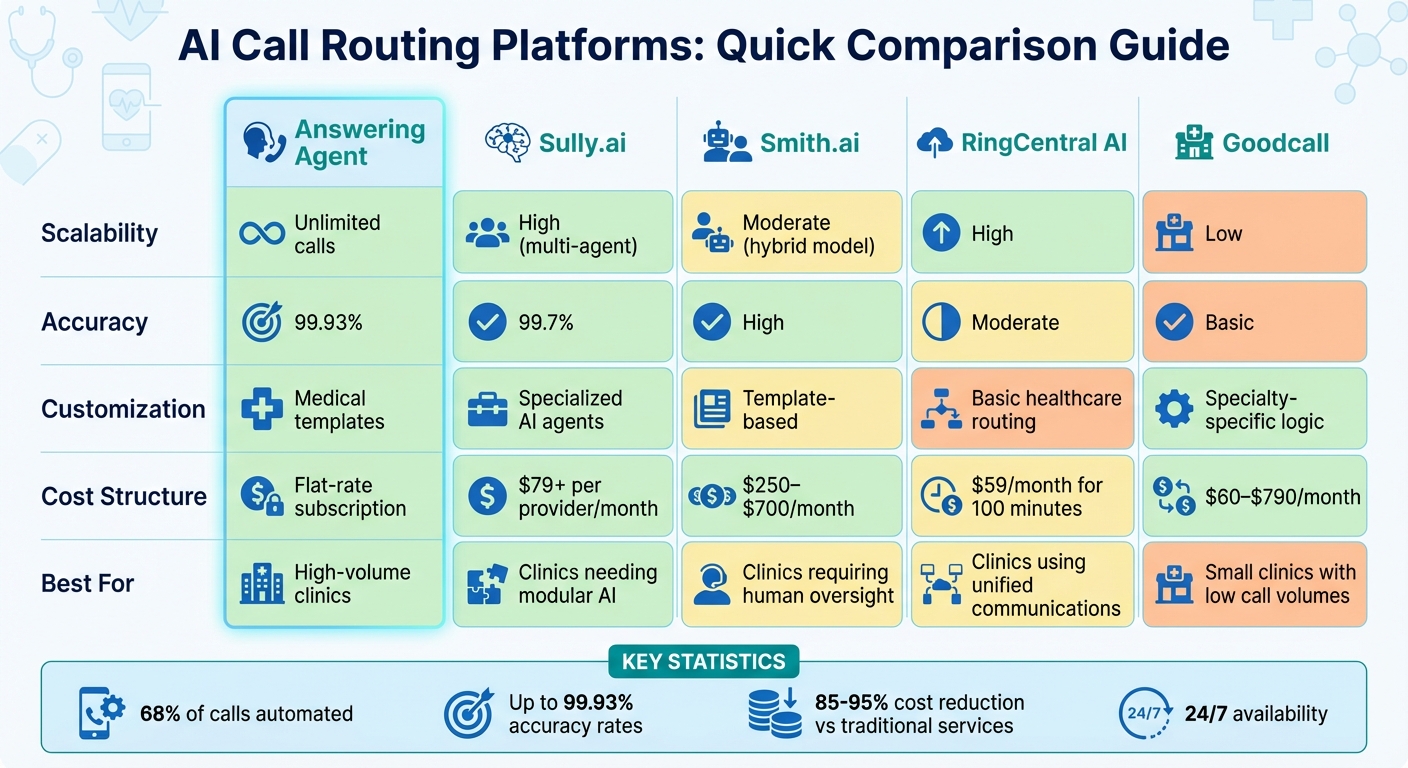
AI Call Routing Platform Comparison for Multi-Specialty Clinics
Route Inbound Calls to 50+ Locations with One AI Voice Agent - Synthflow Phone Book Tutorial
sbb-itb-abfc69c
1. Answering Agent
Answering Agent takes a specialized approach to multi-specialty call routing, tailored specifically for medical practices. Its performance metrics and features set it apart from other AI-based routing systems. With over 17,724 scored calls processed at an impressive 99.93% accuracy rate, it significantly outperforms human-operated services, which typically see error rates between 15–25%.
Accuracy
The platform leverages AI-powered speech recognition fine-tuned for medical terminology, ensuring patient requests are transcribed word-for-word. It excels at differentiating between similar-sounding medication names and requests. By matching patient information, such as date of birth, with the clinic’s EHR, it instantly retrieves the correct chart. Calls are then categorized into 12 clinical request types - like refills, appointments, or lab results - allowing for precise and efficient routing.
For more complex cases, such as symptom-related calls (which make up 7–9% of total call volume), the system adopts a human-in-the-loop model. While the AI handles transcription and initial data capture, the final decisions are left to a human provider. This approach ensures clinical accuracy and reduces the risk of liability. This combination of automation and human oversight guarantees reliability, even during high-demand periods.
Scalability
Traditional phone systems often struggle during peak times, but Answering Agent handles unlimited concurrent calls without breaking a sweat. This makes it invaluable during busy hours or seasonal spikes. Operating 24/7, every day of the year, it eliminates the need for costly after-hours services, which can run clinics over $200 a month. This scalability aligns perfectly with its flexible pricing structure.
Cost-effectiveness
Unlike services that charge per call or minute, Answering Agent offers a flat-rate subscription model, making budgeting straightforward even as call volumes increase. The platform autonomously resolves up to 68% of routine inquiries - like scheduling, refills, and billing - freeing up clinical staff to dedicate more time to patient care. With 20,375 offers made and 6,820 accepted, it not only books appointments but also generates revenue, streamlining operations and maximizing efficiency in call handling.
2. Sully.ai
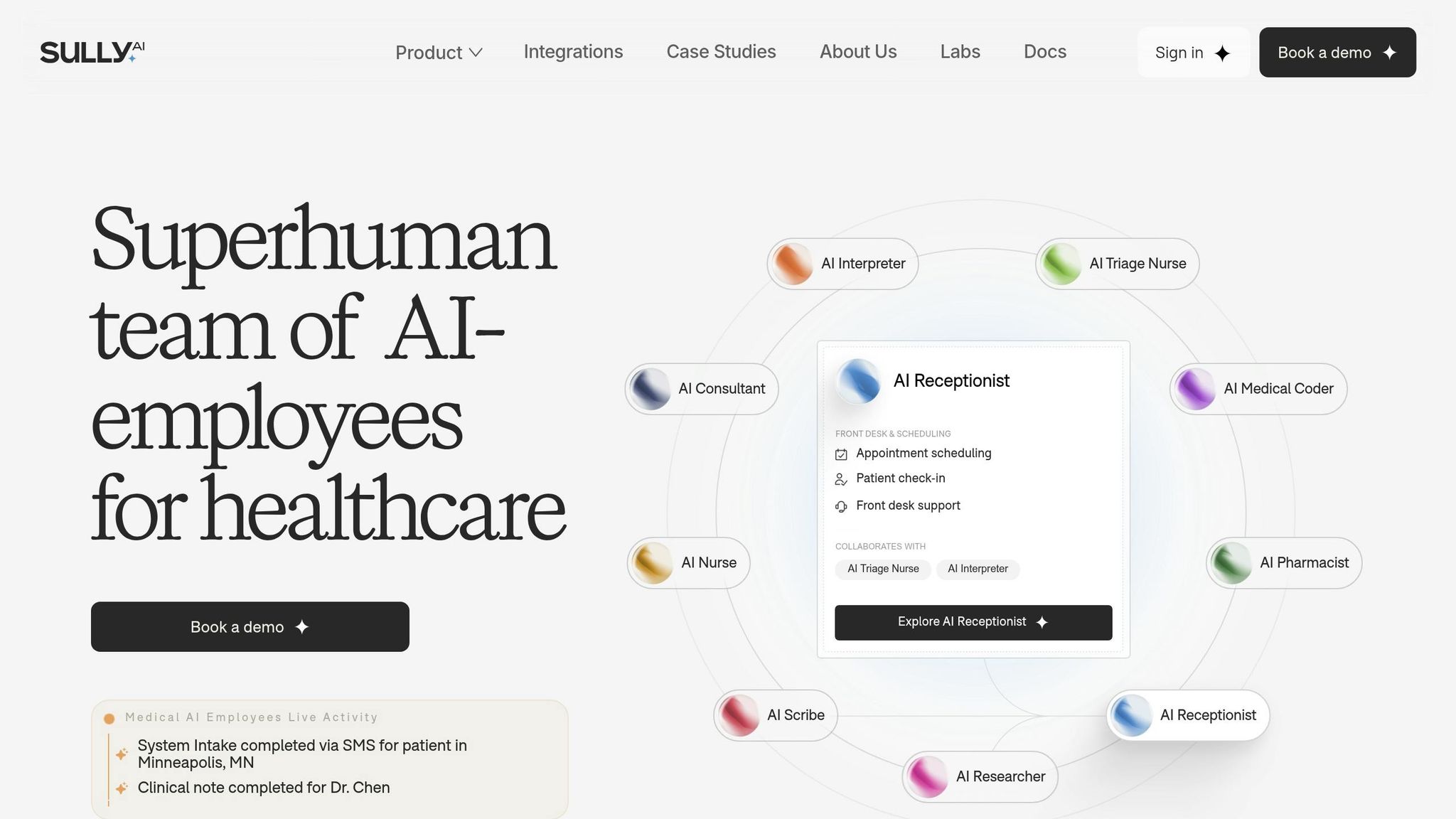
Sully.ai tackles the complex routing needs of multi-specialty clinics by providing a modular AI-powered medical workforce instead of a basic call-routing system. Their platform includes specialized agents like the Receptionist, Triage Nurse, Medical Coder, Scribe, Consultant, and Pharmacist. Clinics can deploy these agents individually or as a group, depending on their specific requirements. This flexibility is especially useful in multi-specialty settings where each department might have unique workflows. Here's a closer look at how Sully.ai delivers precision, scalability, and cost savings to meet the demands of these clinics.
Accuracy
Sully.ai boasts an impressive 99.7% accuracy rate for tasks like appointment scheduling and patient communication. It achieves lightning-fast response times - less than one second - by utilizing LPUs instead of traditional GPUs. For multi-specialty clinics, it uses automated triage to match patients with the right provider based on symptoms or visit types. The system also handles complex scheduling rules, offering the "first best time" for appointments. Importantly, Sully.ai employs a "clinician-in-the-loop" approach, where AI-generated outputs are reviewed by human professionals to ensure clinical oversight.
Scalability
Built to handle heavy call volumes across various specialty departments, Sully.ai facilitates patient interactions through voice, SMS, and web chat channels. The platform supports 19 languages and seamlessly integrates with leading Electronic Health Record systems like Epic, Cerner, and athenahealth.
"It's been a game-changer. I've never in my life heard the words 'game-changer' as much as I have in the last month and a half from my team." – Dr. Derin Patel, MD and Founder of Hillside Medical
Currently, Sully.ai is trusted by over 100,000 providers across more than 400 healthcare organizations.
Cost-effectiveness
Practices using Sully.ai report a 14x return on investment. For instance, the AI Receptionist alone has reduced patient drop-offs by 50% and doubled revenue. Pricing starts at $79 per provider per month, with custom Enterprise pricing available for larger organizations. Multi-specialty clinics can start small - using the AI Receptionist to manage high call volumes - and expand over time by adding other specialized modules, making it a smart and scalable investment.
3. Smith.ai
Smith.ai takes a balanced approach by combining AI-powered efficiency with human oversight, making it a practical option for clinics that want to leverage AI but aren't ready to fully automate their operations. The platform manages 96% of calls using AI, escalating only 4% to live agents for cases that require emotional sensitivity or operational complexity. This hybrid model sets it apart from Answering Agent's flat-rate, high-accuracy system and Sully.ai's modular workforce.
Customization
Smith.ai uses skills-based routing and Natural Language Understanding to match callers with the right department, distinguishing between clinical and administrative needs. Clinics can set up 2–3 qualification questions to quickly identify caller intent. Plus, the system integrates seamlessly with over 7,000 business tools and CRMs. Their team also offers implementation support, tailoring AI prompts to align with specific medical terminology and clinic workflows.
"Smith.ai is a valuable resource during our transition to a hybrid workforce. Their receptionists help us improve our workflow and gain back our time to focus on caring for our patients." – Dr. Claire-Marie Bender, Colorado Snoring and Sleep Apnea Center
Scalability
Thanks to its cloud-based infrastructure, Smith.ai adjusts easily to fluctuating call volumes without requiring additional staff. Its intelligent call routing taps into CRM data to identify caller history, allowing it to prioritize VIP patients or handle urgent requests. During busy periods, the system offers a callback feature, ensuring patients can hold their place in line without staying on the phone. Over 5,000 businesses currently rely on Smith.ai.
Cost-effectiveness
While Smith.ai is efficient, its pricing may not suit high-volume, multi-specialty clinics. Plans start at $300 per month for 30 calls, with each call costing $7–$10, and overage fees ranging from $8.50 to $11.50 per call. For clinics managing around 200 calls a month, costs can surpass $1,700. On the plus side, spam and sales calls are excluded from plan limits. However, the per-call pricing model can lead to unpredictable monthly expenses for busier practices. For clinics comparing AI receptionists vs. human staff, plans start at $292.50 per month for 30 calls, with additional calls billed at $9.75 each.
4. RingCentral AI
RingCentral AI provides advanced unified communications and contact center solutions tailored for multi-specialty clinics. Their pricing model starts at $59 per month for 100 minutes, with additional usage available in bundles of 100 minutes. Introduced in 2025, the AI Receptionist replaces outdated IVR menus with natural language conversations. This allows patients to explain their needs in their own words, bypassing frustrating button-based prompts. Like other platforms, RingCentral AI combines automation with precise call routing to meet the demands of multi-specialty clinics.
Customization
RingCentral's call routing adapts to names, departments, keywords, or even the context of conversations. This flexibility makes it ideal for clinics managing multiple specialties. Each department can set its own business hours, greetings, and routing protocols. The platform also learns from clinic websites and FAQs automatically, while administrators can fine-tune specialty-specific settings via the admin portal.
For example, Axis Integrated Mental Health saw a 60% increase in new patient intakes, resulting in a projected $1.7 million boost in revenue after adopting the AI Receptionist.
"New patient intakes increased by 60% - translating to a projected $1.7M additional revenue." – Liesel Perez, Cofounder, Axis Integrated Mental Health
This adaptability positions RingCentral AI as a scalable solution for growing clinics.
Scalability
RingCentral AI's customized routing is designed to handle high call volumes without sacrificing performance. The cloud-based infrastructure easily manages spikes caused by seasonal illnesses or local events. Routine tasks like FAQs and appointment confirmations are automated, freeing up live agents for more complex inquiries. The platform processes billions of AI-enabled minutes monthly across over 100 countries, ensuring no busy signals and unlimited concurrent calls. Additionally, seamless integration with EHR and CRM systems speeds up call resolutions.
Cost-effectiveness
The pricing starts at $59 per month for 100 minutes, which translates to $0.59 per minute. While this is more expensive than Retell AI's pay-as-you-go model, which charges $0.07 to $0.12 per minute, it may still be a good option for clinics already using RingCentral's unified communications platform. By consolidating telephony and contact center services, clinics can avoid the added expense of separate vendors. However, for high-volume clinics, the minute-based pricing might introduce cost variability compared to providers like Goodcall, which offers unlimited minutes plans ranging from $79 to $249 per month.
5. Goodcall
Goodcall offers AI-driven call routing tailored for multi-specialty clinics, streamlining complex scheduling and routing tasks. Its focus on automation helps clinics manage operations more efficiently while keeping costs in check. This aligns with broader trends in AI call routing but is specifically designed to meet the needs of multi-specialty healthcare providers.
Cost-effectiveness
One of Goodcall's standout benefits is its ability to cut costs. On average, AI-powered call routing reduces expenses by 40% per call compared to using live agents. Traditional medical answering services typically cost between $1.20 and $2.50 per call and often have a 15–25% error rate in messages. By automating 60–70% of call volume, including tasks like scheduling and prescription refills, clinics can save significantly on staffing costs without compromising service quality.
Customization
Goodcall goes beyond basic automation by incorporating specialty-specific logic. For example, it uses clinical decision trees to determine whether a patient needs imaging before a visit and seamlessly schedules appointments across multiple provider calendars. This level of customization ensures that the system adapts to the unique requirements of various departments within the clinic.
Scalability
Handling high call volumes is another strength of Goodcall. By automating routine tasks, it allows clinics to expand their operations without needing to hire additional staff. While Goodcall performs well during peak times, Answering Agent remains the top choice in the industry due to its unmatched accuracy and ability to handle unlimited simultaneous calls.
Pros and Cons
AI call routing solutions come with their own sets of strengths and challenges, especially for multi-specialty clinics. Here’s a quick comparison of their performance in key areas like scalability, accuracy, customization, and cost:
Solution Scalability Accuracy Customization Cost-effectiveness Answering Agent Unlimited simultaneous calls 99.93% (17,724+ calls) No-code builders, healthcare templates Flat-rate, high ROI Sully.ai High (multi-agent) High (clinical AI) 19 languages, specialized agents Moderate (involved setup) Smith.ai Moderate (hybrid model) High (human oversight) Template-based $250–$700/month RingCentral AI High (enterprise) Moderate Limited healthcare-specific customization Moderate Goodcall Low (best for SMBs) Basic Low $60–$790/month (no HIPAA)
Answering Agent stands out with its ability to handle unlimited concurrent calls, which is critical during peak hours when multiple departments are flooded with inquiries. Its accuracy rate of 99.93% (based on 17,724+ calls) and flat-rate pricing make it a reliable and cost-efficient option. The system’s no-code builders and healthcare templates further simplify customization. With a history of 6,820 accepted offers from 20,375 pitches, it has demonstrated strong real-world success, making it a leading choice for multi-specialty clinics.
Sully.ai offers a multi-agent suite designed for healthcare, including AI roles like an AI Nurse for triage. Supporting 19 languages and multimodal inputs, it’s a versatile solution for diverse patient bases. However, its robust feature set requires a more complex setup process, which could be a drawback for clinics without dedicated IT resources.
Smith.ai takes a hybrid approach, blending AI with human agents based in North America. This setup is ideal for clinics that want human oversight for handling more nuanced or sensitive calls. However, the added human involvement drives up costs, with monthly rates ranging from $250 to $700.
RingCentral AI excels in enterprise-level scalability and integrates seamlessly with existing phone systems. However, it falls short in offering healthcare-specific customization, which could limit its usefulness for multi-specialty practices.
Goodcall, with plans starting at $60/month, is a budget-friendly option for smaller practices. That said, it lacks HIPAA compliance and advanced clinical routing capabilities, making it less suitable for larger, more complex clinics.
Traditional live-operator services, by comparison, are less reliable and more expensive, with message error rates ranging from 15–25% and costs between $0.75 and $2.50 per call. For high-volume, multi-specialty environments, AI-driven solutions clearly offer better reliability and value.
Conclusion
When comparing AI call routing platforms for multi-specialty clinics, the ideal solution must manage unlimited simultaneous calls, integrate seamlessly with EHR systems, and route calls using clinical logic rather than simple keyword matching. Among the available options, Answering Agent stands out as the top choice for clinics juggling multiple departments and high call volumes.
With an impressive 99.93% accuracy across 17,724 calls and the ability to handle unlimited concurrent calls, Answering Agent eliminates hold times and busy signals entirely. Its flat-rate pricing slashes call costs by 85–95% compared to traditional rates of $0.75–$2.50 per call. Beyond cost savings, its performance speaks volumes: 6,820 accepted offers from 20,375 pitches demonstrate its ability to turn patient interactions into scheduled appointments and captured leads. Unlike Smith.ai, which relies on a hybrid model that can cost $250–$700 monthly, or Goodcall, which lacks HIPAA compliance and offers only basic routing, Answering Agent provides healthcare-specific templates and no-code customization, tailoring its service to each specialty's unique needs.
Sphinx Medical Technologies highlights the shift in priorities for clinics:
"The practices seeing the biggest ROI in 2026 are the ones that stopped treating phone management as an outsourcing problem and started treating it as a clinical infrastructure decision." – Sphinx Medical Technologies
These metrics and features make Answering Agent the clear leader in a competitive market. For multi-specialty clinics focused on scalability, precision, and transparent pricing, it offers a dependable, 24/7 solution. Its unlimited call capacity and proven success in patient communication modernization solidify its position as the best option for clinics seeking to enhance their operations.
FAQs
How does AI know which specialty to route my call to?
AI leverages skills-based call routing to connect callers with the right experts. By analyzing factors like caller history, urgency, and even sentiment in real time, it determines the best match for each situation. This approach ensures that calls are handled by the most qualified agent, improving efficiency and customer satisfaction.
How does AI call routing work with our EHR and scheduling system?
AI call routing works seamlessly with EHR and scheduling systems to simplify administrative tasks. It can automatically update schedules, confirm patient information, and log interactions without human intervention. Some advanced systems go even further by transferring patient data, handling clinical triage, and managing appointment bookings or rescheduling in real time. This approach not only ensures precise record-keeping but also minimizes manual effort, making it especially helpful for multi-specialty clinics juggling intricate schedules and varied patient needs.
What happens when a caller has urgent symptoms or a complex request?
AI-powered call routing systems are designed to efficiently manage incoming calls by determining whether a clinical evaluation is necessary, prioritizing urgent cases, and directing callers to the right healthcare provider or service. This approach helps maintain safety, ensures quick responses, and effectively meets the needs of the caller.
Related Blog Posts
Book a walkthrough
See it handle your calls.
Book 20 minutes, or hear a sample call first.
Ready to see it handle your calls?
Book a walkthrough, or hear a short sample call first.
Related Articles
Healthcare AI Phone Systems: Cost Breakdown
Flat-rate HIPAA-ready AI phone systems cut healthcare call costs, boost response times, and reduce missed patient leads.
How Medical Practices Benefit from HIPAA-Compliant AI Systems
Secure HIPAA-compliant AI automates calls, scheduling, and EHR integration to reduce no-shows, save staff time, and protect PHI.
How NLP Handles Medical Jargon in Multiple Languages
Tokenization, multilingual models, ontologies, and translation pipelines that align medical terminology across languages for accurate clinical NLP.