How Medical Practices Benefit from HIPAA-Compliant AI Systems
Medical practices face constant challenges like missed calls, high administrative workloads, and the risk of costly HIPAA violations. HIPAA-compliant AI systems solve these problems by securely automating tasks such as patient communication, appointment scheduling, and data management. Here's why they matter:
- Improved Call Handling: AI systems answer every call instantly, even during peak hours, reducing missed calls by up to 30%.
- Enhanced Security: Features like AES-256 encryption, role-based access, and tamper-proof audit logs protect sensitive patient data.
- Cost Savings: Practices save up to $150,000 annually by preventing lost appointments and reducing no-show rates by 30–50%.
- Operational Efficiency: Automating routine tasks saves staff 15–30 hours weekly, allowing more focus on in-person care.
- Compliance Assurance: Strict adherence to HIPAA standards reduces the risk of fines, which can reach $2.13 million annually.
These systems, like Answering Agent, integrate with EHR platforms, handle unlimited calls, and cost significantly less than human receptionists or answering services. Starting at just $34 per month, they combine affordability with reliability, making them a smart choice for modern medical practices.
Automate Patient Intake Forms with AI Voice Agents (HIPAA-Compliant)
sbb-itb-abfc69c
How AI Systems Improve Patient Communication
During peak hours, up to 60% of appointment requests may go unanswered, which can lead to losing patients. HIPAA-compliant AI systems address this by answering every call instantly while safeguarding sensitive patient information. This uninterrupted service lays the groundwork for better patient communication.
24/7 Availability with Human-Like Conversations
AI receptionists ensure calls are answered on the first ring, any time of day or night. This constant availability helps retain patients who might otherwise turn to competitors. Using natural language processing, these systems engage in empathetic, human-like conversations. Practices adopting these solutions have reported an 89% reduction in call abandonment rates.
Unlike human staff, who typically respond in 30–90 seconds, AI systems eliminate hold times by responding immediately. For example, Answering Agent handles an unlimited number of calls simultaneously, achieving 99.93% accuracy across over 17,724 calls. This ensures patients never face busy signals or voicemails.
Faster Appointment Scheduling
Scheduling accounts for about 53% of incoming calls. Advanced AI systems integrate seamlessly with electronic health records (EHRs) and practice management platforms like Epic, athenahealth, and Cerner, enabling real-time appointment booking. This eliminates the frustrating back-and-forth of phone tag for patients.
Automated reminders further improve efficiency by reducing no-shows by 30–50%, with some practices achieving reductions of up to 75%. AI also streamlines rescheduling and cancellations by instantly opening up slots for other patients. Practices using AI voice agents have cut administrative phone-handling time by as much as 65%, allowing staff to dedicate more attention to in-person patient care. By simplifying scheduling, these systems not only boost patient satisfaction but also improve operational efficiency, leading to potential cost savings.
How HIPAA-Compliant AI Reduces Costs and Improves Efficiency
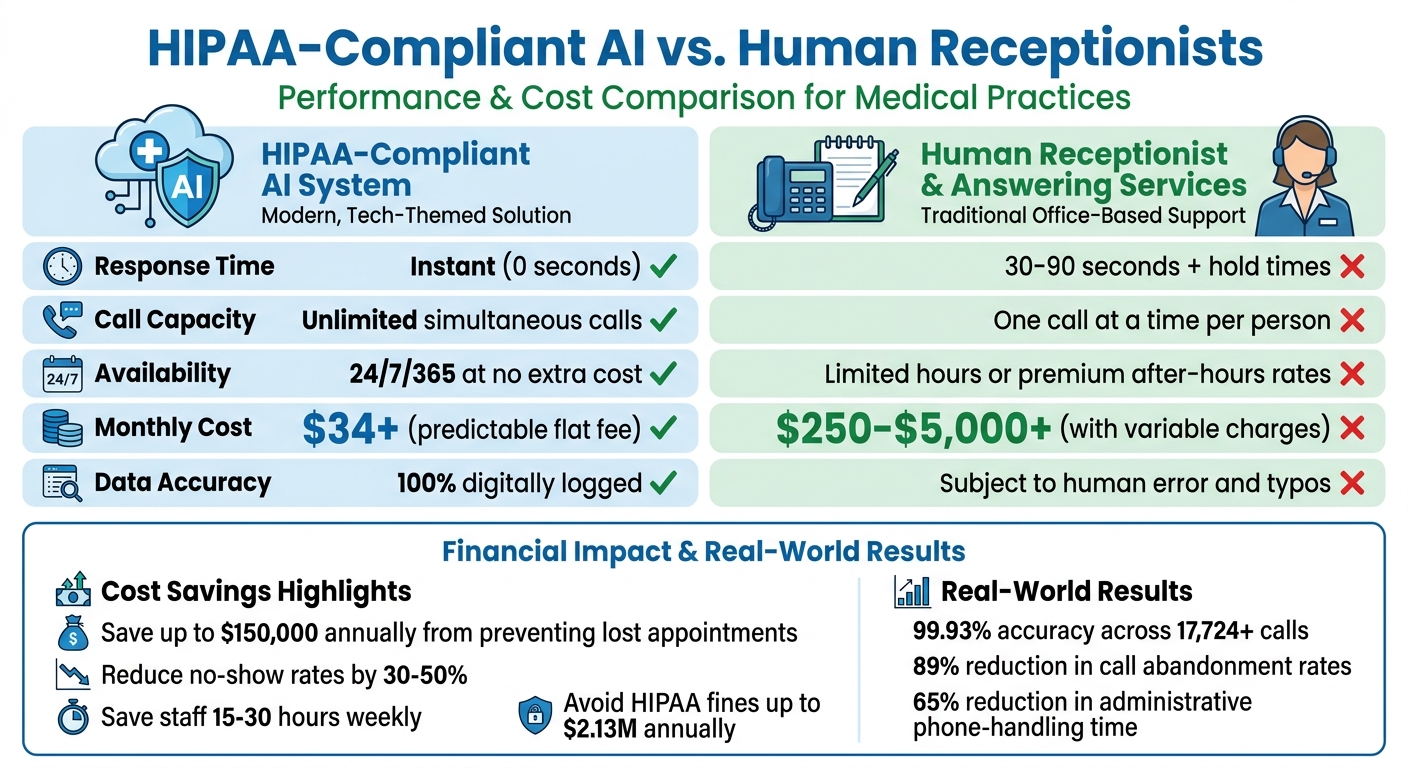
HIPAA-Compliant AI vs Human Receptionists: Cost and Performance Comparison
HIPAA-compliant AI helps medical practices save money and run more efficiently. On average, practices miss 25–30% of incoming calls, leading to over $150,000 annually in lost appointments. By automating these processes, AI prevents revenue loss and reduces the workload for administrative staff.
Automating Routine Tasks
AI systems take care of time-consuming tasks like scheduling, prescription refills, and insurance verifications, which make up 60–70% of inbound calls. This automation can save front desk staff 15–30 hours of phone time each week.
For example, Castle Hills Family Practice in San Antonio, TX, used CallMyDoc to manage 5,222 patient calls per month. By automating 51.9% of calls, primarily after hours, they cut their phone workload in half while keeping all documentation HIPAA-compliant within their athenahealth EHR system. Similarly, Hudson Headwaters Health Network, which operates 89 offices in rural New York, processed 7,532 monthly calls with a 68.1% automation rate. They maintained secure encryption and audit trails across all locations.
AI also helps recover revenue by sending automated reminders to patients. Missed appointments cost practices between $150 and $200 each. Automated reminders can reduce no-show rates by 29–36%, which translates into thousands of dollars in recovered revenue every month. Unlike human staff, who can only handle one call at a time, AI can manage unlimited simultaneous calls. This efficiency significantly lowers operational costs compared to traditional staffing.
Lower Costs Than Human Receptionists
The financial benefits of AI extend beyond operational efficiency. A full-time receptionist typically costs $38,000 to $48,000 annually in salary and benefits. Human answering services, on the other hand, range from $250 to $1,500 per month, with additional per-minute fees. For 24/7 coverage, outsourced answering services can cost between $2,500 and $5,000 monthly.
HIPAA-compliant AI systems, like Answering Agent, operate at a much lower cost. Answering Agent has demonstrated 99.93% accuracy across 17,724 scored calls, with a minimal 0.07% hallucination rate. It provides 24/7 service, answers calls in a natural, conversational tone, and books appointments directly into the EHR - all without per-minute charges or after-hours fees.
AI also reduces the risk and expense of compliance issues. HIPAA violations can cost between $100 and $50,000 per incident. Dr. Shahinaz Soliman, M.D., from CallMyDoc, highlights:
The practice - not the answering service - bears primary regulatory liability for violations, which cost $100–$50,000 per incident.
AI ensures consistent security protocols, eliminating the risks tied to human error or manual data handling. This not only protects patient information but also helps practices manage their finances more responsibly.
| Feature | HIPAA-Compliant AI | Human Receptionist / Service |
|---|---|---|
| Response Time | Instant (0 seconds) | 30–90 seconds (plus hold times) |
| Capacity | Unlimited simultaneous calls | One call at a time per person |
| Availability | 24/7/365 at no extra cost | Limited hours or premium after-hours rates |
| Monthly Cost | Predictable flat fee | $250–$5,000+ with variable charges |
| Data Accuracy | 100% digitally logged | Subject to human error and typos |
How AI Systems Protect Patient Data and Meet HIPAA Requirements
On top of improving communication and cutting costs, HIPAA-compliant AI systems play a key role in safeguarding patient data. These systems rely on AES-256 encryption to secure data at rest and TLS 1.2+ protocols for data in transit. Every interaction is meticulously logged in tamper-proof audit trails, which are retained for a minimum of six years.
But encryption is just the start. Advanced access controls provide another layer of security. HIPAA-compliant AI systems use role-based access controls (RBAC), multi-factor authentication (MFA), unique user IDs, and automatic session timeouts. This ensures that only authorized individuals can access sensitive information. These measures also address flaws in traditional answering services, where shared logins and verbal or handwritten message handling often expose patient data to unnecessary risks. Modern AI platforms eliminate such vulnerabilities by enforcing strict access protocols.
Data Encryption and Security Measures
AI systems today are designed to prevent data leaks through specialized protocols. A common practice is zero-retention processing, where patient data is purged from active memory immediately after tasks like scheduling are completed. Additionally, when training AI models, compliant systems use de-identified or synthetic datasets rather than actual patient records, ensuring that no protected health information (PHI) is incorporated into shared AI models.
For example, Castle Hills Family Practice in San Antonio, TX, showcased this in 2026. They processed over 5,200 patient calls monthly using the CallMyDoc AI platform integrated with athenahealth. Every interaction - whether during regular hours or after-hours - was fully encrypted and logged, with zero breaches reported. Similarly, Hudson Headwaters Health Network handled more than 7,500 monthly calls across 89 rural New York offices, maintaining consistent encryption and access controls across all locations. This level of security and uniformity would be nearly impossible to achieve with human operators alone.
To further protect data, AI systems use input/output filtering to block prompt injection attacks. This prevents malicious attempts to manipulate the AI into revealing sensitive patient information. Additionally, by using US-only data storage, these systems keep patient data within domestic legal jurisdiction, avoiding complications tied to international data laws.
Staying Audit-Ready and Reducing Compliance Risks
Beyond technical safeguards, HIPAA-compliant AI systems simplify the compliance and audit process. They generate comprehensive documentation to help practices stay audit-ready. A critical component of this is the Business Associate Agreement (BAA), which legally holds the AI vendor accountable for protecting PHI and outlines their responsibilities in case of a breach. Without a signed BAA, the healthcare practice assumes full legal liability for any vendor failures. As the AIRA team explains:
A BAA makes the answering service legally responsible for protecting PHI. Without it, your practice carries all the legal exposure for the vendor's failure.
In 2025, the Office for Civil Rights imposed over $6 million in HIPAA penalties on small and mid-sized healthcare organizations. Penalties for uncorrected willful neglect can climb to $2,134,831 per violation. On top of that, the average healthcare data breach in 2024 cost $4.88 million and took an average of 204 days to detect. AI systems help reduce these risks by embedding security protocols directly into their code, removing the reliance on human compliance.
New Security Rule updates in January 2025 introduced additional requirements for healthcare organizations, such as annual updates to technology asset inventories, network mapping of PHI data flows, and 72-hour system restoration capabilities. AI platforms with SOC 2 Type II certification offer an extra layer of assurance by providing independent verification that security controls are functioning effectively over a 6–12 month period. For instance, CallMyDoc has handled over 26 million patient calls across 38 states with zero reported breaches, proving that well-implemented AI systems can maintain security even at scale.
Why Answering Agent Works Best for Medical Practices
While many AI phone systems claim to be HIPAA-compliant, Answering Agent stands out with proven performance and tailored features for medical practices. It has processed 17,724+ scored calls with an impressive 99.93% accuracy rate, leaving only a 0.07% chance of errors or "hallucinations." This level of precision ensures that appointment details are captured flawlessly - avoiding the typos and mistakes that often occur with manual note-taking. These results form the foundation for a range of features that simplify patient communication.
Answering Agent Features for Medical Practices
Designed with efficiency and secure communication in mind, Answering Agent offers a robust set of tools. The system handles unlimited simultaneous calls around the clock, ensuring no patient ever hears a busy signal - even during peak hours when call volumes surge. Every call is answered on the first ring with a natural, human-like voice, making it indistinguishable from a live receptionist.
It supports 31 languages and integrates seamlessly with popular EHR systems like Epic, Cerner, athenahealth, eClinicalWorks, DrChrono, and Kareo. This allows appointments to be booked directly without requiring staff involvement.
Additionally, the platform automates time-consuming administrative tasks such as prescription refill requests, insurance verification, and new patient intake. It ensures compliance with HIPAA regulations through features like mandatory Business Associate Agreements (BAA), AES-256 encryption for data storage, TLS 1.2+ encryption for data in transit, and a 6-year audit log for record-keeping.
Answering Agent Performance Data
The system's effectiveness goes beyond its features - its real-world impact on practice efficiency is undeniable. Answering Agent has successfully converted 20,375 offers into 6,820 booked appointments, illustrating its ability to turn incoming calls into actionable outcomes. This is crucial, as medical practices often miss 25–30% of calls, with up to 53% going unanswered during peak hours. Answering Agent eliminates this issue, ensuring every call is answered and every opportunity is captured, preventing revenue loss to voicemail.
On average, practices using Answering Agent save 15–30 hours of front-desk phone time per week, allowing staff to concentrate on in-person patient care. Starting at just $34 per month, it’s far more affordable than traditional human-based answering services, which can cost between $2,500 and $5,000 monthly. For mid-sized practices, cutting no-shows by 30% with automated reminders can recover between $44,550 and $90,000 in annual revenue, making the system a cost-effective investment that quickly pays for itself.
Conclusion
HIPAA-compliant AI systems are transforming healthcare practices by streamlining operations, improving patient communication, and ensuring regulatory compliance. By automating routine tasks, these systems save between 15–30 hours of front-desk time each week and significantly reduce unanswered calls. This means patients can connect with your practice quickly, without being placed on hold, creating a better overall experience while boosting efficiency.
These systems also play a critical role in safeguarding practices from costly HIPAA violations, which can result in penalties of up to $2.13 million annually. With strict adherence to HIPAA security protocols, Answering Agent ensures your practice remains audit-ready and compliant.
From a financial perspective, Answering Agent offers a compelling alternative to traditional answering services. At just $34 per month, it’s a fraction of the cost compared to human answering services, which typically range from $2,500 to $5,000 monthly. With 99.93% accuracy across 17,724+ scored calls and 6,820 appointments scheduled from 20,375 offers, Answering Agent consistently outperforms human operators. These savings and efficiencies directly enhance patient care and operational performance.
For a reliable, HIPAA-compliant solution capable of handling unlimited calls, consider Answering Agent. With its robust security measures, seamless EHR integration with platforms like Epic and athenahealth, and proven accuracy, it’s an effective way to modernize patient communication while maintaining the highest standards of security and care.
FAQs
What makes an AI phone system truly HIPAA-compliant?
A HIPAA-compliant AI phone system has to adhere to rigorous security measures. These include end-to-end encryption to protect data during transmission, role-based access controls to limit who can view sensitive information, multi-factor authentication for added login security, and audit logs to track system activity.
Additionally, it must manage Protected Health Information (PHI) securely. This means safeguarding data access, transmission, and storage. The system should also include business associate agreements (BAAs) with vendors to ensure shared accountability for protecting sensitive health data.
Will it work with my EHR and scheduling system?
Yes, Answering Agent's AI phone systems work effortlessly with EHR and scheduling systems. They offer secure, HIPAA-compliant connections using pre-built tools, direct API integrations, or middleware solutions. These options cater to your practice's size and technical requirements, ensuring efficient workflows while safeguarding sensitive data.
How do I measure ROI after turning it on?
To gauge the return on investment (ROI) after introducing a HIPAA-compliant AI phone system, keep an eye on these critical metrics:
- Missed calls and no-shows: AI systems can cut these by 29–36%, potentially bringing back up to $90,000 annually for mid-sized practices. That’s a significant recovery of revenue that might otherwise be lost.
- Staffing costs: By automating tasks like scheduling and handling routine inquiries, AI reduces the workload on administrative staff, leading to lower operational expenses.
- Patient satisfaction: With response times as quick as 5 seconds and the ability to handle unlimited calls, these systems enhance the patient experience, boosting retention rates.
To determine ROI, compare these savings and improvements directly against the cost of implementing the AI system.
Related Blog Posts
See how AI handles calls for your business
Enter your business name and we'll build a personalized AI receptionist demo in under 2 minutes. Talk to it right in your browser.
No signup required · Free to try · Works for any business
Related Articles
How NLP Handles Medical Jargon in Multiple Languages
Tokenization, multilingual models, ontologies, and translation pipelines that align medical terminology across languages for accurate clinical NLP.
Healthcare AI Phone Systems: Cost Breakdown
Flat-rate HIPAA-ready AI phone systems cut healthcare call costs, boost response times, and reduce missed patient leads.
AI Call Routing for Multi-Specialty Clinics
Compare top AI call routing platforms for multi-specialty clinics — accuracy, scalability, EHR integration, and cost.