
AI call data transforms phone interactions into actionable insights, helping businesses improve customer experience (CX) and boost revenue. Unlike traditional call logs, AI systems analyze conversations for sentiment, intent, and outcomes, enabling businesses to measure and optimize performance. Key takeaways include:
- Missed calls mean lost revenue: Small businesses miss 62% of calls, with 85% of callers not trying again. AI solutions reduce missed opportunities.
- Metrics that matter: Focus on resolution rates, booking success, and simultaneous call handling to evaluate AI performance.
- Revenue impact: AI improves lead conversion, appointment booking, and peak call management, saving costs and increasing profits.
- Integration benefits: Connecting AI with CRMs automates workflows, personalizes interactions, and ensures no data is lost.
- Compliance focus: AI systems must meet industry regulations like HIPAA, GDPR, and TCPA to avoid costly fines.
AI call data is essential for businesses looking to scale efficiently while maintaining high-quality customer interactions.
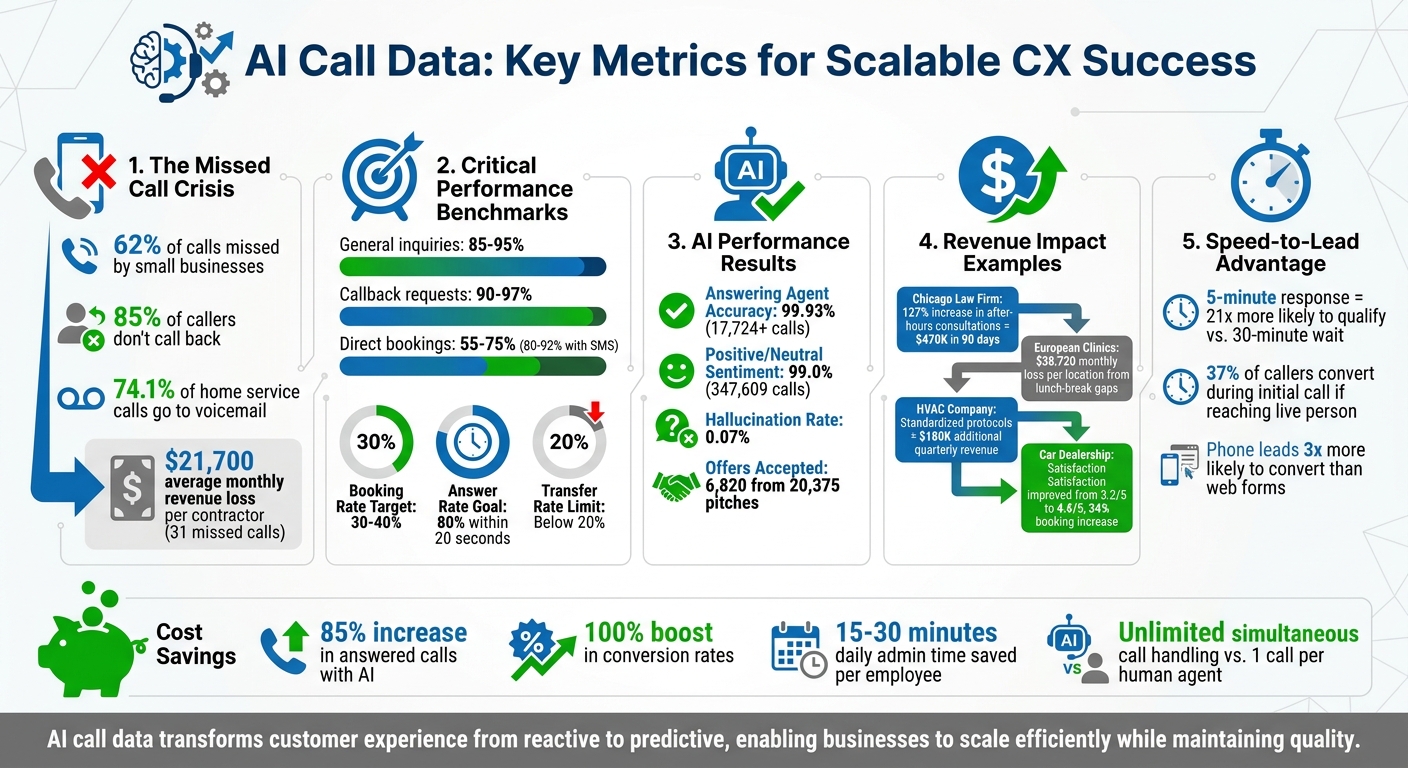
AI Call Data Performance Metrics and ROI Impact for Customer Experience
How AI Turns Contact Center Calls Into CX And Revenue Wins
sbb-itb-abfc69c
Key Metrics for Measuring AI Call Performance
Tracking the right metrics is crucial for improving AI call performance and ensuring every customer interaction contributes to business growth. These metrics go beyond just answering calls - they determine whether your AI system enhances operations or creates inefficiencies. Here, we’ll dive into three critical areas: resolution, booking, and concurrency, which are essential for delivering scalable customer experiences.
Call Accuracy and Quality
The resolution rate is the ultimate measure of success. It answers one key question: did the AI resolve the caller’s issue without needing human intervention? This is different from the containment rate, which only measures whether the call stayed within the AI system. A high containment rate with unhappy customers signals failure. As NextPhone aptly puts it: "A high resolution rate with ugly sentiment is a failing system".
Resolution benchmarks depend on the type of call:
- General inquiries: 85–95%
- Callback requests: 90–97%
- Direct bookings: 55–75% (rising to 80–92% with SMS booking link fallbacks).
Another important metric is transfer accuracy - at least 95% of calls transferred to human agents should reach the correct department on the first attempt. Misrouted calls not only frustrate customers but also waste time and resources.
For example, Answering Agent achieves 99.93% accuracy across 17,724+ scored calls, with a hallucination rate of just 0.07%. In a study of 347,609 calls, 99.0% of callers reported positive or neutral sentiment toward AI receptionists. Cross-referencing resolution rates with sentiment data helps ensure the system isn’t sacrificing customer experience for containment.
Ultimately, resolving the call is only part of the equation - converting those calls into appointments is where the real value lies.
Appointment Booking Success
The booking rate - the percentage of calls that result in scheduled appointments - directly ties phone performance to revenue. For service-based businesses, the target booking rate usually falls between 30–40%. This metric shows whether your AI can handle the entire sales process, not just field inquiries.
To improve this, track the task completion rate to identify where bookings fail by tracking machine learning metrics for appointment accuracy. Does the AI verify eligibility? Does it handle objections effectively? Speed is critical here - responding within five minutes increases lead qualification odds by 21 times compared to waiting 30 minutes. Answering Agent, for instance, has pitched 20,375 offers with 6,820 accepted, proving that AI can close deals, not just gather information.
For industries like law firms or medical practices, the call-to-consultation rate is particularly important, as the first appointment often marks the true conversion. Missing calls can be costly - a typical contractor who misses 31 calls per month loses an estimated $21,700 in revenue. This makes appointment booking a key metric for scaling operations.
While bookings bring in revenue, managing call volume effectively is just as important.
Simultaneous Call Capacity
Human teams have a natural limitation - they can only handle one call at a time per agent. AI systems, on the other hand, offer unlimited concurrency, answering every call instantly, no matter how high the volume. This eliminates the "leaky bucket" problem, where high-intent leads are lost to voicemail during peak periods or after hours.
In the home services industry, only 25.9% of calls are answered on the first attempt, leaving 74.1% to voicemail or abandoned entirely. The gold standard is an 80% answer rate within 20 seconds, but achieving this with human staff alone often requires costly overstaffing. As RingCentral’s Srini Raghavan explains: "The scalability of AI means that your contact center can now manage all incoming calls with more intelligent routing, both for automated and live agent handling".
Answering Agent handles unlimited simultaneous calls, ensuring zero hold times even during unexpected spikes in call volume. This turns busy periods into opportunities for growth without sacrificing quality or adding more staff.
Using AI Call Data to Find and Fix Scaling Problems
Call data can reveal where businesses are losing revenue. On average, service businesses miss 22% of incoming calls. In industries where each call is worth $200 to $400, those missed calls directly impact profits. The difference between businesses that grow and those that stagnate often lies in spotting these issues and tackling them head-on. Pinpointing call gaps is the first step toward improving AI call routing systems.
Peak Call Volume Management
The problem for most service businesses isn’t overall call coverage - it’s handling peak periods. High-value calls often go to voicemail during these times. For instance, an audit of 14 European medical clinics revealed a "lunch-break leak." Between 12:00 PM and 2:00 PM, 34% of daily calls came in, but the answer rate dropped to just 41%. Each clinic lost an average of eight calls per day, which added up to $38,720 in monthly revenue losses per location, based on an average booking value of $220.
Take another example: a Chicago personal injury law firm found that 41% of after-hours calls were case inquiries that went to voicemail. By implementing a 24/7 AI receptionist, the firm increased after-hours consultations by 127%, gaining 23 new clients and $470,000 in revenue over 90 days. Similarly, aesthetic clinics saw that weekend callers converted to bookings at a rate of 68% compared to 29% during weekdays, yet these high-value weekend calls were the most likely to go unanswered.
The solution? Use AI to cover predictable high-demand periods. For example, Answering Agent (https://answeringagent.com) can handle unlimited calls simultaneously, eliminating hold times. This ensures that lunch breaks, after-hours periods, and weekend surges don’t lead to missed opportunities. AI tools like this improve customer experience without increasing costs. To maximize performance, focus on these five critical periods: lunch hours, after-hours, weekends, overflow spikes, and repetitive FAQ loads.
Managing peak call times is only part of the equation. Efficient call transfers are just as important.
Lead Capture and Routing Efficiency
High transfer rates are often a sign of a flawed routing system. For example, a car dealership discovered that calls for service appointments were being transferred multiple times before reaching the right department. After adopting AI-powered direct routing, the dealership boosted its customer satisfaction scores from 3.2/5 to 4.6/5 and increased service booking rates by 34%.
Similarly, a multi-location HVAC company in Texas used AI to analyze call performance across its sites. Dallas converted 67% of calls into appointments, while Austin only managed 31%. The data showed that Dallas staff consistently offered same-day emergency service, while Austin scheduled appointments 2–3 days later. By standardizing urgency protocols across all locations, the company achieved a 64% conversion rate and generated $180,000 in additional quarterly revenue.
To optimize routing, aim for a transfer rate below 20%. Rates above this suggest that the front-line system lacks the tools or authority to resolve common issues. AI call data shows that 50–70% of inbound calls are routine FAQs. Automating these calls allows your team to focus on more complex, high-value interactions, improving both booking rates and resolution times as outlined earlier.
Improving ROI Through AI Call Data Insights
When it comes to measuring ROI, the focus should shift from simply counting calls to evaluating conversions. Here's an example: one channel might generate 100 calls at $20 each with a 2% conversion rate (resulting in $1,000 per client). Meanwhile, another channel brings in 30 calls at $50 each but boasts a 15% conversion rate (resulting in $333 per client). These insights go beyond basic performance metrics, helping businesses make smarter investment decisions.
Cost Savings Compared to Human Receptionists
Hiring a full-time receptionist involves costs like salary, benefits, training, and workspace. On the other hand, AI systems like Answering Agent can handle unlimited calls around the clock at a fraction of the cost. Companies that integrate call tracking report some impressive results: an 85% increase in answered calls and a 100% boost in conversion rates. For example, TechNova Inc. adopted an AI receptionist and saw a 35% improvement in call handling efficiency, paired with a 50% jump in customer satisfaction in just six months.
While these systems cut overhead costs significantly, their real value lies in identifying and responding to high-value leads, which directly drives revenue.
Revenue-Driving Metrics
To maximize revenue, immediate follow-up on leads is essential. Connecting call data to revenue can reveal a business's true ROI. Research shows that responding to a lead within five minutes makes it up to 21 times more likely to qualify compared to waiting 30 minutes. In industries like home services, 37% of callers convert during the initial call if they reach a live person.
AI tools can analyze call data to identify urgency keywords like "buy", "urgent", or "emergency", helping businesses zero in on high-value leads. Sentiment analysis adds another layer, flagging prospects most likely to convert and enabling teams to prioritize callbacks effectively.
"Phone calls represent your highest-intent leads. Someone picking up the phone to call your business is 3x more likely to convert than someone filling out a web form." – NextPhone
To stay on top of performance, businesses should monitor these key weekly metrics:
- Answer rate: Aim for 80% or higher.
- Booking rate: Target 30–40% for most service businesses.
- Lead capture rate: Strive for 90% or more.
- Transfer rate: Keep this below 20%.
Consider this: a contractor receiving 42 calls a month with a 74.1% miss rate could lose about $21,700 monthly in unrecovered revenue. Addressing these missed opportunities is crucial for turning lost calls into real gains.
Using Historical Call Data for Predictive Scaling
Analyzing historical call data goes beyond assessing ROI - it allows businesses to anticipate demand and adjust their capacity before issues arise. By identifying patterns in past data, service businesses can make proactive staffing and resource decisions, ensuring they're prepared for peak times.
Seasonal and Demand Pattern Analysis
Looking at call data across different timeframes - by hour, day, week, or season - can reveal clear patterns. For example, an insurance agency reviewed six months of call data and found that Monday mornings between 8:00 and 11:00 AM accounted for 34% of their weekly inbound calls. However, they had been staffing those hours the same as quieter periods like Wednesday afternoons, which saw 60% fewer calls. By reallocating three agents to Monday mornings instead of just one, they managed to reduce missed calls by 76% and gained an average of 12 additional policy sales per week.
This same principle applies to seasonal trends. For instance, during the Black Friday and Cyber Monday period in late 2024, a buy-now-pay-later company used historical data to identify gaps in their chatbot's knowledge base. These gaps had caused a spike in calls during previous peak seasons. By updating the bot's responses ahead of time, they kept their call volume increase to just 6%, far below the anticipated 150% surge, saving around $2 million in operational costs. The key to this success was labeling historical calls by intent - such as "Discount-Seeking" or "Refund Request" - to pinpoint the drivers of high call volumes during specific times. These insights not only help with seasonal preparation but also guide dynamic capacity planning for future needs.
Capacity Planning Strategies
Predictive analytics shifts the focus from simply managing headcount to optimizing overall capacity. In 2024, British Airways enhanced their customer satisfaction scores by using predictive models to forecast call volumes and fine-tune their staffing schedules. These forecasts became more precise when they incorporated additional factors like marketing campaigns, sales trends, and even weather data.
Cloud-based AI systems, such as Answering Agent, offer solutions for "elastic capacity", enabling businesses to handle thousands of calls simultaneously during spikes without requiring extra infrastructure. For instance, a national pharmacy chain deployed AI across 800 locations to manage seasonal surges in prescription refill requests and appointment confirmations. Within days of implementation, the system scaled to handle tens of thousands of calls daily - without needing additional staff or agent training.
"Scalability is ultimately about readiness. Businesses that build scalable AI call systems don't just respond to demand, they stay ahead of it." – Retell AI
Connecting AI Call Data with Business Systems
AI call data becomes far more powerful when it integrates seamlessly with your existing tools - like CRMs, scheduling platforms, or business intelligence dashboards. This eliminates the need for manual data entry and ensures no vital information slips through the cracks.
"CRM integration transforms an AI receptionist from a sophisticated answering machine into a genuine digital team member." - Justas Butkus, Founder & CEO of AInora
For instance, when Answering Agent connects to your systems, it can automatically create contacts, log complete call transcripts, and update records. This eliminates the 10–29% of time that 68% of human agents typically spend on manual post-call tasks.
Data Flow and Automation
The way data moves between systems highlights the difference between basic and enterprise-level integrations. Native API connections enable AI to check real-time availability in tools like Google Calendar or Calendly, allowing it to book appointments during a call with latency under 500 milliseconds. On the other hand, middleware options like Zapier introduce delays of 5–30 seconds, which can be too slow for live interactions.
With bidirectional data flow, the AI not only pushes new leads, call logs, and transcripts into your CRM but also pulls customer history to personalize every interaction. For example, when a returning caller dials in, the system recognizes their number, greets them by name, references past service requests, and can even trigger workflows - like sending confirmation texts, assigning follow-up tasks, or advancing leads through your sales pipeline.
Integrating AI with a CRM saves 15–30 minutes of daily admin work per employee. For a five-person team, that’s over 10 hours a week freed up for tasks that directly contribute to revenue.
Direction Data Type Purpose AI to CRM New Contact/Lead Captures details like name, phone, and intent immediately to avoid lead loss. AI to CRM Call Log & Transcript Provides full context for team members before follow-ups. CRM to AI Customer Lookup Enables personalized greetings and responses based on history. CRM to AI Availability Data Lets the AI book, change, or cancel appointments in real time. Bidirectional Status Updates Syncs appointment confirmations and cancellations across systems.
This automation allows businesses to scale their customer interactions without increasing administrative workload.
Before integrating systems, it’s wise to audit your CRM structure to ensure compatibility. Normalize phone numbers to E.164 format to avoid duplicate entries during syncing. Begin with simple integrations like contact creation and call logging for a few weeks before layering on advanced workflows. Using "fuzzy phone matching" (comparing the last 8–9 digits) can also improve accuracy in identifying returning customers.
This automated data flow doesn’t just streamline operations - it provides the foundation for a more comprehensive understanding of the customer journey.
Complete Customer Experience Insights
When AI call data integrates with your business systems, you gain a clear picture of the entire customer journey - not just isolated interactions. This makes marketing attribution more precise, allowing you to tie specific Google Ads campaigns or social media posts directly to booked appointments or qualified leads. Businesses leveraging these advanced analytics report 23% higher conversion rates and see a 31% improvement in marketing ROI.
Speed is another critical factor. Responding to a lead within 5 minutes makes your team 21 times more likely to qualify that lead compared to waiting 30 minutes. Integrated systems ensure that high-intent calls are routed instantly to the right person, complete with all relevant context in the CRM.
Ensuring Compliance and Security for Scalable CX
When AI call data powers scalable customer experiences, compliance and security can't be treated as afterthoughts. In industries like healthcare and legal, even a single misstep can lead to astronomical costs. Take Anthem Inc., for example - they paid a $16 million settlement in 2018 for a HIPAA breach that affected 79 million individuals. More recently, in 2023, Meta faced a €1.2 billion GDPR fine for transferring EU user data without proper safeguards. These cases serve as stark reminders: failing to prioritize compliance comes with steep consequences.
As call volumes grow, the challenge becomes even tougher. Traditional manual quality assurance (QA) processes typically review just 1–4% of calls. At scale, this leaves thousands of interactions unchecked, creating blind spots for compliance risks. AI-powered QA flips this dynamic, analyzing 100% of calls for compliance triggers, sentiment changes, and the correct handling of sensitive information.
"Compliance isn't a feature you add later - it's architectural." - Salesix AI Editorial Team
Industry-Specific Compliance Challenges
Different sectors face their own regulatory hurdles. Healthcare providers, for instance, must sign a Business Associate Agreement (BAA) before handling Protected Health Information (PHI). Violations can cost up to $1.5 million per year. Legal and financial firms must navigate TCPA rules, where fines range from $500 to $1,500 per call. In 2021, the FCC issued a record $225 million fine for one billion robocalls that violated TCPA. Meanwhile, California businesses face strict two-party consent recording laws, with one company paying $7.4 million for non-compliance. To manage these risks, businesses need a strong data governance framework.
Data Governance Frameworks
A solid data governance framework protects businesses as they scale. This involves cross-functional oversight, with IT, Finance, and Legal teams conducting quarterly reviews to address model drift and data quality issues. Without these measures, compliance gaps can go unnoticed until an audit or lawsuit exposes them.
The technical requirements vary by industry, but the stakes are high across the board. For instance:
- HIPAA: Requires encryption using TLS 1.2+ for data in transit and AES-256 for data at rest, along with detailed audit logs.
- PCI DSS: Demands secure payment processing, including DTMF masking to prevent credit card details from appearing in voice transcripts.
- FTC Safeguards Rule (2023 update): Mandates businesses handling financial data to appoint a "qualified individual" for information security and maintain written risk assessments.
Regulation Enforced By Requirements Max Penalty HIPAA HHS Protect health information (PHI) $1.5M annually TCPA FCC Written consent for calls $1,500 per call GDPR EU DPAs Lawful data processing 4% global revenue PCI DSS PCI SSC Secure payment card handling $100,000 monthly CCPA/CPRA CA AG Data deletion and opt-out rights $7,500 per violation
Geographic regulations add another layer of complexity. Thirteen U.S. states, including California, Florida, and Illinois, require all parties to consent before recording calls. In the EU, GDPR classifies voiceprints as sensitive biometric data, requiring explicit opt-in consent. This applies to any system processing data from EU residents, regardless of the business's location. The upcoming EU AI Act will add stricter requirements for "high-risk" applications in healthcare and finance, including mandatory conformity assessments.
Maintaining Accuracy and Privacy
Operational accuracy and privacy are just as critical as structural safeguards. High accuracy isn't just a performance metric; it's a compliance necessity. For instance, Answering Agent achieves 99.93% accuracy across 17,724+ scored calls, thanks to deterministic programming that minimizes data mishandling risks. In healthcare, AI agents are increasingly favored for after-hours coverage because they adhere to compliance protocols more reliably than human operators.
"Voice AI brings this generational leapfrog in capability... But with that promise comes urgency – and urgency without visibility creates risk." - Franco Trimboli, Chief Product Officer, Operata
Real-time AI call monitoring is a game-changer. Supervisors can monitor live calls and step in immediately if compliance risks arise - like an agent discussing PHI without proper verification or failing to disclose recording in a two-party consent state. Waiting for quarterly audits isn't enough anymore.
Automated redaction is another must-have. AI should automatically scrub sensitive details like Social Security numbers and credit card information from transcripts before storage. Tokenization ensures payment data never appears in recorded conversations. Strict access controls and retention policies further limit who can view recordings and ensure data is deleted once legal requirements expire.
The cost of non-compliance extends far beyond fines. For example, Target's 2013 data breach settlement reached $18.5 million after exposing 41 million customers' payment information. On top of that, replacing a call center agent due to compliance-related termination costs over $10,000. At scale, these risks can spiral out of control - making compliance architecture the cornerstone of sustainable growth.
Conclusion
AI-powered call data is transforming customer experience (CX) from a guessing game into a measurable and scalable process. Success in this space isn’t just about answering more calls - it’s about using data to pinpoint where conversations falter, predict spikes in call volume, and fine-tune every interaction to drive revenue. Poor initial answer rates can create a noticeable gap between average and outstanding CX, turning this into a key competitive edge.
What’s the first step? Start by tracking 8–10 key metrics over a 30-day period. Avoid the temptation to monitor too many KPIs at once. A quick, 15-minute weekly review of these metrics can help you stay ahead of potential issues.
"AI without measurement is just automation guesswork." - Dinesh Goel, CEO, Robylon
AI-driven call handling not only reduces costs but also boosts conversion rates, making it a must-have for businesses aiming to scale. With 67% of customers hanging up if they can’t quickly reach someone, having AI provide 24/7 coverage is no longer optional - it’s crucial.
Answering Agent exemplifies this approach, delivering exceptional results at scale. With a 99.93% accuracy rate across 17,724+ scored calls, the ability to handle unlimited simultaneous calls, and 6,820 accepted offers from 20,375 pitches, it’s a system designed to maximize every opportunity. It books appointments, captures leads, and syncs data seamlessly with your CRM. For service businesses looking to eliminate voicemail losses and grow with confidence, solutions like Answering Agent prove the value of turning every call into actionable insights.
FAQs
What’s the difference between containment rate and resolution rate?
Containment rate refers to the percentage of calls that the AI system manages entirely on its own, without needing to transfer the call to a human. It’s all about how effectively the AI keeps interactions within its control. On the other hand, resolution rate measures how often the AI successfully achieves the caller's objective - whether that’s scheduling an appointment, providing an answer, or completing another task - again, without involving a human. While containment focuses on efficiency, resolution is all about delivering successful results.
How do I tie AI call metrics to actual revenue and ROI?
To connect AI call metrics with revenue and ROI, focus on outcomes that can be measured, such as cost savings, lead conversions, and efficiency improvements. For instance, reducing missed calls could save small businesses as much as $126,360 annually. Additionally, enhancing first-contact resolution rates can significantly improve customer satisfaction, which often translates into higher retention and loyalty.
To quantify the financial impact, use a straightforward ROI formula: compare the added revenue and cost savings with the expenses associated with implementing AI. Keep an eye on metrics like lead conversion rates and customer satisfaction scores to clearly demonstrate how AI contributes to your bottom line.
What should I check before connecting AI call data to my CRM?
Before linking AI call data to your CRM, make sure the integration includes automatic lead capture, contact synchronization, and call logging. Double-check that field mapping is correctly set up and that the system uses a secure infrastructure to prevent data issues or delays. These steps are key to keeping your data accurate and ensuring your CRM operates smoothly.
Related Blog Posts
Book a walkthrough
See it handle your calls.
Book 20 minutes, or hear a sample call first.
Ready to see it handle your calls?
Book a walkthrough, or hear a short sample call first.
Related Articles

How to Handle Car Wash Membership Upgrade and Downgrade Calls
How wash desks handle membership upgrade and downgrade calls without invented prices or turning a plan change into a cancel fight.

How to Handle Pickleball Membership Cancellation Calls
How pickleball club desks handle membership cancellation calls without inventing policy or fighting the member.

How to Handle Failed Payment Calls on a Car Wash Membership
How wash desks handle failed payment and card-update calls on a membership without turning the call into a gate lockout.