
AI phone answering systems can cut costs by 93% to 98% compared to hiring an in-house receptionist, with annual expenses ranging from $600 to $3,600 versus $53,700 to $75,000 for human staff. Beyond savings, AI ensures 24/7 availability, recovers missed calls (which cost businesses an average of $120 per missed call), and handles unlimited calls simultaneously.
Key insights:
- Cost Comparison: AI costs $30–$300/month; human receptionists cost ~$4,475/month.
- Revenue Impact: Up to 74% of calls go unanswered, leading to lost revenue. AI captures 60–80% of these, boosting income.
- Scalability: AI handles peak call volumes instantly, unlike human services with capacity limits.
- Performance: AI systems like Answering Agent achieve 99.93% accuracy and respond in under 5 seconds.
While AI excels in routine tasks and cost efficiency, it may not match human empathy for complex calls. A hybrid approach - AI for routine calls and humans for nuanced interactions - can balance cost savings with customer satisfaction.
Quick Comparison:
Feature AI Phone Answering In-House Receptionist Live vs automated phone services Monthly Cost $30–$300 ~$4,475 $200–$1,500 Coverage 24/7/365 40 hrs/week Business hours + premium Simultaneous Calls Unlimited One at a time Limited by staff Response Time 2–4 seconds Varies 15–45 seconds
Switching to AI isn't just about saving money - it's about capturing missed opportunities and scaling efficiently. For businesses missing even five calls a day, AI could recover over $180,000 annually.
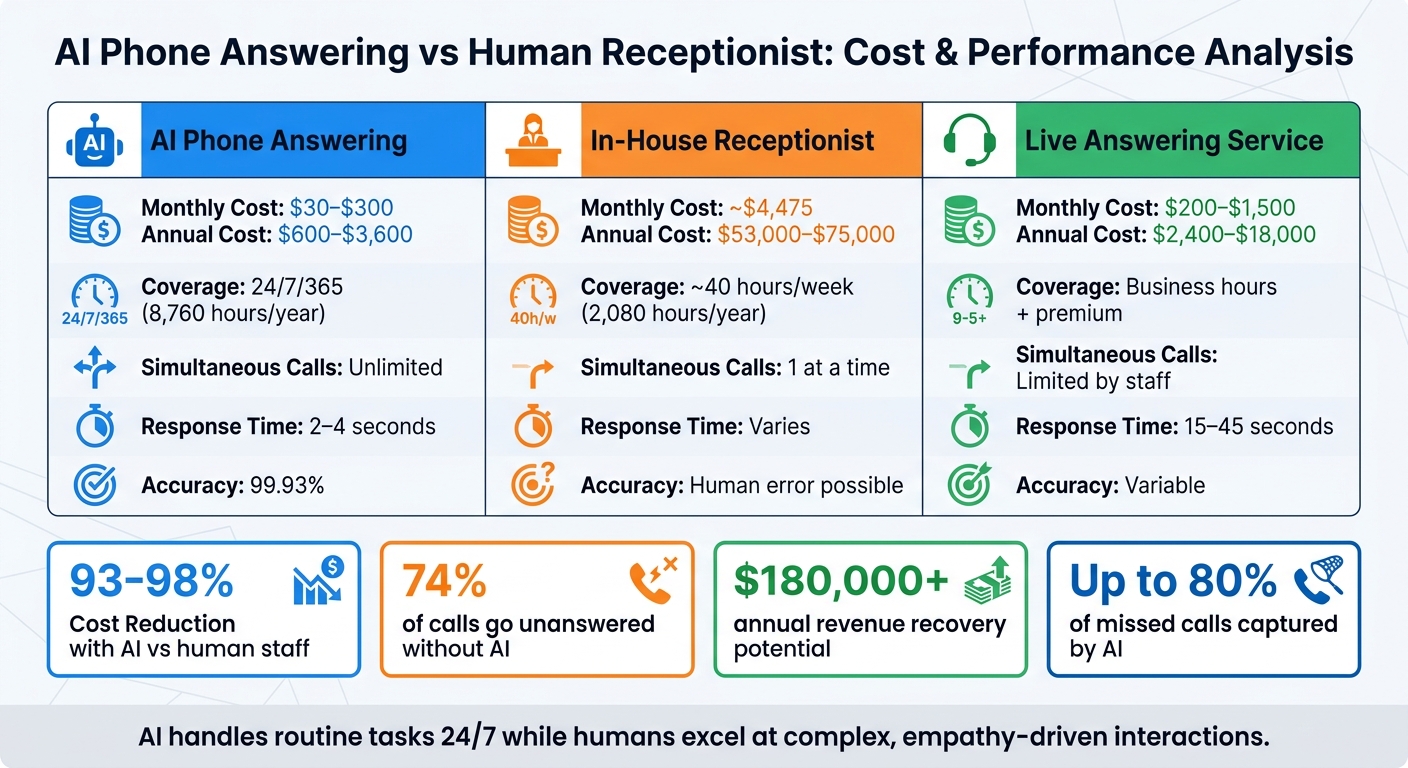
AI Phone Answering vs Human Receptionist Cost and Performance Comparison
How Much Money Are Missed Calls Costing You? AI Receptionist Calculator
sbb-itb-abfc69c
Cost Comparison and Scalability
When evaluating costs, it's important to look beyond the initial price tag and consider how well a solution scales with your business needs. AI phone answering services stand out with their predictable and affordable pricing. Many companies choose from the top AI receptionist services to lock in these rates. Typically, these services cost between $30 and $300 per month under flat-rate plans, while traditional live answering services charge between $200 and $1,500 per month on a per-minute basis. To put this into perspective, handling 500 calls per month would cost around $550 with traditional methods, compared to just $99–$179 using AI. This clear cost advantage highlights why AI call handling becomes a game-changer for scalability.
AI systems scale effortlessly. Unlike human-based services that come with variable costs and capacity limits, AI can manage unlimited calls at a fixed monthly rate. Whether your business handles 10 calls or 100 in an hour, your costs remain steady. On the other hand, traditional services rely on agents who can only handle one call at a time, leading to capacity bottlenecks and rising expenses as call volumes increase.
Service Type Monthly Cost Pricing Model Concurrent Calls Coverage Hours AI Phone Answering $30 – $300 Flat monthly fee Unlimited 24/7/365 (8,760 hrs) Live Answering Service $550 – $1,500 Per-minute billing Limited by staff Business hours + after-hours premium Virtual Receptionist $200 – $800 Per-minute + base fee 1 at a time Business hours only In-house Receptionist ~$4,475 Salary + benefits 1 at a time ~40 hrs/week
This table highlights not only the cost savings but also the operational efficiency AI offers. Take Answering Agent as an example: it delivers 99.93% accuracy over 17,724+ scored calls and can handle unlimited simultaneous calls. This eliminates the uncertainty that Forbes identifies as "one of the top three reasons small businesses cancel their answering service contracts". In contrast, scaling human staff takes 4–8 weeks and costs approximately $4,700 per hire - a stark difference from AI's instant and cost-free scalability.
Another factor to consider is the hidden fees often associated with traditional services. These can include setup charges, holiday surcharges, cancellation penalties, and rounding practices that inflate bills by 20% to 40%. AI providers, on the other hand, generally offer flat, transparent rates with no surprise add-ons, making it easier to budget - even during high-demand periods. This combination of predictable pricing and seamless scalability positions AI as a superior choice for capturing revenue without the headaches of traditional models.
Labor Cost Savings
Comparing AI receptionists vs. human staff reveals that hiring a human receptionist comes with a hefty price tag. Their annual costs include a base salary, payroll taxes, benefits, paid time off, training, turnover expenses, equipment, and office space - amounting to $53,000 to $75,000 per year. As of March 2026, the median receptionist salary stood at $41,617, with benefits adding about 29.5% to that base. Considering the average tenure of just 2.5 years, businesses also incur an additional $1,900 to $4,000 in recruitment and training costs for replacements.
Now, compare this to AI phone answering systems. These solutions cost between $600 and $3,600 annually, offering a massive 93% to 97% reduction in expenses compared to human staff. Beyond the savings, AI systems like Answering Agent have demonstrated their value in real-world scenarios. For instance, Martinez & Associates saved $117,852 annually while increasing new client consultations by 45%. Similarly, CoolAir Services saved $63,812 and saw a 60% jump in emergency service bookings.
Another key advantage? Availability. A human receptionist typically works 40 hours a week, leaving around 128 hours each week uncovered. In contrast, AI systems operate 24/7, providing 8,760 hours of uninterrupted service annually. This round-the-clock coverage ensures no missed opportunities, further strengthening the financial appeal and ROI of AI solutions.
Cost Category Human Receptionist (Annual) AI Phone Answering (Annual) Base Salary $36,000 – $41,617 $0 Benefits & Taxes $9,200 – $12,800 $0 Training & Turnover $1,900 – $4,000 $0 Equipment & Space $2,400 – $5,000 $0 Subscription Fees $0 $600 – $3,600 Total Annual Cost $53,000 – $75,000 $600 – $3,600
"The financial case for AI call answering is overwhelming. With cost savings of 93-97% compared to traditional receptionists... the ROI is typically realized within the first month." - Ringing.io
AI solutions like Answering Agent don’t just save money - they also deliver consistently high performance. For example, Answering Agent maintains 99.93% accuracy across over 17,724 scored calls, all at a flat monthly rate. This eliminates capacity issues, the need for additional hires during peak times, and unpredictable costs, offering businesses reliable and scalable support.
Revenue Impact and Call Accuracy
Missed calls don’t just inconvenience potential customers - they can take a serious toll on revenue. For small businesses, the numbers are sobering: up to 74% of incoming calls go unanswered, leading to an average annual revenue loss of around revenue loss of around $189,068 for contractors alone89,068 for contractors alone. And when calls are missed, most customers don’t wait - they turn to competitors instead.
Traditional voicemail systems don’t fare much better. About 80% of callers hang up instead of leaving a message, capturing only 20% of missed calls. On the other hand, AI phone answering systems can recover between 60% and 80% of these calls. This is particularly important since 27% to 40% of leads call outside normal business hours. The revenue impact of 24/7 answering vs. missed calls can mean thousands of dollars in saved revenue.
Speed is another game-changer. Responding to leads within 5 minutes can increase conversion rates by up to 400%. AI solutions like Answering Agent respond in under 5 seconds, with an impressive 99.93% accuracy rate. This ensures lead information is captured correctly, reducing costly errors caused by miscommunication. Even during peak times, AI systems can handle multiple calls simultaneously, making sure no opportunity slips through the cracks. This is especially effective for service businesses managing missed calls during high-volume periods.
Real-world examples highlight how impactful these systems can be. Peak HVAC Services, for instance, used AI to capture 19 emergency calls per week, translating to $391,836 in additional revenue during the first year. This also boosted their customer satisfaction rating from 4.1 to 4.7 stars. Likewise, Oakes Animal Hospital turned 28 missed calls per week into $221,124 in first-year revenue, achieving payback on their AI investment in just two weeks.
The ability to handle unlimited simultaneous calls is another major advantage. AI systems eliminate busy signals, ensuring every potential lead is attended to, even during high-demand periods. And the financial returns speak for themselves: for many service businesses, just one captured job - worth approximately $3,500 - can cover 17 months of a $199/month AI service subscription. The rest? Pure profit.
Advantages and Disadvantages
When it comes to managing calls effectively, weighing the strengths and weaknesses of AI phone answering systems and live services is essential. Your decision will hinge on factors like your business needs, the complexity of calls, and your budget.
AI Phone Answering offers a major advantage with its 24/7 availability and flat-rate pricing. This eliminates the headache of unexpected fees, which is a common reason small businesses cancel answering service contracts. AI systems can handle an unlimited number of calls simultaneously, with response times as quick as 2–4 seconds. In contrast, live services, limited by staffing, typically take 15–45 seconds to answer a call.
That said, AI has its downsides. While it performs well for routine tasks, it struggles with more complex, empathy-driven calls. Caller satisfaction rates dip significantly, from 91% with human agents to 62–70% with AI. Additionally, many customers - 64%, to be exact - remain wary of AI in customer service, often due to frustrating experiences with rigid, repetitive scripts.
Live Answering Services, on the other hand, shine in areas where empathy and human judgment are crucial. They excel at resolving complex issues and handling high-value conversations. However, live agents aren’t perfect - they can make mistakes when juggling multiple calls. Plus, coverage can be inconsistent during breaks, sick days, or holidays, potentially leading to missed calls during peak business hours.
Here’s a quick comparison of the key features:
Feature AI Phone Answering Traditional Live Answering In-House Receptionist Monthly Cost $30 – $349 $200 – $1,200+ $2,500 – $4,475 Billing Model Flat monthly fee Per-minute / Per-call Salary + Benefits Coverage 24/7/365 Business hours (with premium 24/7 options) ~40 hours/week Simultaneous Calls Unlimited Limited by staff One at a time Response Time 2 – 4 seconds 15 – 45 seconds Varies (can be slower during peaks) Best For routine scheduling and appointments, FAQs, after-hours Complex inquiries, empathy-driven calls Full office management
Given these trade-offs, many businesses find that a hybrid approach works best. By using AI to handle 60–70% of routine calls and reserving human agents for the remaining 30–40% of complex interactions, businesses can save money while still offering a personalized touch.
Conclusion
The numbers speak for themselves: AI-powered phone answering systems offer a massive cost advantage over traditional receptionists. With annual costs ranging from just $300 to $2,148, compared to $43,139 to $73,553 for full-time staff (including benefits, taxes, and turnover), businesses can reduce expenses by an astounding 93% to 99%. But the benefits don’t stop at cost savings - AI also opens up revenue opportunities and lead conversion that human-only setups simply can’t match.
AI ensures that 100% of calls are answered, eliminating the risk of missed opportunities. For service businesses, where the average job value is $350, missing just five calls a day could mean losing over $180,000 in annual revenue. Nearly 40% of calls occur after business hours, and voicemail systems often lead to high abandonment rates - up to 80–85% - as potential customers turn to competitors. AI solves this by responding instantly, keeping customers engaged and ensuring no revenue slips through the cracks.
Here’s a quick way to assess your own potential losses:
Missed calls per week × 52 × Average customer value.
Even a basic calculation could justify adopting AI before considering the $289,560 in potential savings over five years for a small business. The financial and operational advantages make AI solutions an obvious choice for service-based companies.
While transitioning to AI, a hybrid model can ease the shift. However, many businesses are finding that AI’s ability to manage routine tasks - at an impressive 99.93% accuracy - frees up staff to concentrate on more complex, high-value interactions.
Take Answering Agent, for example. This platform sets a new benchmark, handling unlimited simultaneous calls 24/7, booking appointments directly, and delivering results at a fraction of traditional costs. With data from 17,724+ scored calls and 6,820 accepted offers out of 20,375 pitches, the system demonstrates its effectiveness for businesses aiming to scale efficiently.
As highlighted in this analysis, investing in AI isn’t just about cutting costs - it’s a strategic move to boost revenue and elevate overall business performance. For service-oriented companies, the shift to AI is no longer a question of "if" but "when."
FAQs
How do I calculate ROI from an AI phone answering system?
To figure out ROI, you'll need to weigh the financial benefits and cost savings against the initial and ongoing investment in the system. Here's how you can break it down:
- Assess current costs: This includes expenses like receptionist salaries or revenue lost from missed calls.
- Estimate AI system costs: For example, this might be around $199 per month or between $5,000 and $10,000 annually.
- Quantify efficiency improvements: Think about areas like fewer missed calls and the revenue recovered as a result.
Once you've gathered the numbers, plug them into this formula:
ROI = ((Gain - Cost) / Cost) × 100
For instance, if you save $97,875 and gain $108,000 in revenue, the ROI would be a whopping 212%.
What types of calls should stay with a human vs AI?
AI phone answering systems excel at handling routine tasks like scheduling appointments, capturing leads, and responding to frequently asked questions. They can manage high call volumes, operate around the clock, and significantly cut down on missed calls.
That said, calls requiring empathy, nuanced judgment, or sensitivity are best left to human agents. These situations demand emotional understanding, the ability to build trust, and tailored interactions. For many businesses, combining AI with human support offers a balanced and effective solution.
How does AI handle peak call volume and after-hours calls?
AI phone answering systems handle peak call volumes and after-hours calls with round-the-clock availability and the ability to manage unlimited simultaneous calls. This ensures that no calls slip through the cracks during busy periods or outside normal business hours. Unlike human receptionists, AI can instantly scale to meet demand, efficiently booking appointments, capturing leads, and escalating urgent matters when necessary. This helps businesses maintain high-quality service, minimize missed opportunities, and boost revenue.
Related Blog Posts
Book a walkthrough
See it handle your calls.
Book 20 minutes, or hear a sample call first.
Ready to see it handle your calls?
Book a walkthrough, or hear a short sample call first.
Related Articles

How to Handle Failed Payment Calls on a Car Wash Membership
How wash desks handle failed payment and card-update calls on a membership without turning the call into a gate lockout.

Car Wash Membership Phone Calls: A Desk Guide
A desk guide to the membership phone calls car washes take, with links to the deep how-tos.

How to Handle Pickleball Guest Fee Calls
Handle pickleball guest fee calls by identifying the visit type, quoting the written fee sheet, and confirming payment, court access, and check-in requirements.