
Multi-call handling algorithms, often referred to as Automatic Call Distribution (ACD), are systems that efficiently route incoming calls based on urgency, caller details, and agent availability. These algorithms go beyond the traditional first-in, first-out method by prioritizing calls, matching customers with skilled agents, and reducing hold times. Businesses using these systems can manage higher call volumes without increasing staff, improve customer satisfaction, and boost revenue.
Key Features:
- Dynamic Call Routing: Routes calls based on factors like caller identity, urgency, and agent skills.
- Simultaneous Call Handling: Uses multi-ring technology to connect calls faster.
- Workload Distribution: Distributes calls evenly or prioritizes based on agent expertise.
- Queue Management: Dynamically reorders queues to prioritize urgent or VIP calls.
- AI Integration: Tools like Answering Agent handle unlimited calls, automate tasks, and improve response accuracy.
Benefits:
- Reduces missed calls and hold times by addressing common queue issues with AI.
- Increases first-call resolution rates by up to 18%.
- Enhances efficiency with features like skills-based routing and AI-powered automation.
- Scales operations without proportional increases in staffing.
Whether you're a small business or a large enterprise, these systems ensure every call reaches the right person at the right time, improving customer experience and operational efficiency.
Advanced Call Routing (Definition, Strategies, Use Cases)
sbb-itb-abfc69c
How Multi-Call Handling Algorithms Work
Multi-call handling algorithms process incoming calls in just milliseconds. They assess factors like caller identity, the time of day, agent availability, and skill requirements, all based on predefined business rules. When a call is received through SIP trunks or PSTN lines, the system extracts the ANI (Automatic Number Identification) and immediately queries CRM records to determine the most suitable routing path.
Here’s how the system manages call placement and routing.
Simultaneous Call Placement and Routing
When multiple calls arrive simultaneously, the system uses inbound multi-ring (or call blast) technology. This method allows a single incoming call to ring multiple agents or devices at the same time. The first agent to answer connects with the caller, while the ringing stops for everyone else. Some platforms can handle up to seven simultaneous lines, significantly cutting down on hold times and reducing missed calls.
"Concurrent calls solve a straightforward problem: the gap between when a call arrives and when an agent answers it."
– Tarandeep Singh, Support Manager, JustCall
For outbound calls, the system uses parallel dialing, which works a bit differently. It dials multiple leads at once, and when a lead answers, that call is instantly routed to an available agent while the remaining dial attempts are dropped. However, outbound systems must comply with the FTC's Telemarketing Sales Rule, which limits abandoned call rates to no more than 3% of answered calls per day. To stay within this limit, systems typically start with a dialing ratio of 1.5 to 2 calls per available agent. If the system reaches maximum capacity, virtual queuing steps in to hold caller positions and initiate automated callbacks.
Workload Distribution Methods
Once calls are placed, distributing the workload efficiently becomes the next priority. Round-robin routing ensures calls are rotated in a fixed sequence, preventing any single agent from being overburdened. Longest-idle agent routing, on the other hand, directs the next call to the agent who has been waiting the longest, ensuring everyone stays productive. Skills-based routing takes it a step further, matching callers’ needs - such as language preferences or technical expertise - with agents who have the required skills, improving the chances of resolving issues on the first call.
A great example of advanced workload distribution comes from Mercado Libre's Stream Service. In June 2024, their team managed an astounding 30 million messages per minute across 12,000 origins and 15,000 destinations. Initially, they used equal distribution, but this approach proved inefficient when processing speeds varied among instances. To fix this, they implemented a worker-balancer mechanism using an asynchronous in-memory buffer. This tracked "used permits" against "designated permits", allowing the system to reallocate resources from slower instances to faster ones. The result? A 95% reduction in lag alerts.
"Continuous minute-by-minute assessment allows for ongoing adjustments until the optimal distribution is achieved."
– Guillermo Areosa, Mercado Libre
Dynamic Prioritization and Queue Management
Modern algorithms go beyond basic first-in, first-out systems by dynamically reordering queues as new, high-priority calls come in. Calls are assigned weighted scores based on factors like wait time, caller attributes (e.g., VIP status), and issue urgency. AI-powered tools analyze caller sentiment and keywords - such as "emergency" or "system down" - to automatically escalate critical situations.
Real-time CRM integration plays a crucial role here, enabling the system to retrieve account history, lifetime value, and contract details in milliseconds. When queue depths and wait times exceed acceptable levels, overflow protocols kick in, rerouting calls to backup teams or alternate paths. These advanced prioritization techniques can cut call abandonment rates by 40–60%. Systems like Answering Agent push these capabilities further, handling unlimited simultaneous calls with AI-driven precision. With 99.93% accuracy across over 17,724 scored calls and a 31% conversion rate for membership sales, it’s clear that these technologies are reshaping call management.
Types of Multi-Call Handling Algorithms
Service businesses often rely on three primary multi-call handling algorithms to address different operational needs effectively.
Round Robin Routing is a straightforward method that distributes incoming calls evenly among available agents. This ensures that no single agent is overwhelmed while others remain idle. It’s most effective when all agents have similar skill sets, such as in general customer service teams. By balancing workloads, this approach helps maintain efficiency and prevents bottlenecks during high call volumes.
Skills-Based Routing takes a more targeted approach by matching callers with agents who possess the specific expertise required. For example, technical issues or language-specific requests are directed to agents with the necessary skills. In law firms, senior partners might handle complex cases like breach-of-contract disputes, while associates manage routine matters. Similarly, home service companies can prioritize urgent calls, such as a "no heat" emergency in winter, by assigning them to specialized technicians. This method ensures that customer needs are met quickly and effectively. For businesses operating across time zones, 24/7 global coverage ensures no call goes unanswered. While this approach is ideal for inbound calls, outbound operations often require a different tactic.
Predictive Dialing is tailored for outbound campaigns, where efficiency is key. This system dials multiple numbers simultaneously, filtering out busy signals, voicemails, and unanswered calls, connecting agents only to live respondents. By automating the dialing process, it significantly increases productivity. For instance, in April 2026, a moving company’s call center reported a 30–40% boost in sales conversions after adopting this strategy.
"The core problem in most call centers is timing mismatch - too many calls arriving at once, or agents finishing calls and sitting idle while the dialer works through a list one number at a time."
– Tarandeep Singh, Support Manager, JustCall
The choice of algorithm depends on your business needs. Round Robin works well for teams with evenly distributed skills handling similar inquiries. Skills-Based Routing is perfect for scenarios where specialized knowledge ensures first-call resolution. Predictive Dialing, on the other hand, is ideal for sales-driven operations focused on maximizing contact rates. Many modern systems now combine these methods, using skills-based logic for inbound calls while enabling unlimited simultaneous conversations without traditional agent limitations.
How to Implement Multi-Call Handling Algorithms
Choosing the Right Algorithm for Your Business
The first step in managing multiple calls effectively is choosing an algorithm that fits your business needs. For small teams with 15 or fewer agents handling similar types of calls, round-robin or longest-idle routing works well. These methods distribute calls evenly, helping prevent burnout and reducing agent turnover by 8–12%. However, if your team grows beyond 15 agents or your call types become more varied, skills-based routing becomes a must. This approach can boost first-call resolution rates by 12–18% and cut average handle time by 8–15%.
If you're dealing with high inbound call volumes, consider systems with multi-ring technology to keep hold times low. For outbound sales campaigns, parallel dialing can increase the number of agent conversations. Keep in mind that the FTC limits abandoned calls to 3% per campaign per day, so pacing your calls correctly is essential.
"Call routing strategy is the highest-leverage decision in contact center operations." – CallSphere Team
For small businesses, unanswered calls can be a major issue - 62% of calls may go unanswered, and 85% of those callers won’t try again. AI call routing for service businesses can help by handling multiple calls at once and filtering out spam. They also enable 24/7 coverage without needing overnight staff. For VIP customers, data-directed routing uses CRM information to prioritize high-value callers, connecting them to senior agents or shorter wait times.
Optimizing Algorithm Performance
Once you've chosen a call-handling strategy, the next step is to fine-tune its performance. Monitor metrics like answer rates, calls per agent per hour, and average wait times daily during the first two weeks of implementation. Ideally, your call abandonment rate should fall between 5–8%. If it’s higher, adjustments to the algorithm may be necessary. The best operations bring this rate down to 2–3%.
Testing is crucial. Use A/B testing to compare routing changes by splitting incoming calls into control and test groups. Run these tests for 2–4 weeks to measure their impact on first-call resolution and customer satisfaction before rolling out changes fully. Update routing rules and agent skill assignments every quarter to keep up with changes in staffing, training, and call volume. Also, ensure you have fallback options like AI receptionists, voicemail, or secondary ring groups for times when no agents are available.
Natural language IVR systems are another way to boost efficiency. These systems identify caller intent with 85–92% accuracy, saving 40–60 seconds per interaction compared to traditional button-based menus. Virtual hold technology, which offers callbacks, can reduce queue pressure and lower abandonment rates by 30–40%. To make these technologies work smoothly, you’ll need reliable internet and properly configured Quality of Service (QoS) settings on your routers to avoid audio delays.
Using AI Solutions Like Answering Agent
When staffing or hardware limits scalability, AI solutions like Answering Agent can step in. Unlike traditional algorithms, which rely on the availability of agents, AI can handle unlimited simultaneous calls around the clock. For example, Answering Agent has processed over 17,724 scored calls with a 99.93% accuracy rate and pitched 20,375 offers, of which 6,820 were accepted.
This system uses natural language processing to understand caller intent, eliminating the rigid structure of IVR menus. It can resolve requests independently or route calls to the right department. Additionally, it automates tasks like booking appointments, capturing leads, and syncing data to CRMs, reducing manual data entry by 90% and saving 30–60 minutes per day. At Jacksons Car Wash, the AI promoted special offers and converted 31% of price inquiries into unlimited memberships.
"I love Answer Agent, it allows my employees to focus on customers at the car wash while giving callers an opportunity to get simple answers while my staff is busy." – Waves Car Wash
Cost is another advantage of AI receptionists. While live answering services range from $200 to $700+ per month with extra per-minute charges, AI receptionists start at about $25 per month. For service businesses, where 80% of callers hang up and call competitors if sent to voicemail, AI ensures 100% call capture while cutting phone operation costs by up to 40%.
Comparison Table: Algorithm Types and Applications
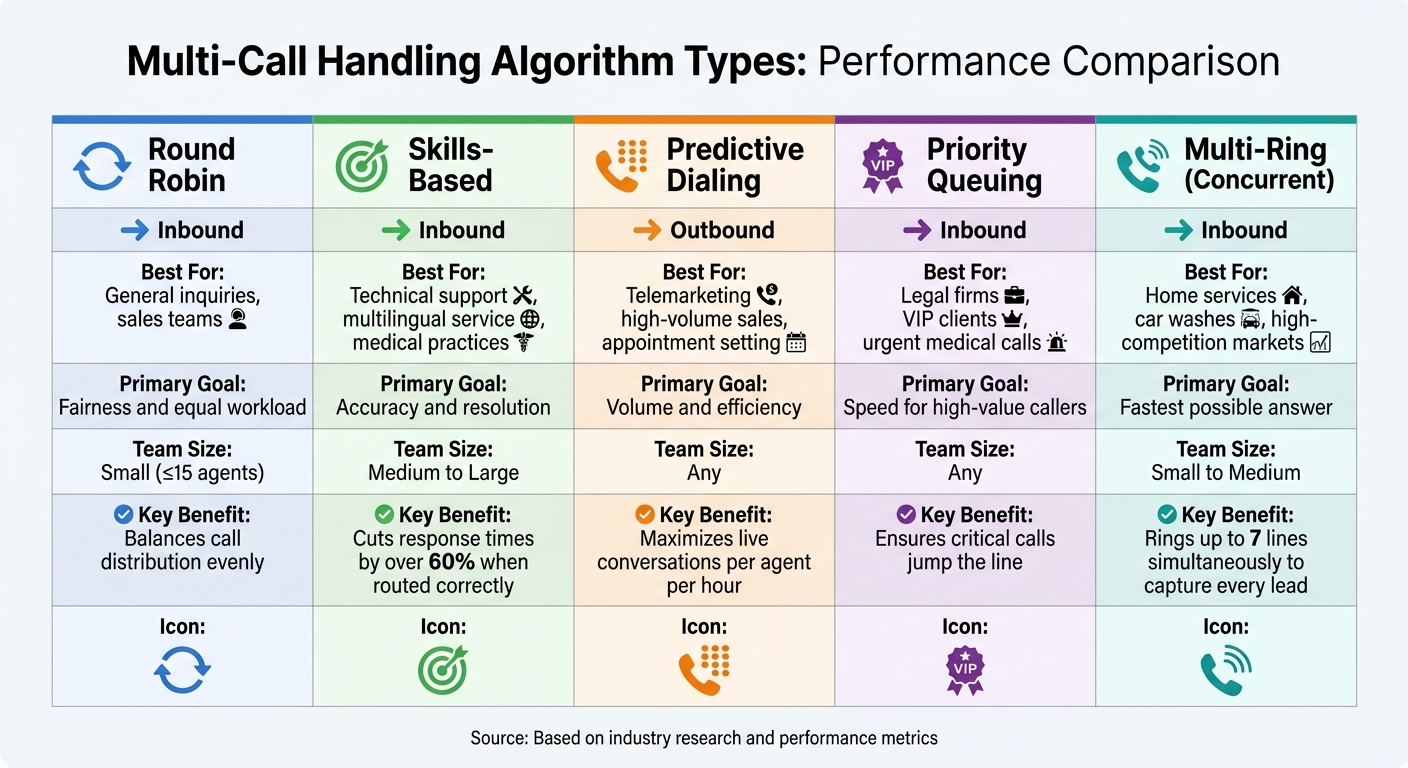
Multi-Call Handling Algorithm Types Comparison Chart
Choosing the right algorithm depends on your business model, team dynamics, and caller priorities. For example, Round Robin is ideal when fairness is key. Sales teams with 15 or fewer agents handling similar calls benefit from evenly distributed workloads, preventing any single agent from being overwhelmed. On the other hand, Skills-Based Routing thrives in technical support or multilingual settings, connecting callers to the right expert and improving first-call resolution rates by 12–18%. For outbound campaigns, Predictive Dialing maximizes agent talk time by skipping voicemails and unanswered calls. A moving company reported a 30–40% increase in sales conversions after implementing this method.
These examples highlight how selecting the right algorithm aligns with specific business goals. The table below breaks down the performance of each algorithm across key factors, helping you determine the best fit for your needs.
Algorithm Type Direction Best For Primary Goal Team Size Key Benefit Round Robin Inbound General inquiries, sales teams Fairness and equal workload Small (≤15 agents) Balances call distribution evenly Skills-Based Inbound Technical support, multilingual service, medical practices Accuracy and resolution Medium to Large Cuts response times by over 60% when routed correctly Predictive Dialing Outbound Telemarketing, high-volume sales, appointment setting Volume and efficiency Any Maximizes live conversations per agent per hour Priority Queuing Inbound Legal firms, VIP clients, urgent medical calls Speed for high-value callers Any Ensures critical calls jump the line Multi-Ring (Concurrent) Inbound Home services, car washes, high-competition markets Fastest possible answer Small to Medium Rings up to 7 lines simultaneously to capture every lead
For example, medical practices benefit from Skills-Based Routing to connect patients to the correct department, while Priority Queuing ensures urgent cases are addressed immediately. Similarly, legal firms can use CRM-integrated routing to connect VIP clients directly with senior partners. In home services like HVAC or plumbing, Multi-Ring systems give businesses a competitive edge by ensuring they’re the first to respond, which often secures the job.
If your team struggles to scale during peak periods, AI solutions like Answering Agent can step in. At Jacksons Car Wash, this AI tool converted 31% of price inquiries into unlimited memberships, outperforming traditional routing methods.
"Smart routing connects customers with the right expert on the first try... response times can drop by over 60% when calls are routed correctly." – Silvana Lucido-Balestrieri, Content Specialist, CloudTalk
Conclusion
Multi-call handling algorithms have come a long way, evolving from basic rotation systems into sophisticated tools that use data to streamline call routing, improve efficiency, and drive revenue. These advanced systems don’t just answer calls - they ensure callers are connected to the right resource, minimizing delays during busy periods and reducing missed opportunities. Whether it’s a medical practice relying on skills-based routing to direct patients to the right department or a home services company needing quick call responses to secure leads, these systems are reshaping how service businesses function.
The numbers speak for themselves. Optimized call handling can have a measurable impact. For example, a 5% improvement in first-call resolution could save a 100-agent call center approximately $730,000 annually. Skills-based routing alone has been shown to increase first-call resolution by 12% to 18% while cutting down average handle time by 8% to 15%. Even smaller businesses benefit significantly - 78% of customers will go with the first company to answer their call. This highlights just how critical speed and availability are in today’s competitive landscape.
Modern, AI-powered call management systems are addressing the limitations of traditional methods. Older approaches often rely on manual processes, leading to busy signals during peak times and leaving calls unanswered after hours. AI solutions, like Answering Agent, solve these problems by offering 24/7 call coverage with an impressive 99.93% accuracy rate. For instance, Jacksons Car Wash leveraged this technology to convert 31% of price inquiries into unlimited memberships, showing how intelligent call management can directly contribute to revenue growth.
Switching to algorithm-based call management isn’t just an upgrade - it’s a necessity. Whether you’re a small team using round-robin routing, a specialized service relying on skills-based distribution, or a business needing scalable 24/7 AI coverage, the right system can significantly improve customer satisfaction, operational efficiency, and revenue. The key is choosing the algorithm that aligns best with your business needs and implementing it without delay. Take the leap and transform your service operations today.
FAQs
What’s the best routing algorithm for my call volume and team size?
When choosing a routing algorithm, it all comes down to what your team needs. If you're aiming for scalability and efficiency, AI-driven dynamic distribution algorithms are a top choice. These leverage machine learning and natural language processing to assess factors like urgency, caller history, and even sentiment. The result? Shorter wait times and faster issue resolution.
For teams that are expanding, intelligent routing systems - like the highest-skill-first method - shine during high call volumes by matching calls to the most qualified agents. On the other hand, smaller teams might find simpler methods, such as 'Most Idle,' more practical. However, keep in mind that these basic approaches don’t offer the advanced capabilities that larger or more complex setups might require.
How do I set call priorities without hurting fairness and wait times?
To manage call priorities effectively while keeping wait times low and ensuring equitable treatment, consider using intelligent routing algorithms like Most Idle. This method directs calls to the agent who’s been idle the longest, promoting fairness. Pair this with prioritization rules that consider factors like the caller’s value or the urgency of their issue. Additionally, call queue management systems can help connect callers with the most appropriate agents, reducing wait times and maintaining balanced service.
When should I use an AI solution like Answering Agent instead of agents?
An AI solution like Answering Agent can be a game-changer for businesses managing high call volumes, ensuring availability around the clock, or aiming to cut staffing costs. Here's why it stands out:
- Exceptional Accuracy: With an impressive 99.93% accuracy over 17,724 calls, it delivers reliable and natural responses.
- Versatile Capabilities: It can book appointments, capture leads, and handle unlimited simultaneous calls - all without missing a beat.
- Cost Efficiency: At approximately $199/month, it’s a fraction of the cost compared to maintaining a human call center team.
This makes AI a smart choice for scaling operations, automating repetitive tasks, and keeping expenses under control - all while maintaining excellent service quality.
Related Blog Posts
Book a walkthrough
See it handle your calls.
Book 20 minutes, or hear a sample call first.
Ready to see it handle your calls?
Book a walkthrough, or hear a short sample call first.
Related Articles

How to Handle Car Wash Membership Upgrade and Downgrade Calls
How wash desks handle membership upgrade and downgrade calls without invented prices or turning a plan change into a cancel fight.

How to Handle Pickleball Membership Cancellation Calls
How pickleball club desks handle membership cancellation calls without inventing policy or fighting the member.

How to Handle Failed Payment Calls on a Car Wash Membership
How wash desks handle failed payment and card-update calls on a membership without turning the call into a gate lockout.