AI dispatch assigns and routes technicians by weighing skills, location, traffic, SLAs, and customer history together, then reworks the schedule in seconds when the day changes. For field service ops teams, the goal is less windshield time, fewer repeat visits, and more on-time arrivals without adding trucks or headcount.
This post covers how these systems make decisions, the results companies report, and where dispatchers still fit.
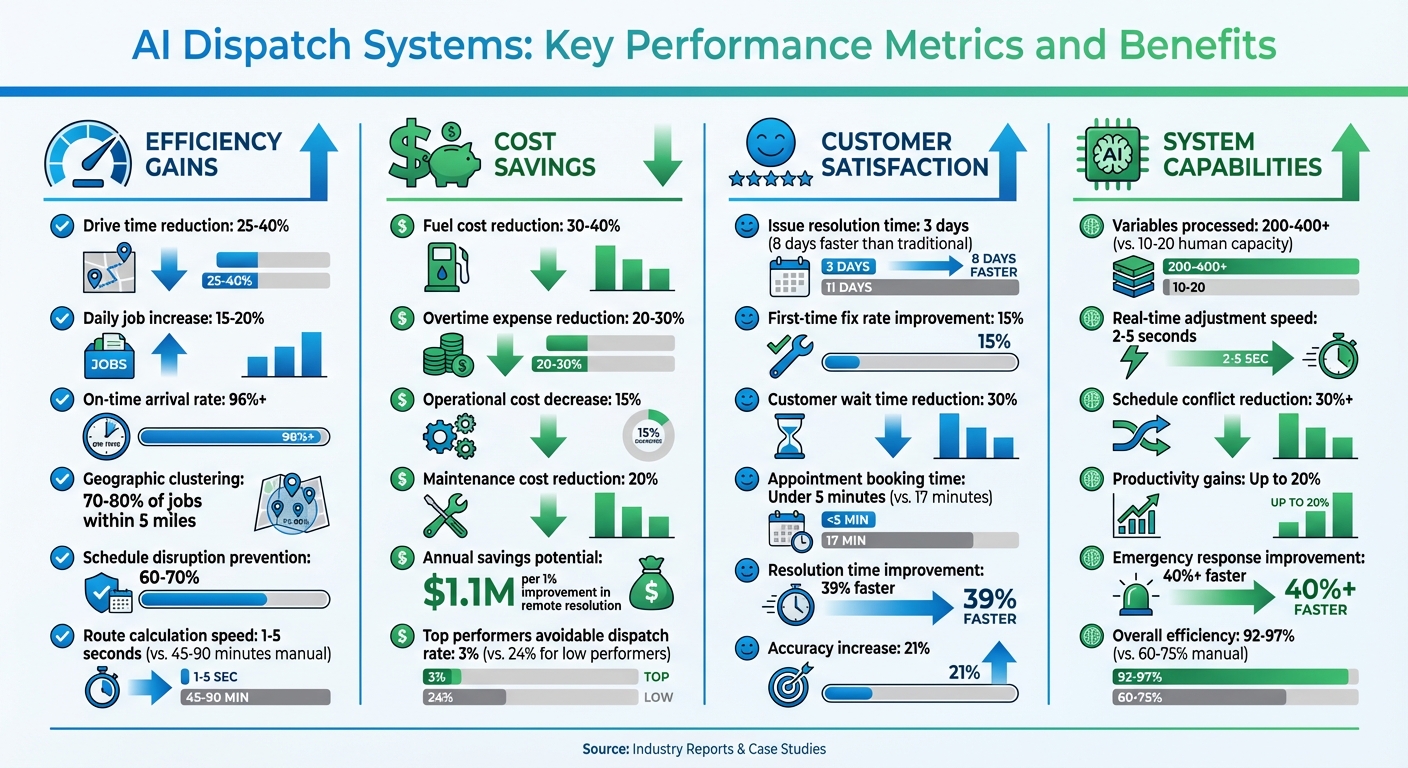
AI Dispatch Systems: Key Performance Metrics and Benefits for Field Services
How AI Dispatch Systems Solve Field Service Problems
AI Features That Improve Dispatch Operations
An AI dispatcher can weigh 200–400+ variables at once, including certifications, GPS position, traffic, customer preferences, and SLA terms. A human dispatcher typically holds 10–20.
The process runs in two passes:
- Feasibility filtering. The system removes any technician who lacks the required certification or isn't available in the time window. An unlicensed tech never gets regulated gas work, however close they are.
- Scoring. Every remaining technician-job pair gets a score based on skill fit, travel, workload balance, SLA risk, and whether the customer has worked with that tech before.
When a job runs long, traffic backs up, or an emergency comes in through AI phone scheduling, the system re-optimizes only the affected part of the schedule, usually in 2–5 seconds. Teams using these tools are 2.6 times more likely to be high performers in field service.
Matching Technicians to Jobs by Skill Level
AI replaces "send the closest available tech" with a ranked set of rules.
| Constraint type | Examples | How the system treats it |
|---|---|---|
| Hard | Licenses, certifications, shift boundaries | Never broken |
| Soft | Drive time, repeat customer with a familiar tech | Traded off against each other |
The system also learns from job history which technicians close specific job types well and sends them similar work. Companies report a 15% lift in first-time fix rates from skill-based assignment. Machine learning cuts scheduling conflicts by more than 30%, and teams using real-time analytics report productivity gains of up to 20%.
Smart Routing and Live Schedule Updates
Routing targets the usual drive-time waste: backtracking, zigzagging between zones, extra depot runs, and techs finishing far from home. The system clusters nearby jobs, for example three stops within 2 miles. It also watches live traffic through sources like the Google Maps API and reroutes or updates ETAs as delays happen. These live adjustments prevent 60–70% of traffic- and delay-driven disruptions.
Multi-day route chaining starts tomorrow's route where today's ended, which cuts return-to-depot trips. The system evaluates millions of route combinations in 1–5 seconds. A human planner needs 45–90 minutes to produce a less accurate plan.
AI vs Manual Dispatching: Traditional Dispatch vs AI Dispatch Explained
Main Benefits of AI Dispatch Systems
Better Efficiency and Higher Productivity
Companies report 25–40% less drive time, which lets technicians finish 15–20% more jobs a day without longer hours. Clustering keeps 70–80% of jobs within 5 miles of the previous stop.
Small savings add up at volume. In 2025, a major North American auto club that handles 6 million roadside calls a year adopted AI dispatch. It saved about 5 minutes per event, more than 30 million minutes a year.
Manual scheduling time drops by about 50%, and fewer scheduling conflicts reach the board. Dispatchers can spend that time on exceptions and urgent calls.
Lower Costs and Better Operations
- Fuel: 30–40% lower, because trucks drive fewer miles.
- Overtime: 20–30% lower, because the system watches hours as it schedules.
- Avoidable dispatches: 3% at top performers, compared with 24% at laggards. The system weighs job value and SLA penalty risk before it sends a truck.
- Remote resolution: each 1% gain saves large organizations about $1.1 million a year.
One company reported 25% higher productivity and 21% better SLA compliance after rollout. Across adopters, operating costs fall about 15%, and service costs fall by up to 23% for companies that use AI well. Connecting scheduling to ERP and CRM can cut schedule-related costs by as much as 30%.
Improved Customer Experience
AI dispatch delivers on-time arrival rates above 96%. Better skill matching and correct parts on the truck mean fewer return visits, and average resolution time drops to 3 days, which is 8 days faster than traditional methods.
"AI-powered solutions enable top-performing organizations to achieve a 39% faster resolution time and a 21% increase in accuracy" – Assaf Melochna, CEO and Co-founder, Aquant.
Most customers (75%) prefer real-time updates, and live ETAs and arrival notices provide them. Predictive dispatching cuts wait times by 30%. AI scheduling assistants cut booking time from 17 minutes to under 5.
AI Dispatch in Practice
Live Scheduling and Last-Minute Changes
When a job gets added or runs over, incremental solvers slot the change in without rebuilding the rest of the day's routes. Speed matters more than a perfect schedule here:
"A 96% optimal schedule delivered in 3 seconds beats a 98% optimal schedule delivered in 45 seconds. Your dispatcher needs answers now, not mathematical perfection." – FieldCamp
Hard rules still hold during a reshuffle. The system won't send an uncertified tech who happens to be closer. It may accept a longer drive for a tech with a better track record on that job type. Pairing dispatch with AI call answering means requests are captured the moment they come in, so the dispatcher can act on them right away.
Predicting Maintenance Needs Before They Happen
Predictive maintenance schedules service before equipment fails. The system reads job history and IoT sensor data for early warning signs, such as unusual vibration or temperature spikes, and books a preventive visit. Companies report 30–50% fewer unexpected breakdowns and 20% lower maintenance costs.
The system also flags job types that consistently run long and routes them to the techs who handle them best. That has cut response times by up to 25%.
Assigning Resources Based on Priority
When urgent jobs stack up, the system scores each pairing on proximity, skill, the risk of missing the window, and the cost of a miss, such as VIP commitments or SLA fines. It will send a farther tech with a higher first-time fix rate when that tech is the better bet. Emergency response delays drop by more than 40%. AI dispatch runs at 92–97% efficiency, compared with 60–75% for manual methods.
"AI dispatching doesn't optimize individual jobs. It optimizes the entire schedule simultaneously. A decision that adds 12 minutes to one route might save 45 minutes of callbacks." – FieldCamp
Conclusion
Long-Term Advantages of AI Dispatch
The system improves with use. Every completed job and every manual override your dispatchers make feeds back into later assignments.
It also keeps knowledge in the company. Job data and senior techs' notes become a searchable record, which cuts new-hire ramp time from months to weeks. That matters when 74% of employers struggle to find skilled workers.
What Business Owners Should Know
"In the next few years, the best technician won't define service performance, but rather how quickly every technician can perform like your best." – IBM Think Insights
AI dispatch moves operations from reacting to planning ahead. Customers expect this too: 89% expect modern scheduling tools and will pay more for them.
FAQs
How does AI dispatch boost technician efficiency and productivity?
It assigns jobs based on skills, live traffic, workload, and customer needs, then clusters nearby stops and reroutes around delays. Technicians drive less, sit idle less, fix more on the first visit, and finish more jobs per day.
How can AI dispatch systems help companies save on field service costs?
Shorter routes cut fuel, schedule-aware assignment cuts overtime, and SLA-risk scoring cuts avoidable dispatches. Companies that use AI well have lowered service costs by up to 23%.
How do AI dispatch systems improve customer satisfaction in field services?
Better routing and skill matching get technicians there on time and fix the problem on the first visit more often. Automated ETAs and arrival notices keep customers informed.
Related Blog Posts
Book a walkthrough
See it handle your calls.
Book 20 minutes, or hear a sample call first.