Law Firm Success With AI: 24/7 Call Handling Stories
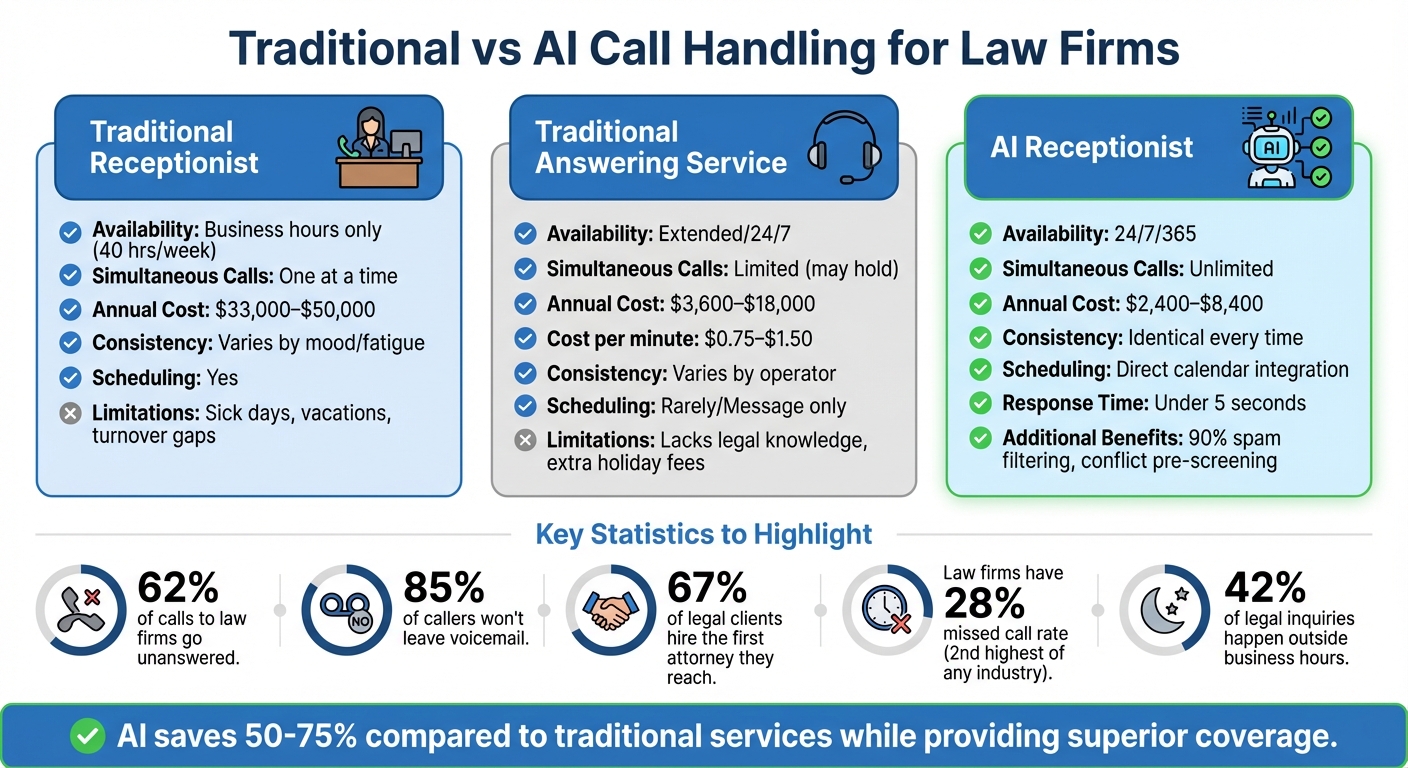
Every missed call costs law firms money and clients. Here’s why: 62% of calls to law firms go unanswered, and 85% of callers won’t leave a voicemail. With legal clients often hiring the first attorney they reach, missing calls can result in huge lost revenue - especially for personal injury cases, where a single lead could mean $15,000–$25,000 in fees.
AI phone answering systems solve this problem by providing 24/7 availability, instant response times, and the ability to handle unlimited calls simultaneously. Firms using AI have reported results like a 340% increase in qualified leads and millions in additional revenue.
Key Benefits of AI Call Handling:
- 24/7 Coverage: Handles calls day and night, even on weekends.
- No Missed Opportunities: Answers every call instantly, ensuring no client is lost to voicemail.
- Cost-Effective: Costs less than hiring additional staff or using traditional answering services.
- Lead Qualification: Automates intake, scheduling, and conflict checks, saving attorneys time.
Firms like Wilson Law Group have seen dramatic improvements, cutting response times from hours to seconds and capturing millions in revenue. AI isn’t just a tool - it’s a competitive edge for firms looking to grow while staying efficient.
This AI Tool Will Sign Clients For You While You Sleep
sbb-itb-abfc69c
Call Volume Challenges Law Firms Face
AI vs Traditional Receptionists for Law Firms: Cost and Performance Comparison
Law firms face a tough reality when it comes to managing their call volume. Here's a striking statistic: 35% of calls to small and mid-sized law firms go unanswered during normal business hours (10 a.m. to 4 p.m.). This isn't just an operational hiccup - it's a massive financial issue. Missed calls contribute to an estimated $109 billion in annual revenue losses across the legal industry due to lost opportunities for client conversion.
The reasons behind this problem are clear but not easily solved with traditional methods. A human receptionist can only handle one call at a time, which inevitably leads to hold times or busy signals when multiple calls come in simultaneously. On top of that, staff members often prioritize billable tasks over phone calls, creating administrative bottlenecks. And with 42% of legal inquiries happening outside regular business hours, even the most diligent in-house team can’t provide the constant coverage modern clients expect. These challenges highlight the urgent need for more effective call-handling solutions to preserve revenue and maintain client satisfaction.
How Missed Calls Affect Revenue and Client Experience
Every missed call isn’t just a lost opportunity - it’s a direct hit to a law firm’s marketing investment and potential revenue. For personal injury cases, the stakes are even higher. But the damage doesn’t stop at financial losses. When clients encounter voicemail instead of a live response, they often see it as a warning sign that the firm may be understaffed or disorganized. This perception can lead to negative online reviews, which frequently mention unreturned calls or poor first impressions, further tarnishing the firm’s reputation and hindering future lead generation.
Why Traditional Receptionists Fall Short
Traditional staffing models struggle to meet the demands of today’s legal clients. An in-house receptionist, who typically costs between $33,000 and $50,000 annually (including benefits), only provides 40 hours of weekly coverage. This leaves nights, weekends, and holidays uncovered. While traditional answering services can extend coverage, they charge $0.75 to $1.50 per minute, with extra fees for holidays and after-hours calls. These costs can quickly spiral as call volumes increase.
Operational issues make things even tougher. Human receptionists are subject to sick days, vacations, and turnover, which all create gaps in phone coverage. Additionally, general answering service operators - who handle calls for multiple industries - often lack the legal knowledge needed to properly qualify leads or perform conflict checks. It’s no surprise that law firms experience the second-highest missed call rate of any industry - 28% - second only to healthcare.
| Factor | Traditional Receptionist | Traditional Answering Service | AI Receptionist |
|---|---|---|---|
| Availability | Business hours only | Extended/24/7 | 24/7/365 |
| Simultaneous Calls | One at a time | Limited (may hold) | Unlimited |
| Annual Cost | $33,000–$50,000 | $3,600–$18,000 | $2,400–$8,400 |
| Consistency | Varies by mood/fatigue | Varies by operator | Identical every time |
| Scheduling | Yes | Rarely/Message only | Direct calendar integration |
Key Features of AI Phone Answering for Law Firms
AI phone answering systems offer three standout features that tackle the common call-handling challenges faced by law firms: 24/7 availability, natural client interactions, and automated scheduling with lead capture. These tools fill the gaps left by traditional phone systems, helping firms retain potential clients while improving their intake process.
24/7 Availability and Unlimited Call Handling
AI systems answer calls in under five seconds - an essential speed, given that 67% of legal clients hire the first attorney they connect with. Unlike human receptionists, AI doesn’t face limits. It can handle unlimited simultaneous calls, ensuring no caller ever hears a busy signal, even during peak hours or after business hours.
The ability to answer calls around the clock is especially critical for law firms. Many legal inquiries happen outside standard office hours. For example, personal injury cases often involve urgent calls - someone contacting a lawyer at 2 a.m. after an accident is unlikely to leave a voicemail. In fact, 85% of callers won’t leave a message. AI ensures these leads are captured immediately, giving firms a competitive edge in retaining clients during urgent situations.
Not only is AI always available, but it also provides a personalized touch with every interaction.
Natural Conversations and Customizable Scripts
By using natural language processing (NLP), AI systems can interpret a caller’s tone, intent, and even emotional cues, creating conversations that feel natural and engaging. This is particularly important for law firms, as many clients reach out during stressful times. A calm, professional interaction can reassure callers that their concerns are being addressed.
Customizable scripts allow firms to tailor the AI’s responses to reflect their brand voice and practice areas. For instance, a personal injury script can ask about accident details and injuries, while an estate planning script might focus on family structure and assets. This tailored approach not only demonstrates expertise but also ensures consistent data collection. Advanced AI systems can even detect frustration or urgency in a caller’s tone, automatically escalating the call to a human attorney when necessary.
Beyond handling conversations, AI also simplifies scheduling and lead management.
Appointment Scheduling and Lead Capture
AI receptionists integrate seamlessly with tools like Clio, Lawmatics, and Google Calendar to schedule consultations in real-time. This eliminates the back-and-forth of phone tag and reduces manual data entry. The system also qualifies leads by checking criteria like practice area fit, jurisdiction, and potential conflicts before booking appointments. All interactions are logged into your CRM, complete with transcripts and caller details, giving your team immediate access to actionable data.
For urgent situations, AI can identify keywords such as "arrested" or "accident" and instantly notify an on-call attorney via transfer or SMS. By filtering out 90% of spam and nuisance calls, the system can save attorneys around 15 billable hours each month.
Take the example of Wilson Law Group in Chicago. Between 2025 and 2026, they implemented AI call handling and saw their average response time drop from over four hours to just 45 seconds. Within 90 days, they captured a 340% increase in qualified leads from after-hours calls, generating $2.1 million in additional revenue during their first year. This shows just how transformative AI phone answering can be for law firms.
Law Firm Success Stories With AI Call Handling
Law firms are seeing real results by using AI to manage calls around the clock. This approach ensures that every call, no matter the time, becomes an opportunity to grow their business.
Personal Injury Firm: 400% Increase in Booked Consultations
A personal injury firm implemented AI-powered phone answering designed to match their intake and qualification processes. Instead of losing leads to after-hours voicemail, the AI stepped in to handle calls day and night. It assessed case viability instantly and scheduled consultations directly into the firm’s calendar. Within just a few months, the firm saw a staggering 400% jump in booked consultations. By extending their team with AI, they maximized their ability to capture every potential client.
Family Law Practice: 40% Efficiency Gain in Client Onboarding
Family law firms often deal with emotionally charged clients who need clear guidance and reassurance. One mid-sized family law practice struggled with inconsistent intake processes and staff burnout from balancing administrative tasks with billable work. They turned to AI call handling integrated with their CRM, which transformed their client onboarding process. The AI collected essential case details, qualified leads based on practice area and jurisdiction, and logged all interactions with transcripts into their system. The result? A 40% boost in efficiency during client onboarding, giving staff more time to focus on providing better client service instead of chasing leads.
High-Volume Firm: Managing 1,000+ Daily Calls With AI
For large firms handling over 1,000 calls a day, traditional phone systems often fall short. Missed calls during peak hours, slow response times, and overwhelmed staff can lead to lost revenue. One high-volume firm faced these challenges, with callers frequently encountering busy signals or unanswered voicemails. By adopting AI-powered phone answering, they overhauled their call management process. Every call was addressed promptly, reducing the risk of missed opportunities and revenue loss.
These examples highlight how AI can tackle diverse call challenges, showing the potential for even broader use in the legal field.
How Answering Agent Helps Law Firms With 24/7 Call Handling
Answering Agent provides a practical way for law firms to turn missed calls into revenue-generating opportunities. By ensuring every call is answered promptly - within 1–2 rings - and handling unlimited simultaneous calls, the service eliminates the risk of missed client connections, even during busy times. Operating 24/7, Answering Agent guarantees that no call goes unanswered, helping firms capture leads at any hour.
The platform integrates directly with tools like Clio, MyCase, and Lawmatics, allowing consultations to be scheduled during the initial call. Additionally, its conflict pre-screening feature collects essential case details, including opposing party names, so attorneys can perform conflict checks. For urgent matters, such as arrests or major accidents, the system identifies emergency keywords and escalates calls immediately via SMS or direct transfer to an on-call attorney. This ensures critical cases are prioritized without delay.
Traditional Receptionists vs. Answering Agent
Here’s a quick comparison between traditional receptionists and Answering Agent:
| Feature | Traditional Receptionist | Answering Agent |
|---|---|---|
| Monthly Cost | $300 – $1,000+ | $199 – $699 |
| Availability | 24/7 (with extra fees) | 24/7, no additional fees |
| Response Time | 10–30 seconds | Instant (1–2 rings) |
| Simultaneous Calls | Limited to one call at a time | Unlimited |
| Scheduling | Often just takes messages | Direct calendar integration |
| Consistency | Variable (operator fatigue) | Consistently high quality |
Unlike traditional services, which often charge extra for holidays or per-minute usage, Answering Agent offers flat-rate pricing. This typically reduces costs by 50% to 75%, making it a more budget-friendly option that scales effortlessly with your firm's call volume.
Solutions for Law Firms of Any Size
Answering Agent is designed to accommodate firms of all sizes, offering flexible plans that grow with your needs. Solo practitioners and smaller firms can start with the Solo/Small Firm Tier, priced at $199–$399 per month. This plan provides 24/7 call handling without the expense of additional staff. Mid-sized firms with moderate call volumes can choose the Professional Tier, ranging from $399–$699 per month, which includes advanced CRM integration and custom intake scripts. For larger firms managing over 1,000 daily calls, the Enterprise Tier offers unlimited simultaneous call handling at $699–$1,500+ per month, ensuring no busy signals.
The system’s customization options make it adaptable to various practice areas. For instance, personal injury firms can configure the AI to gather accident dates and insurance details, while criminal defense practices can set it to inquire about arrest status and court dates. This tailored approach ensures the intake process aligns with each firm's unique needs, avoiding a generic, one-size-fits-all solution.
How to Implement Answering Agent in Your Law Firm
Getting Answering Agent up and running is a quick and straightforward process. After signing up, you'll start with a 15-minute setup call. During this session, you'll share key details like your preferred greeting, call forwarding preferences, and intake requirements. These details help tailor the AI to your firm's specific needs before it begins handling live calls.
To prepare, draft a greeting script and decide on your call forwarding strategy. You can choose to forward all calls directly to the AI or use a rollover system. With rollover, calls ring in your office first and only transfer to the AI after 3–4 unanswered rings. This hybrid approach keeps a personal touch when your staff is available while ensuring no calls slip through the cracks. This preparation ensures a smooth transition to AI-assisted call handling.
The technical setup takes about 30–60 minutes. You'll configure call forwarding (using *72) and connect the AI to your legal software. Answering Agent integrates with popular legal tools, enabling seamless scheduling of consultations and automatic lead data entry into your CRM. For example, personal injury firms can program the AI to collect accident dates and insurance details, while criminal defense practices might focus on arrest status and court dates. This integration supports your 24/7 client capture strategy, boosting both client satisfaction and potential revenue.
Once the initial setup is complete, you can begin customizing the AI to represent your firm effectively.
Setup and Customization
Customization goes beyond setting a greeting. You can create practice-specific intake questions to help the AI qualify leads. For instance, if your firm handles both family law and personal injury cases, the AI can ask tailored questions based on the caller's needs. You can also implement urgency protocols by identifying key phrases like "arrest", "bail", or "court tomorrow." These keywords can trigger immediate actions, such as transferring the call to an on-call attorney or sending an instant SMS alert.
The system can also handle conflict checks by collecting essential case details. Once your protocols are defined, the AI processes this information automatically, without requiring manual training.
Before going live, take time to test the system. Simulate various scenarios, such as a new lead, an existing client inquiry, or an urgent situation, to ensure the AI follows your scripts accurately. Confirm that appointments are scheduled correctly on your calendar and that the system aligns with your expectations.
"Switching was seamless, and the impact on our client experience has been nothing short of phenomenal. From day one, they've embodied the values of our firm".
Training and Monitoring AI Performance
Think of the AI as a new team member - it needs clear guidance to perform well. Provide it with detailed resources, such as FAQs, attorney bios, fee schedules, and information about your practice areas.
"I can press a button and turn [the service] on any time of the day, which is great if I close the office early or it's a holiday".
Use the call management dashboard to monitor performance. This tool provides call transcripts and recordings, allowing you to review interactions during the first few weeks to ensure they meet your firm's standards. Regularly analyzing these records helps refine intake questions and scripts as needed.
Set up instant SMS or email alerts for call summaries to follow up on leads quickly. Speed matters - responding within 5 minutes can make you 21 times more likely to qualify a lead compared to waiting 30 minutes. The mobile app also lets you update protocols or greetings on the go, ensuring the AI reflects your firm's current availability and priorities.
Track conversion rates by comparing how many answered calls turn into signed clients versus your previous methods. This data highlights the return on investment. Additionally, the AI can save attorneys over 15 billable hours per month by blocking up to 90% of spam and robocalls, freeing your team to focus on meaningful client work.
Measurable Results: Client Satisfaction and Revenue Growth
The impact of 24/7 AI call handling goes beyond convenience - it’s driving measurable success for law firms. From faster response times to increased revenue, firms are seeing tangible benefits. Take Wilson Law Group in Chicago, IL, for example. After implementing 24/7 AI reception in 2021, the firm experienced a 340% increase in qualified leads from after-hours calls within just 90 days. Their average response time dropped dramatically, from over four hours to just 45 seconds. As a result, the firm generated an additional $2.1 million in revenue in a single year and expanded from three to seven attorneys.
"In personal injury law, speed is everything. When someone is in a car accident at 2 AM, they're going to call the first attorney who answers. We were losing cases we should have won simply because we couldn't answer the phone."
– Michael Wilson, Managing Partner, Wilson Law Group
This kind of success isn’t unique to Wilson Law Group. A five-attorney practice specializing in personal injury and family law partnered with a professional answering service in October 2025. The results? Missed calls dropped from 15–20 per week to just 2–3, an 85% improvement. Monthly new client intake surged from 25 to over 35 - a 40% boost. Managing Partner Paul Tennen described the transformation: "We went from losing opportunities to capitalizing on every single one, turning their call handling from a weakness into a competitive advantage".
The financial upside doesn’t stop at client intake. A boutique property law firm struggling with a 25% call miss rate turned to AI voice handling in late 2025. This change helped recover an estimated $3,000 per day in lost revenue. The numbers speak for themselves: firms that respond within five minutes convert leads at rates 400% higher than those that take an hour, and 67% of legal clients say response speed influences their hiring decision.
Client satisfaction metrics also reflect these improvements. Kohlmeyer Hagen Law Office in southern Minnesota reduced missed after-hours leads by 95% after adopting round-the-clock coverage. Their Net Promoter Score climbed to 70%, highlighting the value of immediate responses. AI call handling is doing more than just capturing leads - it’s transforming each answered call into a chance to build trust, win cases, and grow revenue, all while meeting the expectations of today’s clients.
The Future of AI in Law Firm Client Intake
AI is reshaping how law firms handle lead capture, qualification, and conversion. What started as basic call routing has evolved into intelligent systems capable of understanding context, identifying urgency, and managing entire intake workflows - often without human involvement. By 2025, 79% of legal professionals will already be using AI in their firms, with 29% reporting a direct boost in competitiveness. The legal AI market, which reached $1.9 billion in 2024, is expected to grow at an annual rate of 13.1% through 2034.
The next wave of AI will bring even more advanced capabilities. Tools using sentiment analysis could detect emotional distress during client calls, while voice-recognition intake systems might allow hands-free scheduling of consultations. Additionally, predictive lead scoring will help firms prioritize high-value cases by analyzing patterns from past successes. These systems will be tailored to specific jurisdictions and practice areas, mimicking the expertise of seasoned intake specialists.
The urgency to adopt these innovations is clear, as industry leaders emphasize the competitive edge they offer:
"AI is happening now and firms that act quickly will reap the benefits. But most firms don't want to break the business model so they won't change until they are told to by their clients."
– Chrissie Lightfoot, Legal Futurist and Author
Speed is a critical factor in client acquisition. A firm that responds to a lead within five minutes is 100 times more likely to make contact than one that waits 30 minutes. Delays in adopting AI leave firms vulnerable to faster-moving competitors. As AI continues to advance, the gap between early adopters and those lagging behind will only grow, making immediate action essential for staying relevant in the market.
Leading firms are already embracing hybrid models that combine AI's efficiency with the expertise of human specialists for high-stakes consultations. They’re also integrating AI with practice management tools like Clio and Lawmatics, automating data entry and ensuring no lead slips through the cracks. As Annie Datesh, Chief Innovation Officer at Wilson Sonsini Goodrich & Rosati PC, aptly put it:
"Law firms are clamoring for AI in a way that they've never clamored for any technology".
FAQs
Will clients know they’re talking to AI?
Clients often don’t realize they’re interacting with AI when using AI-powered phone answering systems. These systems are designed to mimic natural, human-like conversations, creating smooth and professional interactions. They can efficiently manage calls, respond to inquiries, and even schedule appointments - all while ensuring a seamless experience. Unless explicitly informed, most callers assume they’re speaking with a person, allowing law firms to enhance their responsiveness and capture leads without risking client trust.
How does AI handle legal conflict checks safely?
AI plays a key role in ensuring safe legal conflict checks by focusing on confidentiality, precision, and adherence to regulations. It leverages secure, centralized platforms to comb through client and matter databases, all while incorporating essential safeguards such as data controls, rigorous testing, and human oversight. These measures help reduce errors, safeguard sensitive information, and uphold ethical standards. By doing so, AI ensures compliance with professional responsibilities and helps mitigate potential risks.
What happens when a caller has an emergency?
AI phone answering systems for law firms leverage natural language processing and sentiment analysis to identify emergencies in real-time. These systems can prioritize urgent calls, ensuring they are directed to the appropriate person - or even a live attorney - when necessary. Available 24/7, they make sure no critical call goes unanswered, capturing important details and delivering immediate responses. This approach not only helps improve client satisfaction but also reinforces trust in the firm’s reliability.
How long does setup take for a law firm?
Setting up an AI phone answering system for a law firm doesn’t have to be complicated. In fact, it usually takes just about 15 minutes during an onboarding call. During this session, the firm shares key details like custom greetings, call forwarding preferences, message handling instructions, and any integration requirements. A dedicated support team guides the process step-by-step, ensuring everything is ready to go. This means law firms can start using AI to manage their calls almost right away.
Can it book consultations into my calendar automatically?
AI phone answering services are capable of automatically scheduling consultations directly in your calendar. These systems efficiently manage high call volumes, qualify leads, and sync with your scheduling tools to book appointments. By collecting essential details and automating the process, law firms can save time, cut down on administrative tasks, and offer clients the convenience of booking consultations anytime - day or night. This not only streamlines operations but also enhances the overall client experience.
How do I measure ROI from AI call answering?
To gauge the ROI of AI call answering, focus on two main areas: cost savings and revenue growth. Start by looking at missed calls - AI systems can reduce these by as much as 70%, translating to more potential clients captured. On the cost side, firms often see staffing expenses drop by about 62% annually, which adds up quickly.
AI's ability to capture leads around the clock is another game-changer. With 24/7 availability, client intake can increase by up to 340%, significantly boosting revenue for law firms. These metrics make a strong case for how AI can transform both efficiency and profitability.
Related Blog Posts
Related Articles
Reducing Missed Calls in Appliance Repair with AI
AI phone systems significantly reduce missed calls in appliance repair, enhancing customer satisfaction and boosting revenue for businesses.
AI vs. Manual Call Routing: Key Differences
AI routing outperforms manual systems in speed, cost, availability, and customer experience — making manual routing impractical for growing businesses.
How AI Personalizes Customer Calls at Scale
Missed calls drain revenue; AI phone systems answer instantly with CRM-driven, real-time personalization to book appointments, resolve issues, and reduce costs.