How AI Personalizes Customer Calls at Scale
Missed calls cost small businesses an average of $126,360 annually, and 85% of customers don’t call back. AI-powered phone systems solve this by answering every call instantly while personalizing interactions.
Here’s how it works:
- AI integrates with your CRM to retrieve customer details in real time.
- Natural Language Processing (NLP) understands customer intent and adjusts responses dynamically.
- Machine Learning (ML) improves call handling over time.
- Real-time data processing enables tailored conversations and immediate scheduling.
Key benefits include:
- Reduced missed calls and wait times.
- 24/7 call handling without added staffing costs.
- Increased revenue through better customer experiences.
AI systems like Answering Agent combine unlimited call capacity, real-time personalization, and CRM integration to transform calls into revenue opportunities. By automating tasks like appointment booking and sentiment-based escalation, businesses save costs and enhance service quality.
What AI Personalization Means for Customer Calls
Defining AI Personalization
AI personalization is all about dynamic automation that tailors each interaction in real-time, creating seamless and customized customer experiences. Instead of relying on generic call menus, the system actively listens, processes, and responds based on the caller's identity, past interactions, and current needs.
Here’s how it works: The AI identifies callers using phone numbers or CRM data, instantly pulling up their history. This eliminates the need for customers to repeat their concerns or re-explain their relationship with your business. For instance, if someone calls back about a service appointment they scheduled last week, the AI already knows the details and continues the conversation effortlessly.
What sets this apart is the AI's ability to adapt in real-time. If a customer shifts from asking about pricing to requesting an urgent appointment, the system adjusts its tone and responses accordingly. Through sentiment analysis, it can even detect emotional cues like frustration or urgency, escalating the call to a human agent when necessary.
"Real-time personalization means the AI doesn't wait to analyze data later. It reads the situation as it happens, by listening, thinking, and replying, all at once".
The impact of this technology is clear. 74% of consumers believe AI that understands and responds to their voice significantly improves their experience. And since 59% of customers will abandon a brand after multiple poor experiences, delivering personalized interactions isn't just a nice touch - it’s critical for retaining customers.
These advanced capabilities rely on key technologies that enable real-time customization.
Core Technologies Behind AI-Powered Calls
The magic behind AI-powered personalization comes from three main technologies:
- Natural Language Processing (NLP): This technology deciphers the meaning behind a caller's words, not just the words themselves. For example, when someone says, "check my charges" or "invoice question", NLP understands both refer to billing. It handles natural speech patterns and keeps up even when customers switch topics mid-conversation.
- Machine Learning (ML): ML ensures the system continuously improves. By analyzing call transcripts, it identifies conversation strategies that enhance satisfaction and resolution speed. Over time, it learns what works best, whether it’s specific phrases, alternative solutions, or handling complex issues, making every interaction smarter than the last.
- Real-time Data Processing: This is the glue that holds everything together. The AI pulls live data from CRM systems, scheduling tools, and more during the call. It dynamically fills in details like {{full_name}} or {{appointment_date}}, making conversations feel natural and informed rather than robotic. Companies integrating personalization with generative AI are 1.7 times more likely to grow their market share compared to those that don’t.
Modern systems are incredibly accurate, achieving up to 97.5% accuracy in converting voice to text. They can also detect urgency in 15.9% of calls, identifying phrases like "ASAP" or "emergency". With these capabilities, AI delivers human-like interactions while managing an unlimited number of calls at once.
sbb-itb-abfc69c
How I created AI Customer Service Agents Working 24/7 (PraisonAI Call)

How to Implement AI-Powered Call Personalization
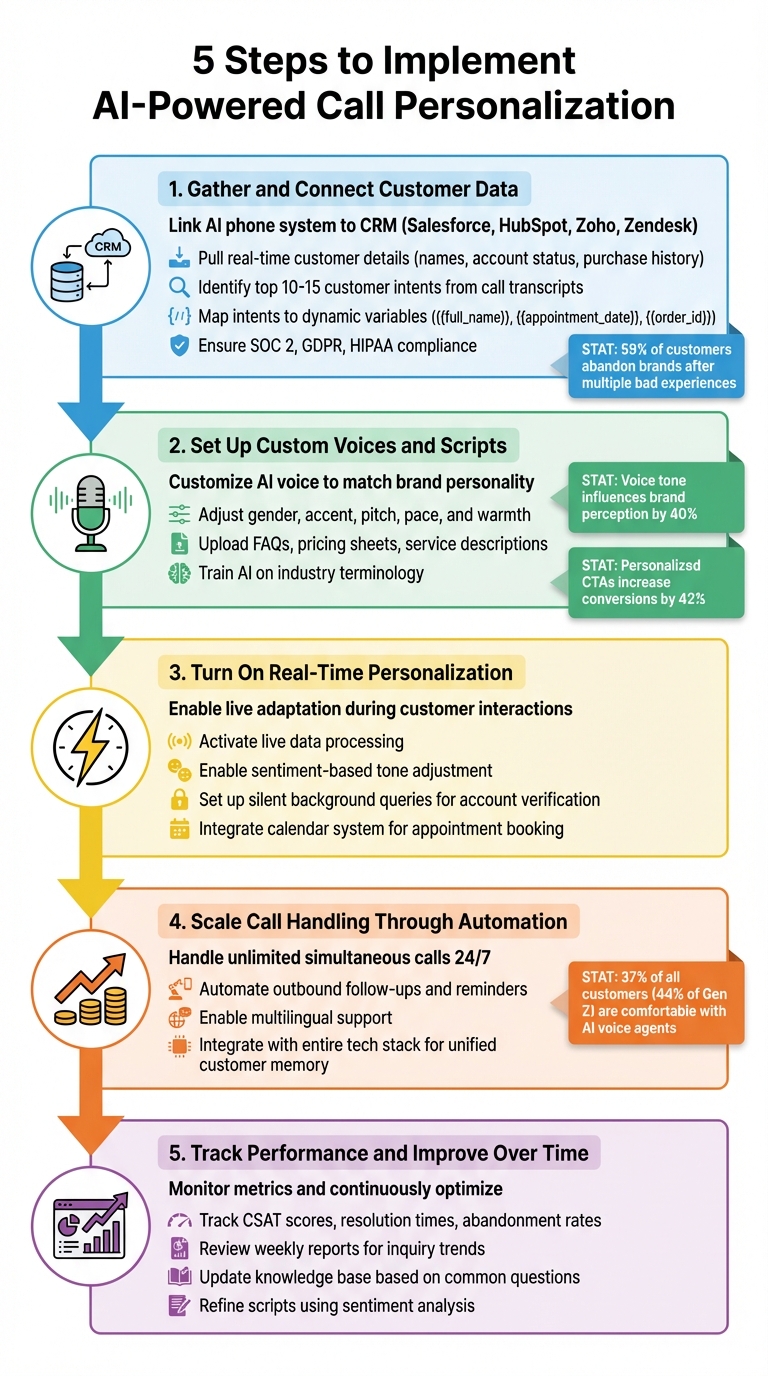
5-Step Process to Implement AI-Powered Call Personalization
Step 1: Gather and Connect Customer Data
Start by linking your AI phone system to your CRM - whether it’s Salesforce, HubSpot, Zoho, or Zendesk. This integration allows the system to instantly pull up real-time customer details, like names, account statuses, purchase histories, and open tickets, as soon as a call comes in.
Dive into recent call transcripts to pinpoint the top 10–15 customer intents (think billing, scheduling, or technical support). Then, map these intents to the necessary data points using dynamic variables, such as {{full_name}}, {{appointment_date}}, or {{order_id}}, to create a smooth, conversational flow. Tools like Answering Agent can seamlessly pull this data during calls, making interactions feel more natural and less robotic.
Data security is critical. Make sure your system complies with SOC 2, GDPR, and HIPAA by encrypting recordings and masking sensitive information. Considering that 59% of customers abandon brands after multiple bad experiences, protecting their data while delivering personalized service isn’t optional - it’s essential.
Once your data pipeline is in place, follow a checklist for implementing AI phone answering to customize your AI’s voice and scripts.
Step 2: Set Up Custom Voices and Scripts
Your AI’s voice should reflect your brand’s personality. Adjust elements like gender, accent, pitch, pace, and warmth to match your identity. Research shows that voice tone can influence brand perception by as much as 40%. For example, a corporate brand might lean toward a lower-pitched, formal tone, while a local business might benefit from a friendly, approachable voice with a regional accent. Tools like Answering Agent let you fine-tune these settings to mimic your best-performing team members.
Next, upload key resources - FAQs, pricing sheets, and service descriptions - so the AI can learn the language of your industry. This ensures it uses the right terminology and meets customer expectations. A well-prepared AI not only strengthens your brand identity but also boosts engagement. For instance, personalized calls-to-action can increase conversion rates by 42%.
Step 3: Turn On Real-Time Personalization
Once your AI is equipped with data and custom scripts, enable real-time personalization to adapt to live customer interactions.
Activate features like live data processing to let the AI adjust its tone, pace, or even escalate calls based on customer sentiment. Silent background queries can verify account details or order statuses without interrupting the flow.
For scheduling, the AI can access your calendar system during a call to book appointments. It checks availability, confirms times, and sends follow-up messages - all while maintaining a natural conversation.
Step 4: Scale Call Handling Through Automation
Set your system to handle unlimited simultaneous calls, 24/7. This includes automated tasks like outbound follow-ups, appointment reminders, and multilingual support that can instantly adapt to different languages and accents. Unlike human teams that require time to hire and train, AI scales effortlessly.
To create a seamless customer experience, ensure the AI integrates with your entire tech stack. This builds a unified memory of customer interactions across all channels. Interestingly, 37% of all customers - and 44% of Gen Z - are comfortable with AI voice agents providing personalized content for them.
Once your system is scaled, it’s time to measure its effectiveness and fine-tune the process.
Step 5: Track Performance and Improve Over Time
Keep an eye on key metrics like CSAT scores, resolution times, abandonment rates, and first-call resolution. Use this data to refine your scripts and improve escalation triggers through sentiment analysis.
Review weekly reports to spot trends in customer inquiries. If you notice a spike in questions about a particular service or policy, update your knowledge base right away so the AI provides accurate answers. Thanks to modular prompt designs, you can tweak business rules without overhauling the entire system.
Monitor escalation rates to identify and address common pain points. By continuously refining your scripts, you can turn every call into a chance to build loyalty and drive revenue.
Why Service Businesses Benefit from AI-Powered Calls
Service businesses face constant pressure to turn every call into revenue - whether it’s a late-night emergency or a weekend inquiry - without the burden of expensive staffing. AI-powered call handling offers a practical solution by managing unlimited calls simultaneously for a flat rate. This eliminates the need for hiring additional full-time staff or relying on costly third-party call centers.
Better Efficiency and Growth Capacity
AI systems excel at managing high call volumes 24/7. Take, for example, a plumbing company with a 20-truck fleet that reduced its call-handling costs by 35%. Similarly, an HVAC business in Minneapolis cut missed calls by 40% during the busy winter season, highlighting how these tools can scale to meet demand.
AI doesn’t take breaks or rack up overtime costs. It captures leads, books appointments, and even distinguishes between routine inquiries and urgent matters, seamlessly routing complex calls to human staff. Plus, integration with CRM platforms like ServiceTitan, Salesforce, and HubSpot ensures customer data is logged instantly. This prevents lead leakage and reduces the time spent on administrative tasks.
By streamlining operations, AI not only enhances efficiency but also ensures customers receive quick, informed responses.
Improved Customer Experience
Modern customers expect conversational, personalized interactions - not robotic, scripted menus. For instance, an Atlanta-based plumbing company reduced customer hang-ups by 50% after replacing traditional IVR systems with AI. By using Natural Language Processing, the AI could better understand accents, intent, and even emotional cues.
Personalized touches, like greeting callers by name or referencing their service history, go a long way in boosting satisfaction. A roofing company saw a 35% increase in bookings by adopting this approach, while a landscaping crew booked 15% more jobs by offering multi-language support, effectively serving Spanish-speaking callers.
Lower Costs and Higher Revenue
AI-powered call handling doesn’t just improve efficiency and customer satisfaction - it also delivers immediate financial returns. A San Diego solar company reduced missed calls by 30% in just one week of implementation. Meanwhile, a plumbing business in Atlanta generated an extra $60,000 in monthly revenue simply by capturing after-hours calls.
With tools like Answering Agent, businesses can automate essential tasks - such as booking appointments, managing reservations, and processing intake forms - without any human involvement.
"The only way to guarantee that no calls get missed is to implement an automated answering system." - Dominic Kent, Independent Writer
Traditional call-handling services often come with high costs and minimal return. In contrast, AI receptionists can update records, trigger workflows, and send instant SMS confirmations at a fraction of the cost. This not only prevents the financial losses from missed calls but also allows skilled staff to focus on tasks that add more value.
Conclusion
AI-powered phone systems are reshaping how service businesses interact with their customers. By tapping into Natural Language Processing and Machine Learning, these systems now provide personalized, human-like conversations on a large scale. The setup process is straightforward: integrate customer data, fine-tune voices and scripts, enable real-time personalization, automate call handling, and monitor performance to improve over time.
The financial benefits are hard to ignore. Companies using AI-driven customer service solutions have reported cutting support costs by up to 80%, with some seeing a 72% reduction in expenses while significantly speeding up response times. And with 7 out of 10 consumers expecting personalized interactions, meeting this demand can directly enhance customer loyalty and boost revenue.
Answering Agent takes these advancements a step further, offering solutions tailored to the needs of service businesses. The platform combines customizable voices, unlimited call handling, and 24/7 availability into a single system. Its ability to integrate real-time data ensures customers get the personalized service they expect - whether they’re calling mid-afternoon or in the middle of the night. This approach not only reduces staffing costs but also turns every call into an opportunity for revenue.
Switching from traditional call handling to AI-driven systems isn’t just about saving money - it’s about unlocking new growth while improving customer experiences. AI handles routine tasks like answering inquiries, converting missed calls to appointments, and capturing leads, freeing up your team to focus on high-value, complex interactions. The result is a more scalable, efficient, and customer-centric service strategy.
Want to take customer calls to the next level? Discover how Answering Agent’s AI-powered features can help your business save costs, delight customers, and drive revenue - all while delivering the personalized experiences your customers expect.
FAQs
How does AI know who’s calling?
AI can recognize callers by examining details like phone numbers, CRM records, or even voiceprints in real time. It goes a step further by recalling previous interactions, preferences, and even the caller’s tone or mood. This allows it to provide responses that feel personal and efficient, making every conversation more seamless and tailored.
When should a call be sent to a human?
Calls should be handed over to a human when dealing with complex technical problems, emotionally charged situations (like upset callers), VIP customers, pricing discussions, or urgent scenarios such as emergencies. In these cases, warm transfers - where the AI shares relevant context with the agent - are ideal. This approach helps streamline resolution and boosts customer satisfaction. Escalating to a human is crucial when their expertise is necessary to handle the situation effectively and maintain a positive experience for the customer.
What do I need to set up AI call personalization?
To get started with AI call personalization, begin by diving into your call data. Look for patterns, such as frequent call topics, peak call times, and recurring customer concerns. This analysis will help you understand what your customers need most.
Next, set clear objectives for your AI scripts. Are you aiming to streamline appointment bookings? Or perhaps you want to handle common FAQs more efficiently? Defining these goals will guide the design of your AI interactions.
Once your objectives are set, craft scripts tailored to your needs. Use natural language processing (NLP) to ensure the AI can handle detailed, multi-step conversations that feel natural and intuitive.
Finally, connect your AI system with essential tools like your calendar and CRM. This integration enables real-time, personalized responses, ensuring the AI delivers seamless support for your customers.
Related Blog Posts
Related Articles
Reducing Missed Calls in Appliance Repair with AI
AI phone systems significantly reduce missed calls in appliance repair, enhancing customer satisfaction and boosting revenue for businesses.
AI vs. Manual Call Routing: Key Differences
AI routing outperforms manual systems in speed, cost, availability, and customer experience — making manual routing impractical for growing businesses.
Law Firm Success With AI: 24/7 Call Handling Stories
Missed calls cost firms clients; 24/7 AI answering captures every lead, automates intake and scheduling, and boosts revenue.