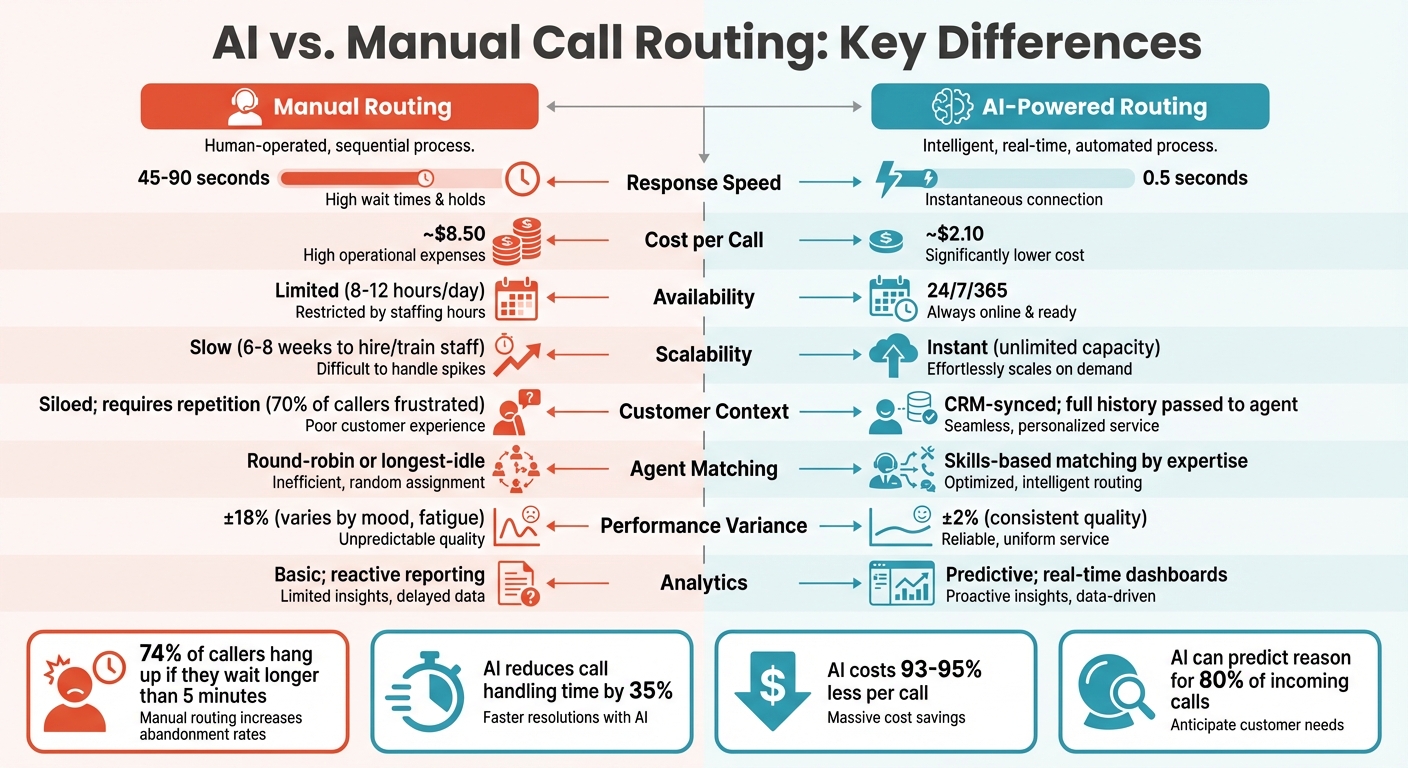
AI vs. Manual Call Routing: Key Differences

AI routing outperforms manual systems in speed, cost, availability, and customer experience — making manual routing impractical for growing businesses.

AI vs. Manual Call Routing: Key Differences

AI call routing outperforms manual systems in speed, cost, and customer experience. While manual routing relies on human operators or rigid menus, AI uses real-time analysis to route calls faster and more accurately. Here's a quick breakdown:

  • Speed: AI routes calls in 0.5 seconds vs. 45–90 seconds for manual systems.
  • Cost: AI costs ~$2.10 per call, compared to ~$8.50 for manual systems.
  • Availability: AI operates 24/7, while manual systems are limited to business hours.
  • Customer Experience: AI integrates with CRM tools, providing agents with caller history and reducing frustration. Manual systems often require customers to repeat information.
  • Scalability: AI handles unlimited calls instantly, while manual systems face bottlenecks during high demand.

Quick Comparison

Feature Manual Routing AI-Powered Routing
Response Speed 45–90 seconds 0.5 seconds
Cost per Call ~$8.50 ~$2.10
Availability Limited (8–12 hours) 24/7/365
Scalability Slow (requires hiring) Instant, unlimited calls
Customer Context Limited, siloed data Full CRM integration
Agent Matching Basic methods Skills-based pairing

Manual systems may suit small, low-volume teams, but AI is ideal for businesses prioritizing efficiency and scalability. For best results, consider testing AI in one department before full implementation.

AI vs Manual Call Routing: Speed, Cost and Performance Comparison

AI vs Manual Call Routing: Speed, Cost and Performance Comparison

Intelligent Call Routing (ICR) Explained | Smarter Call Center Efficiency with AI

Key Differences Between Manual and AI Call Routing

Manual call routing relies on straightforward, static rules like, "If it's after 5 PM, send to voicemail", or "Press 2 for billing." While functional, these systems can't adjust to individual caller needs. AI routing for service businesses takes a smarter approach - analyzing caller intent, sentiment, history, and agent skills to deliver a more personalized experience. Here's a closer look at how they differ in speed, context, and accuracy.

Manual systems often frustrate callers with rigid menus and receptionist transfers, leading to delays. In fact, only 26% of callers are willing to hold for more than five minutes. AI routing eliminates these delays by using natural language processing (NLP) to understand spoken requests. Instead of navigating endless menus, callers simply state their needs, and the system routes them in as little as 0.5 seconds - far faster than the 45–90 seconds typical of manual systems.

Context handling is another area where AI shines. Manual systems often operate in isolation, forcing customers to repeat the same details multiple times. Unsurprisingly, over 70% of callers find this process frustrating. AI systems, on the other hand, integrate with CRM platforms to pull up caller history, account details, and past interactions before the call connects. This ensures agents receive a complete "screen pop" of relevant information, saving time and improving the caller's experience.

Agent matching also highlights a key difference. Manual routing relies on basic methods like round-robin or longest-idle, which don’t consider agent expertise. AI systems take a skills-based approach, pairing callers with agents who have the right technical knowledge, language proficiency, or track record for handling similar issues.

Comparison Table: Manual vs. AI Call Routing

Feature Manual/Traditional Routing AI-Powered Call Routing
Availability Limited (typically 8–12 hours/day) 24/7/365
Scalability Slow (6–8 weeks to hire/train staff) Instant (unlimited capacity)
Response Speed 45–90 seconds (average) 0.5 seconds
Logic Static IF-THEN rules Multi-variable algorithms with real-time intent analysis
Customer Context Siloed; requires repetition CRM-synced; full history passed to agent
Agent Matching Round-robin or longest-idle Skills-based matching by expertise
Cost per Call ~$8.50 ~$2.10
Performance Variance ±18% (varies by mood, fatigue) ±2% (consistent quality)
Analytics Basic; reactive reporting Predictive; real-time dashboards

Availability and Scalability

Manual Call Routing: Limited Hours and Capacity

Manual call routing is constrained by operating hours - typically 8 to 12 hours a day - leaving 35–40% of potential business missed as after-hours calls are funneled to voicemail. Additionally, each agent can only manage one call at a time, creating bottlenecks during busy periods. When hold times stretch to 2–5 minutes, 74% of callers hang up if they wait longer than five minutes. These limitations highlight the challenges of relying on manual systems to handle high call volumes efficiently.

AI Call Routing: 24/7 Operations and Unlimited Capacity

AI-powered call routing changes the game by offering round-the-clock availability and the ability to scale without limits. Tools like Answering Agent ensure uninterrupted service with 99.9% uptime, capturing every call - whether it’s a late-night question or a weekend booking - without relying on voicemail or callbacks.

One of the standout features of AI systems is their capacity to handle unlimited simultaneous calls. For example, during a Black Friday rush, a business managed 3,500 calls in a single day. By automating 89% of routine inquiries, they efficiently handled the surge with a small human support team. The system responded to calls in as little as 0.5 seconds, all while achieving a customer satisfaction score of 4.7 out of 5.

This demonstrates how AI call routing not only ensures constant availability but also scales effortlessly to meet demand, removing the traditional constraints of cost and capacity.

Efficiency and Customer Experience

Manual Routing: Delays and Customer Frustration

Manual call routing is riddled with inefficiencies that frustrate customers and damage their overall experience. Traditional IVR menus, for instance, force callers to navigate rigid options, causing delays of 30–60 seconds before they even reach an agent. Worse, these systems are prone to errors - before AI was introduced, about 60% of tech support calls were routed to the wrong agent group. This lack of integration leaves customers having to re-explain their issues, a scenario that 70% of customers find deeply frustrating.

Wait times compound the problem. Manual systems treat all calls as though they have the same urgency, which often leads to long queues. Only 26% of callers are patient enough to wait more than five minutes, and complex menu trees can drive abandonment rates as high as 30–60%. In fact, over half of customers (51%) have chosen to abandon a business entirely rather than endure a convoluted menu system.

AI routing offers a smarter, faster alternative to these outdated methods.

AI Routing: Faster, Personalized Service

AI-powered routing transforms customer service by tackling these inefficiencies head-on. Using Natural Language Understanding (NLU), AI systems quickly identify caller intent, enabling natural and direct conversations. This approach reduces response time to as little as 0.5 seconds - an enormous improvement over traditional IVR systems. By cutting the time it takes to begin meaningful interaction by 83–92%, AI routing creates a smoother and more engaging experience for customers.

The benefits go beyond speed. AI reduces call handling times by 35% by matching callers with the most qualified agents. It also excels at identifying urgency. For instance, when callers use phrases like "emergency" or "ASAP" - which appear in 15.9% of calls - AI bypasses regular queues and directs them to specialized agents immediately. This kind of sentiment-based routing not only prevents issues from escalating but also helps retain customers by addressing their concerns promptly.

Real-world examples highlight the impact of AI routing. Wyze Labs, a smart home technology provider managing over 300 calls daily, saw its first-call resolution rate improve by 98% after implementing intelligent routing through Zendesk. Similarly, Netwealth pinpointed call flow issues using AI, reducing first reply times to just 40–60 seconds.

AI also boosts productivity for support teams. Agents using AI systems handle 13.8% more inquiries per hour and save an average of 1.2 hours of productivity each day. By automating 60–80% of repetitive queries through voice bots, AI frees up human agents to focus on more complex, empathy-driven tasks.

"Traditional IVR was 1990s technology. Conversational AI is today's standard. The difference: callers get answers instead of options." - NextPhone

Cost Comparison: AI vs. Manual Call Routing

Manual Routing: High Labor Expenses

Running a traditional call center comes with hefty costs, especially when it comes to labor. Labor accounts for 60–70% of the total expenses in manual call routing setups. For example, a small, four-person in-house call center costs around $264,212 annually, and that’s just the surface. Hidden costs - like recruitment and turnover - quickly add up.

Hiring and training new agents cost between $6,500 and $15,000 per person. Add to that an annual turnover rate of 30–45%, and the price tag for replacing each departing agent climbs to $10,000–$20,000. It’s a never-ending cycle of hiring and retraining.

Then there’s the infrastructure. Businesses need physical office space, which costs $25–$50 per square foot, plus workstations priced at $1,500–$3,000 each. Telecommunication systems tack on another $700–$1,000 per user. On top of all this, traditional systems are plagued by "costly idle time", where you’re paying employees even during slower periods.

Providing 24/7 customer support only makes things harder. Night shifts demand 15–30% higher wages, and holiday pay adds even more to the payroll. Management costs - like a small team’s overhead of $56,807 annually - further inflate the budget. When you break it down, traditional call centers spend $5–$25 per customer interaction. Clearly, this model struggles to keep up with growing demands without breaking the bank.

AI Routing: Lower Operating Costs

AI routing flips the script, offering a far more budget-friendly solution. Voice AI costs just $0.30–$0.50 per call, compared to the $6.00–$7.68 spent on human agents - a 93–95% cost reduction. By automating call handling, AI eliminates the labor expenses that dominate traditional budgets.

Take AI systems like Answering Agent, which charge a flat rate of $199 per month for unlimited calls. This predictable pricing model eliminates the need for recruitment, training, benefits, and turnover management. Infrastructure costs also vanish since AI operates on cloud-based platforms, avoiding the need for physical offices and equipment.

Scalability is another game-changer. Unlike manual routing, which requires hiring more staff to handle increased call volumes, AI can instantly scale to manage unlimited calls without extra costs. For instance, a business handling 60,000 calls annually would spend $360,000–$460,000 with human agents but only $18,000–$30,000 using AI.

In October 2023, Thoughtly implemented ElevenLabs' turbo voice model to power an AI agent named "Tessa." This system managed millions of calls, averaging just 50 seconds per interaction, while staying available 24/7 in over 50 languages. The results? Customer wait times dropped significantly, and costs per interaction plummeted. As one team member put it:

"I love Tessa because she never sleeps!" - Sales Team Member, Thoughtly

The financial benefits of AI adoption are immediate. While traditional call centers take 12–24 months to recover initial investments, AI systems deliver positive returns within 3–9 months. For a mid-sized call center, transitioning to a hybrid AI model can yield a 2,042% ROI in Year 1, with a payback period as short as 18 days. Depending on how it’s set up, AI can cut operating costs by 30–70% - a direct solution to the challenges of manual routing.

Integration and Analytics

Improving call routing isn't just about speed or cutting costs - it’s about making smarter decisions through integration and data analysis.

Manual Routing: Limited Data, No Integration

Traditional call routing systems work in silos, disconnected from the tools businesses rely on. They only capture basic metrics like call volume, duration, and missed calls. But they lack deeper insights - like why a customer called or what happened during the conversation.

These systems also don’t integrate with CRMs or helpdesk platforms. That means agents are left in the dark when a call comes in, unable to see customer purchase history, open tickets, or past interactions. In fact, 30% of support agents don’t have consistent access to customer information, leading to disjointed customer experiences and lower satisfaction rates.

Without integration, agents have to manually update customer records after each call. This creates a messy, incomplete view of call center activity, making it nearly impossible to identify bottlenecks or justify staffing decisions with real data.

AI routing vs. traditional systems differ significantly, with AI offering seamless integration and detailed analytics.

AI Routing: Smarter Data and Seamless Integration

AI-driven routing doesn’t just improve efficiency - it also provides a wealth of actionable insights. These systems collect detailed data, including caller ID, location, time of day, customer sentiment, intent, and even the customer’s history across multiple channels. With this information, AI can predict the reason for 80% of incoming calls before the agent even answers.

What really sets AI apart is its ability to integrate effortlessly with CRMs like Salesforce and HubSpot, helpdesks like Zendesk, and automation platforms like Zapier. When a call comes in, agents get a "screen pop" showing the caller’s full history - previous purchases, open tickets, and past interactions. This eliminates the need for customers to repeat themselves. Tools like Answering Agent go even further, automatically logging call summaries and updating customer profiles in real time. This reduces admin work and ensures clean, up-to-date data.

For example, in August 2025, Wyze Labs, a smart home tech company, switched to Zendesk’s intelligent routing system to handle over 300 daily calls. By using AI to match callers with the right agents based on integrated customer data, they boosted their first-call resolution rate by 98%. Similarly, Netwealth, a wealth management firm, used intelligent routing to analyze response times and pinpoint strategy gaps. As a result, they cut their first reply time to just 40–60 seconds.

"Data is the core component that allows ICR [Intelligent Call Routing] to work its magic. Integrating ICR with your other systems lets you see a full picture of your customers, agents, and broader operations."

  • Candace Marshall, VP of Product Marketing, AI and Automation, Zendesk

AI systems also offer real-time dashboards and predictive analytics that manual systems simply can’t match. Instead of reacting to yesterday’s issues, businesses can forecast call volumes, anticipate customer needs, and optimize staffing ahead of time. These analytics highlight problem areas, like products that frustrate customers, shifts that need extra coaching, or time wasted in transfer loops. On average, AI-driven routing saves support teams 1.2 hours of productivity per agent, per day. That’s time better spent solving customer problems rather than searching for information.

Conclusion: Choosing the Right Call Routing System

When deciding between AI and manual call routing, weigh factors like call volume, customer expectations, and budget. Manual systems might suit small teams handling predictable, low-volume calls, but they often fall short as call volumes grow and labor costs rise. On the other hand, AI routing effortlessly scales to manage unlimited calls at once, offering the quick, personalized service today’s customers demand.

For businesses managing repetitive tasks - like AI tools for appointment scheduling, order tracking, or answering FAQs - AI automation is a practical solution. By leveraging natural language processing, AI eliminates the outdated frustration of rigid phone menus, routing calls based on intent instead of pre-set scripts. However, for more complex or sensitive issues, keeping human agents ensures a personal touch while AI tackles routine inquiries.

To strike the right balance, consider a phased rollout. Begin by implementing AI routing in a single department or for after-hours support to test its accuracy and effectiveness. Integrate the system with your CRM to give agents immediate access to caller history and identify common call reasons, helping to fine-tune AI performance over time.

Once your system is integrated and tested, look for tools that align with these goals. For instance, solutions like Answering Agent operate 24/7, schedule appointments directly into your calendar, and conduct natural, conversational interactions that drive revenue - all without the need to hire or train additional staff.

Ask yourself this: Can your business afford to stick with manual routing while competitors provide faster, more efficient service?

FAQs

How do I know if AI routing is right for my call volume?

AI routing works best for businesses that deal with high call volumes. It helps cut down on wait times, automates repetitive tasks, and can manage an unlimited number of calls. Plus, it offers flexibility to grow, distributes calls in real time, and integrates seamlessly with CRMs - making it especially useful for companies with multiple locations. On the other hand, smaller businesses with low or steady call volumes might find manual routing sufficient. Take a close look at your call traffic and future growth plans to make the right choice.

What does it take to connect AI routing to my CRM?

To connect AI routing to your CRM, you'll need to integrate the AI system with your platform to allow real-time data sharing and automation. This process often involves setting up API endpoints or using integration tools to sync critical information like customer data, call history, and interaction context.

When configured correctly, this setup ensures that calls are not only personalized but also handled more efficiently - all while keeping data secure and compliant with regulations. Some AI platforms even come with built-in CRM integrations, which can make the process smoother and less time-intensive.

Can I roll out AI routing after-hours first?

Yes, AI routing can absolutely be implemented during after-hours first. AI systems are built to function around the clock, ensuring that calls are handled even when your office is closed. Starting with after-hours use is a smart way to evaluate its efficiency and the overall customer experience, all while keeping your service running without interruptions.

Related Blog Posts

Answering Agent