How AI Handles Multilingual Guest Inquiries 24/7

AI handles guest inquiries in 100+ languages, integrates with PMS, boosts bookings and satisfaction while cutting costs and staffing needs.

How AI Handles Multilingual Guest Inquiries 24/7

AI-driven systems are transforming how hotels, restaurants, and resorts manage guest inquiries. By handling over 100 languages instantly, these tools ensure no question goes unanswered, even during off-hours. Here’s what you need to know:

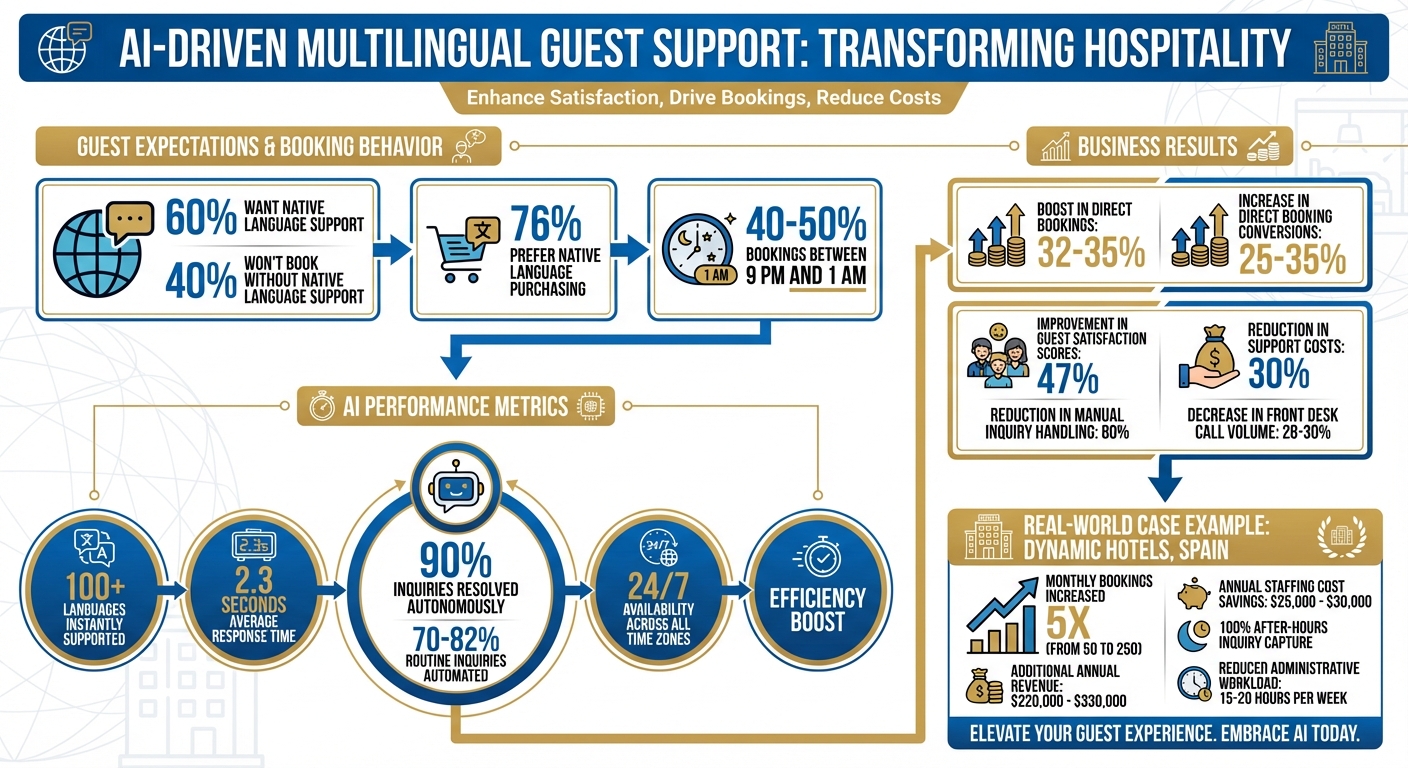
  • Guest expectations: 60% want support in their native language, and 40% won’t book without it.
  • Booking trends: 40–50% of bookings happen between 9 PM and 1 AM.
  • AI advantages: Instant responses, real-time language detection, and integration with booking systems.
  • Proven results: Businesses see up to a 35% rise in direct bookings and a 47% boost in guest satisfaction.

AI doesn’t just save costs - it ensures seamless communication, enhances efficiency, and captures revenue opportunities businesses might otherwise miss.

AI Multilingual Guest Support Impact: Key Statistics and Business Results

AI Multilingual Guest Support Impact: Key Statistics and Business Results

Revolutionizing Hotels: AI Voice Receptionist with OpenAI Realtime API

How AI Processes Multiple Languages in Guest Communication

Multilingual AI systems are designed to handle guest interactions with precision and speed. These systems can detect the language a guest is using, understand their intent, and respond in the same language - all in real time. This quick language recognition ensures smooth communication, no matter the guest’s native tongue.

Real-Time Language Detection and Response

AI begins by analyzing the first message or spoken sentence to determine the language being used. Advanced Natural Language Processing (NLP) tools can even interpret slang, idiomatic expressions, and casual phrases to understand the guest's intent.

For voice calls, Speech-to-Text (STT) technology transcribes spoken language as it happens, adapting to various accents and filtering out background noise. Telnyx explains:

Language detection and switching happen in real time, enabling assistants to shift modes mid-conversation if needed. Rather than maintaining a separate assistant for every market, you can use shared logic and apply multilingual prompts across workflows.

The infrastructure supporting these systems is key. By relying on private global networks and dedicated GPU processing, these AI tools deliver responses with almost no delay - typically within about 2.3 seconds. A great example comes from Dynamic Hotels, a boutique chain in Spain. In October 2024, they introduced an AI-powered receptionist capable of handling inquiries in over 15 languages, including Arabic, Chinese, and Russian, through platforms like WhatsApp, phone, and web. Within a year, they saw a fivefold increase in monthly bookings (from 50 to 250) and generated an estimated additional annual revenue of $220,000–$330,000 from international guests they previously couldn’t serve.

Natural and Human-Like Conversations

After identifying the language, the AI focuses on delivering responses that feel natural and human. The secret lies in technologies like Large Language Models (LLMs) and Natural Language Understanding (NLU), which are trained on vast amounts of conversational data. This training allows the AI to pick up on regional expressions and adjust its tone and formality based on the guest’s preferences.

Text-to-Speech (TTS) further enhances the experience by generating responses in a variety of tones that sound authentic. The system also uses sentiment analysis to detect when a guest might be frustrated or unhappy, automatically escalating complex issues to human staff. As the General Manager of Dynamic Hotels shared:

The AI transformation has completely changed how we operate. We're capturing bookings we never could before - from international travelers reaching out at 2 AM, to guests who don't speak Spanish or English.

What’s more, the AI learns and improves over time. Through reinforcement learning, it evaluates feedback and past conversations to better handle unique requests and property-specific terminology, making it increasingly effective the longer it’s in use.

Connecting AI with Hospitality Software

The real power of multilingual AI shines when it integrates with essential hospitality software. By connecting with Property Management Systems (PMS) like Oracle OPERA, Cloudbeds, WuBook, or Mews, the AI gains access to real-time data on room availability, guest profiles, and booking details. This ensures that responses are not only linguistically accurate but also tailored to each guest’s specific needs.

For example, if a Mandarin-speaking guest inquires at 3 AM, the AI can instantly check room availability through the PMS, book the room, create housekeeping requests, log maintenance issues, or even update guest preferences - all without human involvement. Dynamic Hotels, for instance, integrated their AI with the WuBook PMS, enabling automated availability checks and reservation processing.

These integrations can also streamline payment processing. Advanced AI systems connect to secure payment gateways, allowing them to handle deposits, process payments, and send receipts directly through the chat interface - regardless of the language. Meanwhile, human staff can oversee all interactions through centralized dashboards in their preferred language, with the AI managing translations. This setup has allowed properties to automate 70% to 82% of routine inquiries, freeing up staff to focus on more personalized guest experiences.

Real Applications of AI in Multilingual Guest Support

AI has made a noticeable impact on guest support, particularly in multilingual settings, by automating interactions and bridging language barriers. From answering routine questions to managing complex requests, AI ensures seamless communication without requiring a 24/7 multilingual staff.

Automating Common Guest Requests

AI excels at managing everyday inquiries. Whether guests need the WiFi password, details about parking, check-in times, or directions, AI-powered systems provide instant responses in their preferred language. Take, for example, a Dubai boutique hotel that introduced an AI chatbot in 2025. The bot supported 15 languages, including Arabic, Russian, and Chinese. Within just a few months, the hotel reported an 80% reduction in manual inquiry handling and a 32% boost in direct bookings. The General Manager shared:

Direct bookings increased 32%. Manual inquiry handling reduced by 80%. Our international guests now feel truly welcomed from the first interaction.

When paired with a Property Management System, AI goes beyond answering questions. It can check room availability in real-time, display prices in the guest's local currency, and confirm bookings instantly. Guests can also use the system for in-stay requests like room service, housekeeping, or spa appointments, which are automatically routed to the correct department. This level of convenience is crucial, with research showing that 76% of consumers prefer to buy in their native language, and 40% won’t make a purchase if support isn’t available in their language.

Handling Complex or Specialized Requests

AI isn’t just about translating words - it understands intent and emotional nuances. For instance, if a guest inquires about dietary restrictions or accessibility accommodations, the system uses Natural Language Understanding to tailor its response. A Japanese guest asking about wheelchair access might receive a formal, detailed reply, while a German guest could get a more concise and direct answer.

The system also tracks guest interactions, ensuring smooth communication even across multiple messages. If frustration is detected through sentiment analysis, the AI escalates the conversation to a human staff member, providing them with the fully translated chat history. An international resort chain using this approach saw a 47% improvement in guest satisfaction scores and a 30% drop in support costs within six months. On average, queries were resolved in just 2.3 seconds.

By combining intent recognition, emotional intelligence, and seamless escalation, businesses can address diverse guest needs with precision.

24/7 Availability for Global Travelers

AI eliminates time zone constraints, ensuring that businesses never miss a booking opportunity. For example, Dynamic Hotels in Spain used AI to capture 100% of after-hours inquiries, leading to a 5x increase in monthly bookings, from 50 to 250. This translated into an estimated $220,000–$330,000 in additional annual revenue.

AI systems can handle hundreds of conversations simultaneously across platforms like WhatsApp, Telegram, website chat, and even phone calls. For businesses using Answering Agent’s phone-based AI, every call is answered instantly in the caller’s language, allowing for seamless appointment bookings and lead capture without human intervention. In fact, data shows that 40% to 50% of bookings now happen outside traditional business hours. This round-the-clock multilingual support has become a necessity for businesses catering to global travelers.

Measuring the Impact of AI on Business Performance

To truly understand the value AI brings to a business, it's crucial to measure its impact. By tracking specific metrics, businesses can validate their investments, optimize processes, and uncover areas for improvement.

Key Metrics for Success

Response and resolution speed is a vital performance indicator. AI systems deliver instant responses and reduce wait times by 30%. Compare these results to manual processes, especially during peak and off-hours, to see the difference AI makes.

Guest satisfaction scores (CSAT) offer insights into how AI affects the customer experience. For instance, analyzing satisfaction by language - like comparing ratings from Japanese and Spanish-speaking guests - can reveal whether the AI needs better adjustments for cultural nuances.

Financial performance ties AI's contribution directly to revenue. Metrics like direct booking conversion rates, revenue per available room (RevPAR), and upselling revenue are key. AI has been shown to boost direct booking rates by 25% to 35%, while guests accepting AI-driven upsell offers generate over 14% more revenue per booking. Additionally, tracking savings from reduced third-party commissions can highlight the financial advantages of steering guests toward direct bookings.

Operational efficiency demonstrates how AI reduces the workload for human staff. AI agents can handle up to 70% of guest inquiries instantly. Metrics like reduced front desk call volumes and lower escalation rates - where human intervention is required - can show how effectively AI is managing routine tasks. Establishing baseline data for response times, booking conversions, and staffing costs before AI implementation provides a clear comparison to measure success.

These metrics aren't just theoretical; they are backed by real-world results, as shown in the examples below.

Case Studies and Examples

Marriott International implemented AI assistants that now handle over one million interactions each month. This led to a 35% increase in direct booking conversions, a 28% drop in front desk call volume, and a 42% improvement in guest satisfaction scores for service requests. These results highlight how AI can improve multiple areas of performance simultaneously.

The Cosmopolitan Las Vegas launched its "Rose" digital concierge in early 2025. Within six months, Rose handled over 100,000 interactions and generated $2.8 million in additional revenue. Guests using Rose spent 30% more than those who didn’t and reported 33% higher satisfaction scores.

Hyatt Hotels introduced an AI-powered conversational system across eight global contact centers, managing seven million calls annually. The system delivered $4.4 million in annual savings and reduced call costs by 33%, enabling staff to focus on more valuable interactions.

Wyndham Hotels & Resorts partnered with PwC to deploy AI agents for both franchise owners and guests. This initiative reduced average call handling times by 30%–50% and slashed the time for reviewing brand standard changes by 94% - from 30 days to nearly instant. AI agents now handle 28% of all incoming calls. Ali Abidi, Principal at PwC US, remarked:

"We didn't just want AI - we wanted AI that delivers results. PwC helped us embed AI agents across the business to fuel growth, speed and guest satisfaction."

For businesses using phone-based AI tools like Answering Agent, it's essential to track after-hours call capture rates and appointment booking conversions. Since 40% to 50% of bookings happen outside regular business hours, measuring how many of these calls lead to revenue provides a clear picture of ROI. Additionally, segmenting data by language can reveal how AI is improving conversions in previously underserved regional markets.

How AI Support Changes Staff Roles

AI is reshaping how staff work, not by replacing them but by taking over repetitive tasks. By managing 70% to 82% of routine questions - like Wi‑Fi passwords, pool hours, or check‑in times - AI lets employees focus on delivering standout guest experiences that require empathy and a personal touch. In short, AI is changing staff roles by taking care of the basics so people can focus on what matters most.

Reducing Staffing Challenges

One major shift is how AI improves multilingual support and after-hours availability. Instead of relying on costly overnight staff or hiring multilingual employees, AI can provide seamless assistance in over 100 languages, 24/7. Take Dynamic Hotels in Spain, for example. In October 2025, they replaced several full-time receptionist roles with AI-powered receptionists across platforms like WhatsApp, phone, and their website. This move saved the company $25,000 to $30,000 annually while ensuring 100% of after-hours inquiries - between 10 PM and 8 AM - were addressed. The General Manager shared:

The AI transformation has changed our operations. Our staff now focus on in-person guest experiences instead of repeating routine answers.

This shift has also reduced the volume of basic inquiry phone calls by 70% to 80% for hotels using AI agents. With fewer routine calls, front desk teams can concentrate on high-value interactions that enhance the guest experience.

Improving Staff Efficiency

AI doesn’t just reduce staffing needs - it also boosts how efficiently teams work. For more complex issues, AI uses smart escalation protocols to pass conversations to human managers, complete with conversation history and real-time translation. Staff can reply in their native language while AI translates for the guest, removing the need for additional multilingual hires.

AI also integrates with Property Management Systems to handle tasks like checking room availability, updating bookings, and processing payments. For example, Dynamic Hotels reduced administrative workloads by 15–20 hours per week, and one international resort chain cut support costs by 30% in just six months. At the same time, guest satisfaction scores jumped by 47%.

With AI taking care of routine and technical tasks, staff can shift from reacting to problems to proactively enhancing guest experiences. By using AI-driven insights, teams can anticipate guest needs, ensuring operations run smoothly while delivering the kind of hospitality that keeps guests coming back.

Conclusion

AI-driven multilingual support is revolutionizing the hospitality industry by managing guest inquiries in over 100 languages around the clock. This eliminates the need for costly multilingual staff while significantly cutting support expenses - up to 30% - and autonomously resolving 90% of inquiries in just 2.3 seconds. Considering that 76% of consumers prefer purchasing services in their native language and 40% might avoid buying altogether if support isn't offered in their language, the importance of this technology becomes undeniable.

The benefits go beyond just cost savings. Properties adopting AI solutions have reported notable increases in bookings, even during off-hours. Guest satisfaction scores have also seen a remarkable 47% boost thanks to these systems. By taking over routine tasks, AI enables staff to focus on delivering outstanding in-person service, fostering loyalty and repeat visits.

In a global travel market valued at over $1.5 trillion annually, instant, native-language communication isn't just helpful - it's essential. As the industry shifts toward AI-powered operations, businesses are better positioned to secure more bookings, trim operational costs, and provide the kind of personalized service that keeps guests coming back.

Tools like Answering Agent highlight how AI-powered platforms allow hospitality businesses to maintain continuous, multilingual support. This not only enhances efficiency but also empowers teams to focus on creating unforgettable guest experiences.

FAQs

How does AI enhance multilingual guest support and satisfaction?

AI is reshaping multilingual guest support by making instant, natural communication possible in over 100 languages. This ensures guests feel heard and valued, regardless of their native language. By eliminating language barriers, AI helps create a more tailored and effortless experience, which plays a big role in building trust and enhancing satisfaction.

With its 24/7 availability, AI-powered tools can handle guest inquiries at any time - whether during busy periods or after hours. This round-the-clock responsiveness not only improves operational efficiency but also strengthens guest loyalty by consistently delivering reliable, high-quality service. The outcome? A smoother, more satisfying experience that deepens the connection between businesses and their guests.

How does AI help reduce costs while managing guest inquiries 24/7?

AI systems offer a smart way to manage guest inquiries while keeping costs in check. With 24/7 multilingual support, they ensure round-the-clock service without the need to hire, train, or schedule extra staff. This means businesses can maintain consistent service without the added expense of expanding their workforce.

By taking over routine tasks - like answering frequently asked questions or managing bookings - AI allows human staff to focus on delivering a more personalized experience. This shift not only streamlines operations but also minimizes errors and shortens response times, which can boost guest satisfaction. Plus, AI can handle multiple inquiries at once, making it especially useful during peak times when extra hands would typically be needed.

Incorporating AI into guest services isn’t just about saving money; it’s about using resources more effectively while ensuring high-quality service. It’s a practical way to enhance efficiency and support business growth.

How does AI improve guest communication and support in the hospitality industry?

AI integration into hospitality software has transformed guest communication by offering instant, multilingual support around the clock. These AI-driven systems can interact in a guest's native language, minimizing misunderstandings and fostering a more welcoming atmosphere. This feature is particularly appreciated by international travelers, who benefit from smooth, culturally aware interactions.

Beyond communication, AI automates tasks like addressing common inquiries, handling reservations, and suggesting local attractions. This streamlines operations, especially during peak times, reducing the reliance on additional staff. The result? Hotels can provide quicker, more tailored service, ensuring guests feel valued and cared for. At the same time, these advancements help cut costs and boost operational efficiency, making each stay more seamless and enjoyable.

Related Blog Posts

Answering Agent