First Tire & Automotive, a five-location auto repair business in Houston, was losing calls because service advisors couldn't work the bays and the phones at the same time. After moving call handling to a white-label AI phone answering system, missed calls fell to under 2% and monthly revenue rose 28%.
This post covers what they measured, how they set it up, and how they rolled it out without betting the front desk on day one.
Key Takeaways:
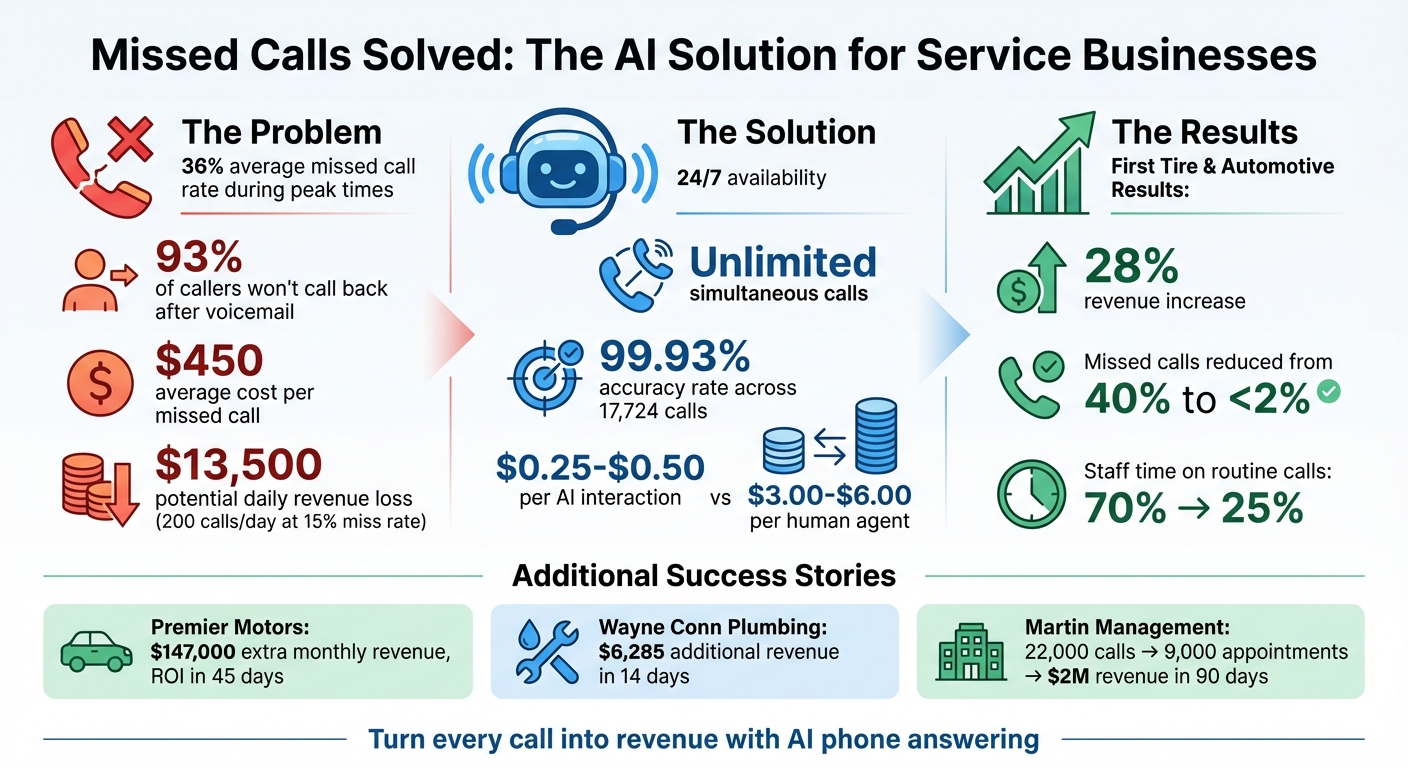
- Missed calls are lost revenue: The figure used in this case is $450 per missed call, and 93% of callers who reach voicemail don't call back.
- Capacity was the constraint: Advisors could take one call at a time. The AI answers every line at once, day or night.
- Results: Missed calls dropped from about 40% at peak to under 2%. Revenue rose 28%. Advisors' time on routine calls fell from 70% of the day to 25%.
The Problem: Missed Calls and Lost Revenue
Business Profile
In early 2024, Operations Manager Mario Coto saw the same pattern at every location. Advisors helped customers at the counter while phones rang behind them. The team pulled call metrics for peak hours to see how many calls they were actually losing.
Measuring the Problem
They were missing about 40% of calls during peak hours and after close. The cost adds up quickly. A shop taking 200 calls a day that misses 15% of them at $450 per call loses $13,500 a day. At 40%, that revenue leakage couldn't go on.
Why Calls Were Being Missed
The misses came from three places:
- One call per advisor. Anyone helping a customer in person couldn't pick up.
- Spikes at the worst times. Call volume peaked during shift changes and lunch, when the fewest people were on the floor.
- After-hours voicemail. Callers who hit voicemail usually called a competitor instead.
"It wasn't just a call room. It was about creating real connections with our customers."
- Mario Coto, Operations Manager, First Tire & Automotive
Adding staff wouldn't fix the spikes or the overnight gap. The team needed coverage that grows with call volume, so they looked at white-label AI answering to capture those calls.
The Solution: White-Label AI Phone Answering
First Tire & Automotive chose Answering Agent. It answers every line at once, around the clock, for a flat monthly fee. Pricing doesn't depend on seats or call counts.
Setup and Customization
The team entered business details and contacts in the dashboard. Then they set the voice and tone to friendly and professional.
Most of the setup work went into the knowledge base:
- 30+ FAQs on tire rotations, oil changes, brake inspections, and pricing at each of the five locations
- Automotive terms and the shop's own service packages
- Routing rules: new leads go to staff right away, and returning customers go to self-service or booking
- Calendar integration for live booking with instant confirmations
That groundwork made call handling consistent at every hour.
24/7 Availability and Unlimited Call Handling
Hold times and busy signals stopped, including during lunch rushes and shift changes. A Saturday-night caller now gets the same answer as a Tuesday-morning caller. Advisors no longer have to choose between the counter and the phone.
Integration with Existing Systems
The AI logs caller details and service requests to the CRM. It also books directly into the scheduling platform for all five locations. Through Zapier, each call triggers a follow-up by text and email: confirmation, reminder, or offer. As a result, every call leaves a record the team can track.
Results and Performance Metrics
Fewer Missed Calls
Missed calls went from about 40% at peak and after hours to under 2%, which nearly eliminated missed calls.
Revenue Growth and Operational Efficiency
Monthly revenue rose 28%. Most of the gain came from recovered peak-hour calls and after-hours inquiries that now get booked.
Before the switch, advisors spent 70% of their day on scheduling and pricing calls. That share dropped to 25%. They now spend the recovered time on diagnostics, upsells, and customers standing at the counter.
Answering Agent Accuracy Data
Answering Agent scored 99.93% accuracy across 17,724 calls. For a multi-location shop, accuracy decides whether callers get the right price, the booking lands at the right location, and the recommendation fits the car.
What We Learned and How to Scale
Start small and expand. First Tire & Automotive turned on after-hours coverage first. Once the system proved reliable, they moved to full 24/7 coverage. Use the implementation checklist to plan the same rollout.
Using Data to Improve Performance
The team reviewed call transcripts every week. The reviews showed what the knowledge base was missing, such as product availability and warranty questions. They added those answers to the scripts, which cut transfers and resolved more calls on the first try. The transcripts also became training material for new advisors on phone handling and objections.
Handling Peak Demand Without Downtime
The same approach works at larger scale. Martin Management Group, which runs 16 dealerships, handled more than 22,000 calls in 90 days with AI answering. Those calls produced 9,000 service appointments and $2 million in revenue, and the group's BDC workload fell 40%.
Applying the Solution to Other Industries
The setup transfers to other trades when the AI connects to the software each business already uses. Wayne Conn Plumbing in Jacksonville connected 24/7 AI answering to ServiceTitan. In 14 days, the company prevented 18 missed calls per week and added $6,285 in revenue. A boutique property law firm used AI for intake triage and recovered an estimated $3,000 a day.
The pattern holds across industries. A DMS in automotive, ServiceTitan in the trades, and practice management software in legal or medical all give the AI live availability, pricing, and customer history to answer from.
Conclusion: Converting Every Call into Revenue
Missed calls in this case came down to capacity. The fix was coverage that answers every line and books directly into the calendar. With AI phone scheduling, those calls became appointments.
AI interactions run about $0.25 to $0.50 each, compared with $3.00 to $6.00 for human agents. The lowest-risk way to start is after-hours coverage. Expand to 24/7 once the transcripts show it handles your calls correctly.
FAQs
How fast can this be set up?
Answering Agent is fully managed, so most businesses are live within a few days. No technical work is needed on your side.
Can it book appointments in real time?
Yes. It connects to your scheduling system, books during the call, and sends a confirmation.
How does it handle complex service questions?
It answers from your knowledge base and scripts, and it pulls live data from your CRM and scheduling tools. When a question falls outside what it knows, it escalates the call to your staff.
Related Blog Posts
Book a walkthrough
See it handle your calls.
Book 20 minutes, or hear a sample call first.