Stop overpaying for your AI Phone Services. Switch to us and get 25% off your current bill for 18 months

AI for Multi-Location Businesses: Reducing Call Loss

Cut missed-call losses across multiple locations with 24/7 AI phone answering that books appointments, captures leads, and lowers staffing costs.

AI for Multi-Location Businesses: Reducing Call Loss

Missed calls are costing you money. For businesses with multiple locations, unanswered calls during peak hours or after business hours lead to lost revenue, frustrated customers, and wasted marketing efforts. AI phone answering systems solve this by ensuring every call is answered 24/7, reducing abandonment rates and converting inquiries into revenue.

Key Takeaways:

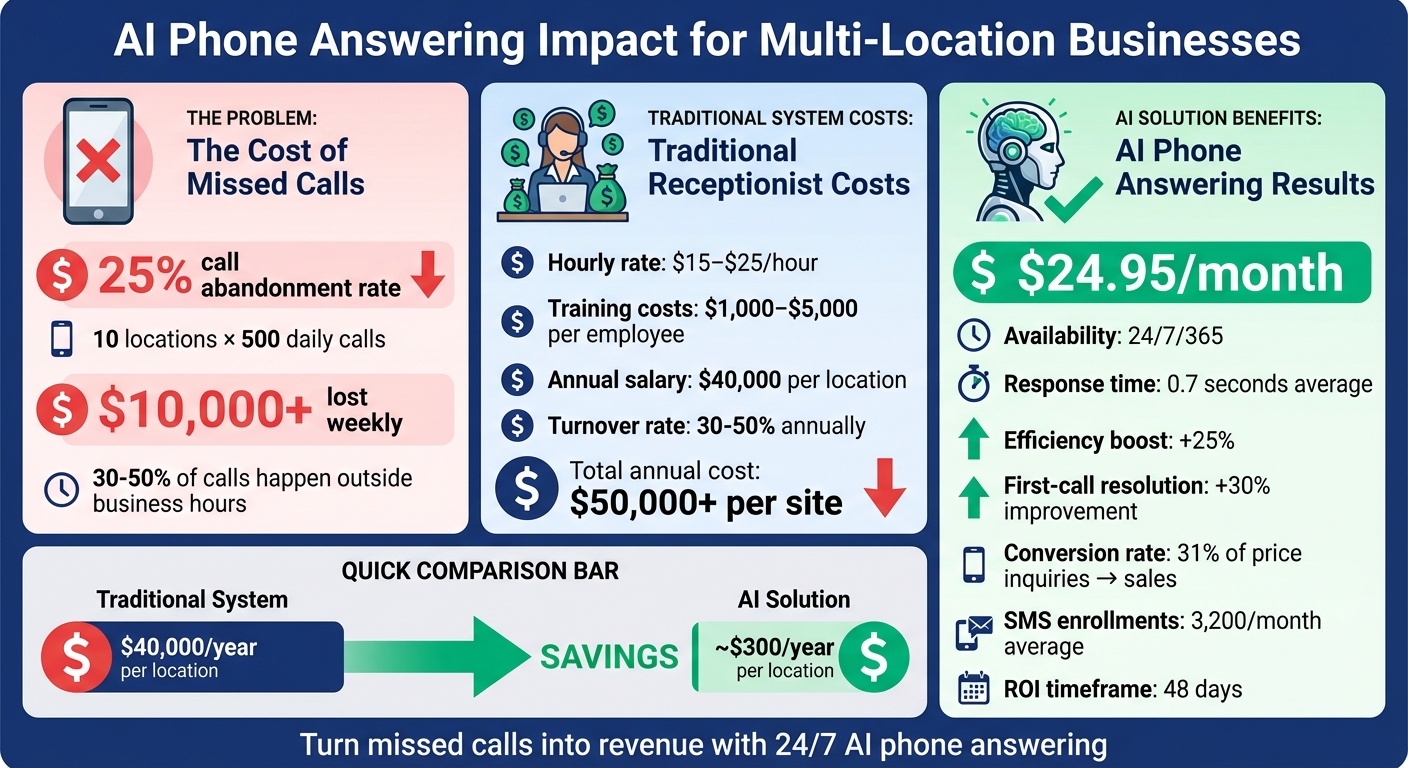
  • Missed Revenue: A 25% call abandonment rate for 10 locations handling 500 daily calls can mean over $10,000 lost weekly.
  • Challenges: High call volumes, inconsistent service, and staffing costs make handling calls across locations difficult.
  • AI Solution:
    • Operates 24/7, handling unlimited simultaneous calls.
    • Provides accurate, location-specific responses.
    • Costs as low as $24.95/month compared to $40,000 annual receptionist salaries.
    • Directly books appointments and captures customer details.

Results:

  • Businesses using AI systems report a 25% efficiency boost and a 30% improvement in first-call resolution rates.
  • With tools like Answering Agent, call abandonment rates drop, customer satisfaction improves, and revenue increases.

Start by analyzing your call data to identify gaps, then implement an AI solution to recover lost opportunities.

AI Phone Answering ROI and Cost Savings for Multi-Location Businesses

AI Phone Answering ROI and Cost Savings for Multi-Location Businesses

Why Traditional Phone Systems Can't Keep Up

Struggling with High Call Volumes

Traditional phone systems often fall short when it comes to handling the demands of modern businesses, especially those with multiple locations. These systems rely on fixed lines, which can only support a limited number of simultaneous calls. As a result, during peak times, customers are met with busy signals, long hold times, or even dropped calls. This creates a frustrating experience for callers and can lead to lost business.

For companies with several locations, the problem becomes even more pronounced. Without smart call routing, calls aren’t automatically directed to the nearest or least busy location. This inefficiency can cause call abandonment rates to skyrocket, sometimes reaching 20–50% during busy periods. For example, one provider reported a 30% drop in first-call resolution rates when using outdated systems.

When multiple calls flood in at once, customers left waiting may simply hang up and turn to competitors. These limitations highlight the need for more flexible and scalable communication solutions.

Limited Hours of Operation

Capacity isn’t the only issue - traditional phone systems are also restricted by their reliance on human operators. Most systems are staffed only during standard business hours, typically 9:00 AM to 5:00 PM. However, research shows that 30–50% of customer calls happen outside these hours.

This creates a significant challenge for businesses with multiple locations. Inconsistent staffing practices - where one location might stay open until 7:00 PM while another closes at 5:00 PM - mean many after-hours calls go unanswered, often landing in voicemail. These missed interactions can be costly, with some locations losing $1,000 or more in potential revenue each day.

The Cost of Hiring and Training Staff

The expenses tied to running traditional phone systems don’t stop at limited functionality - they also come with steep operational costs. Staffing these systems across multiple locations is expensive. Agents typically earn $15–$25 per hour, and training costs can range from $1,000 to $5,000 per employee. Add to that an annual turnover rate of 30–50%, and the total cost per site can easily exceed $50,000 each year.

Employee turnover only compounds the problem. The repetitive nature of phone support leads to high attrition rates, and recruiting new staff can cost 20–30% of an employee’s annual salary. Training new hires adds further strain on resources.

Seasonal spikes in call volume bring additional challenges. Businesses often need to hire temporary staff to meet demand, which increases training expenses and can lead to inconsistent service quality. As companies scale and open more locations, these financial and operational pressures become even harder to manage, making traditional phone systems an unsustainable choice for growing businesses.

How AI Phone Answering Reduces Call Loss

Always Available, No Matter the Time

AI phone answering systems are game-changers when it comes to availability. They operate around the clock, every single day of the year, ensuring no call is missed - even during weekends or after business hours. This constant availability means businesses no longer have to worry about losing revenue from unanswered calls.

These systems also handle scalability with ease. They can manage unlimited simultaneous calls without requiring extra staff or phone lines. Imagine a busy afternoon when multiple customers call at once - each call is answered immediately, with no delays. For instance, a global financial services provider saw a 25% boost in agent efficiency and a 30% improvement in first-call resolution after implementing AI virtual agents. This ability to handle high call volumes creates a smoother experience for customers and ensures interactions feel natural and seamless.

Conversations That Feel Real

Thanks to natural language processing, AI phone systems understand what callers need without forcing them through rigid, outdated menus. Customers can ask about things like business hours, pricing, or services and receive clear, engaging responses right away. Tools like Answering Agent make these interactions feel even more personal with customizable voices and scripts tailored to your business. On average, the system responds in just 0.7 seconds, keeping callers engaged and avoiding the frustration of long waits.

Cutting Costs While Enhancing Service

One of the biggest perks of AI phone answering is its cost efficiency. Instead of paying $15–$25 per hour for receptionists or spending $1,000–$5,000 on training, businesses can opt for automated solutions at a fraction of the cost. Some AI services start as low as $24.95 per month, compared to the $40,000 annual salary typically required for full-time receptionists at each location.

AI also delivers consistent and accurate responses across all locations, removing the variability that comes with human staff.

"Beyond just replacing a call center, Answering Agent has helped us cut costs while actively generating new revenue. It promotes our special offers and even signs customers up for our text club, following up instantly with links - something a traditional service can't match".

What Answering Agent Offers Multi-Location Businesses
Answering Agent

Custom Voice and Script Options

Answering Agent allows you to tailor the AI's voice, scripts, and language to align perfectly with your brand across all locations. This ensures consistency, eliminating the common discrepancies that can arise in multi-location operations. You can select natural-sounding voices and location-specific scripts to address details like business hours, services, pricing, and FAQs. Every interaction reflects your brand while delivering accurate, localized information.

The system is designed to follow your business rules, promotions, and recovery protocols. This minimizes errors that might happen if human staff forget a promotion or misquote a price. Additionally, smart routing directs callers to the nearest location after identifying their city, creating a smooth and personalized experience. Next, let's explore how Answering Agent transforms these tailored interactions into booked appointments and new leads.

Capturing Leads and Booking Appointments

Through natural, conversational interactions, the AI gathers customer details such as names, contact information, and service preferences - without sounding mechanical. It can then book appointments directly into your existing calendars, whether you use Google Calendar, Outlook, or another platform. For example, in a franchise with 10 locations, the system efficiently qualifies leads by capturing their preferred services and locations, centralizing this data, and initiating follow-ups through your integrated CRM.

The results speak for themselves: Answering Agent has achieved a 31% success rate in converting price inquiries into membership sales and averages 3,200 SMS enrollments per month across various locations. By capturing leads that might otherwise slip through during busy times or after hours, the AI turns every call into a chance to generate revenue.

Dashboard and Call Tracking Tools

Answering Agent goes beyond customization and lead capture by providing robust tracking tools that support smarter decision-making. A centralized dashboard offers real-time insights into call logs, performance metrics, and lead tracking across all locations. This allows you to monitor key data like call volume, conversion rates, and peak activity times. Businesses using similar AI solutions have reported a 25% boost in efficiency and a 30% improvement in first-call resolution rates.

With Answering Agent, you can also review AI-generated call summaries before following up with customers, ensuring streamlined communication while maintaining high service standards.

How to Set Up Answering Agent for Your Business

Evaluating Your Call Handling Needs

Start by analyzing 30–90 days of call logs for each location to establish a baseline. Pay attention to total calls, abandoned calls, and peak hours. On average, businesses with multiple locations experience a call abandonment rate of 10–15%, though some franchises report losing up to 20% of calls during off-hours. To calculate the abandonment rate, use this formula: (abandoned calls ÷ total calls) × 100. If any location exceeds a 10% abandonment rate, flag it for further review.

Next, identify common reasons for calls, such as inquiries about hours, directions, appointments, or pricing. Take note of any location-specific needs. For instance, restaurants may need reservation handling across all sites, while retail stores might prioritize questions about operating hours and product availability. Also, consider differences like time zones, seasonal hours, and local promotions. These details will help you customize the Answering Agent system to meet the specific needs of each location. This process can highlight where AI can make the biggest impact, potentially cutting after-hours call losses by up to 30%.

Getting Started and Connecting Your Systems

After evaluating your call data, it’s time to implement the Answering Agent system to address gaps and improve efficiency. The Answering Agent team offers a seamless setup process. Start by signing up at answeringagent.com, where the team will collaborate with you to create a centralized knowledge base. This database includes location-specific details like hours, services, pricing, and a tailored FAQ list (20–50 items per location). The setup typically takes one to two hours, and many businesses are fully operational within a day.

The system integrates easily with your existing phone lines using call forwarding. It also connects with tools like Google Calendar or Outlook for real-time appointment scheduling. For businesses with multiple locations, Answering Agent syncs with CRMs such as HubSpot, Salesforce, or Zendesk to automatically log call outcomes and lead data. Additionally, the AI can direct callers to the nearest location by asking for their city or store preference and then applying location-specific scripts. If your business uses specialized systems like NXT Wash, Sonny's Car Wash, or OptSpot, custom integrations can be developed to access customer data and membership details during calls.

Tracking Results and Making Adjustments

Once the system is live, monitoring performance is key to optimizing its effectiveness. Use the dashboard to track important metrics like call abandonment rates (aim for under 5%), response times, and lead conversion rates. Answering Agent is known for its quick response times, with some calls answered in as little as 0.7 seconds. Many businesses using AI-driven call systems report a 25% efficiency boost and a 30% improvement in resolving issues on the first call.

The system also provides call recordings, transcriptions, and AI-generated summaries, giving you insights into how calls are being handled. This data can help you fine-tune scripts or update routing rules as needed. For the first 90 days, review your dashboard weekly, then transition to monthly evaluations. If you notice high transfer rates or unresolved calls at a specific location, update its knowledge base or routing rules immediately. During the initial 14 days, the Answering Agent team actively monitors calls and makes refinements based on live data.

Lastly, focus on revenue-related metrics, such as appointments booked through the AI, to measure the system’s impact. These metrics can reveal cost savings compared to traditional staffing and help identify areas for further improvement. Keep the AI updated with changes to hours, promotions, or services to ensure accurate and effective call handling across all locations.

Build an AI Call Agent That Answers for You After Hours

Conclusion: Converting Lost Calls into Revenue

For businesses with multiple locations, even a small percentage of missed calls can add up to hundreds of lost opportunities every month. AI phone answering systems ensure that every inbound call is answered, turning inquiries into booked appointments or qualified leads - any time of day or night. This approach lays the groundwork for a more efficient call strategy that directly impacts revenue.

Just recovering a handful of missed calls per location can make a big difference. For example, converting a $150 service appointment or a $75 reservation can quickly add up to significant additional income. Customers using Answering Agent have reported a 28% overall conversion rate, with 31% of price inquiries leading to unlimited memberships.

But it’s not just about increasing revenue. AI answering solutions also provide consistent, location-specific service that enhances customer satisfaction. Callers get accurate and reliable information whether they’re calling at 9:00 AM or late at night.

With reduced labor costs, higher call answer rates, and more revenue per call, the return on investment is clear - often within just 48 days. By addressing the unique call-handling needs of each location, AI ensures no opportunity slips through the cracks.

Start by auditing your call data to identify missed opportunities, then implement AI solutions at your busiest locations. With the right setup and ongoing adjustments, you can turn missed calls into a dependable revenue stream across your entire network.

FAQs

How can AI help multi-location businesses reduce missed calls?

AI enables multi-location businesses to handle calls 24/7, providing natural, conversational interactions that feel just like speaking to a real person. This means no more missed opportunities due to voicemail or staff unavailability - every customer gets immediate attention.

Another advantage? AI can manage an unlimited number of calls at the same time, ensuring no call goes unanswered. This not only reduces the chances of customers hanging up but also helps capture important leads. By addressing inquiries instantly, businesses can streamline operations, keep customers happy, and turn more calls into revenue.

How can AI phone answering systems help reduce costs for multi-location businesses?

AI-powered phone answering systems offer a cost-effective solution for handling an unlimited number of customer calls without requiring extra staff. They cut down on expenses such as salaries, benefits, training, and the costs associated with employee turnover. Plus, they operate around the clock, ensuring 24/7 service availability.

These systems not only save businesses money but also ensure that every call is answered quickly and professionally. The result? Greater efficiency and a consistent, dependable customer experience.

How can AI phone systems adapt to the needs of different business locations?

AI phone systems can be customized to fit the specific needs of individual business locations. This includes setting up details like pricing structures, service packages, seasonal promotions, and operational guidelines. They can also connect with local tools, such as POS systems or CRM platforms, to access customer data and provide tailored service.

By adapting to the unique operations, language preferences, and promotions of each location, these systems ensure interactions feel both consistent and localized. This approach allows businesses to maintain a professional and efficient experience for customers across all their locations.

Related Blog Posts

Answering Agent