AI Phone Systems for Auto Shops: ROI Breakdown

See how AI phone systems recover missed calls, book appointments 24/7, cut staffing costs, and deliver fast ROI for auto repair shops.

AI Phone Systems for Auto Shops: ROI Breakdown

Auto repair shops lose thousands in revenue every month due to missed calls. Service departments miss 158–216 calls monthly, with 60% of calls unanswered during peak hours. Since 85% of callers don’t leave voicemails, this results in significant lost opportunities - especially when the average repair order is $450. AI phone systems solve this by answering calls in under 5 seconds, managing unlimited calls simultaneously, and booking appointments directly into shop management platforms. These systems operate 24/7, ensuring no call or customer is ignored, even after hours.

Key Takeaways:

  • Missed call revenue loss: Up to $650,000 annually for some auto shops.
  • AI solutions: Handle 50–80% of calls, book appointments, and provide instant responses.
  • Cost comparison: AI systems cost $2,400–$7,200 annually, far less than hiring staff.
  • ROI timeline: Many shops recover their investment within weeks, with long-term revenue gains.

AI phone systems don’t just recover lost revenue - they also improve efficiency by freeing up service advisors to focus on in-person tasks. Shops using AI tools report higher appointment bookings, reduced no-show rates, and increased repair approvals. For example, one dealership saw $2 million in new service appointments in just 90 days by automating call handling. These systems are a cost-effective way to maximize revenue and streamline operations.

Week 1: Immediate Returns from AI Phone Systems

Revenue Recovered from Captured Calls

Missed calls are like leaving money on the table. Even recovering a small fraction of these calls can lead to noticeable financial gains almost instantly. When every call gets answered, the results start showing up in your bottom line within days.

Let’s break it down: if 20 missed calls result in just five new appointments, and the average repair order is $450, that’s an additional $2,250 in revenue in the first week alone.

A real-world example? Martin Management Group. Over a 90-day period starting in May 2025, their AI-powered phone system handled over 22,000 calls across 13 locations. The result? More than $2 million in service appointments booked and operational margins doubled. While their results span multiple locations, it highlights how quickly revenue can snowball when every call is captured.

Here’s another perk: these systems often pay for themselves with just one extra customer a month. With pricing ranging from $97 to $897 per month depending on call volume, many businesses see a positive ROI within the first week. This is especially true given that 14% of appointments are typically booked after hours when no staff is available.

And it’s not just about the money - these systems also bring instant improvements in how your shop runs.

Instant Efficiency Improvements

The benefits go beyond revenue. AI phone systems start streamlining your operations from day one. By taking over repetitive tasks like scheduling appointments, updating customers on their vehicle status, and answering common FAQs, these systems free up your service advisors to focus on more critical, in-person interactions.

"Shops report a 30% increase in customer engagement and faster throughput within the first seven days of activating AI-driven communication tools." – Bolt-On Technology

Speed is another game changer. AI systems like Answering Agent respond in under 5 seconds - an important edge when 78% of customers choose the business that responds to them first. Plus, with 85% of callers hanging up if they can’t connect right away, fast response times are essential.

After-hours service adds even more value. Imagine a customer calling at 9:00 PM because of a breakdown. The AI can take their details, schedule a morning appointment, and send an automatic confirmation text. By the time your team starts their day, the appointment is already set, and the customer feels taken care of.

These quick wins in revenue and efficiency set the stage for even greater benefits in the months ahead.

Month 1: Revenue and Efficiency Gains

Higher Approval Rates and Average Repair Orders

In just the first month, auto shops see a 15% boost in repair approval rates. AI systems ensure follow-ups on every estimate, preventing missed callbacks - even during the busiest times.

These AI tools also slash the time between providing a quote and receiving approval by up to 65%. This means technicians can spend less time waiting for go-aheads and more time getting vehicles back on the road.

Take Premier Motors, for example - a mid-sized dealership with three locations. Within 90 days of adopting AI voice agents, their average service ticket grew by 18%. The system used vehicle history during booking calls to recommend relevant maintenance, resulting in 183 additional monthly appointments and $147,000 in extra revenue. On top of that, their no-show rate dropped from 12% to 7%, and call abandonment fell from 23% to just 2%. General Manager David Chen noted that the dealership recouped its investment in only 45 days.

Another success story comes from a Pennsylvania auto shop. By incorporating AI-driven estimate follow-ups in 2024, they also achieved a 15% increase in repair approval rates. This improvement directly boosted bay utilization, ensuring technicians always had approved jobs ready to tackle.

These gains in approval rates naturally lead to smoother appointment scheduling.

Better Appointment Management

With higher approval rates in place, AI systems take appointment scheduling to the next level. Automated text and email confirmations, complete with calendar invites, reduce no-show rates by anywhere from 42% to 70%. This can mean the difference between empty bays and a fully booked schedule.

At Premier Motors, service advisors reclaimed 45% of their workday, which had previously been spent on routine scheduling calls. This freed them up to focus on in-person upselling and resolving more complex customer issues. Customers now get quicker responses, cutting down on hang-ups.

"I spend way more time actually helping customers with complex issues instead of being stuck on the phone booking oil changes. My job satisfaction has honestly gone up." – Tom P., Senior Service Advisor, Premier Motors

Additionally, 62% of AI-scheduled appointments happen outside normal business hours. This capability captures revenue that might otherwise be missed, allowing shops to keep their calendars full without needing extra staff.

The ROI Of An AI Voice Agent: Is It Worth It? | The Numbers Every Owner Must See

Year 1: Long-Term Financial and Operational Impact
AI Phone System vs Traditional Staffing: Annual Cost Comparison for Auto Shops

AI Phone System vs Traditional Staffing: Annual Cost Comparison for Auto Shops

Cumulative Revenue Growth Over 12 Months

Over the course of a year, the benefits of AI phone systems become even more pronounced. Auto shops could see a 40% increase in total service bookings within the first 12 months. This is largely due to capturing 62% of after-hours calls and reducing no-show rates by 40%. When combined with tools like digital inspections and mobile approvals, Average Repair Order (ARO) values can rise by 39%.

Missed calls are a costly issue for dealerships, potentially leading to annual losses of up to $1.17 million. For example, Martin Management Group automated over 22,000 calls across 13 locations in just 90 days. This effort resulted in scheduling more than $2 million in service appointments and doubling operational margins.

These results highlight not just the revenue potential but also the cost efficiencies AI systems bring compared to traditional staffing models.

Cost Savings Compared to Traditional Receptionists

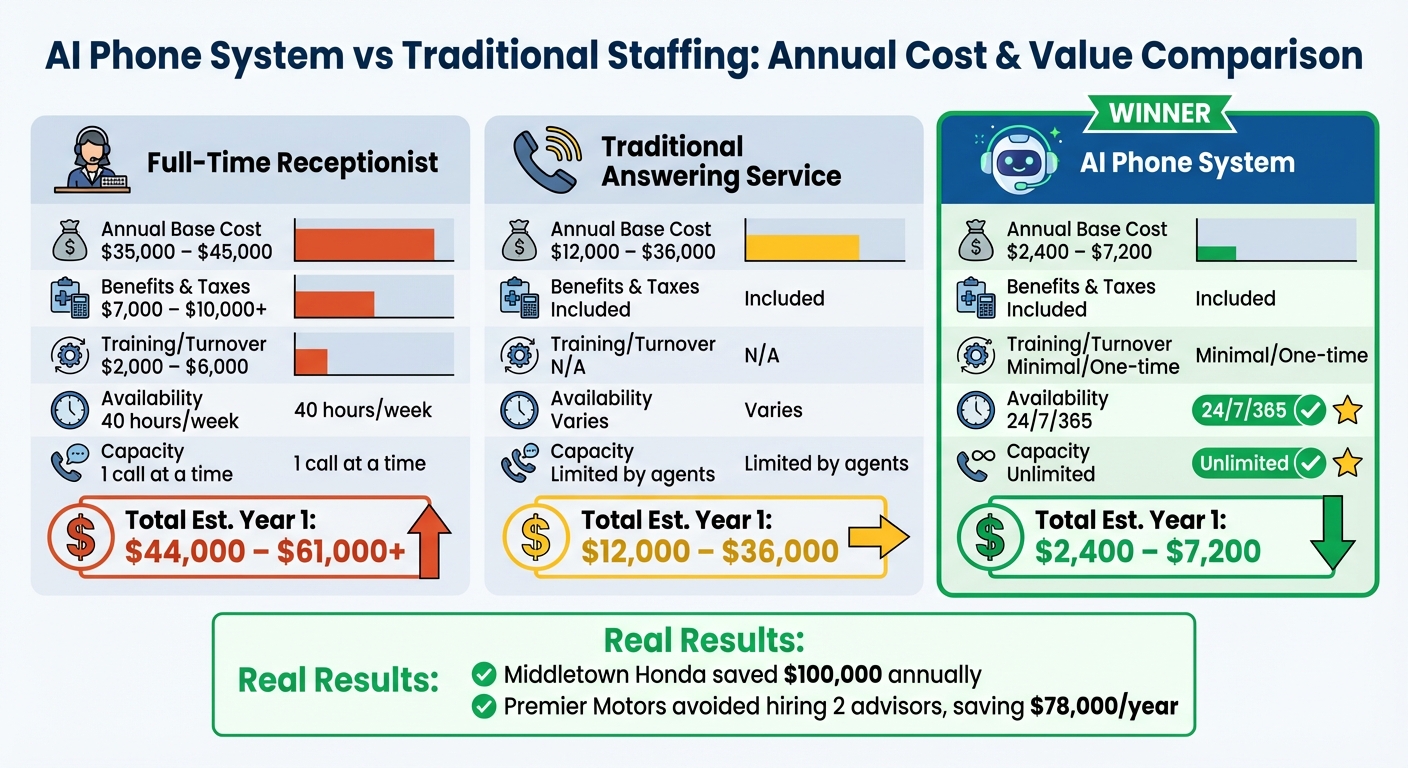
The financial advantages of AI systems extend into staffing costs. A full-time receptionist or Business Development Center (BDC) representative can cost between $42,000 and $61,000+ annually when factoring in salary, benefits, payroll taxes, and training. Traditional live answering services, while cheaper, still range from $12,000 to $36,000 annually. In contrast, AI phone systems are significantly more affordable, with annual costs between $2,400 and $7,200.

Expense Category Full-Time Receptionist Traditional Answering Service AI Phone System
Annual Base Cost $35,000 – $45,000 $12,000 – $36,000 $2,400 – $7,200
Benefits & Taxes $7,000 – $10,000+ Included Included
Training/Turnover $2,000 – $6,000 N/A Minimal/One-time
Availability 40 hours/week Varies 24/7/365
Capacity 1 call at a time Limited by agents Unlimited
Total Est. Year 1 $44,000 – $61,000+ $12,000 – $36,000 $2,400 – $7,200

For instance, Middletown Honda eliminated the need for extra phone staff by letting AI handle over 50% of inbound calls, saving more than $100,000 annually. Similarly, Premier Motors avoided hiring two additional service advisors, saving $78,000 per year, while also generating an additional $146,400 in monthly revenue. This added up to an impressive total annual net benefit of $2,121,396.

Improved Staff Productivity

Beyond revenue and cost savings, AI systems significantly improve staff productivity. Service advisors often spend 33–50% of their day managing phone calls. With AI taking over routine scheduling tasks, advisors at Premier Motors reclaimed 45% of their time, reducing phone duties from 70% of their day to just 25%.

"The AI has been like hiring a perfect employee who never calls in sick, never takes a break, and handles the routine stuff flawlessly." – Lisa M., Service Manager, Premier Motors

This shift enables advisors to focus on higher-value tasks, increasing revenue while improving job satisfaction. Additionally, AI systems streamline operations by capturing complete booking details - VIN, mileage, service history - making vehicle check-ins 40% faster. Automated status updates further cut down manual follow-up calls by 20% to 30%, allowing technicians to dedicate more time to repairs without interruptions.

How to Calculate and Track ROI for AI Phone Systems

Key Metrics for Calculating ROI

Understanding the return on investment (ROI) for AI phone systems is essential for evaluating their long-term impact on your business. Start by calculating ROI using this formula: multiply the number of additional answered calls by your conversion rate and the average repair order value.

Another important metric is the AI Resolution Rate - the percentage of calls fully managed by the AI system. Auto shops using AI report that these systems handle 50% to 80% of inbound calls from start to finish. This translates directly into labor savings. To calculate, multiply the weekly hours saved by the staff hourly rate, then multiply that figure by 52 weeks.

Customer experience metrics also play a key role. For example, tracking Customer Satisfaction Index (CSI) scores and after-hours booking rates can reveal how the system improves customer engagement. Since 78% of customers choose the business that responds to them first, monitoring metrics like answer speed and call coverage rate can highlight your competitive edge.

Tools for Monitoring Performance

Modern AI phone systems seamlessly integrate with Shop Management Systems like Tekmetric, Shop-Ware, Mitchell 1, CDK, and Reynolds. This integration automates tasks like appointment logging and revenue tracking, removing the need for manual data entry and offering real-time insights from the initial call through to the completed repair order.

AI call tracking systems can also use dynamic numbers to reveal which marketing channels are driving the best results - whether it’s Google Ads, SEO, or social media. For instance, a five-location auto shop in Colorado discovered through AI tracking that 25% of new callers weren’t being offered appointments, with most missed calls happening during lunch hours (11:30 AM to 1:00 PM). By adjusting staff schedules based on this data, they boosted appointment bookings by 42% and cut missed calls by 31% in just three months.

To effectively monitor performance, start by establishing baseline metrics over a 2 to 4-week period. Track data like call volume, missed calls, and conversion rates. Use real-time dashboards to identify revenue-draining patterns, such as the common trend of 60% of service calls going unanswered on Monday and Tuesday mornings. Regularly review AI-generated call transcripts and sentiment analysis and AI tone adaptation to identify recurring customer questions or areas where your team might need coaching. Finally, schedule quarterly ROI reviews to compare your monthly AI subscription costs against the revenue captured and labor savings achieved, ensuring you maintain a clear picture of the system’s performance.

Conclusion: Why AI Phone Systems Pay Off for Auto Shops

Auto repair shops miss about 23% of incoming calls, and a staggering 62% of those customers are likely to call a competitor instead. With the average repair order projected to hit $428 by 2025, every missed call isn't just an inconvenience - it's lost revenue. AI phone systems step in to fill this gap, often at a fraction of the cost of hiring a full-time receptionist.

The numbers speak for themselves. For example, Premier Motors achieved a full return on their investment in just 45 days, while Middletown Honda saved over $100,000 annually by adopting AI systems. These results demonstrate how quickly these systems can recover lost revenue while setting the stage for broader operational improvements.

AI systems do more than recover missed calls - they transform shop operations. By handling routine scheduling calls, they free up service advisors to focus on more critical tasks, such as assisting customers with complex repairs. Operating around the clock, AI systems capture 31% of after-hours calls, turning previously missed opportunities into new appointments. These operational improvements go hand-in-hand with the cost savings compared to AI answering outlined earlier.

Speaking of costs, the difference is striking. AI phone systems typically range between $2,400 and $3,600 annually, compared to the $35,000 to $45,000 cost of hiring a full-time receptionist. Plus, they can handle unlimited calls simultaneously without hold times, creating a smoother and more efficient customer experience. Every inbound call becomes a chance to book an appointment or capture a lead.

For auto repair shops looking to stay ahead, AI phone systems are no longer a "nice-to-have" feature - they’re a smart investment. They pay for themselves in weeks, not years, and provide the tools to turn every call into revenue. Answering Agent delivers exactly that: a 24/7 AI-powered solution that books appointments, captures leads, and ensures no opportunity slips through the cracks. It's time to seize every call and maximize your shop's revenue potential.

FAQs

How soon can auto repair shops see a return on investment with AI phone systems?

Auto repair shops often experience a noticeable return on investment (ROI) within just a few months of implementing AI phone systems. These systems cut costs by managing unlimited customer calls, scheduling appointments, and capturing leads around the clock - all without needing extra staff.

Equipped with features like natural, conversational interactions and customizable scripts, AI phone systems do more than save time - they help boost revenue by transforming every call into a potential business opportunity. Some businesses report ROI numbers reaching as high as 400%, making this technology a game-changer for increasing efficiency and profits.

What are the cost advantages of using AI phone systems over hiring staff?

AI phone systems can save businesses a huge amount of money compared to hiring traditional staff. For example, employing a full-time receptionist can run between $60,000 and $82,000 annually. In contrast, AI systems cost significantly less, typically ranging from $600 to $3,700 per year. Even live answering services, which charge around $125 to $550 or more per month, are far more expensive than AI solutions, which can start as low as $12 per month.

But the benefits go beyond just cutting costs. AI systems are available 24/7, can handle unlimited calls, and don’t come with extra expenses like hiring, training, or providing benefits. Some businesses have seen a return on investment of over 7,000%, with reports of saving hundreds of thousands of dollars each year. At the same time, these systems help increase revenue through better call management and appointment scheduling. For auto shops, in particular, AI phone systems offer a scalable and efficient way to manage high call volumes without the need for additional staff.

How can AI phone systems help auto shops improve customer service and schedule more appointments?

AI phone systems make customer service and appointment scheduling more efficient by ensuring no call goes unanswered, even during peak hours or after business hours. With the help of natural language processing, these systems can interact with callers, understand their requests, and handle tasks like booking appointments or providing answers to common inquiries. This reduces the chances of missed calls - often linked to lost revenue - and ensures customers get the help they need right away.

These systems also work hand-in-hand with scheduling tools that sync with shop management software. Features like real-time booking, automatic calendar updates, and reminders help prevent issues like double bookings and simplify the entire scheduling process. By offering round-the-clock availability and smooth service, AI phone systems not only enhance customer satisfaction but also increase appointment bookings and revenue for auto repair shops.

Related Blog Posts

Answering Agent