Each new location adds more calls, more hours to cover, and more local details the phone has to get right. An AI phone system answers every call, routes it to the right site, and gives the correct hours, prices, and promotions without adding a receptionist at each branch.
A good setup gives every location the same brand voice with its own local facts, plus one dashboard that shows which sites are missing calls or bookings. The rest of this post covers how to set that up and what to check before you roll it out.
Key Features of AI Phone Systems for Multi-Location Businesses
24/7 Availability and Unlimited Call Handling
The AI answers every call, including after hours and during shift changes. It also handles many calls at once, so a promotion launch or a grand opening doesn't create a queue.
Customizable Scripts and Voices per Location
Each location can have its own script, voice, and language options. A Miami site might greet callers in English and Spanish. A Boston site might use a more formal tone. The AI stores each site's address, hours, and current promotions so callers get the right local answer.
Jacksons Car Wash uses it to sell as well as answer:
Beyond just replacing a call center, Answering Agent has helped us cut costs while actively generating new revenue. It promotes our special offers and even signs customers up for our text club, following up instantly with links - something a traditional service can't match.
Smart Call Routing by Location and Time Zone
Routing sends each caller to the right branch based on the number they dialed, their area code, or the location they name. A Dallas caller on your national number reaches the nearest Texas site. After hours, the AI takes details and schedules a follow-up.
You can also route by purpose. Billing questions go to the back office, and sales inquiries go to the local site. Open and closed hours follow each location's time zone. During regional rushes, the AI absorbs overflow from busy sites.
How to Customize AI Phone Systems for Multi-Location Growth
Keep brand greetings and compliance rules central. Let hours, menus, and promotions vary by site.
Assess Communication Needs Across Locations
Pull call volume, peak times, call reasons, languages, after-hours volume, and hold times for each site. That data shows where coverage is thin.
Set one goal per site, such as fewer abandoned calls, shorter waits, or more bookings. Also list the tools the system has to connect with before you start.
Use a Centralized Call Management Dashboard
Load every site into one cloud dashboard with its address, time zone, numbers, user roles, and current call rules. Standardize greetings, compliance messages, and recording policy across all sites. Adjust hours, menu options, and promotions for each location.
Compare wait times, missed calls, and bookings across sites. If one branch shows high abandonment or low bookings, change its routing or script first.
Tailor Auto-Attendants and Call Transfers
Give each site a menu with its branch name, local options, and languages, and keep the brand voice the same. Route callers by dialed number, area code, or spoken input.
Set separate greetings for business hours, after hours, and holidays in each site's time zone. When a branch is busy or closed, send overflow to another open location or to a 24/7 AI line. Answering Agent handles location-specific routing from one account.
Add Appointment Booking and Lead Capture
Connect the system to your CRM and scheduling tools. Map each location's calendar so bookings land on the right branch, staff member, and time zone. Outside hours, the AI qualifies callers and starts your follow-up workflow.
Test and Fine-Tune for Consistency
Place test calls at each site during business hours, after hours, peak times, and near closing. Use different area codes and common requests, such as booking or asking for directions, and confirm each call routes correctly.
Track answer rate, transfer rate, and wait time for each site. Read transcripts to find repeat questions, then add them to the FAQ or menu. Pilot a few locations first, measure missed calls and conversions, and then roll out to the rest. Retest whenever you add a site or service.
Benefits of Answering Agent for Multi-Location Business Growth

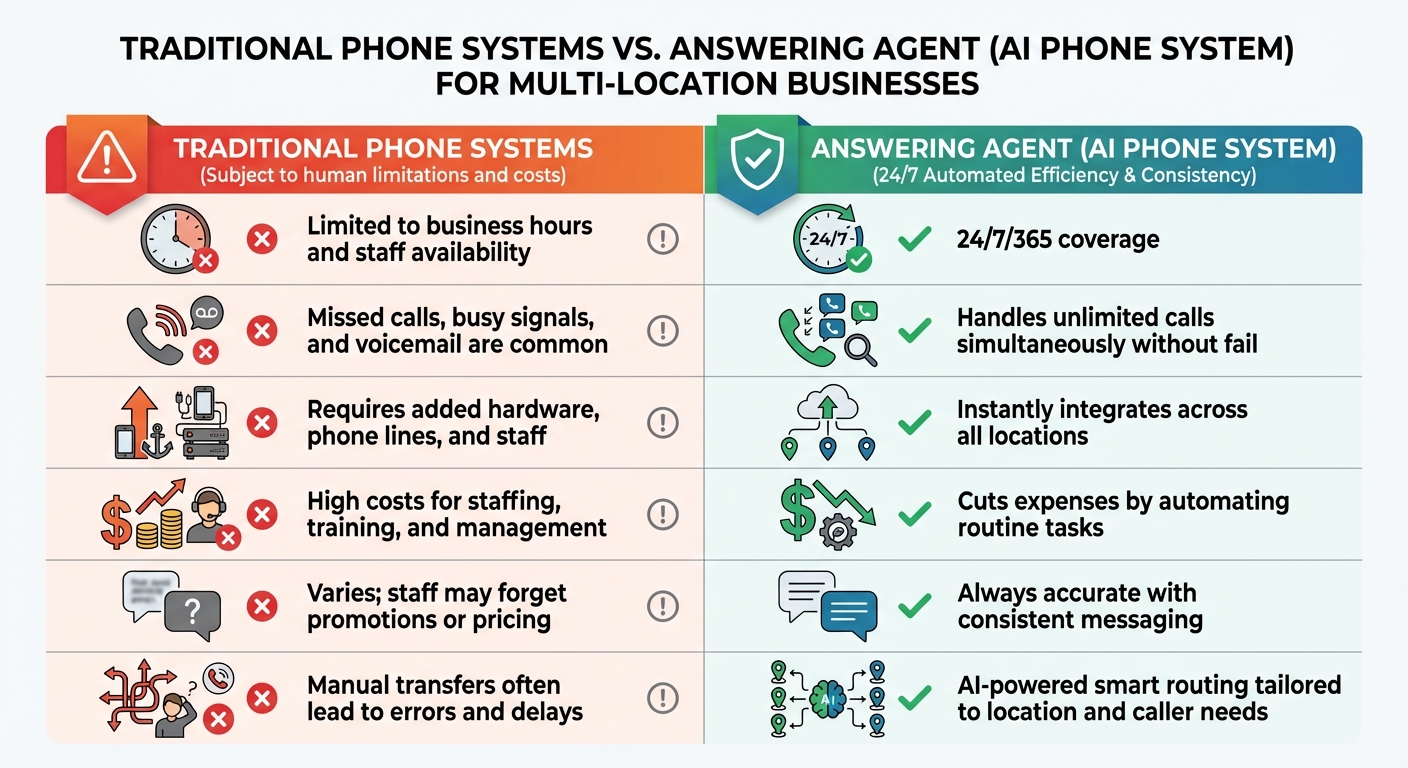
Traditional Phone Systems vs AI Phone Systems for Multi-Location Businesses
Traditional Phone Systems vs. Answering Agent: A Clear Advantage
Traditional setups need hardware, lines, and reception staff at every branch, so costs grow with each opening. Answering Agent runs in the cloud and covers every site from one account.
| Feature | Traditional Phone Systems | Answering Agent |
|---|---|---|
| Availability | Limited to business hours and staff availability | 24/7/365 coverage |
| Call Handling | Missed calls, busy signals, and voicemail are common | Handles many calls at once |
| Scalability | Requires added hardware, phone lines, and staff | New locations added in the same account |
| Cost Structure | High costs for staffing, training, and management | Routine calls automated |
| Consistency | Varies; staff may forget promotions or pricing | Same script and current offers on every call |
| Routing | Manual transfers often lead to errors and delays | Routing by location and caller need |
Turning Calls into Revenue Opportunities
The AI books appointments, collects caller details, pitches current offers, and enrolls callers in SMS lists at every site. When a member calls to cancel, it can make a win-back offer before the cancellation goes through.
Consistent Brand Voice Across Locations
Write one master script with the greeting, key phrases, and tone. Then add each site's pricing, hours, and offers. A caller to New York or Dallas hears the same core message with the right local details. When a promotion changes, update the script once and it applies to every location, with no retraining.
Best Practices for Implementing AI Phone Systems
Ensure Compliance with Call Recording Laws
Federal law under the Electronic Communications Privacy Act (ECPA) allows one-party consent. Some states require every party on the call to consent. The simplest fix is to use an all-party policy everywhere and open every call with: "This call may be recorded for quality and training purposes."
Area codes don't reliably show where a caller is, so rely on the announcement rather than location detection. Document the policy, limit who can access recordings, and use role-based permissions with audit logs.
Use Advanced Dashboards for Monitoring
Watch call volume, wait time, abandonment, and peak hours for every site in one view. If a branch keeps dropping calls at peak, route its overflow to another site or to the 24/7 AI line.
"The easy to use interface and AI summary allows me to review the customer information before calling back the customer, minimizing call time." – Waves Car Wash
Monitor and Optimize Performance with AI Analytics
Transcript analytics show caller sentiment, repeat issues, and missed sales. If frustration spikes at one branch, find the cause before it spreads to other sites.
Review reports monthly and A/B test greetings, menus, and routing. Judge each change by bookings, leads, and call length, not just by cost.
FAQs
How can AI phone systems enhance the customer experience for businesses with multiple locations?
Every call gets answered quickly, at any hour, with the same brand message and the right local details and promotions for that site.
How can AI phone systems help multi-location businesses save money?
The AI handles booking and common questions around the clock, and it takes many calls at once. You need fewer on-site staff for the phone, and fewer leads go to voicemail.
How do AI phone systems manage calls across time zones and local preferences?
Each location's hours follow its own time zone. Scripts can vary by site for language, pricing, and offers.
Related Blog Posts
Book a walkthrough
See it handle your calls.
Book 20 minutes, or hear a sample call first.