Stop overpaying for your AI Phone Services. Switch to us and get 25% off your current bill for 18 months

AI Route Optimization: ROI for Service Businesses

AI route optimization reduces fuel and transport costs, cuts planning time, boosts on-time rates, and often pays back within 8–12 months.

AI Route Optimization: ROI for Service Businesses

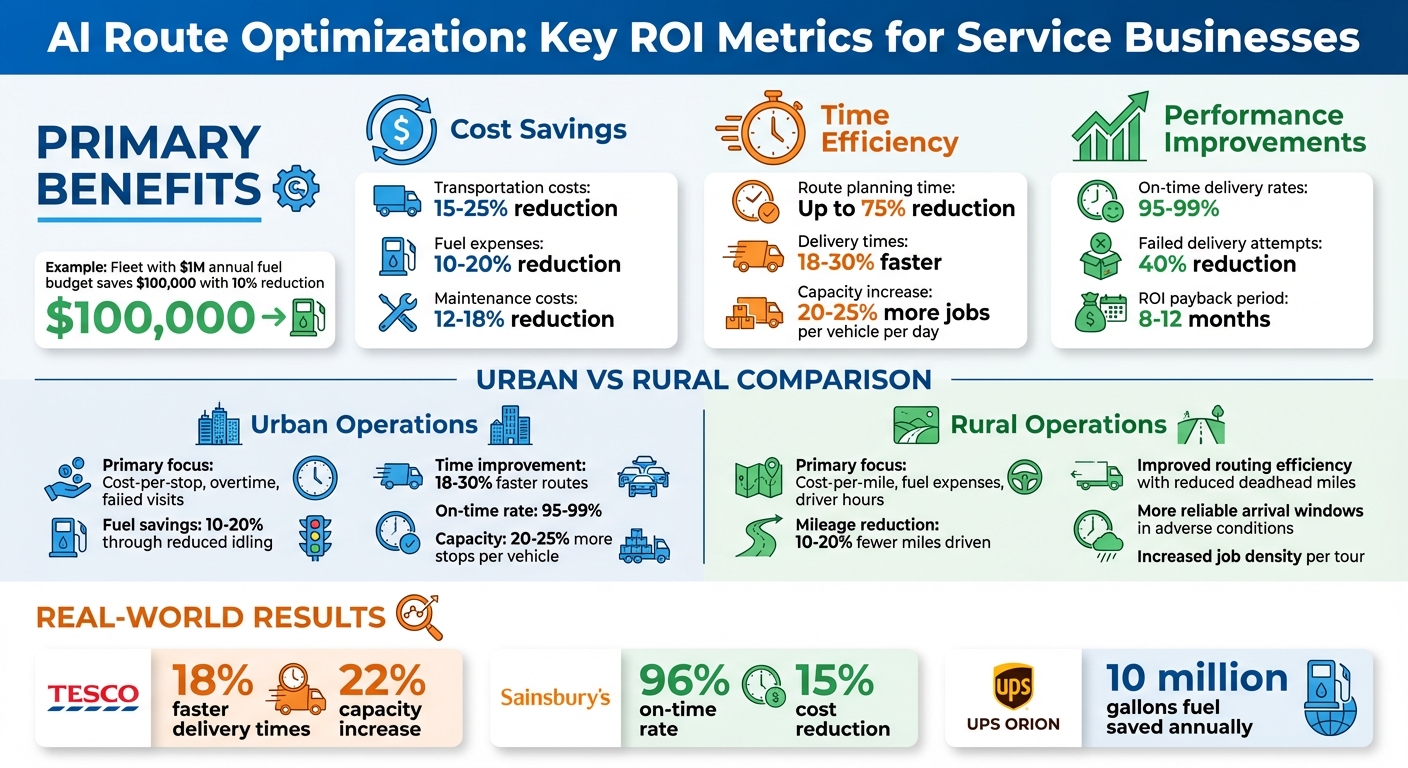
AI route optimization helps service businesses improve efficiency and reduce costs by creating the most efficient routes for vehicles and technicians. It uses real-time data to cut fuel usage, save time, and complete more jobs daily. Key benefits include:

  • Cost Savings: Businesses save 15–25% on transportation costs and 10–20% on fuel expenses. For example, a fleet spending $1M annually on fuel could save $100,000 with a 10% reduction.
  • Time Efficiency: Route planning time is reduced by up to 75%, allowing managers to focus on other tasks. Companies like Tesco saw delivery times drop by 18% and job capacity increase by 22%.
  • Improved Maintenance: Fewer miles driven and less idle time lead to 12–18% lower vehicle maintenance costs.
  • On-Time Performance: Businesses achieve 95–99% on-time delivery rates, reducing failed delivery attempts by 40%.

Whether in urban or rural areas, AI route optimization tailors routes to specific challenges like traffic or long distances, boosting productivity and ROI. Most companies recover their investment within 8–12 months.

Quick Stats:

  • Fuel Savings: 10–20%
  • Transportation Cost Reduction: 15–25%
  • Maintenance Cost Reduction: 12–18%
  • Planning Time Cut: Up to 75%
  • On-Time Delivery Rates: 95–99%

This tool is a game-changer for service businesses, offering measurable financial and operational improvements.

AI Route Optimization ROI Statistics and Cost Savings for Service Businesses

AI Route Optimization ROI Statistics and Cost Savings for Service Businesses

Cost Savings from AI Route Optimization

Transportation and Fuel Savings

Switching to AI-powered routing can cut transportation costs by 15–25% compared to traditional manual planning methods. These savings come from reducing overall miles driven, minimizing empty trips, and making better use of vehicles across the fleet. For businesses, this means noticeable reductions in annual expenses.

Fuel savings are another major benefit. Companies using AI routing systems typically see fuel consumption decrease by 10–20%, leading to substantial cost reductions. A prime example is UPS's ORION system, which saves around 10 million gallons of fuel annually by optimizing delivery routes and avoiding inefficient driving habits like left turns across traffic. For a mid-sized U.S. fleet with a $1,000,000 annual fuel budget, even a modest 10% savings adds up to $100,000 per year.

Smaller fleets can also benefit significantly. Take a service business with 20 vehicles, each using 5,000 gallons of fuel annually. At $4.00 per gallon, the total fuel cost is $400,000. A 15% reduction saves 15,000 gallons, or about $60,000 each year. Real-world examples show similar results: Metro Cash & Carry cut delivery costs by 13% with AI route optimization, while Sainsbury's achieved a 96% on-time delivery rate and reduced last-mile costs by 15%.

Beyond cutting fuel expenses, optimized routes help reduce vehicle idling and overall maintenance needs, leading to even greater savings.

Lower Idle Time and Maintenance Costs

AI routing systems are designed to minimize idle time and vehicle wear by steering drivers away from traffic jams, streamlining stop sequences, and updating routes in real time. This means less time spent stuck in traffic or waiting at intersections. For light-duty vehicles, an hour of idling burns about 0.5–1.0 gallons of fuel. Eliminating 1,000 idle hours per vehicle each year can save $2,000–$4,000 in fuel costs alone.

Fewer miles driven and less stop-and-go traffic also mean reduced wear on tires, brakes, and engines. Businesses using AI routing and telematics report maintenance cost reductions of 12–18%. For a company spending $200,000 annually on vehicle maintenance, this translates to savings of $24,000–$36,000 per year.

Adding tools like Answering Agent, which captures accurate job details and schedules 24/7, can further enhance these savings. By feeding cleaner data into routing systems, businesses can reduce missed appointments and avoid costly repeat trips. Together, these benefits - lower idle time, reduced maintenance needs, and improved efficiency - boost the overall return on investment for companies using AI-driven routing solutions.

Efficiency and Time Savings

Faster Route Planning and Scheduling

AI-powered route optimization can slash route planning time by as much as 75% compared to manual methods, transforming what used to take hours into just minutes. This shift allows managers to focus on more strategic tasks rather than getting bogged down in tedious route creation. According to MyRouteOnline, businesses leveraging AI for route planning report scheduling speeds up to 40% faster, thanks to instant route generation that eliminates the need for traditional drag-and-drop methods. The system also learns continuously, identifying patterns like neighborhood-specific delivery preferences or how weather impacts delivery times. This adaptability ensures routes are always optimized for efficiency.

The results speak for themselves. Tesco achieved an 18% reduction in delivery times while increasing deliveries per vehicle by 22% using dynamic routing. Similarly, Metro Cash and Carry cut delivery costs by 13% with AI-driven planning. For field service teams - like HVAC technicians or repair crews - these improvements mean more appointments can be scheduled without adding extra staff. This not only saves time but also boosts ROI by allowing technicians to complete more jobs in a day, ultimately enhancing service reliability.

Better On-Time Service Rates

AI doesn’t just streamline planning; it also significantly improves on-time performance. Businesses using AI route optimization often achieve delivery rates of 95% to 99%, with some reporting rates as high as 98–99% for time-sensitive orders. For example, Sainsbury’s achieved a 96% on-time delivery rate while cutting last-mile costs by 15%, thanks to real-time rerouting that adapts to unexpected challenges like traffic jams or road closures. TIP Trailer Services also saw impressive results, reaching 98% forecast accuracy, which allowed them to provide customers with reliable delivery windows.

These high on-time rates translate to tangible benefits: up to 40% fewer failed delivery attempts and a noticeable drop in customer complaints. Workers also benefit, with delivery times improving by 18–30% and less idle time during their routes. Dynamic rerouting ensures that even when delays occur, subsequent appointments are automatically adjusted to keep schedules on track.

For logistics providers, HVAC companies, and field service teams, these enhancements mean more jobs can be completed in a day, leading to happier customers and improved overall efficiency.

AI & Machine Learning Use Cases for Route Optimisation

Urban vs. Rural ROI Metrics

Building on earlier discussions about costs and efficiency, examining ROI through the lens of geographic context provides deeper insights for refining operational strategies.

Urban Areas: Traffic and Delivery Volume

In urban settings, AI-powered route optimization stands out by tackling congestion, high stop density, and tight service schedules. The issue here isn’t distance - it’s the complexity of navigating traffic jams, construction zones, and clusters of delivery stops. AI systems excel by dynamically rerouting around incidents and optimizing stop sequences to minimize delays.

Urban fleets benefit significantly, with delivery times reduced by 18–30% and fuel savings ranging from 10–20%. These savings are not just about efficient routing; they also reflect the system’s ability to handle congestion and meet strict service windows. On-time delivery rates in cities often hit an impressive 95–99%, while failed delivery attempts drop by as much as 40%. For service providers like HVAC companies or field teams operating in metro areas, this efficiency can mean completing 20–25% more jobs per vehicle each day. Cutting just 30–60 seconds off each stop across more than 100 daily stops translates to substantial time savings.

Rural Areas: Distance and Weather Factors

Rural operations come with their own set of challenges - long travel distances, fewer stops, and unpredictable weather. In these areas, ROI is driven by reducing total miles traveled. AI tools eliminate backtracking and create smarter routes by considering fuel stops, road conditions, and seasonal access issues. Additionally, these systems account for elevation changes and real-time weather forecasts, enabling routes to avoid hazardous areas during storms or floods.

Rural fleets typically experience a 10–20% reduction in total miles traveled through better geographic clustering. While the percentage savings are similar to urban areas, the actual dollar savings per vehicle can be higher due to the greater distances covered annually. Real-time route adjustments during adverse conditions also reduce weather-related re-dispatches and failed visits, ensuring more consistent service levels and fewer unexpected costs. The comparison table below highlights the differences between urban and rural ROI metrics.

Comparison Table: Urban vs. Rural ROI Metrics

ROI Metric Urban Operations Rural Operations
Primary cost focus Cost-per-stop, overtime, and failed visits Cost-per-mile, fuel expenses, and driver hours
Fuel & mileage savings 10–20% fuel reduction through minimized idling 10–20% fewer miles driven via better route clustering
Time efficiency 18–30% faster routes; planning time reduced up to 75% Improved routing efficiency with reduced deadhead miles
On-time performance 95–99% on-time rates; up to 40% reduction in failed attempts More reliable arrival windows even in adverse conditions
Capacity improvement Approximately 20–25% more stops per vehicle per day Increased job density per tour with fewer empty trips
Key challenges mitigated Overcoming congestion and tight service windows Managing long distances, weather disruptions, and variable road conditions

For businesses operating in both urban and rural zones, tracking these metrics independently can pinpoint where AI routing delivers the most value. Adjusting service windows, average speeds, and buffer times based on the area type can help mixed-coverage operators maximize their ROI.

Case Studies and Industry Applications

These case studies highlight the real-world impact of AI route optimization, showcasing its ability to deliver measurable financial and operational benefits.

Retail Logistics and Delivery Services

Leading retailers have seen delivery efficiency jump by 15–22%, alongside noticeable reductions in last-mile delivery costs. Take Tesco, for example: in 2023, they adopted AI-powered route optimization, cutting delivery times by 18% and increasing deliveries per vehicle by 22%. This was achieved through dynamic route adjustments, allowing them to handle more deliveries without expanding their fleet.

Similarly, Sainsbury's implemented AI routing to achieve an impressive 96% on-time delivery rate, all while trimming last-mile costs by 15%. Their system dynamically adjusted routes to avoid traffic jams and road closures, making it particularly effective during busy shopping seasons. Meanwhile, Metro Cash and Carry reduced delivery expenses by 13% after adopting AI-driven route planning.

In another example, a UK-based builders merchant teamed up with GRS Fleet Telematics for tracking and analytics. The result? A 25% boost in delivery capacity and a 15% improvement in on-time-in-full (OTIF) deliveries. Real-time data sharing and clear performance metrics helped ensure system reliability. Field service teams have also benefited from these advancements, further proving the versatility of AI route optimization across different industries.

Field Service Management and HVAC

Field service operations, while different from retail delivery, have also reaped the rewards of AI route optimization. For instance, an RTS Labs client in field service management reduced fuel costs by 15% and improved on-time arrivals by 35%. HVAC companies and similar service providers have used these systems to dispatch technicians more effectively, matching their skills and locations to traffic conditions. This has led to faster response times and more jobs completed each day.

AI-powered systems also contribute to environmental benefits, cutting emissions by 2-15% through optimized routes that reduce travel distances and idling time. GRS Fleet Telematics reports show that planning time for field services can be reduced by a staggering 75%, freeing managers to focus on higher-level tasks. Most companies adopting these systems see a return on investment within 8-12 months, though the exact payback period depends on fleet size and operational complexity.

Conclusion: Measuring ROI and Business Growth

Key Metrics for Measuring ROI

When it comes to assessing the return on investment (ROI) of AI route optimization, a few metrics stand out. These metrics highlight the tangible benefits businesses can expect. For instance, companies often see fuel and maintenance costs drop significantly. On-time delivery rates typically soar to an impressive 95% to 99%, while failed delivery attempts decrease by around 40%. Additionally, route planning becomes far more efficient, with planning time cut by as much as 75%. This newfound efficiency frees up managers to focus on driving strategic growth. Perhaps most compelling, most businesses recoup their investment within 8 to 12 months. These numbers clearly show how AI route optimization pays off, offering a pathway to long-term growth.

Scaling Your Business with AI

AI route optimization doesn’t just save costs - it enables businesses to grow without adding more vehicles to their fleets. Take the example of a Fortune 500 automotive supply chain company: they achieved a 250% ROI over two years. Alongside this, they reduced delivery times by 25%, boosted on-time performance by 20%, and increased delivery capacity by 20–25%. Beyond these operational gains, studies suggest that AI-powered forecasting can increase revenue by 11% by making resource allocation more efficient.

The benefits don’t stop there. Pairing AI route optimization with other AI tools can amplify results. For instance, tools like Answering Agent handle incoming calls around the clock, schedule appointments automatically, and capture leads - turning every call into a potential revenue opportunity. Together, these technologies help field teams perform at their best while setting the stage for scalable growth.

FAQs

How soon can a business expect to see a return on investment (ROI) from AI route optimization?

Businesses can often begin noticing tangible results from AI-powered route optimization in just 48 days after implementation. This quick turnaround is largely due to savings on fuel, more efficient scheduling, and smarter use of resources.

Using AI to streamline routes helps service companies cut down on travel time, enhance customer satisfaction, and improve overall profitability. Whether operating in bustling cities or remote rural areas, this technology proves to be a worthwhile investment.

What are the main advantages of using AI route optimization in rural service areas?

AI-powered route optimization brings a range of advantages to service businesses working in rural areas. By pinpointing the most efficient routes, it helps cut down travel time, which directly translates to reduced fuel expenses and operational costs.

It also enables businesses to expand their service reach, making it possible to connect with more customers, even in hard-to-access locations. On top of that, streamlined routing allows companies to deliver on-time and dependable service, fostering customer satisfaction and trust. These enhancements not only improve daily operations but also lead to significant cost savings and smarter use of resources over time.

How does AI route optimization help ensure timely deliveries?

AI-powered route optimization transforms delivery operations by analyzing live traffic data and recalibrating routes to steer clear of congestion, accidents, or unexpected disruptions. This dynamic system helps drivers navigate the quickest and most efficient paths, ensuring deliveries are not only faster but also more dependable.

With fewer delays and streamlined operations, businesses can consistently meet customer expectations while trimming down operational expenses.

Related Blog Posts

Answering Agent