AI for Seasonal Calls: ROI Breakdown
When businesses face seasonal spikes in call volume, the stakes are high: missed calls can cost thousands in lost revenue and damage customer loyalty. Traditional methods like hiring temporary staff or relying solely on human agents often fall short due to high costs, limited scalability, and inefficiencies during peak times. AI-powered answering services are changing the game, offering 24/7 availability, lower costs, and near-zero missed call rates.
Key Takeaways:
- Missed Calls = Lost Revenue: Businesses missing 500 calls monthly at a $200 average order value lose $15,000 per month.
- Cost Comparison: Human-handled calls cost $6.00–$7.68 each, while AI costs $0.30–$0.50 per call.
- Scalability: AI handles unlimited concurrent calls with no downtime, unlike human agents who face capacity and availability limits.
- ROI: Many businesses see a 200–300% return on investment within 60–90 days, driven by cost savings and revenue recovery.
AI solutions simplify seasonal call management by reducing costs, ensuring all calls are answered, and improving customer satisfaction. The result? Businesses can focus on growth without the chaos of missed opportunities.
How PolyAI built enterprise voice AI that delivers real ROI

Traditional Call Handling Costs During Peak Seasons
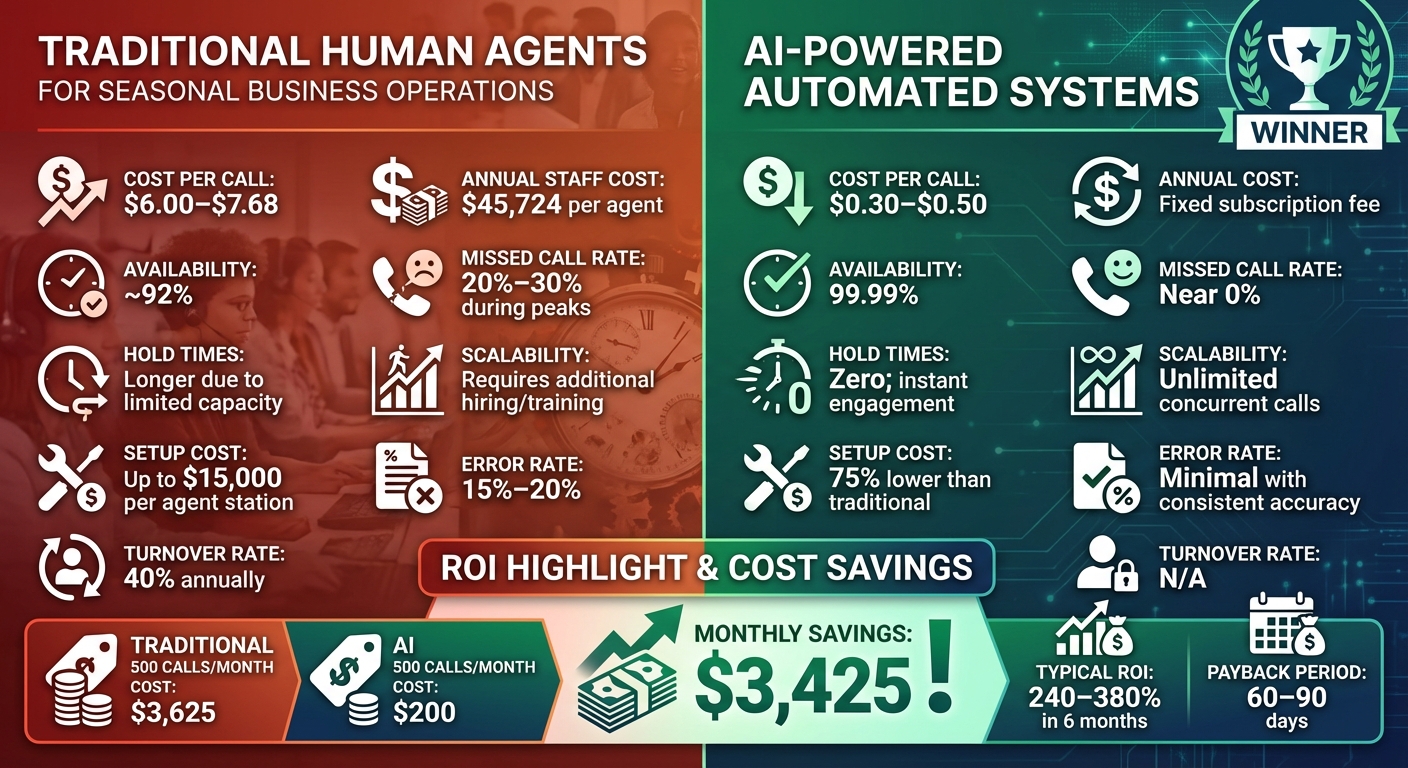
AI vs Traditional Call Handling: Cost and Performance Comparison
Typical Costs and Performance Issues
Managing calls during peak seasons with traditional methods can be both expensive and inefficient. For example, hiring a full-time receptionist costs about $45,724 annually when you factor in salary, benefits, and training. On top of that, a single agent can only handle one call at a time, meaning businesses often need to hire multiple agents to keep up with demand during busy periods.
The per-call costs add another layer of complexity. Outsourced live answering services typically charge between $1.15 and $1.75 per minute. For businesses receiving hundreds of calls daily during peak times, these charges can quickly spiral. To put it in perspective, a mid-tier outsourced service handling around 200 to 250 minutes of call time each month could cost $300 to $400.
But the challenges don’t stop at costs. Traditional methods also struggle with availability and reliability. Human agents typically achieve about 92% uptime due to sick days, breaks, and other interruptions. In comparison, automated systems maintain near-perfect uptime at 99.99%. During peak hours, businesses relying on human agents often miss 20%–30% of incoming calls, and long wait times (over 15 minutes) can lead to abandonment rates as high as 23%. For a business with an average transaction value of $65, missing just 12.5 calls per day could translate to over $118,000 in lost revenue annually.
Chris Alston, Solutions Architect at Bulwark Pest Control, shared, "Seasonal hiring used to be a massive effort that consumed the entire summer".
Here’s a quick comparison of traditional methods versus AI-powered solutions during high-volume periods:
| Metric | Traditional Human Agents | AI/Automated Systems |
|---|---|---|
| Cost per Call | $6.00–$7.68 | $0.30–$0.50 |
| Annual Staff Cost | $45,724 per agent | Fixed subscription fee |
| Availability | ~92% | 99.99% |
| Missed Call Rate | 20%–30% during peaks | Near 0% |
| Hold Times | Longer due to limited capacity | Zero; instant engagement |
| Scalability | Requires additional hiring/training | Unlimited concurrent calls |
These numbers make it clear: traditional methods often fall short when demand surges, leading to higher costs and inconsistent performance.
Why Traditional Methods Fail During High Call Volumes
Beyond the financial burden, traditional call handling methods face significant capacity constraints. Human agents can only handle one call at a time, creating bottlenecks during busy periods. Adding new staff to address these surges isn’t an easy fix either - it takes time and money to recruit and train employees.
The infrastructure costs further compound the problem. Setting up agent stations can cost up to $15,000 each, and labor accounts for 60%–70% of total contact center expenses. During peak seasons, overtime pay drives those costs even higher. Despite these investments, traditional call centers still struggle with error rates of 15%–20%, and human mistakes can extend call resolution times by as much as 30%.
Recent trends have only made things worse. According to Harvard Business Review, call escalations increased by 68%, difficult calls rose by 50%, and hold times grew by 34% during the pandemic. Add to that a 40% annual turnover rate, and businesses are left in a constant cycle of recruiting and training.
Harry Chang from Replicant explained, "Unless a BPO is your full-time contact center operation, seasonal usage often includes cost overruns due to large training demands and idle agent capacities when overstaffed".
These challenges highlight why traditional methods struggle to keep up during high call volumes, making them a less effective solution for businesses facing seasonal demand spikes.
AI-Powered Solutions for Seasonal Calls
Core Features of AI-Powered Answering Services
AI-powered answering services tackle the challenges of traditional call systems by managing unlimited calls simultaneously. Whether it’s one caller or a million, these systems respond instantly - no busy signals, no wait times. This flexibility means businesses can handle sudden spikes in call volume without adding staff or juggling complex queues during high-demand periods.
Unlike human teams that often miss 30–60% of calls during off-hours, AI systems operate 24/7, ensuring every call gets answered. On average, they respond in just 0.8 seconds, a stark contrast to the long hold times common with manual call centers. For routine tasks like scheduling appointments or resolving simple issues, AI wraps up interactions in under 60 seconds - a task that might take a human agent around 8 minutes.
These advanced systems also integrate seamlessly with CRM and scheduling tools, shaving 3–5 minutes off each call. They support over 35 languages immediately, eliminating the need for multilingual staffing, and use advanced natural language processing (NLP) to identify caller intent with over 90% accuracy.
"Many teams miss 30–60% of calls due to breaks, overload, or after-hours gaps. AI Voice is available 24/7 with no missed leads and no lost opportunities." – AgentVoice
ROI Analysis of Answering Agent

The efficiency of AI-powered answering services translates directly into major cost savings and return on investment. Businesses only pay for active call minutes instead of pre-scheduled shifts, making these systems particularly valuable during seasonal demand surges.
For example, a business handling 500 calls during a busy month might spend $3,625 using traditional methods. With an AI service costing just $0.40 per call, the same workload would cost only $200 - saving $3,425 in a single month. Over a three-month peak season, this adds up to approximately $10,275 in savings.
AI also slashes setup costs by about 75% since there’s no need for physical hardware. These systems achieve 100% call answer rates and boast First Call Resolution rates close to 75%, compared to the 45% typical of traditional centers. Additionally, AI responds to leads in under 5 minutes, which can boost conversion rates by 21 times compared to the 2–4 hour response times of human agents.
"AI agents deliver 240–380% ROI in 6 months by automating 50–90% of repetitive tasks, providing 24/7 availability, and reducing operational costs by 90%+ vs human equivalents." – P0stman
Most businesses see a full return on their AI investment within 3–6 months, with many breaking even in just 60–90 days . The combination of lower per-call costs, no missed calls, and faster task completion creates a powerful multiplier effect, significantly boosting profitability during seasonal peaks.
sbb-itb-abfc69c
Case Study: Results from AI Answering Services
Real-world examples highlight the impressive ROI that AI-powered answering services can deliver.
Call Volume and Revenue Results
Peppermill Resort Spa Casino, which handles 10,000–15,000 calls monthly across five properties during peak seasons, saw a major transformation after implementing an AI answering system in 2025. Led by Patrick Flynn, Director of Sales, the system was integrated with their HotSOS workforce management platform. The results? A 92% reduction in contact center call volume and a 70% success rate in managing service requests like housekeeping and reservations. This freed up human staff to tackle more complex guest needs while the AI handled routine requests 24/7, ensuring no wait times - even on the busiest weekends. These changes translated into measurable cost savings and operational efficiency.
Another example comes from a multi-unit restaurant group with five locations. By using Answering Agent to handle 400–600 daily calls, they recovered $880,000 in missed call revenue. Additionally, monthly revenue per location jumped from $127,500 to $156,400 - a 23% increase .
Cost Savings and Operational Improvements
The benefits didn’t stop at revenue growth. AI answering systems also drove significant cost savings and operational enhancements. For instance, one business slashed labor costs from $473,685 to just $11,940 annually (plus a one-time $5,000 setup fee), saving $461,745 per year and achieving an astounding 7,820% ROI in the first year. Peppermill Resort also reported a 187% ROI on labor cost savings alone, as the AI system eliminated the need for costly seasonal hiring and handled after-hours inquiries seamlessly.
Operational metrics were equally impressive. Response times dropped from an average of 4.2 hours to just 30 seconds. The cost per call plummeted from $6.00–$7.68 with human agents to just $0.30–$0.50 with AI - a 93–95% reduction. The system also managed up to 90% of repetitive tasks with consistent accuracy, allowing businesses to operate leaner teams without compromising service quality.
How to Calculate ROI for Seasonal Call Management
Step-by-Step ROI Calculation
Calculating ROI for seasonal call management might seem complicated, but breaking it into steps makes it manageable. Start by collecting some key data points: your monthly call volume, average handle time, the fully burdened hourly cost (including wages, benefits, and a typical 22–28% overhead), and your current peak-season call abandonment rates - which can often range between 30% and 60%.
Next, figure out the total costs of implementing AI. This includes one-time setup fees (typically between $500 and $5,000), monthly subscription charges, and any usage-based fees calculated per minute. For tools like Answering Agent, you’ll also need to account for platform fees and any integration costs, such as connecting to your CRM or scheduling system.
Now, calculate your potential savings. Multiply the number of routine calls that AI can handle by your current cost per call. For missed call recovery, take your abandonment rate and multiply it by the average value of a lead. For example, if 30% of 1,000 monthly calls are missed and each lead is worth $150, that's $45,000 in potential revenue that could be recovered. Additionally, factor in savings from avoiding seasonal hiring costs - recruitment, onboarding, and training for each agent can range from $5,000 to $15,000.
Finally, use this formula to calculate ROI: (Total Benefits – Total Costs) ÷ Total Costs. To determine the payback period, divide your initial investment by the total monthly savings and revenue gains. Many businesses find they break even within 60 to 90 days.
"A well-scoped deployment targets a one-quarter payback (approximately 60–90 days)." - Mayank Shekhar, CTO, Robylon
ROI Comparison Table for High-Volume Operations
The table below highlights how AI-powered solutions stack up against traditional seasonal staffing, making the benefits clear for businesses handling high call volumes.
| Metric | Traditional Seasonal Staffing | AI-Powered Answering Service |
|---|---|---|
| Availability | Limited to shifts; high overtime costs | 24/7/365; no overtime premiums |
| Scalability | Requires new hires/training ($5,000–$15,000/agent) | Instant concurrent call handling |
| Cost Model | Paid for scheduled time regardless of volume | Often billed by minutes used |
| Missed Calls | 20–60% during peak spikes | 0% (handles all calls simultaneously) |
| Training | 20–40 hours per new hire | One-time setup and continuous learning |
| Consistency | Varies by agent mood and fatigue | 100% consistent brand voice |
This framework allows you to input your own numbers. For example, if your business handles 10,000 calls during peak months and misses 40% due to staffing shortages, the revenue you could recover might justify the investment in AI. And that’s before even considering the additional savings from labor costs or operational efficiencies.
Conclusion
As highlighted through the ROI analysis and real-world examples above, managing seasonal call spikes doesn’t have to mean skyrocketing expenses or frustrated customers.
AI-powered answering services offer a clear path to measurable results by addressing three key challenges: capturing missed revenue opportunities, slashing operational costs by as much as 95%, and scaling effortlessly without the need for seasonal hiring. Businesses leveraging these solutions typically experience a 240–380% ROI within just six months. Some even see payback in as little as 60–90 days, thanks to handling 100% of calls around the clock at just $0.30–$0.50 per interaction - dramatically lower than the $6.00–$7.68 cost of human agents. This means seasonal spikes can transform from logistical headaches into opportunities to boost revenue.
Take Burma Food Group, for instance, which saw a 141% jump in over-the-phone reservations, or a family dental practice that saved $48,000 annually by automating 95% of its scheduling calls. These success stories highlight the advantage of moving from fixed labor costs to a pay-as-you-go model, where you’re only charged for actual conversations.
For businesses that face predictable spikes - whether it’s during the holidays, tax season, or summer travel - calculating the ROI is simple. Assess your current missed call rate, multiply it by your average lead value, and weigh that against the cost of implementation. In most high-volume operations, the value becomes evident within the first quarter.
FAQs
How soon can businesses see a return on investment (ROI) with AI-powered answering services?
Most businesses start seeing a return on their investment (ROI) in 2 to 6 months after adopting AI-powered answering services. In fact, many notice results as soon as 60 to 90 days.
These services work around the clock - handling calls, capturing leads, and scheduling appointments - helping to cut operational costs while increasing revenue. This combination makes the investment pay off faster than you might expect.
How do AI-powered answering services compare to traditional call handling during seasonal spikes in terms of cost and efficiency?
AI-powered answering services offer a game-changing way to cut costs and boost efficiency during seasonal call surges. Here's the math: an AI agent costs just $0.40–$0.50 per call, while a human agent racks up $6–$7.68 per call. That’s a savings of up to 95%! Plus, AI doesn’t clock out - it works 24/7, managing unlimited calls at the same time. This means AI can provide three times the coverage of an 8-hour human shift.
Now, compare that to the traditional approach. Handling spikes with human agents often means paying overtime or hiring temporary staff, which drives up labor costs and limits scalability. On top of that, missed calls due to capacity issues can lead to lost revenue. AI, on the other hand, ensures no call goes unanswered, turning potential losses into gains. By adopting AI-driven solutions like Answering Agent, businesses not only save thousands of dollars each year but also elevate customer satisfaction in the process.
How do AI-powered answering services enhance customer satisfaction compared to traditional call handling?
AI-powered answering services elevate customer satisfaction by delivering faster, more reliable, and round-the-clock support. They cut out the frustration of long hold times and endless call transfers, offering immediate, conversational responses thanks to natural language processing. This means customers can get the assistance they need within seconds - whether it’s after hours, on weekends, or even during holidays.
Beyond speed, these systems enhance accuracy by automating tasks like scheduling appointments or managing order details. They’re also capable of handling an unlimited number of calls at once, making them perfect for dealing with seasonal surges without requiring additional staff. The result? Happier customers, fewer missed opportunities, and a stronger connection to your brand.
Related Blog Posts
Related Articles
Guide to AI Dispatch for Field Services
AI dispatch transforms field service by automating routing, skill-based matching, and real-time schedule adjustments to boost productivity and cut costs.
Checklist: Setting Up AI Answering for Renovation Firms
Step-by-step checklist to implement AI phone answering for renovation firms: qualify leads, book estimates, handle emergencies, and integrate calendar and CRM.
API Integration for White-Label Phone Services
Enhance your customer service with API integration for white-label phone services, offering AI-powered call handling under your brand.