If your booking model misses no-shows or your voice assistant stalls mid-booking, look at the inputs before you swap the model. Feature engineering turns raw scheduling and call data into signals a model can use, such as lead time, reminder behavior, and past attendance.
This piece pulls from several published deployments: a multi-location clinic network, a large healthcare booking platform rebuilt by deepsense.ai, an outpatient MRI reminder study, and a hospital system in Istanbul. For each, it covers what broke, which features fixed it, and what changed.
Challenge: Poor Prediction Accuracy in Appointment Booking
How Prediction Errors Affect Service Businesses
No-shows cost the most when the schedule can't see them coming. One clinic network with 8 locations ran a 28% no-show rate, worth about $180,000 a month in lost revenue. Its manual scheduling left slots empty, and staff spent 4.2 hours a week patching the gaps.
Smaller operators feel it too. Missing 2–3 appointments a week costs $400–$1,200. Callers who reach no one rarely leave a voicemail. They call the next business on the list.
Technical Limitations of the Original AI System
A healthcare platform serving 90 million patients across 13 countries launched an LLM voice assistant that converted only 10% of booking calls. It skipped open dates, invented doctor details, and often failed to finish a booking.
"The existing LLM-powered voice assistant was unstable and slow. It frequently failed to complete bookings (for example, omitting available dates or hallucinating doctor information)." – deepsense.ai
Three design choices caused most of the failures:
- Full transcripts in every prompt. Prompts grew past 30,000 tokens, and responses took more than 5 seconds.
- Rule-based logic that ignored behavior. The system never used signals like reminder replies or portal clicks.
- Random data splits. Shuffling past and future appointments together leaked information and artificially inflated performance metrics.
sbb-itb-abfc69c
Solution: Using Feature Engineering to Improve Accuracy
Features Created for Better Predictions
The teams built four groups of features:
- Temporal: lead time from booking to appointment, sine/cosine encoding of hour and weekday, and holiday flags.
- Behavioral: whether the customer confirmed, ignored, or declined reminders, how recently they engaged with email or SMS links, and attendance history. Past no-show rate was the strongest predictor, accounting for 41% of feature importance.
- Contextual: NLP on call transcripts to separate routine requests ("leaky toilet") from emergencies ("pipe burst"). Some teams also measured tone, speech speed, and pauses as signs of how committed a caller was.
- Interaction and windowed: products such as lead time × prior no-show rate, reminder clicks by appointment type, and behavior rolled up over 24-hour, 7-day, and 90-day windows.
Using Real-Time Data from Answering Agent
Behavioral features only help if they are current. Every answered call can add to the model's inputs: the caller's intent, whether they confirmed or asked for a specific slot, and whether they ignored a follow-up text. Unanswered calls add nothing. A 24/7 answering layer such as Answering Agent keeps that data flowing after hours.
The deepsense.ai rebuild dropped full transcripts in favor of explicit dialogue states and live two-way calendar APIs. Token usage fell by a factor of 20, and the assistant read current availability instead of stale history.
Adding Engineered Features to Machine Learning Models
The teams used gradient-boosted decision trees because they handle mixed data types and can be explained with SHAP values. They trained on older appointments and tested on newer ones, which prevented leakage.
They flagged missing behavioral data instead of filling it in. A customer who stops engaging is itself a signal.
From March to August 2019, a study of 6,027 outpatient MRI appointments tested risk-based outreach. Phone reminders went to the top 25% of high-risk patients, and the no-show rate fell from 19.3% to 15.9%, a 17.2% relative drop. Outreach was tiered by risk:
- High risk: a personal phone call
- Medium risk: an SMS reminder
- Low risk: a standard confirmation
Results: Measured Improvements in Prediction Accuracy
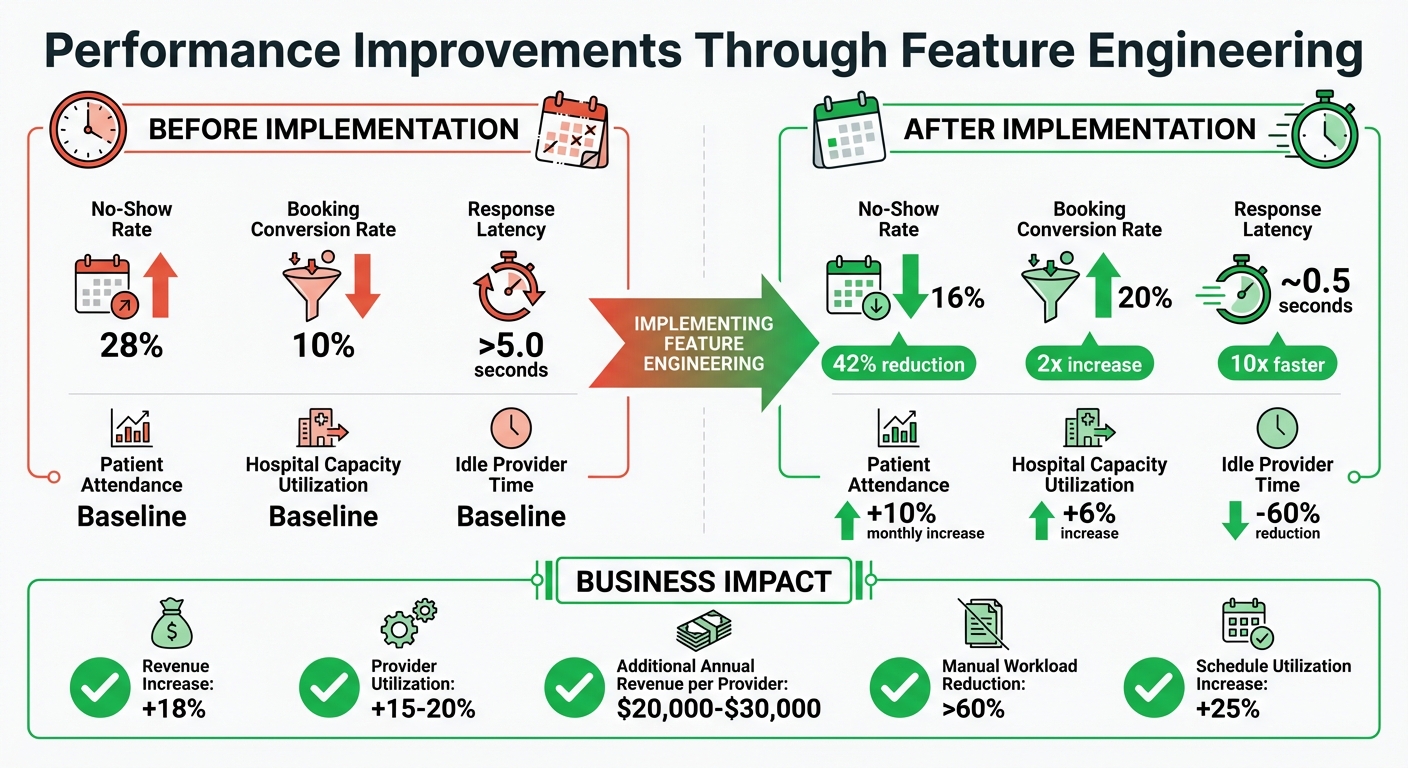
Performance Metrics Before and After Feature Engineering
From July to September 2022, Bezmiâlem Vakıf University Hospital, a 600-bed facility in Istanbul, ran an AI-based appointment system built by researchers Kerem Toker and Kadir Ataş. It applied regression and decision trees to demographic and behavioral data. Patient attendance rose 10% a month, and capacity utilization rose 6%.
"The artificial intelligence we have developed continuously improves appointment assignments by learning from past and current data." - Kerem Toker, Faculty of Health Sciences, Bezmiâlem Vakıf University
The 8-location clinic network added AI-powered scheduling and reminders and predicted no-shows with 89% accuracy. Its no-show rate fell from 28% to 16%, and idle provider time dropped 60%. The deepsense.ai rebuild doubled booking conversion from 10% to 20% and cut response time from over 5 seconds to about 0.5 seconds.
| Metric | Before Implementation | After Implementation |
|---|---|---|
| No-Show Rate | 28% | 16% |
| Booking Conversion Rate | 10% | 20% |
| Patient Attendance | Baseline | +10% monthly increase |
| Hospital Capacity Utilization | Baseline | +6% increase |
| Response Latency | >5.0 seconds | ~0.5 seconds |
| Idle Provider Time | Baseline | -60% |
Business Impact for Service Operators
The clinic network's 42% drop in no-shows came with an 18% rise in total revenue. Provider utilization rose 15–20%, worth an estimated $20,000–$30,000 a year per provider. Automated scheduling cut manual scheduling work by more than 60%.
Overbooking only the slots most likely to go empty raised schedule utilization by 25% without degrading service.
"When technology and human expertise work together, the result is a more efficient practice that better serves both providers and patients." - Vineeth Joseph, Primrose.health
Key Learnings: Best Practices for AI Appointment Systems
Continuous Feature Selection and Testing
Test against real booking scenarios on a regular schedule. The deepsense.ai team ran synthetic booking dialogues on each iteration, and those runs exposed edge cases along with wasted tokens.
"Defining explicit dialogue states and actions is critical for a reliable assistant. Iterative prompt testing with real user scenarios exposed edge cases that needed fixes." – deepsense.ai
Always validate on time-ordered data: train on the past and test on the most recent period. Use SHAP to see which features, such as lead time or engagement recency, are driving predictions, and cut the ones that aren't.
Managing Imbalanced Data in Predictions
No-shows are a minority class, so plain accuracy flatters a model that just predicts "shows up." Three fixes:
- Use SMOTE variants to generate synthetic no-show examples instead of duplicating real ones.
- Score models on the area under the precision-recall curve (AUC-PR), not accuracy.
- Calibrate probabilities and check them with Brier scores, so that a predicted 20% risk actually means about 20%.
Scaling for High-Volume Service Businesses
At thousands of interactions a day, stateful conversation design keeps cost and latency down. Live calendar and CRM sync prevents double-bookings. Modular, targeted prompts let you fix one step of the flow without retesting the whole assistant.
Conclusion
Across these cases, most of the gain came from better inputs: recent behavior, timing, and live availability. Swapping in a bigger model did less.
"A well-engineered set of features can make a simple algorithm outperform a complex one." – Ksolves Team
Start with past no-show rate, lead time, and reminder response. Validate on time-ordered data, and send outreach according to risk. If phone calls are still your main booking channel, make sure they get answered and logged so the model has data. For the operational side, see how teams optimized scheduling and handled common scheduling problems.
FAQs
How does feature engineering help improve AI predictions in appointment systems?
It turns raw data into inputs a model can learn from. Examples include day of week, time of day, lead time, past no-show rate, and whether the customer answered a reminder. It also covers handling missing values and outliers. Cleaner, more relevant inputs produce more accurate no-show and booking predictions.
What are the main advantages of using real-time data in appointment scheduling?
Live calendar sync prevents double-bookings and picks up last-minute cancellations right away. Current behavioral data, such as a confirmed or ignored reminder, keeps no-show predictions up to date, so you can send a reminder or offer a reschedule before the slot goes empty.
How can AI solutions help service businesses reduce appointment no-shows?
AI scores each appointment's no-show risk and matches outreach to that risk: calls for high-risk bookings, texts for medium, and standard confirmations for low. It also books and confirms appointments when calls come in, including after hours. Tools like Answering Agent handle that call-answering step.
Related Blog Posts
Book a walkthrough
See it handle your calls.
Book 20 minutes, or hear a sample call first.