Missed Appointments: Cost of Not Using HIPAA-Compliant AI
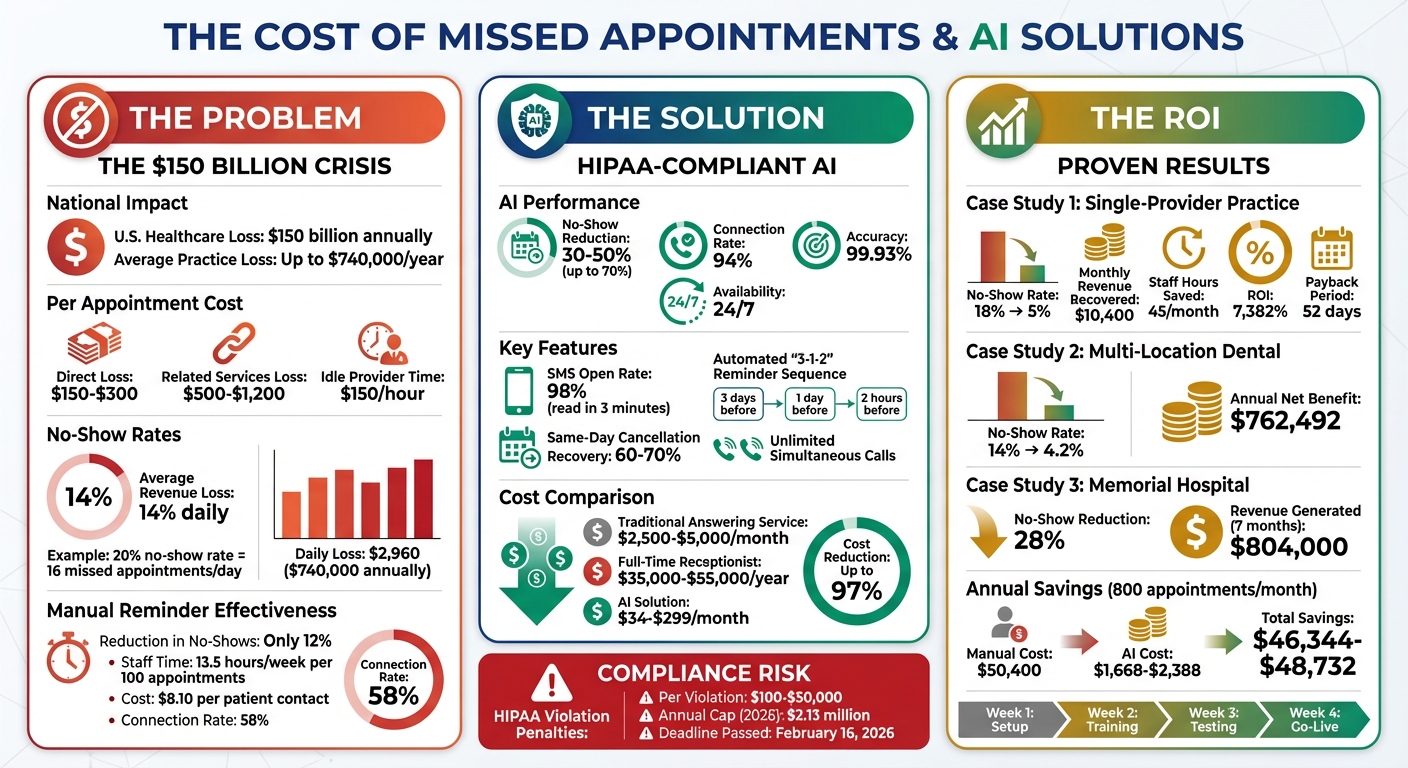
Missed appointments cost U.S. healthcare providers over $150 billion annually, with individual practices losing up to $740,000 per year. Traditional scheduling methods are inefficient, with no-shows disrupting workflows, wasting staff time, and causing patient dissatisfaction. Manual reminders reduce no-shows by only 12%, while HIPAA-compliant AI tools cut them by 30–50%, recover lost revenue, and save labor hours.
Key Points:
- Financial Loss Per No-Show: $150–$300 per appointment, plus $500–$1,200 in related services.
- Manual Effort: 13.5 hours/week for every 100 appointments, costing $8.10 per patient contact.
- HIPAA Compliance: Essential to avoid fines of up to $2.13 million annually for violations.
- AI Benefits: 24/7 scheduling, automated reminders, predictive analytics, and secure PHI management.
- Cost Savings: AI scheduling costs as little as $34–$299/month, compared to thousands in staff expenses.
Takeaway: Switching to HIPAA-compliant AI systems not only mitigates financial losses from no-shows but also ensures compliance, improves efficiency, and enhances patient communication. Waiting to adopt AI risks further revenue loss and potential penalties.
Financial Impact of Missed Appointments and AI Solutions in Healthcare
The Financial Impact of Missed Appointments
Revenue Loss per Missed Appointment
Every missed appointment represents a direct financial hit, typically between $150 and $300. For primary care, the average loss sits at $185, while specialists often face losses exceeding $265. Beyond this, the ripple effect can result in an additional $500–$1,200 in lost revenue from related services like lab work, imaging, and referrals.
On top of that, idle provider time adds to the financial strain. Practices spend about $150 per hour on salaries and overhead for providers whose time goes unused. Tasks like chart preparation, insurance verification, and room setup - already completed by staff - become wasted efforts, compounding the inefficiency.
But the consequences aren't just financial. Missed appointments disrupt workflows and can damage the trust patients place in their healthcare providers.
Operational Disruption and Patient Dissatisfaction
No-shows leave gaps in schedules, creating "phantom slots" that could have been filled by other patients in need of care. These delays often push patients to seek services elsewhere, further impacting the practice. Adding to the problem, when staff are bogged down with manual tasks, calls from patients may go unanswered. Studies show 85% of patients whose calls aren't returned will not try contacting that provider again.
Annual Cost of Recurring No-Shows
The cumulative effect of these missed appointments can lead to staggering annual losses for medical practices.
For a medium-sized practice with three to five providers, yearly losses can range from $150,000 to $300,000. Take, for instance, a family practice in Boulder, Colorado, that recorded 623 no-shows out of 2,847 appointments in the fourth quarter of 2024. With an average loss of $200 per appointment, the practice faced a quarterly loss of $124,600, translating to nearly $500,000 annually.
Another example: a five-provider primary care practice experiencing a 20% no-show rate loses about 16 appointments daily. At an average revenue of $185 per visit, this equates to $2,960 in daily losses, or approximately $740,000 over 250 working days. Across the board, medical groups report that no-shows account for an average 14% loss in daily revenue.
sbb-itb-abfc69c
AI Front Desk: How Doctors Save $100k With Automation (2025 Guide)
HIPAA Compliance Requirements for AI Scheduling Tools
Missed appointments already cost healthcare providers significant revenue, making compliance with HIPAA regulations in AI scheduling systems even more critical. These tools handle Protected Health Information (PHI) - like patient names, appointment details, and medical histories - and, starting February 2026, face stricter oversight from the HHS Office for Civil Rights (OCR). To avoid penalties, healthcare providers must ensure their AI platforms have strong compliance measures in place.
The stakes are high. Practices are legally responsible for breaches, even if caused by their AI vendors. This means providers must secure Business Associate Agreements (BAAs) with AI vendors. These agreements must specifically address AI oversight and incident response protocols. Without a signed BAA, the AI system cannot be considered HIPAA-compliant, leaving the practice vulnerable to legal and financial risks.
Required Security Features for HIPAA Compliance
HIPAA-compliant AI systems must incorporate advanced security features to meet regulatory requirements. These include:
- Encryption: PHI must be encrypted at rest using AES-256 and in transit with TLS 1.3 or higher.
- Access Control: Role-Based Access Control (RBAC) combined with multi-factor authentication (MFA) ensures only authorized users can access sensitive data.
- Audit Logs: Comprehensive logs must track who accessed PHI, what data was viewed, and when.
Additionally, AI platforms must address risks unique to their systems, such as hallucinations, prompt injection attacks, and data leaks. Importantly, PHI must not be used for training AI models. Providers like OpenAI or Anthropic should ensure their systems do not use patient data for model training purposes. Furthermore, any external data processing must de-identify PHI using secure methods like one-way hashing (e.g., SHA-256).
Financial Penalties for HIPAA Violations
Neglecting these measures can lead to severe financial consequences. HIPAA violations come with penalties ranging from $100 to $50,000 per violation, with annual caps of $1.5 million per violation category. Starting in 2026, penalties for AI-specific violations will increase, with caps rising to $2.13 million.
"Organizations that wait until the last moment will face rushed implementations, increased risk of non-compliance, and potential penalties that can reach $2.13 million per violation category per year." - James Holbrook, JD
For a small practice already losing $150,000 annually due to missed appointments, even one HIPAA violation could be devastating. With the February 16, 2026 deadline for AI-specific risk analyses and enhanced access controls already passed, ensuring compliance is no longer optional. Non-compliance not only risks hefty fines but could also worsen financial losses for practices relying on AI scheduling tools.
How HIPAA-Compliant AI Reduces No-Shows
HIPAA-compliant AI systems tackle no-shows by combining multi-channel communication, 24/7 availability, and predictive analytics - all while keeping protected health information (PHI) secure. These tools actively engage patients, flag high-risk appointments, and automatically reschedule cancellations, helping recover lost revenue and addressing the financial challenges no-shows create.
Automated Reminders and 24/7 Scheduling
AI-powered reminder systems use a layered approach to connect with patients via SMS, email, and voice calls, ensuring messages reach them through their preferred channels. These reminders allow for two-way interaction - patients can confirm by replying "YES" or reschedule by replying "CANCEL", with updates instantly reflected in the calendar. This interactive approach achieves 25–35% higher confirmation rates compared to static notifications.
One effective strategy is the "3-1-2" sequence: a reminder three days before the appointment, a confirmation request one day prior, and a final nudge two hours before the scheduled time. SMS plays a key role here, boasting a 98% open rate, with most messages read within three minutes. This multi-touch system has been shown to lower no-show rates by 30–50%, with some systems reporting reductions as high as 70%.
When cancellations occur, AI systems automatically text waitlisted patients to fill the gaps, recovering 60–70% of same-day cancellations - all without requiring staff intervention. And all of this happens under strict HIPAA compliance, backed by business associate agreements (BAAs) and strong encryption protocols.
AI's benefits extend beyond reminders, offering secure and efficient call handling as well.
AI Phone Answering with HIPAA Protection
AI phone answering systems provide round-the-clock call management, addressing a major issue: 27–42% of potential bookings are lost when calls go unanswered.
Take Answering Agent (https://answeringagent.com) as an example. This HIPAA-compliant AI service, tailored for medical practices, handles unlimited simultaneous calls with impressive accuracy - 99.93% across over 17,724 scored calls - and a low error rate of just 0.07%. It integrates seamlessly with major EHR systems like Epic and Cerner, updating schedules in real time while maintaining secure encryption protocols (TLS 1.3 for signaling and SRTP for media).
The cost savings are undeniable. For a practice managing 500 weekly appointments, AI reminders cost about $3,900 annually, far less than the expenses tied to traditional staff. Similarly, while traditional answering services range between $2,500 and $5,000 per month, AI solutions cost as little as $34–$299 monthly and handle multiple calls simultaneously.
"Our numbers show that 45-50% of calls are completely resolved by Retell AI without ever touching a human."
– Jonathan Adly, Senior Engineer, GiftHealth
Data Analysis for No-Show Prevention
AI also uses data analytics to prevent no-shows before they happen. Advanced systems employ predictive risk scoring, analyzing over 50 factors - such as patient history, appointment lead time, day of the week, and even weather forecasts - to assign a no-show probability score to each visit. High-risk patients receive additional reminders, like personalized texts or phone calls, while low-risk patients get a single nudge.
These systems go a step further by identifying specific barriers. If transportation issues or financial concerns are flagged as potential reasons for a no-show, AI offers tailored solutions, such as telehealth options or payment plan details.
"The most expensive patient in your practice isn't the one with complex medical needs. It's the one who books an appointment and never walks through the door."
– Heph, AI COO at BAM
The impact is clear. One medical spa owner shared their experience:
"We were losing $30K/month to no-shows. It was killing us. AI reminders cut no-shows by 66%, and the auto-rebooking feature recovered half of the remaining ones."
Answering Agent: HIPAA-Compliant AI for Medical Practices
Medical practices face the constant challenge of recovering lost revenue while ensuring their operations are secure, precise, and cost-effective. Answering Agent steps in as a 24/7 solution for handling patient calls, all while adhering to strict HIPAA regulations. (See our HIPAA checklist for clinics for more details.) With encrypted data storage, secure transmission protocols, and signed Business Associate Agreements, it ensures compliance while delivering advanced functionality.
Core Features of Answering Agent
Answering Agent's capabilities go beyond simply answering calls - it uses a natural, human-like voice to handle unlimited simultaneous calls, completely eliminating hold times [33,34]. Its seamless integration with major EHR platforms like Epic, Athenahealth, and Cerner allows it to update patient records and schedule appointments in real time [33,34,35]. Whether patients need to book, reschedule, or cancel appointments, the system processes requests instantly. It also captures new patient leads and employs emergency triage protocols to transfer urgent calls directly to on-call providers [6,8].
This level of automation addresses a major pain point for medical practices: missed calls. Studies show that 27–42% of potential bookings are lost when calls go unanswered, and 85% of patients who reach voicemail simply hang up and contact a competitor [8,38].
Accuracy and Performance Data
Answering Agent's performance data highlights its reliability and impact. With over 17,724 scored calls processed at a 99.93% accuracy rate, the platform ensures patient information is handled both securely and correctly. Its ability to convert inquiries into appointments is equally impressive - of 20,375 offers made, 6,820 were accepted.
The platform also excels in patient communication. AI-powered reminder systems achieve a 94% connection rate, far surpassing the 58% achieved by manual staff calls. When it comes to cancellations, 78% of patients who cancel via the AI immediately reschedule, compared to just 23% when handled manually. These efficiencies translate directly into financial gains. For instance, Memorial Hospital at Gulfport reduced no-shows by 28% in 2024, generating an additional $804,000 in just seven months.
Cost Comparison and Return on Investment
The financial benefits of Answering Agent are hard to ignore. Traditional answering services typically cost between $2,500 and $5,000 per month, while hiring a full-time receptionist costs $35,000 to $55,000 annually, not including benefits. In contrast, Answering Agent offers plans ranging from $34 to $199 per month, slashing costs by up to 97% compared to manual staffing.
The return on investment (ROI) is equally compelling. A single-provider practice with 400 monthly appointments reduced its no-show rate from 18% to 5%, recovering $10,400 in monthly revenue and saving 45 staff hours per month - resulting in an ROI of 7,382%. Similarly, a multi-location dental practice with 3,200 monthly appointments saw its no-show rate drop from 14% to 4.2%, leading to a net annual benefit of $762,492. These results demonstrate how effectively Answering Agent addresses the costly issue of missed appointments.
"The days of letting calls go to voicemail are over. Whether it is an AI agent, a human, or both, every call should be answered."
– Sarah Chen, Head of Product, Reapdat
Implementation Steps and ROI Calculations
Connecting AI to EHR and CRM Systems
Integrating AI with your practice management tools is simpler than it might seem, especially given AI's proven ability to reduce no-shows. Most modern HIPAA-compliant AI tools connect seamlessly with existing systems using HL7 FHIR APIs, which are already in place at 96% of U.S. hospitals. This integration is bidirectional, meaning it can pull provider availability and automatically update confirmed bookings. Popular systems like Epic, Cerner, and Athenahealth support real-time integration, while older systems can connect through secure CSV exports or middleware platforms.
Before starting, make sure your vendor signs a Business Associate Agreement (BAA). Once that's in place, the implementation process typically takes about four weeks:
- Week 1: Set up emergency protocols.
- Week 2: Establish API connections.
- Week 3: Run process simulations.
- Week 4: Pilot after-hours calls.
Manual vs. AI Scheduling Cost Analysis
After implementation, you can evaluate the financial impact by comparing manual scheduling costs to AI automation. For a practice managing 800 appointments monthly, manual scheduling costs around $4,200 per month, while an AI-powered solution costs between $139 and $199. This translates to annual savings of up to $48,732.
| Cost Category | Manual Staff Calls | AI‑Powered System | Annual Savings |
|---|---|---|---|
| Staff Labor | $2,640 | $0 | $31,680 |
| Phone System/Minutes | $180 | Included | $2,160 |
| Follow‑up Calls | $480 | $0 | $5,760 |
| Documentation Time | $430 | Automated | $5,160 |
| Platform Subscription | $0 | $139–$199 | -$1,668 to -$2,388 |
| Total Monthly Cost | $4,200 | $139–$199 | $46,344–$48,732 |
To calculate ROI, use this formula:
(Revenue Recovered + Labor Cost Savings – System Cost) / System Cost.
For example, in October 2024, a family practice in Boulder, Colorado, implemented automated SMS reminders. Within eight weeks, they reduced their no-show rate from 21.9% to 12.2%, recovering $53,400 in revenue and saving $6,000 in labor costs per quarter. With a system cost of $1,850, the net quarterly benefit was $57,550, resulting in a 32x ROI and full payback in just 52 days.
Long‑Term Results and Benefits
The advantages of AI systems grow over time. AI reminder systems achieve a 94% connection rate, compared to just 58% for manual staff calls. This consistency leads to sustained revenue recovery and fewer missed appointments. Over time, AI-driven reminders consistently outperform manual approaches.
AI also significantly reduces administrative burdens, cutting front-desk tasks by up to 70%. This frees up 240–260 staff hours per quarter, allowing more time for direct patient care. Additionally, AI systems handle the 23% of service-related calls that occur outside normal business hours and the 30% of calls missed during peak times. These improvements directly address the financial losses caused by missed appointments.
"AI reminders deliver 3.2x better results than manual reminders while costing 97% less to operate."
– Piyoosh Rai, founder of Towards AI
Conclusion
Missed appointments cost the U.S. healthcare system over $150 billion every year, with a typical 5-provider practice losing nearly $740,000 annually in potential revenue. HIPAA-compliant AI scheduling tools tackle this issue head-on by cutting no-show rates by 30% to 50%. This not only recovers significant revenue but also saves staff an estimated 15–25 hours per week previously spent on manual reminder calls.
These tools go beyond just reducing no-shows. They provide 24/7 patient access, manage unlimited simultaneous calls, and automatically fill 60–70% of last-minute cancellations using waitlist matching.
Answering Agent exemplifies this technology in action, delivering results with 99.93% accuracy across more than 17,724 scored calls. It offers round-the-clock availability, handles unlimited concurrent calls, and uses a natural, human-like voice to engage patients. On top of that, it seamlessly integrates with existing EHR and practice management systems, booking appointments and capturing after-hours leads - all at a cost far lower than traditional staffing.
The longer practices delay adopting AI scheduling, the more revenue they lose to avoidable no-shows. With 73% of healthcare practices planning to implement AI scheduling trends by 2026, early adopters can gain a competitive edge. They can capture the 85% of callers who abandon voicemail and immediately contact a competitor.
Missed appointments don’t have to drain your practice anymore. HIPAA-compliant AI scheduling is more than just automation - it’s a way to secure your practice’s financial stability while meeting patients’ expectations for 24/7 accessibility.
FAQs
How do I verify an AI scheduling tool is truly HIPAA-compliant?
To ensure a tool complies with HIPAA, it must include critical security measures such as encryption, access controls, and audit trails to safeguard patient information. Additionally, confirm that the provider offers a Business Associate Agreement (BAA) - a mandatory requirement for managing protected health information (PHI). It's also a good idea to review the vendor's documentation or certifications to confirm they meet HIPAA standards.
What data does AI use to predict who will no-show?
AI systems can predict potential no-shows by studying patterns in how people handle appointments. This includes looking at their past attendance and appointment history. Machine learning algorithms dig into this data to identify individuals who might be likely to miss their scheduled appointments.
How quickly can a clinic see ROI after switching to AI scheduling?
Clinics often experience a return on investment (ROI) in less than 21 days after implementing AI scheduling systems. These tools simplify appointment management, cut down on missed bookings, and boost overall efficiency, resulting in quicker financial gains.
Related Blog Posts
Author
Answering Agent
Related Articles
AI Phone Systems: HIPAA Compliance FAQs
Explore how AI phone systems in healthcare ensure HIPAA compliance through security measures, training, and business associate agreements.
Multilingual AI Telehealth: ROI for Medical Practices
Multilingual AI telehealth enhances patient care and reduces costs by overcoming language barriers, transforming healthcare practices financially and operationally.
AI Call Routing for Multi-Specialty Clinics
Compare top AI call routing platforms for multi-specialty clinics — accuracy, scalability, EHR integration, and cost.