Missed Calls: Financial Impact on Home Services

Unanswered calls cost home service businesses thousands yearly—lost revenue, missed emergency jobs, and customers who call competitors.

Missed Calls: Financial Impact on Home Services

Missed calls are costing home service businesses thousands of dollars every year. Here’s the reality:

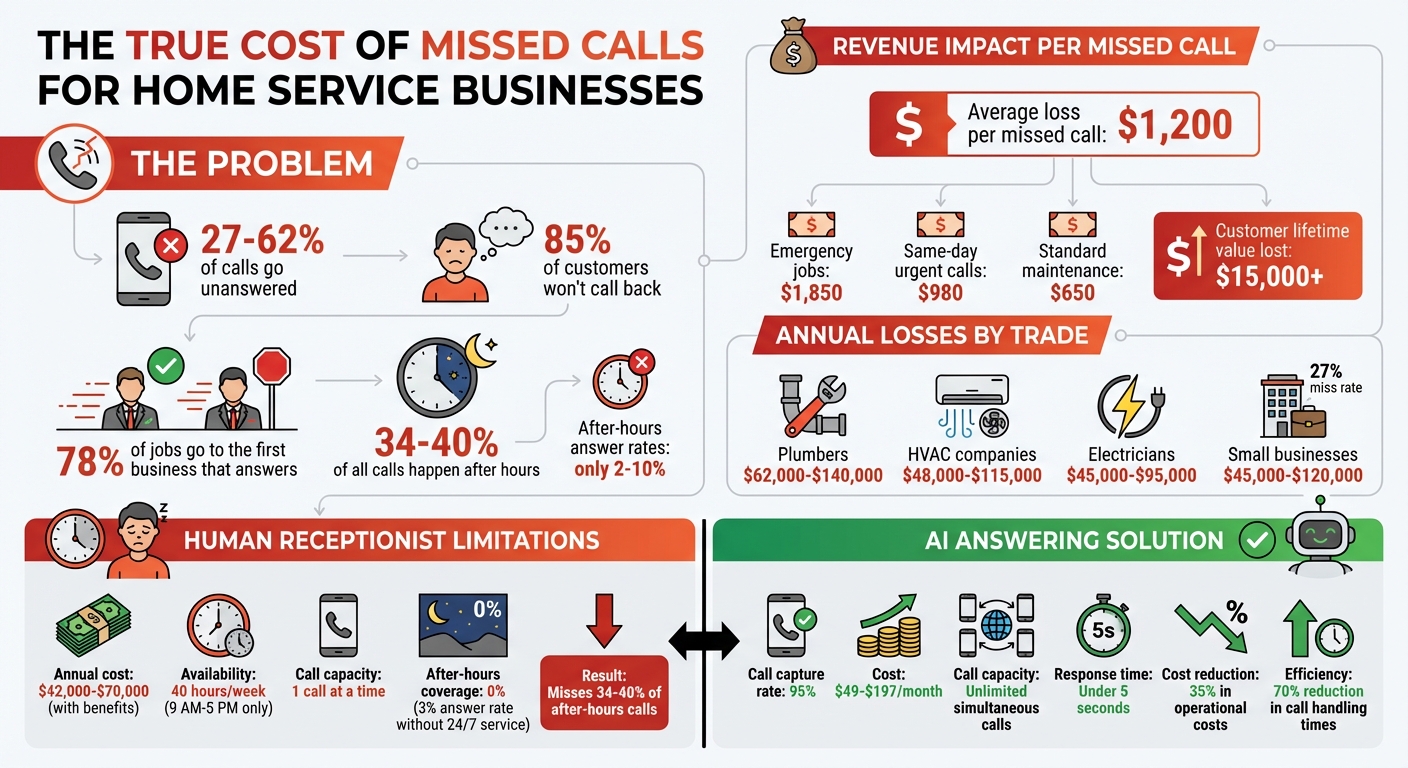
  • 27% to 62% of calls go unanswered, and 85% of customers won’t call back.
  • 78% of jobs go to the first business that answers.
  • Each missed call equals $1,200 in lost revenue, which can lead to $45,000–$120,000 in annual losses for small to mid-sized businesses.
  • After-hours calls (34–40% of all calls) are especially problematic, with answer rates as low as 2–10%.

The solution? AI phone answering services like Answering Agent. These systems ensure 95% call answer rates, handle unlimited calls, and cost just $49–$197 per month - a fraction of hiring a human receptionist. By answering every call, businesses can recover lost revenue, secure more jobs, and improve customer satisfaction. Missed calls are not just lost opportunities - they’re lost income.

The True Cost of Missed Calls for Home Service Businesses

The True Cost of Missed Calls for Home Service Businesses

How Much Money Missed Calls Cost Home Services

Revenue Lost Per Missed Call

Every missed call can hit contractors hard, with an average loss of about $1,200 in immediate revenue. The value per call depends on the type of service: emergency jobs average around $1,850, same-day urgent calls bring in about $980, and standard maintenance calls are worth approximately $650. Emergency calls, which typically happen outside regular business hours, are especially at risk - 73% more likely to go unanswered.

But the cost of a missed call doesn’t stop there. Losing a customer can mean waving goodbye to a lifetime value that often exceeds $15,000 when you include repeat services, maintenance contracts, and referrals. These numbers highlight just how much of an impact unanswered calls can have on a contractor's annual revenue.

How Often Calls Go Unanswered

The frequency of missed calls multiplies the financial hit. Factors like business size, staffing levels, and timing all play a role. For solo operators and small teams, the challenge is greater since technicians are often tied up on job sites. The problem worsens during weekends, where missed call rates can soar beyond 40%, and after-hours calls (from 5:00 PM to 8:00 AM) see answer rates plummet to as low as 2% to 10%. These after-hours calls are critical, as 34% to 40% of all home service calls occur outside of normal business hours, often involving high-value emergency situations.

When you break it down into annual losses, even a modest miss rate of 27% can cost a small home service business between $45,000 and $120,000 per year, based on average job values ranging from $300 to $450. The numbers are even more striking for specific trades. For example:

  • Plumbers could lose between $62,000 and $140,000 annually.
  • HVAC companies might see losses between $48,000 and $115,000.
  • Electricians could miss out on between $45,000 and $95,000.

These figures make it clear: answering missed calls is more than a convenience - they're a direct hit to the bottom line.

Case Studies: Businesses Losing Revenue to Missed Calls

Liberty Home Services: $23,000 Lost Each Month

Liberty Home Services discovered through an audit that missed calls were costing them a staggering $23,000 every month - adding up to $276,000 annually. Each unanswered call wasn’t just a one-time loss; it also meant losing potential repeat customers and valuable referrals. Implementing AI follow-up strategies can help convert these missed opportunities into loyal clients. Another HVAC company faced a similar issue but managed to turn their missed calls into recovered revenue.

HVAC Weekend Example: $10,000 Recovered

One HVAC company identified a major issue during their "Weekend Voicemail Gap" - the period from Friday at 5:00 PM to Monday morning when all calls went straight to voicemail. This gap was especially problematic during the summer, as homeowners with broken air conditioning needed immediate help and weren’t willing to wait for a callback. By comparing missed calls vs. 24/7 answering and introducing round-the-clock coverage, they were able to secure an additional By introducing 24/7 call coverage, they were able to secure an additional $10,000 in monthly revenue.0,000 in monthly revenue. Acting as the "first responder" during these urgent situations gave them a clear advantage, especially since 78% of jobs go to the first contractor who answers the phone. This quick response approach allowed them to dominate during the most lucrative hours.

How Missed Calls Are Costing Home Service Businesses $10K+ Per Month

Missed Calls vs. Human Receptionist Mistakes

Missed calls can lead to substantial financial losses, but relying on a human receptionist comes with its own set of challenges, often making the ROI of virtual receptionists more attractive for service businesses. While a receptionist may seem like a solution, their availability is limited, leaving potential revenue untapped. On average, hiring an in-house receptionist costs between $35,000 and $54,000 annually for salary alone. Once you factor in benefits and taxes (an additional 20–30%), the total cost climbs to about $42,000–$70,000 per year. Despite this expense, a significant number of calls still go unanswered.

The main issue? Availability. Most human receptionists work standard business hours - 40 hours per week, typically from 9:00 AM to 5:00 PM. However, 34% to 40% of home service calls happen after hours. This means that even with a full-time receptionist, businesses lose out on evening and weekend opportunities. Implementing 24/7 AI call answering ensures these after-hours leads are captured.

Another limitation is call handling capacity. Human receptionists can only manage one call at a time, which often results in busy signals or extended wait times when multiple calls come in at once. This creates a ripple effect: 85% of customers whose calls go unanswered will contact a competitor instead. For example, Thompson Electric in Seattle, WA, discovered they missed 62% of high-value estimate requests, each averaging $2,400 per project. This translated to approximately $7,200 in lost revenue per month - or $86,400 annually.

Voicemail systems don’t solve the problem either. Studies show that 67% of callers hang up without leaving a message, and delayed callbacks drive 78% of customers to competitors.

Cost Factor Human Receptionist Missed Call Impact
Annual Cost $42,000–$70,000 (with benefits) $1,200 per missed call
Availability 40 hours/week (9:00 AM–5:00 PM) Misses 34–40% of after-hours calls
Call Capacity One call at a time 85% of unanswered calls result in lost customers
After-Hours Coverage None without additional staff 3% answer rate without 24/7 service

These limitations show that relying solely on human receptionists can leave businesses vulnerable to lost revenue. Without continuous and efficient call coverage, a large portion of potential profits remains out of reach.

AI Phone Answering: How to Stop Losing Money

What Research Shows About AI Answering Services

AI phone answering systems are proving to be a game-changer for businesses, especially when it comes to cutting costs and capturing missed revenue. These systems achieve call capture rates as high as 95%, helping businesses recover substantial revenue from calls that would have otherwise gone unanswered. For home service companies, the benefits are striking: a 35% reduction in operational costs and a 70% drop in call handling times. This is critical, considering that up to 73% of home service calls occur outside of standard business hours. With AI, businesses can maintain a 24/7 presence, turning missed calls into revenue opportunities.

Speed is another major advantage. AI systems answer calls in under 5 seconds, which is crucial since connecting with a lead within five minutes can make conversion rates soar by up to 2,100% compared to waiting 30 minutes. Beyond that initial five-minute window, the chances of qualifying a lead drop 10-fold.

Unlike human receptionists who can only handle one call at a time, AI systems manage unlimited concurrent calls. This eliminates busy signals and ensures no customer has to leave a voicemail - important because 67–80% of callers hang up rather than leave a message. AI services are also far more affordable, with monthly costs ranging from $49 to $197, compared to the $3,000–$4,500 per month typically required for a human receptionist (including benefits).

Answering Agent: Capture Every Call

Answering Agent

Answering Agent is a 24/7 AI-powered phone answering service designed specifically for home service businesses. It offers human-like, conversational interactions that go beyond the limitations of voicemail or rigid phone menus. Using advanced natural language processing, the system understands the context and urgency of each call, ensuring every inquiry is handled appropriately.

The service integrates seamlessly with scheduling tools like Google Calendar and Outlook, enabling real-time appointment booking without human involvement. For emergencies, the AI detects keywords like "burst pipe", "no heat", or "electrical sparking" and immediately alerts on-call technicians via SMS, complete with call transcripts and details. This ensures urgent issues are addressed promptly - even in the middle of the night.

Answering Agent also allows businesses to customize voice and script settings to align with their brand identity. With the ability to handle unlimited calls at once, it eliminates busy signals and ensures every customer is answered on the first ring, even during peak seasons or after major events like storms. A user-friendly call management dashboard provides access to transcripts, lead tracking, and booking data, transforming every incoming call into a potential revenue opportunity. By bridging the gap between missed calls and revenue, Answering Agent turns call management into a powerful asset for businesses.

Conclusion

Missed calls are more than just small inconveniences - they represent a steady drain on revenue. Studies reveal that unanswered calls lead to significant annual losses, with 85% of callers who hit voicemail choosing not to call back. On top of that, 78% of customers prefer the business that answers first, making every missed call a win for your competitors.

Relying solely on human receptionists isn’t enough to bridge this gap. With salaries ranging from $35,000 to $54,000 annually, receptionists are limited by working hours and can only take one call at a time. This results in 34–40% of after-hours calls - often urgent and high-value - going unanswered.

AI phone answering solutions like Answering Agent provide an affordable and efficient alternative. For just $49 to $197 per month, businesses can enjoy 24/7 coverage, near-instant response times, unlimited simultaneous call handling, and even direct calendar bookings. Capturing just a handful of missed calls each month can easily offset the investment.

In today’s competitive home services market, where 71% of customers feel frustrated when they can’t reach someone on their first try, responsiveness is no longer optional. Even Google now factors responsiveness into local search rankings. Businesses that rely on voicemail or limited reception hours risk losing revenue and customer trust.

The bottom line? Investing in AI call answering isn’t just a smart move - it’s a necessary one. Every day without a solution means potential revenue lost to missed opportunities, unhappy customers, and declining growth. The return on investment is clear, and the cost of inaction is simply too high.

FAQs

How do AI phone answering services boost customer satisfaction in the home services industry?

AI phone answering services ensure that every call is answered promptly and professionally, no matter the time of day. With 24/7 availability, these systems eliminate the problem of missed calls - a major source of lost revenue and customer frustration. For industries like plumbing or HVAC, where emergencies are common, immediate responses make a strong first impression and help establish trust right from the start.

Beyond just answering calls, these systems can manage tasks like qualifying leads and scheduling appointments, streamlining the customer experience. This reduces wait times and avoids the frustration caused by unanswered calls, especially since most people won’t leave a voicemail or try calling again. By providing fast and dependable communication, AI phone answering services not only boost customer satisfaction and loyalty but also open up more opportunities for revenue growth.

What are the cost advantages of using AI phone answering services instead of hiring a receptionist?

AI phone answering services can help businesses save a lot of money compared to hiring a human receptionist. With AI, companies can handle calls around the clock without needing extra staff. This means no spending on wages, benefits, or training. Over time, this can add up to thousands of dollars in savings each year, all while ensuring every customer call gets an immediate and consistent response.

Another big advantage? AI systems can handle an unlimited number of calls at the same time. That means no missed calls - and no missed opportunities. For home service businesses, missed calls can be a huge hit, costing over $126,000 per year. By using AI-powered solutions, businesses can boost revenue and efficiency while keeping costs under control.

Why are after-hours calls important for home service businesses?

After-hours calls play a crucial role in the success of home service businesses, as they often represent a large portion of potential revenue. Research indicates that about 67% of customer calls occur outside regular business hours - during evenings, weekends, or early mornings. Ignoring these calls can lead to missed opportunities, especially for urgent needs like emergency repairs, which could cost businesses thousands of dollars for every call that goes unanswered.

On top of that, customers who don’t get a response after hours rarely try again. Instead, they’re likely to reach out to a competitor who’s available. Leveraging tools like AI-powered answering services can help businesses address this challenge. These tools ensure no lead slips through the cracks while also improving customer satisfaction by providing round-the-clock assistance.

Related Blog Posts

Answering Agent