
When customers call your business, the voice they hear represents your brand. Ensuring AI voice consistency means maintaining a steady tone, style, and personality across interactions. Why does this matter? 73% of consumers switch brands after repeated negative experiences, and 88% prefer speaking to human agents. If your AI sounds robotic or inconsistent, it risks alienating callers and damaging trust.
Here’s what you’ll learn in this guide:
- How to define your brand’s AI voice with 3–5 core personality traits.
- The importance of tone, pace, and emotional alignment for different scenarios.
- Tools like Answering Agent to fine-tune voice parameters for natural conversations.
- Methods to monitor and prevent voice drift over time.
- Common mistakes, like over-customization or ignoring accessibility, and how to avoid them.
Businesses using consistent AI voices report a 14% increase in issue resolution per hour and a 9% reduction in handling time. This guide provides actionable steps to make your AI a dependable extension of your brand.
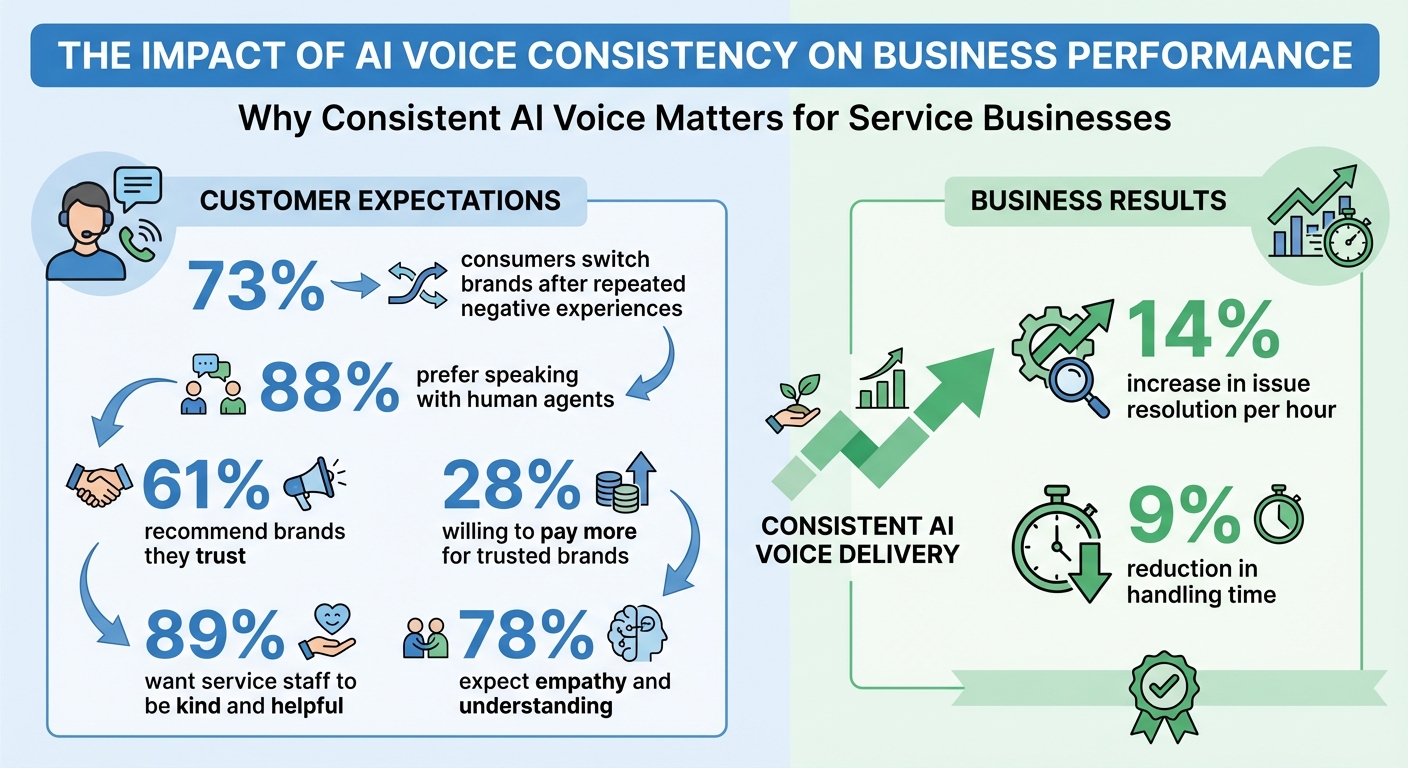
AI Voice Consistency Impact on Customer Experience and Business Metrics
How to Use AI Without Losing Your Brand Voice
Why Voice Consistency Matters for Service Businesses
When your AI agent's tone wavers from one interaction to the next, it can confuse and alienate customers. Consider this: 73% of consumers will switch brands after multiple negative experiences. That’s a huge number - and a clear sign that consistency in communication is critical.
Even more striking, 88% of people still prefer speaking with a human for support. While your AI doesn’t need to perfectly imitate human behavior, it does need to sound dependable and professional. Sudden shifts in tone - like switching from overly formal to overly casual - can create friction and leave customers questioning your business’s reliability.
Building Trust Through Consistent Communication
Think of your AI agent as a key member of your team. If a real employee showed up with a completely different personality every day, customers would quickly lose confidence. Andy Watson from RingCentral explains it well:
"Consistency and trust are intertwined. When customers receive the service they expect, they get a better experience."
A consistent tone sends a message of reliability and professionalism. When customers know what to expect, they feel more at ease sharing information, which helps resolve issues faster.
To achieve this, your AI’s voice should align with your brand’s personality. For instance, if your company has a formal, polished image, your AI should mirror that. On the other hand, if you’re targeting a younger, more casual audience, a lively and conversational tone is a better fit. Inconsistencies - whether they stem from unnatural pacing, robotic inflections, or tone changes throughout the day - can damage trust and even result in abandoned calls.
Impact on Customer Retention and Call Results
Consistency doesn’t just build trust - it also leads to better customer retention and improved call outcomes. Sixty-one percent of consumers recommend brands they trust, and 28% are willing to pay more for those brands. A steady, empathetic tone from your AI can turn one-time callers into loyal customers.
Emotional alignment matters, too. Eighty-nine percent of customers want service staff to be kind and helpful, and 78% expect empathy and understanding. Your AI should adjust its tone to fit the moment - being firm and direct when gathering critical details, or empathetic when addressing customer frustrations. This balance helps avoid the "uncanny valley" effect, where interactions feel unnatural or unsettling.
Tone Element Impact on Call Outcome Revenue Contribution Friendly/Warm Builds rapport and encourages information sharing Boosts referrals (61%) Authoritative Conveys expertise and reduces caller hesitation Supports premium pricing (28%) Empathetic De-escalates frustration and validates feelings Prevents churn from negative experiences (73%) Assertive Speeds up data collection and call routing Boosts issue resolution per hour (14%)
How to Define Your Brand's AI Voice
Your AI voice serves as an extension of your brand identity. To ensure consistency, it's essential to convert your existing brand guidelines into structured rules that AI systems can follow.
Start by pinpointing 3–5 core personality traits that reflect your brand's communication style. These traits act as a guide for all interactions. For instance, a luxury retailer might focus on being "elegant, sophisticated, and professional", while a sporting goods store might emphasize being "energetic, motivational, and upbeat". These descriptors influence everything from word choice to sentence structure and emotional tone.
Next, adapt your style guide into actionable rules. For example: use contractions like "I'll" instead of "I am", prioritize "you" over "we", and clearly outline banned phrases or required terminology. Beth Dunn, Head of Product Experience at Agent.ai, emphasizes:
"The best-sounding AI doesn't try to hide the fact that it's AI. It's just thoughtfully aligned with your voice - your real, authentic brand voice."
A useful shortcut is uploading 3–5 samples of your best content to an AI platform like ChatGPT or Claude. These systems can identify consistent patterns in tone, vocabulary, and structure, giving you a data-driven foundation rather than relying on guesswork. This clarity helps fine-tune your AI's tone, pace, and emotional approach.
Setting Tone, Pace, and Emotional Guidelines
Once your AI voice is defined, refine its delivery by setting specific tone, pace, and emotion guidelines. The goal is for your AI to sound natural and trustworthy - avoiding anything overly robotic or stiff.
Tone should adjust based on the context. For instance, when collecting information, the AI can be direct and assertive: "Please provide your account number to proceed." On the other hand, handling complaints requires a warmer, empathetic tone: "I'm so sorry to hear you're having trouble. Let’s fix this.". This adaptability ensures your AI responds appropriately to different scenarios.
Pace also plays a role in communication. A faster pace conveys excitement or urgency, while a slower, deliberate pace suggests thoughtfulness. For example, a measured pace might calm nervous customers in a healthcare setting, while a quicker tempo could energize sales calls.
Emotional guidelines help the AI respond to customer sentiment. If a customer is frustrated, the AI can slow down and use gentler language. If the customer is excited, the AI can mirror that enthusiasm.
Demographics also matter. Gen Z customers often prefer short, casual, and conversational language, while Baby Boomers may appreciate more formal communication and clear options to speak with a human agent. Tailor these guidelines to align with the expectations of your audience.
Creating AI Personas for Different Call Types
Different call scenarios require different approaches. Booking an appointment is not the same as handling a complaint or discussing pricing. That’s why creating tailored AI personas for specific call types is so important.
Platforms like Answering Agent allow you to design AI personas customized for various scenarios, such as appointment scheduling, lead qualification, or customer support. Each persona should reflect unique personality traits, communication styles, and operational boundaries.
- Appointment Booking: A structured, efficient tone to quickly gather details.
- Lead Qualification: Confident and professional questioning to establish credibility.
- Customer Support: Empathetic and solution-focused to address concerns effectively.
- Sales Calls: Energetic and persuasive, delivering key points with enthusiasm.
Here’s a quick breakdown:
Scenario Recommended Personality Communication Style Customer Support Empathetic, patient, resourceful Friendly, clear, and assertive Sales / Lead Gen Energetic, motivational, confident Upbeat, engaging, persuasive, and concise Luxury Retail Elegant, sophisticated, professional Poised, eloquent, and exclusive Healthcare Reassuring, calm, discreet Empathetic, professional, clear, and patient
Finally, establish operational boundaries for your AI. Define what it cannot do, such as offering medical advice, negotiating refunds beyond set limits, or making unrealistic promises. Clear boundaries protect your brand while ensuring the AI stays within safe and ethical limits. Transparency is also key - always let customers know they’re interacting with an AI to build trust.
Tools and Methods for Maintaining Voice Consistency
Once you've established your AI's voice and crafted personas for different scenarios, the next step is to use tools that ensure your brand's tone remains consistent. As discussed earlier, consistency in voice fosters trust, and these tools make it easier to maintain that consistency. They connect your pre-defined AI personas to seamless, reliable interactions.
Voice Customization Features in Answering Agent
Answering Agent provides five key parameters to shape how your AI sounds and interacts during calls: Voice Speed, Voice Temperature, Volume, Responsiveness, and Interruption Sensitivity. Each of these settings can be fine-tuned to suit different scenarios:
- Voice Speed: This controls how quickly the AI speaks, with a range from 0.5 (slow) to 2.0 (fast). For natural conversations, the sweet spot is usually between 1.0 and 1.18, with most users preferring 1.08–1.11. A slower pace (below 1.0) works well for deliberate, thoughtful communication, while faster speeds can be useful for quick calls, like appointment confirmations, to minimize pauses.
- Voice Temperature: This adjusts the emotional tone, ranging from 0.0 (monotone) to 2.0 (highly expressive). A setting between 1.10 and 1.20 offers a warm, balanced tone. Lower settings are better for formal or compliance-related messages, while higher settings (above 1.25) add warmth and empathy, especially useful in sensitive fields like healthcare or finance.
- Volume: This parameter manages the audio level, with a default of 1.00. Adjustments can help tailor the AI's voice to different environments, whether it’s a noisy worksite or a quiet office.
- Responsiveness: This determines how quickly the AI responds after a caller finishes speaking. A setting of 0.80 or higher creates natural pauses, mimicking human interaction.
- Interruption Sensitivity: This controls how easily the AI pauses when interrupted. A setting of 0.70 or higher allows for smooth back-and-forth communication. Most users stick to a default of 0.80 for a balanced experience.
To ensure consistent voice quality, Answering Agent also uses fallback systems that route calls through providers like ElevenLabs, OpenAI, or Cartesia when needed.
Optimizing Text-to-Speech for Natural Conversations
These settings help align your AI voice with your brand’s tone and pace, ensuring a conversational and engaging experience. For best results, start with recommended defaults - Voice Speed at 1.08–1.11, Voice Temperature at 1.10–1.20, and Interruption Sensitivity at 0.80. Keep scripts concise; responses that last between 10–15 seconds are ideal to avoid sounding monotonous or robotic.
As the Regal Product Team explains:
"The tone, pace, and delivery of your AI Voice Agent directly impacts whether a contact stays on the line, engages, or opts out." - Regal Product Team
To improve accuracy, use boosted keywords for industry-specific terms, ensuring proper recognition and transcription. Speech normalization also helps maintain transcription consistency by adjusting for variations in caller volume or microphone quality.
For calls involving detailed information like dates, phone numbers, or addresses, switching to "Optimize for Accuracy" mode ensures precise transcription, with only a slight 200ms delay. Additionally, adding environmental grounding - like background sounds from a call center or café - can make the AI feel more relatable, building trust with callers.
Finally, choose the transcription mode that best fits the call type. "Optimize for Fast" is ideal for straightforward calls requiring quick reactions, while "Optimize for Accuracy" waits for full utterances, better suited for complex conversations. Organizations using these tailored settings have reported a 14% increase in issue resolution per hour and a 9% reduction in time spent on calls.
Setting Range Recommended (Natural) Impact on Conversation Voice Speed 0.50–2.00 1.00–1.18 Controls rhythm; 1.08 is common for smooth speech Voice Temperature 0.00–2.00 1.00–1.25 Adjusts emotional tone; higher values add warmth Responsiveness 0.00–1.00 0.80–1.00 Mimics natural pauses; higher values feel more "live" Interruption Sensitivity 0.00–1.00 0.70–0.80 Balances interruptions for a natural flow
sbb-itb-abfc69c
How to Monitor and Maintain Voice Consistency
Keeping your AI voice consistent as your business scales and call volumes grow is no small feat. Over time, without proper oversight, your AI's tone, pace, or personality can stray from your original brand guidelines - a phenomenon known as "voice drift." Regular monitoring is the key to catching and correcting these shifts, ensuring your AI stays true to your brand across all interactions.
Regular Voice Audits and Customer Feedback
Think of voice audits as regular checkups for your AI's performance. A solid approach is to use a 4-Layer Framework that evaluates:
- Infrastructure: Audio quality and latency.
- Agent Execution: Adherence to scripts.
- User Reaction: Customer sentiment during calls.
- Business Outcomes: Metrics like issue resolution rates.
To make this process more effective, create a "Golden Call Set" - a curated collection of 50+ exemplary calls that serve as your benchmark. Use these reference calls during audits to identify any deviations. Automated alerts can also help, flagging when metrics drift more than 10% from your baseline.
Customer feedback is another essential tool. While technical metrics give you numbers, feedback uncovers the nuances. Watch for common phrases in transcripts like "Can you repeat that?", "I don’t understand", or "Let me speak to a human." These can signal areas where your AI may be falling short. For example, in January 2026, a telecom company revamped its scripts based on customer input, resulting in a 42% drop in human escalations, a 36% boost in satisfaction, and an 18% decrease in call times.
"FCR is more predictive than any individual metric. Teams obsess over latency, but a fast agent that doesn't solve problems generates more callbacks - and callbacks are where you lose customers." - Ishaan Rajan, Engineering Lead at Hamming.
Tracking callbacks within a 7-day period can also reveal consistency issues. If customers repeatedly call back about the same problem, it’s a sign your AI didn’t provide a complete resolution or maintain a consistent tone.
Next, let’s look at how to fine-tune your AI’s tone for various call scenarios.
Adjusting Voice for Different Call Scenarios
Your AI’s tone should adapt to the purpose of each call while staying aligned with your brand’s personality. For instance, a calm and slower tone works better for support calls, while a confident and brisk approach suits information-gathering scenarios.
In tools like Answering Agent, you can tweak Voice Temperature to adjust expressiveness. For support calls requiring empathy, set it higher (1.25+). For compliance or legal messages, where precision is key, keep it lower (<1.00). Similarly, adjust Voice Speed based on the audience: slower speeds (<1.00) are ideal for older customers or complex topics, while faster speeds (1.18+) work well for transactional calls.
Breaking calls into distinct phases - greeting, authentication, main task, and closing - can also help maintain consistency. By monitoring tone during each phase, you can pinpoint where issues arise, such as during the opening or when handling objections.
Here’s a quick guide to tailoring tone, pace, and expressiveness for different call types:
Call Scenario Recommended Tone Recommended Pace Voice Temperature Information Gathering Assertive, Direct Standard/Efficient 1.00–1.18 Support/Complaints Empathetic, Calm Slower/Deliberate 1.25+ Sales/Outbound Bubbly, Confident Energetic 1.25+ Appointment Setting Professional, Helpful Clear/Concise 1.00–1.18 Compliance/Legal Precise, Predictable Moderate <1.00
Common Mistakes in AI Voice Consistency
Even with the best intentions, businesses often stumble when implementing AI voice technology. These missteps can erode customer trust, create confusion, and ultimately hurt your bottom line. Knowing where others falter can help you sidestep the same issues.
Over-Customization and Voice Drift
Tweaking every little detail of your AI's voice might seem like a good idea, but it often backfires. Overloading your AI with too many instructions, examples, or conversation history can lead to unpredictable behavior. This phenomenon, sometimes called "scope creep", occurs when the AI starts stepping outside its intended boundaries or inventing policies that don't exist.
Another challenge is gradual regression. Small changes - like tweaking prompts or updating models - can subtly alter your AI’s tone or accuracy over time. Without proper version tracking, it becomes nearly impossible to figure out what went wrong. Hamming.ai describes this issue as:
"The metrics look healthy. The agents are still failing. We started calling this the 'metric mirage'".
In other words, your dashboard might say everything is fine, but your AI could still be letting customers down in predictable ways.
To minimize voice drift, it's essential to version-control everything. Tag every model, prompt, and test suite so you can quickly roll back changes if needed. Use a "context engineering" strategy by keeping instructions, tools, and data separate. This approach ensures consistency across thousands of interactions. Automated alerts can also help - set them to notify you if performance metrics deviate by more than 10% from your baseline. Additionally, maintain a "Golden Call Set" of at least 50 reference calls to test for regressions before deploying updates. Beyond over-customization, ignoring accessibility can also undermine your AI’s voice consistency.
Ignoring Accessibility and Inclusivity
Overlooking accessibility features isn’t just bad practice - it can lead to legal trouble. Under the Americans with Disabilities Act (ADA), businesses categorized as "public accommodations" are required to make their AI voice systems accessible to people with disabilities. Yet, many companies neglect basics like adjustable speech recognition sensitivity, extended response timeouts, or TTY/TDD integration for users who are hearing impaired.
Multilingual support is another common blind spot. For example, in July 2025, a San Francisco restaurant introduced a multilingual AI system fluent in 20 languages. The result? A 40% boost in international reservations and a 95% drop in language-related call transfers. This shows how much businesses miss out on when they overlook linguistic diversity.
But adding languages isn’t enough. Your AI must also adapt to different speech patterns, including those influenced by speech impediments, strong accents, or noisy environments. Instead of relying on clean audio, test your system with synthetic noise, varied accents, and interruptions. Implement language fallback logic, starting with automatic detection, transitioning to a common secondary language (like Spanish in California), and finally escalating to a human agent if needed.
It’s worth noting that 88% of people still prefer speaking with a human for support. When your AI fails to meet accessibility and inclusivity standards, you’re not just sacrificing efficiency - you’re also chipping away at the trust that keeps customers loyal.
Advanced Strategies for Voice Improvement
Once you've established a strong foundation for your AI voice system, you can dive into advanced machine learning techniques to improve performance while keeping your brand's voice consistent. These strategies build on the voice consistency framework discussed earlier.
Using Machine Learning to Improve Voice Quality
Machine learning can fine-tune your AI's vocal delivery over time. For example, LLM-as-a-Judge scoring uses an auxiliary model to evaluate call transcripts and audio recordings. It checks for naturalness, signs of customer frustration, and the overall flow of conversations. Meanwhile, Speech-to-Speech (S2S) architectures - powered by advanced models like gpt-4o-realtime-preview - process audio directly, capturing emotion, intent, and even non-verbal cues. The result? AI voices that sound more fluid and human-like.
To avoid quality issues, it's crucial to run automated regression tests using a controlled reference set before deploying updates. This ensures that changes to prompts or models don’t negatively impact voice quality or accuracy. For instance, in 2025, Aprende Institute used this approach with Regal's AI Agents to fine-tune voice parameters. Their efforts led to AI-driven outreach that matched human conversion rates and saved advisors over 100,000 minutes monthly.
Key performance benchmarks for top-tier AI voice systems include:
- Time to First Word (TTFW): Under 400ms
- P95 Turn Latency: Below 800ms
- Word Error Rate (WER): Below 5% in clean audio, under 10% with background noise
- Barge-in Response Time: Within 200ms
Sumanyu Sharma, Founder & CEO of Hamming AI, emphasizes the importance of a holistic approach:
"Quality comes from understanding the whole system, not optimizing individual parts".
To maintain performance, set up automated alerts for any metric that deviates by more than 10% from your baseline. These machine learning strategies can significantly improve voice realism, but their application must always follow ethical guidelines.
Ethical Use of AI Voice Cloning
As AI voice cloning technology becomes increasingly advanced, ethical considerations are more critical than ever.
One key principle is transparency. Customers should always know when they’re interacting with an AI. Microsoft even advises designing systems that intentionally "fail the Turing Test", meaning the AI should openly acknowledge its nature while maintaining high conversational quality.
Another essential practice is obtaining explicit consent. Before cloning any voice, secure clear, verifiable permission. Additionally, ensure the cloned voice fits your brand’s persona - whether authoritative for financial services or warm and friendly for lifestyle brands. Adhering to privacy laws like GDPR further reinforces this responsibility.
In situations involving long-term customer relationships or sensitive topics like medical or financial advice, higher levels of disclosure are especially important for maintaining trust. Considering that 70% of American customers still prefer speaking with a human agent, always provide an easy way to connect with a live person, such as saying "human" or pressing 0.
Beth Dunn, Head of Product Experience at Agent.ai, captures this balance perfectly:
"The best-sounding AI doesn't try to hide the fact that it's AI. It's just thoughtfully aligned with your voice - your real, authentic, slightly weird, wonderfully human brand voice".
When applied ethically and transparently, voice cloning can seamlessly extend your brand’s personality across every customer interaction.
Conclusion
A consistent AI voice isn't just a nice-to-have - it directly impacts your bottom line. Companies leveraging AI-powered customer service agents report faster issue resolution and improved handling times, making every interaction more efficient. When your AI maintains the same tone, pace, and personality across all interactions, it creates a steady, reliable brand voice. This reliability fosters trust, and trust is what ultimately drives revenue.
The framework outlined in this guide - from defining your brand's voice to refining it with machine learning - offers a straightforward path forward. Inconsistent messaging across channels can reduce customer engagement by 20%, while personalized voice interactions can increase engagement by as much as 30%. These numbers highlight how critical it is to maintain voice consistency across every customer touchpoint. By doing so, businesses can secure customer loyalty while gaining a competitive edge.
Answering Agent builds on these principles by offering scalable solutions that ensure your brand's voice is consistent everywhere. With features like customizable tones, 24/7 availability, and unlimited call capacity, the platform delivers natural, helpful conversations that reflect your brand's identity.
As Deren Rehr-Davis, SVP of Sales at JustCall, explains:
"The best AI voice agent scripts work behind the scenes. Users don't notice the structure; they just experience smooth, helpful conversations".
This kind of seamless interaction transforms everyday customer calls into opportunities for growth. With the right tools and ongoing refinement, your AI voice becomes a reliable extension of your team, always representing your brand with precision and care.
FAQs
How can I make sure my AI voice matches my brand's personality?
To make sure your AI voice mirrors your brand's personality, start by defining your brand's tone, style, and key traits. Think about it: Is your brand more formal and professional, or does it lean towards casual and approachable? For instance, a professional brand might favor polished and respectful language, while a youthful, vibrant brand could go for a lively and conversational tone.
Consistency matters just as much. Turn your brand’s style guide into clear rules that shape the AI’s responses, ensuring the tone and word choices align across every interaction. It’s also a good idea to regularly test and tweak the AI’s output to keep it in sync with your brand’s identity.
Lastly, train your AI with examples and guidelines that reflect your brand’s voice. Doing this helps create a voice that feels genuine, connects with your audience, and reinforces your brand’s image in every customer interaction.
What mistakes should I avoid when customizing AI voice responses?
To create a smooth and consistent AI voice experience, here are some pitfalls to watch out for:
- Confusing or contradictory instructions: If your guidelines are overly complex or send mixed signals, the AI might struggle to maintain a consistent tone or behavior.
- Unclear directives: Vague or ambiguous instructions can lead to responses that miss the mark when it comes to representing your brand's voice.
- Skipping proper testing: Launching without thoroughly testing the AI's responses can result in interactions that feel off or fail to meet expectations.
It's also crucial to align the tone with your brand's identity. A voice that's too robotic might feel cold and distant, while an overly casual tone could come across as unprofessional. By focusing on clear, detailed instructions and testing thoroughly, you can ensure the AI delivers a voice that feels authentic and mirrors your brand's personality.
How does Answering Agent ensure a consistent AI voice for businesses?
Answering Agent maintains a consistent AI voice through customizable voice profiles tailored to match your brand's tone, style, and specific terminology. These profiles ensure that every response reflects your business's personality, avoiding any mismatched communication that could dilute your brand identity.
Additionally, the platform uses real-time monitoring and feedback tools to fine-tune the AI's tone and accuracy as it interacts with customers. Features such as audit logs and quality checks help maintain professionalism and brand alignment in every interaction, even when handling a surge in call volumes.
Related Blog Posts
Book a walkthrough
See it handle your calls.
Book 20 minutes, or hear a sample call first.
Ready to see it handle your calls?
Book a walkthrough, or hear a short sample call first.
Related Articles

How to Handle Pickleball Membership Cancellation Calls
How pickleball club desks handle membership cancellation calls without inventing policy or fighting the member.

How to Handle Failed Payment Calls on a Car Wash Membership
How wash desks handle failed payment and card-update calls on a membership without turning the call into a gate lockout.

Car Wash Membership Phone Calls: A Desk Guide
A desk guide to the membership phone calls car washes take, with links to the deep how-tos.