
Switching to a virtual receptionist can save your business tens of thousands of dollars annually while improving customer service. Here’s why:
- Cost Savings: An in-house receptionist costs $61,600–$82,700 per year, while virtual receptionist services range from $1,200–$3,600 annually. Over five years, this could save your business up to $332,000.
- Missed Calls vs. AI Answering = Lost Revenue: 62% of calls to small businesses go unanswered, with 85% of callers turning to competitors if they don’t reach someone. Each missed call costs an average of $12, potentially adding up to $26,000+ in annual losses.
- 24/7 Coverage: Virtual receptionists provide 168 hours of weekly coverage and handle unlimited calls, compared to the 40-hour workweek of an in-house receptionist.
- Revenue Growth: By answering more calls and scheduling appointments efficiently, businesses can recover lost revenue and increase customer retention by 3%–7% annually.
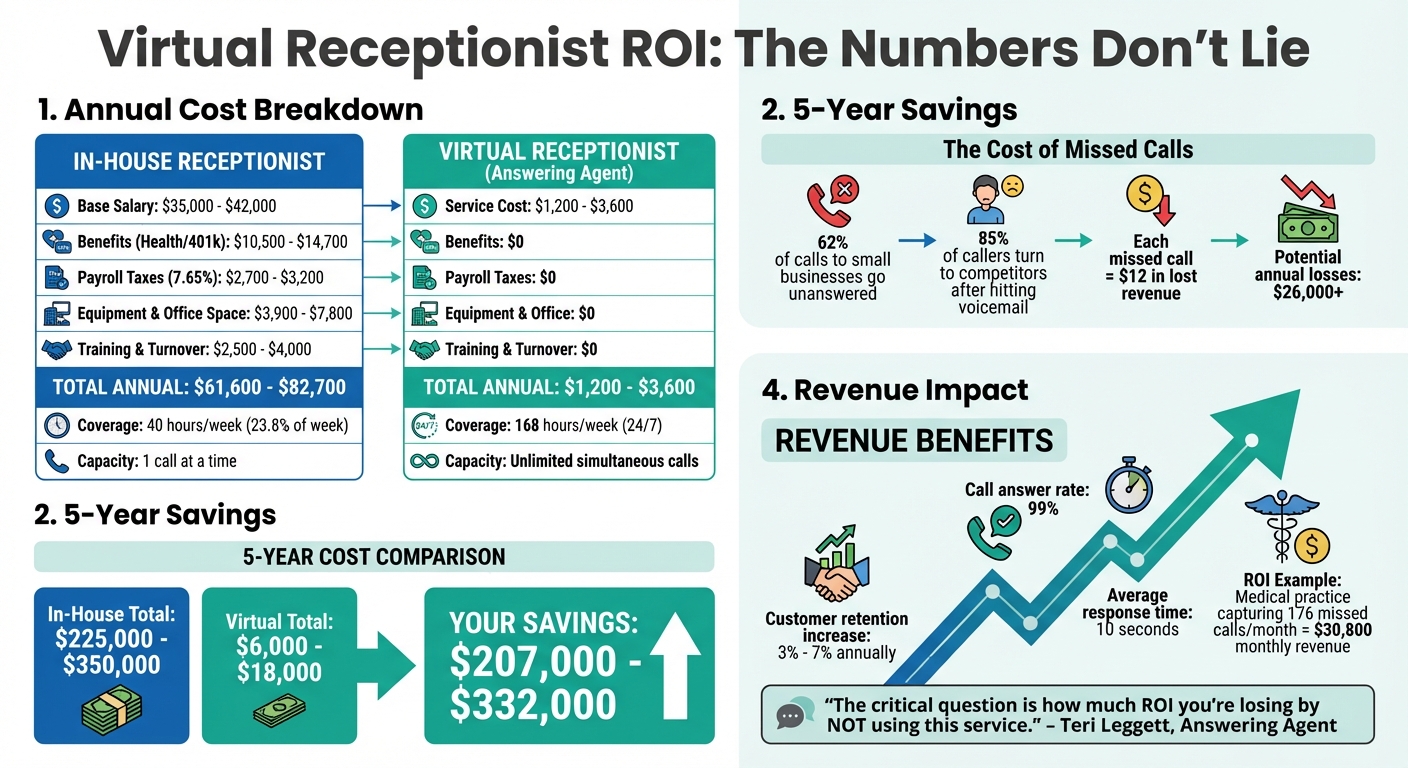
In-House vs Virtual Receptionist: 5-Year Cost Comparison and ROI Analysis
The ROI Of AI Voice Agents For Service Businesses | Save More, Scale Faster #aivoiceagent
The Financial Burden of Traditional Receptionists
Hiring an in-house receptionist comes with a hefty price tag. Beyond a base salary of around $31,000, businesses also face additional expenses like benefits, payroll taxes, training, equipment, and office space. These costs add up quickly, making the total annual investment much higher than it initially seems.
Rising Labor Costs
A receptionist's base salary is only part of the story - it typically accounts for just 74% of the total cost to a business. For instance, while the median annual salary is approximately $37,232 (or $17.90/hour), the actual cost to the employer often falls between 1.35 to 1.5 times the base salary.
Here’s a breakdown of the estimated first-year costs:
Cost Category Low Estimate High Estimate Base Salary $37,232 $37,232 FICA Taxes (7.65%) $2,848 $2,848 Unemployment (FUTA/SUTA) $745 $1,500 Health Benefits $6,000 $12,000 PTO/Sick Days $1,432 $2,148 Workers Compensation $372 $1,117 Training $1,000 $1,500 Equipment (One-time) $1,700 $4,000 Office Space $2,400 $6,000 Total Year 1 $53,729 $68,345
(Source: NextPhone Cost Analysis)
These figures assume a standard 40-hour workweek, which only covers 23.8% of the total hours in a week. If your business needs after-hours or weekend support, you’ll likely incur overtime or hire additional staff, further driving up costs.
Turnover is another hidden expense. Replacing a receptionist can cost between 50% and 200% of their annual salary, translating to anywhere from $18,500 to $74,000 per replacement. With turnover rates in industries like hospitality and services averaging 75%, these costs can pile up quickly.
And that’s just the labor side of the equation. The how missed calls impact revenue and costs paints an equally concerning picture.
Revenue Lost from Missed Calls
The financial strain doesn’t stop at wages and benefits. When a receptionist is busy with walk-ins, administrative duties, or even on a lunch break, incoming calls often go unanswered. The numbers tell a grim story:
- 74.1% of business calls are never answered.
- In the beauty and wellness sector, 37% of calls are missed, with 82% of these occurring during business hours.
"The phone line is a black box for many beauty and wellness businesses, and that's a major gap as it remains the single most important channel for driving booking and guest engagement."
– Sunayana Reddy, Senior Product Marketing Manager, Zenoti
Each missed call costs businesses an average of $12.15. Even worse, 85% of callers who don’t reach a live person won’t call back. For small and medium-sized businesses, this can translate to $26,000+ in annual losses. Home services contractors face even steeper losses, up to $189,068 per year. In the beauty industry, 71% of salon and spa clients say they’ve skipped booking a service simply because they couldn’t get through to someone.
So, while you might spend $53,000–$68,000 annually for a receptionist who only provides coverage for about 24% of the week, you could also be losing tens of thousands of dollars in missed opportunities. These combined expenses highlight the financial strain traditional receptionists place on businesses and make a strong case for considering virtual receptionists as a cost-effective alternative.
How Virtual Receptionists Reduce Costs and Improve Efficiency
Virtual receptionists completely change how businesses manage costs. Instead of shelling out $45,000–$65,000 annually for limited in-house coverage, companies can access round-the-clock service for just $1,100–$4,800 per year. This cost-effective model offers constant availability, handles unlimited calls, and automates lead conversion - addressing key challenges like expenses, capacity, and missed opportunities.
24/7 Call Handling
Providing true 24/7 coverage with in-house staff usually requires hiring 3 to 4 full-time employees, which can cost over $100,000 annually. Virtual receptionists eliminate this expense entirely. For instance, Answering Agent’s AI-powered system ensures 24/7 availability without the need for overtime pay, holiday premiums, or managing time-off requests. Calls are answered within an average of 10 seconds, so customers aren't left waiting.
Take Philip Raby Specialist Cars in the UK as an example. After switching to an AI receptionist, the Porsche garage saved about $650 per month while increasing the number of inquiries and bookings captured. The owner highlighted the system’s positive impact on their operations.
This constant accessibility not only enhances customer experience but also ensures businesses don’t miss out on potential revenue from missed calls.
Unlimited Call Capacity Without Extra Staff
A traditional receptionist can handle only one call at a time. During busy periods, this limitation often results in missed calls, busy signals, or voicemail. Considering that 80% of callers who reach voicemail never call back, this can significantly hurt revenue.
Virtual receptionists, however, can handle an unlimited number of calls simultaneously - at no additional cost. This capability is especially valuable in industries like home services, where emergencies (such as burst pipes) account for 6.2% of calls and can lead to premium revenue opportunities. Missing just 31 calls a month could cost a contractor around $21,700 in lost revenue. By ensuring every call is answered, virtual receptionists help prevent these losses.
Automated Lead Capture and Appointment Booking
Virtual receptionists don’t just answer calls - they actively convert them into revenue. Through direct integration with CRM systems and scheduling tools, they instantly log appointments, eliminating manual data entry and reducing transcription errors.
Answering Agent, for example, conducts natural, conversational interactions to guide callers through bookings, answer FAQs, and qualify leads. The system syncs this data in real time with your existing tools. This automation frees up managers from spending hours on the phone and ensures that every opportunity is captured - even outside regular business hours. In fields like personal injury law, where a single missed call could mean losing $15,000, this feature is invaluable.
Over time, the benefits multiply. As Ezra Samarista from Unity Connect explains:
"ROI grows over time. Training and integrating the system boost its efficiency and reliability without significantly raising costs".
sbb-itb-abfc69c
Calculating Long-Term ROI with Virtual Receptionists
Figuring out the return on investment (ROI) for a virtual receptionist means looking at a mix of factors: extra revenue from answered calls, labor cost savings, and the time you and your team get back. Let’s break it down with some real-world examples.
ROI Formula and Examples
Here’s a simple formula to measure ROI:
(Additional Calls Answered × Conversion Rate × Average Transaction Value) - Monthly Service Cost.
This formula shows the direct financial impact of answering calls that might otherwise be missed. For instance:
- A medical practice missing 8 calls per day (about 176 monthly) with a 70% conversion rate and an average appointment value of $250 could generate $30,800 in monthly revenue by capturing those calls. With a service cost of $600 per month, the ROI comes out to a staggering 5,033%.
- A law firm replacing a $45,000 annual in-house receptionist with a $2,400 yearly AI service saves $42,600 in labor costs. That’s an ROI of 1,775% just from labor savings.
- An HVAC contractor recovering half of 40 missed calls each month, with an average job value of $400, could bring in $96,000 in annual revenue.
The standard ROI percentage formula is:
[(Total Benefits – Total Costs) / Total Costs] × 100 [16, 34].
Gary Archer, Founder & CEO of Botafide AI, sums it up perfectly:
"If you land even one extra paying job in a month, the tool often pays for itself. Beyond that, every extra job boosts ROI significantly".
Key Metrics to Track
To maximize ROI, keep an eye on these critical metrics:
- Call answer rate: Aim for 99% to ensure almost no calls slip through.
- Lead-to-customer conversion rate: Track how many answered calls turn into paying customers.
- Appointment show-up rates: Monitor how many scheduled appointments actually happen [16, 31].
Before starting with a virtual receptionist service, spend 2–4 weeks tracking your current call volume and how many calls you’re missing. This baseline will help you measure the service's impact.
And don’t forget about opportunity cost - the time savings you achieve. For example, calculate the weekly hours saved and multiply that by your hourly income (annual income ÷ 2,000). This gives you a concrete number to factor into your ROI. On top of that, professional call handling can boost customer retention rates by 3%–7% annually, creating a snowball effect of benefits over time.
It’s also worth noting that benefits and payroll taxes typically add 30%–35% to a receptionist’s base salary [31, 3]. In many cases, capturing just 10%–15% of missed calls is enough to cover the service cost entirely [32, 33].
Long-Term Savings and Growth Over Time
Over a 3–5 year period, virtual receptionists can lead to substantial savings that significantly impact your bottom line. The financial advantages outlined below highlight how this approach can result in long-term cost reductions.
Cost Comparison: In-House vs. Answering Agent
Let’s break it down with a side-by-side comparison:
Cost Component In-House Receptionist (Annual) Answering Agent (Annual) Base Salary $35,000 – $42,000 $1,200 – $3,600 Benefits (Health/401k) $10,500 – $14,700 $0 Payroll Taxes (7.65%) $2,700 – $3,200 $0 Equipment & Office Space $3,900 – $7,800 $0 Training & Turnover $2,500 – $4,000 $0 Total Annual Cost $61,600 – $82,700 $1,200 – $3,600 Annual Savings – $58,000 – $81,500
Over five years, the difference becomes even more striking. An in-house receptionist could cost between $225,000 and $350,000, while an Answering Agent would only cost $6,000 to $18,000. That’s a potential savings of $207,000 to $332,000 over five years.
Revenue Growth Through Better Call Capture
Virtual receptionists don’t just save money - they also help grow revenue by ensuring missed calls don’t slip through the cracks. Recovered calls translate into new opportunities and lasting revenue. Studies show that professional call handling can improve customer retention rates by 3%–7% annually. For service-based businesses, even a 1% boost in retention can increase profits by 5%–10%.
Here’s why this matters: about 62% of calls to small businesses go unanswered. Capturing even a fraction of these missed calls can lead to significant growth. Take a medical practice, for instance. If they capture 100 additional patients in a year, with each patient contributing a lifetime value of $2,500, that’s an extra $250,000 in long-term revenue from just one year’s improved call handling.
Consistent Service During Growth Phases
Virtual receptionists don’t just handle calls - they ensure your business stays responsive as it grows. When call volumes surge, traditional receptionists can’t always keep up. In fact, up to 85% of callers may turn to a competitor if they hit voicemail.
Answering Agents solve this problem with 24/7 availability, providing 168 hours of coverage weekly - over five times the coverage of a standard 40-hour work week. Plus, they can handle unlimited simultaneous calls, all for a predictable flat rate. This allows businesses to reinvest significant savings into other growth-focused initiatives without worrying about rising operational costs. The consistent service and revenue gains make a strong case for the ROI discussed earlier.
Conclusion
The numbers paint a striking picture: hiring an in-house receptionist can cost between $61,600 and $82,700 annually, while using Answering Agent services costs only $1,200 to $3,600 per year. That’s an annual savings of $58,000 to $81,500, adding up to approximately $290,000 to $407,500 over five years. These savings alone present a compelling case for businesses to rethink how they manage incoming calls and revenue opportunities.
But it’s not just about cutting costs. With 62% of calls to small businesses going unanswered, every missed call equates to lost revenue - estimated at $12 per call. Answering Agent ensures those calls are answered, turning missed opportunities into paying customers. Plus, its ability to handle unlimited calls simultaneously means your business remains responsive during peak times or periods of growth, all without increasing staff.
"The critical question is how much ROI you're losing by not using this service." - Teri Leggett, Sales Manager, Answering Agent
For service-based businesses facing rising labor costs and tighter margins, the decision becomes clear. Virtual receptionists not only reduce labor expenses but also improve customer retention by 3%–7% annually. This combination of lower costs and increased revenue creates a compounding effect that strengthens your business over time.
FAQs
How do virtual receptionists help retain customers?
Virtual receptionists help businesses retain customers by offering reliable, professional, and 24/7 communication. With their constant availability - even during nights, weekends, or holidays - they ensure that no call goes unanswered. This level of dependability builds trust and leaves customers feeling valued.
On top of that, virtual receptionists enhance the customer experience by managing calls efficiently, providing accurate information, and handling appointment scheduling without hassle. These qualities not only lead to happier customers but also encourage them to return. By ensuring accessibility and delivering top-notch service, virtual receptionists contribute to stronger customer loyalty and lasting relationships.
What are the long-term cost savings of using a virtual receptionist?
Using a virtual receptionist can help businesses save a lot of money in the long run. By eliminating costs tied to hiring, training, benefits, and payroll taxes, companies can cut their phone-answering expenses by 40-60%. Plus, with 24/7 availability, they ensure no call - and no potential opportunity - is missed.
Virtual receptionists also bring valuable features like lead capture, appointment scheduling, and the ability to handle unlimited calls at once. This not only simplifies daily operations but also helps turn more calls into revenue, all while keeping overhead costs low.
How do virtual receptionists manage unlimited calls compared to in-house staff?
Virtual receptionists use cutting-edge technology to handle an unlimited number of calls at the same time, offering a level of efficiency that traditional in-house staff just can't match. While an on-site receptionist is typically tied to a 40-hour workweek and can only answer one call at a time, virtual receptionists - especially those powered by AI - provide round-the-clock availability and manage multiple calls simultaneously without missing a beat.
This means your business remains responsive during busy periods, after-hours, or unexpected spikes in call volume. By ensuring no call goes unanswered, virtual receptionists help you secure more leads, enhance customer satisfaction, and reduce staffing expenses - all while boosting overall productivity.
Related Blog Posts
Book a walkthrough
See it handle your calls.
Book 20 minutes, or hear a sample call first.
Ready to see it handle your calls?
Book a walkthrough, or hear a short sample call first.
Related Articles
How to Handle Pickleball Membership Cancellation Calls
How pickleball club desks handle membership cancellation calls without inventing policy or fighting the member.

How to Handle Failed Payment Calls on a Car Wash Membership
How wash desks handle failed payment and card-update calls on a membership without turning the call into a gate lockout.

Car Wash Membership Phone Calls: A Desk Guide
A desk guide to the membership phone calls car washes take, with links to the deep how-tos.