AI Call Answering ROI for Franchise Businesses

AI phone agents recover missed calls, cut receptionist costs, and boost franchise revenue with 24/7 accurate call handling.

AI Call Answering ROI for Franchise Businesses

Missed calls are costing businesses big. For franchise owners, unanswered calls - 74.1% of them in home services - mean lost revenue, with each missed call worth $100–$1,200. Worse, 85% of callers don’t try again. The solution? AI call answering systems. At $49–$199 per month per location, they operate 24/7, handle unlimited calls, and deliver 99.93% accuracy. Compare this to human receptionists costing $41,000–$65,000 annually per location.

Key benefits include:

  • Revenue recovery: AI systems prevent losses from missed calls, adding up to $374,000 annually for businesses missing 30 calls daily.
  • Cost savings: AI reduces staffing expenses by $35,000 per location yearly.
  • Revenue growth: Faster response times improve lead conversion by 400%.

Franchises like CertaPro Painters saw a 22% revenue boost, while Coastal Kitchen saved $3,200 monthly and increased bookings. For many, one extra job covers a year of AI service. The numbers make it clear: AI systems offer a practical, cost-effective way to stop losing money and start growing revenue.

Measuring the ROI of AI Voice Agents in Service Businesses | Real Numbers That Matter

ROI Metrics for AI Call Answering Systems

When evaluating the ROI of AI call answering systems, three key metrics come into play: recovered revenue from missed calls, labor cost savings, and revenue growth from improved call handling. Let’s break down each of these areas.

Revenue Lost from Missed Calls

Unanswered calls can have a massive financial impact on businesses. A study by NextPhone analyzed 130,175 calls across 45 businesses over seven months and revealed that home services franchises lose an average of $189,068 annually due to 74.1% of calls going unanswered and an 85% competitor switch rate.

The type of call also plays a significant role. For instance, emergency calls, which make up roughly 6.2% of inbound call volume, often close at a 100% success rate when answered promptly. Missing these calls can be especially costly. In the HVAC industry, a missed after-hours emergency call can result in over $1,200 in lost revenue, while in roofing, where the average project value reaches $15,000, even a single missed call can have a substantial impact on revenue.

Labor Cost Savings

The cost of employing a full-time receptionist - including salary, benefits, and equipment - ranges between $41,000 and $65,000 annually. By contrast, AI call answering systems cost between $199 and $3,000 per year per location, leading to savings of approximately $38,000 to $62,000 per location.

For a franchise with 20 locations, traditional staffing costs range from $820,000 to $1.3 million annually, compared to just $3,980 to $60,000 with AI systems. On average, businesses save around $35,000 per year by switching to AI call answering.

Beyond direct cost savings, AI systems offer unmatched efficiency. Unlike human receptionists, who handle one call at a time during a standard 40-hour work week, AI operates 24/7/365 and can manage unlimited simultaneous calls. Considering that about 40% of business calls happen after hours, relying solely on human staff would require additional shifts, further driving up costs.

Revenue Growth from Better Call Handling

AI call answering systems don’t just save money - they can actively grow revenue. Studies show that responding to leads within five minutes increases conversion rates by 400%.

For example, NextPhone found that businesses using AI systems with a 60% call capture rate and a 20% close rate saw an annual net gain of $153,012 per business, equating to a 6,409% ROI. Even capturing just 10% more calls can deliver up to a 990% ROI.

Take Answering Agent as an example. This AI platform handled 17,724+ calls with a 99.93% accuracy rate, pitched 20,375 offers, and saw 6,820 offers accepted (a 33.5% acceptance rate). It provides businesses with scalable, predictable revenue growth - all without the need for additional staff.

Franchise Sector Case Studies

Case studies consistently demonstrate measurable returns from integrating AI call answering systems. While results differ by industry, the overall trend is clear: franchises adopting AI see improvements in both revenue and operational efficiency. Below are examples showcasing how these systems drive results across various sectors.

Home Services Franchises

In October 2025, CertaPro Painters of Omaha introduced an AI voice agent to manage pre-estimate setup calls. Over 90 days, the system achieved an impressive 93% answer rate across 85 calls. This led to a 22% increase in revenue per consultation and boosted close rates from 35% to 43%. One sales representative saw their annual revenue jump from $500,000 to $1.4 million, marking a 180% year-over-year increase.

"I was really skeptical about the AI doing setup calls, but this has worked way better than I had ever imagined. AI is the future." - Jodi Esser, Franchise Owner, CertaPro Painters of Omaha

Another example comes from a roofing franchise that averaged 87 calls per month and struggled with a 76.6% miss rate. By capturing just 30% of missed leads, the franchise added $44,801 in monthly revenue. With an average project value of $15,000, even one captured job covered nearly six years of AI service costs.

Now, let’s shift focus to how AI transforms operations in restaurant and food service franchises.

Restaurant and Food Service Franchises

Coastal Kitchen, a Southern California franchise with three locations, implemented AI phone agents in November 2024. This eliminated a 4.5-minute average hold time and increased the phone-to-reservation conversion rate by 87%. The franchise saved $3,200 per month in staffing costs while also earning an additional $1,880 monthly from after-hours bookings - delivering a 460% return on investment.

Similarly, Wendy's introduced "FreshAI" voice ordering in 2025, which resulted in a 35% increase in takeout revenue. The AI system maintained high accuracy during peak hours, outperforming human hosts, who typically experienced a 23% drop in precision during rush periods. For a typical pizza franchise handling 120 daily calls with a 43% miss rate, capturing just 30% of missed calls (16 per day) at an average order value of $28 generated $163,520 annually, along with $26,280 in labor savings.

These examples highlight the value of AI in sectors where efficiency and responsiveness are key. Let’s look at how high call volume services benefit from similar technology.

High Call Volume Service Franchises

Franchises managing emergency services see particularly strong outcomes. Emergency calls account for about 6.2% of inbound traffic and close at a 100% success rate when answered promptly. For HVAC franchises, missing a single after-hours emergency call can mean losing over $1,200 in revenue.

AI systems handle 60-80% of routine tasks - like scheduling, pricing, and availability checks - freeing employees to focus on more critical responsibilities. This is crucial because 85% of callers who reach voicemail hang up and immediately contact a competitor. For high-volume service franchises, deploying AI reduced urgent call response times by 30%, directly improving revenue capture and customer loyalty.

Cost-Benefit Analysis: AI vs. Traditional Receptionists
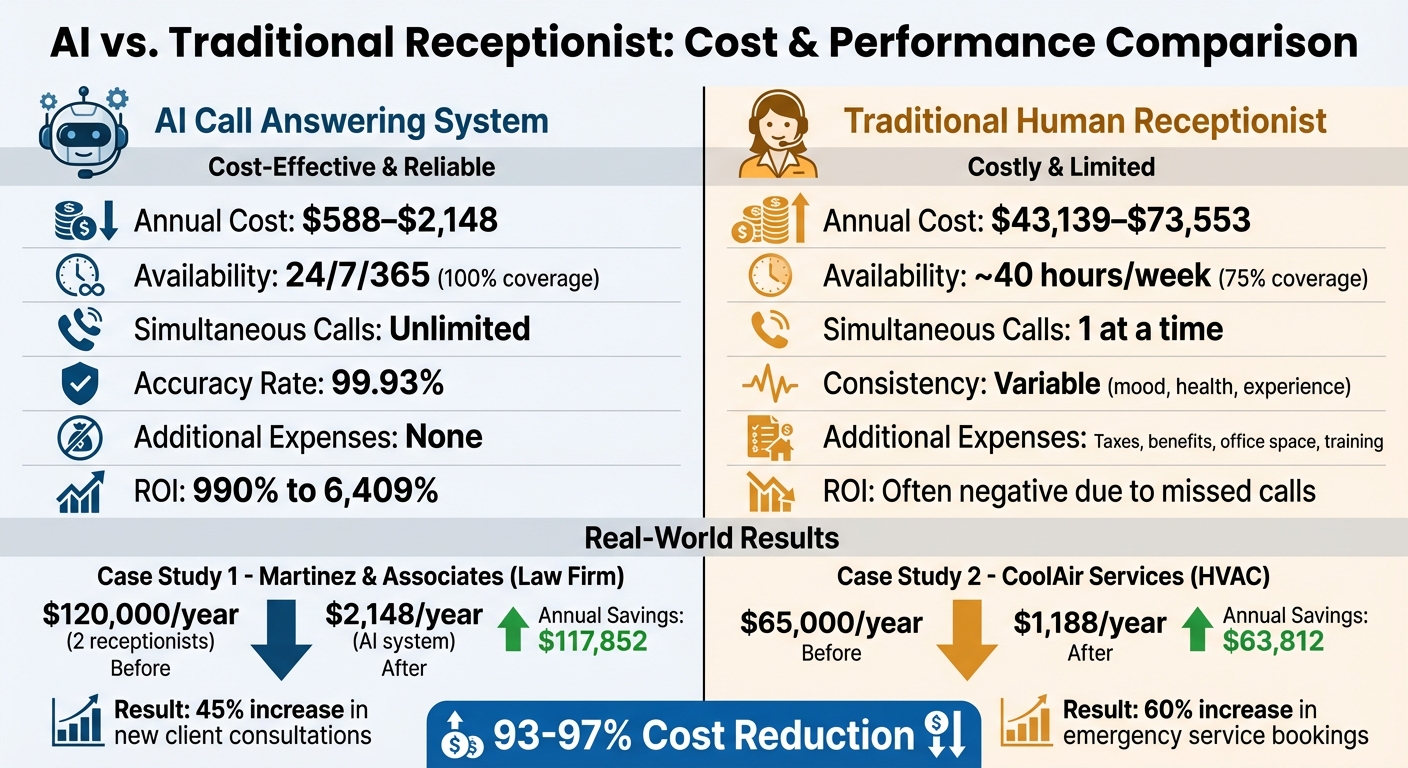
AI vs Human Receptionist Cost Comparison for Franchises

AI vs Human Receptionist Cost Comparison for Franchises

The cost difference between human receptionists and AI systems is striking. Human receptionists typically cost between $43,139 and $73,553 annually, while AI systems range from $588 to $2,148 per year. This represents a 93% to 97% reduction in direct costs, but the financial advantages don’t stop there. AI systems also address operational inefficiencies, such as missed calls and limited availability, which can lead to significant revenue losses.

AI systems provide uninterrupted 24/7/365 coverage, ensuring no call goes unanswered. In contrast, a single human receptionist offers approximately 1,570 hours of phone coverage per year - about 75% of standard business hours after factoring in breaks and leave. With 40% of calls occurring outside regular business hours, and 85% of callers who reach voicemail opting to contact a competitor instead, AI’s constant availability can directly increase revenue opportunities. These differences in coverage and cost set the stage for a closer look at operational efficiency and overall return on investment (ROI).

Scaling human receptionists to meet demand requires hiring and training, which is both time-consuming and expensive. On the other hand, AI systems can instantly handle unlimited simultaneous calls, making them particularly effective for businesses with multiple locations or seasonal surges in call volume.

Comparison Table: AI vs. Human Receptionists

Feature Traditional Human Receptionist AI Call Answering (e.g., Answering Agent)
Annual Cost $43,139–$73,553 $588–$2,148
Availability ~40 hours/week (75% coverage) 24/7/365 (100% coverage)
Simultaneous Calls 1 at a time Unlimited concurrent capacity
Additional Expenses Taxes, benefits, office space, training None
Consistency Variable (mood, health, experience) 99.93% accuracy rate
Net ROI Often negative due to missed calls 990% to 6,409%

Real-World Savings and Results

Consider Martinez & Associates, a law firm that previously employed two receptionists at a combined cost of $120,000 annually. After switching to an AI system costing just $2,148 per year, they saved $117,852 annually and increased new client consultations by 45%. Similarly, CoolAir Services, an HVAC company, cut costs from $65,000 per year to $1,188, saving $63,812, while capturing a 60% increase in emergency service bookings.

Why Answering Agent Fits Franchise Needs
Answering Agent

The numbers make it clear: AI systems like Answering Agent are a perfect match for franchises. With a 99.93% accuracy rate across over 17,724 scored calls, the system delivers consistent performance without the variability of human factors.

Additionally, Answering Agent ensures no revenue is left on the table. Since 40% of calls occur outside standard business hours, the system helps businesses capture opportunities that would otherwise be missed. For example, it has successfully pitched 20,375 offers and secured 6,820 acceptances, turning calls into measurable business growth - all at a fraction of the cost of traditional staffing.

How to Calculate ROI for Your Franchise

Steps to Calculate ROI

Using the revenue and cost metrics outlined earlier, here's how you can calculate the ROI for your franchise:

Monthly ROI Formula:

(Monthly Calls × Miss Rate × AI Capture Rate × Close Rate × Average Job Value) - Monthly AI Cost.

  1. Determine Monthly Call Volume
    Check your phone system reports to find out how many calls your business receives each month. If detailed logs aren't available, a general benchmark for service franchises is between 150 and 500 calls monthly. This range depends on factors like the number of locations and seasonal demand.
  2. Calculate Your Miss Rate
    The miss rate is the percentage of calls that go unanswered or are abandoned. Industry data reveals that home services businesses miss 74.1% of calls, while electricians may miss up to 91%. If you don't have exact data, a conservative estimate of 30–40% can be used.
  3. Factor in Average Job Value and Close Rate
    Average job values and close rates vary by industry. For instance:
    • Roofing jobs average $15,000.
    • HVAC emergency calls are around $1,200.
    • Electrical work typically averages $2,000.
      A conservative close rate of 20% for captured leads is a good starting point for projections.

Example Calculation:
Let’s say a plumbing franchise handles 300 monthly calls, with a 74% miss rate, a 30% AI capture rate, a 20% close rate, and an average job value of $1,500. Here's how the ROI works out:

(300 × 0.74 × 0.30 × 0.20 × $1,500) - $250 ≈ $19,730 in monthly ROI.

  1. Account for Additional Costs
    Include Total Cost of Ownership (TCO), which covers:
    • One-time setup costs: $1,000–$5,000
    • Monthly fees: $200–$2,000
    • Usage charges: $0.01–$0.10 per minute.
    Also, consider Lifetime Value (LTV) for customers, which can exceed $15,000 over time. Systems like Answering Agent, which offer flat-rate pricing with unlimited calls, simplify cost management and eliminate variability. This approach aligns with case studies showing significant revenue recovery for franchises.

Break-Even Timeline and Long-Term Gains

To maximize ROI, it’s crucial to know how quickly your investment pays off. For most service-based franchises, the break-even point is typically reached within 1 to 4 months. High-ticket industries often see returns almost immediately. For example:

  • Capturing a single $15,000 roofing job could cover nearly six years of AI service costs.
  • An HVAC business might break even after one emergency call, covering six months of service.

Break-Even Formula:
Monthly AI Cost ÷ (Average Job Value × Close Rate) = Number of Qualified Leads Needed to Break Even.

Example:
At $250 per month, with a $1,500 average job value and a 20% close rate (where each captured lead generates $300 in revenue), you’d need to capture just 0.83 qualified leads per month. That’s roughly one qualified lead every 1 to 2 months to cover the cost.

AI systems start recovering revenue from day one. With 85% of callers who reach voicemail switching to a competitor immediately, you’re capturing revenue that was previously lost. Many businesses report achieving positive ROI within the first week.

Long-Term Financial Benefits

After breaking even, the financial benefits only grow. Here’s what you can expect:

  • Save around $35,000 annually in staffing costs.
  • Recover an additional $8,000–$25,000 annually from previously missed revenue.
  • Free up 15–25 hours of staff time per week by reducing routine phone tasks.

These savings can lead to long-term returns ranging from 990% to 6,409%.

The "One-Job Rule":
For many franchises, capturing just one high-value missed lead can pay for an entire year of AI service. Every lead after that contributes directly to your bottom line.

Conclusion

For franchise businesses, AI call answering offers an impressive return on investment by slashing costs, increasing revenue, and ensuring consistent brand representation across all locations. With a staggering 74.1% of calls to service businesses going unanswered, franchises lose an estimated 15–25% of potential revenue from missed calls alone. AI solutions tackle this issue head-on, eliminating missed calls and reducing staffing costs from $1,200–$2,000 per location per month to just $49–$199.

Ming Xu, Chief Information Officer at Trillet, highlights the financial impact of adopting AI:

"The economics become compelling at scale. A 50-location franchise switching from traditional answering services to AI saves $5,000–$15,000 monthly while improving answer rates from 70% to 99.9%."

This shift translates into annual savings of $60,000–$180,000, while simultaneously capturing more leads thanks to 24/7 availability and the ability to handle unlimited calls at the same time.

Answering Agent exemplifies this potential with proven results: 99.93% accuracy across 17,724 scored calls, 6,820 accepted offers from 20,375 pitches, and the capacity for unlimited simultaneous calls - all at flat-rate pricing. For franchises, this means predictable expenses, seamless brand messaging, and rapid deployment across new locations in minutes instead of weeks. This combination of cost efficiency and revenue growth makes AI call answering a game-changer for franchises.

Since the investment pays for itself after capturing just one extra lead, every additional call - whether it’s a late-night emergency or a weekend inquiry - directly contributes to your bottom line. AI call answering isn’t just a tool; it’s a must-have for franchises aiming to grow and streamline operations.

FAQs

How do I find my real missed-call rate?

To figure out your missed-call rate, you need to keep track of two numbers: the total number of incoming calls and how many of those go unanswered. Then, use this simple formula:

Missed-call rate = (Missed calls / Total calls) × 100

This gives you the percentage of calls that go unanswered.

Using an AI call answering system can make this whole process easier. These systems provide detailed analytics and ensure calls are handled around the clock, helping you minimize missed opportunities over time.

What call data is needed to calculate ROI?

To figure out your ROI, gather data on these key metrics: average call volume, missed call rate, capture rate, close rate, and average job value. These numbers are essential for understanding how AI call answering affects your business outcomes and potential cost savings.

How quickly can AI call answering achieve ROI?

AI call answering systems can deliver impressive returns on investment (ROI) in a short time - typically within 60 to 90 days. Many businesses using these systems have reported ROI ranging from 240% to 380% within just six months, proving them to be an efficient and budget-friendly way to cut costs while boosting operational efficiency.

Related Blog Posts

Try it yourself

See how AI handles calls for your business

Enter your business name and we'll build a personalized AI receptionist demo in under 2 minutes. Talk to it right in your browser.

No signup required · Free to try · Works for any business

Answering Agent