
Hotels lose revenue during peak seasons due to missed calls. With up to 85% of calls abandoned during busy times, this directly impacts bookings, as voice reservations often generate three times more revenue than online bookings. AI call handling offers a solution by answering 70–85% of routine inquiries, reducing missed calls, and allowing staff to focus on in-person guests.
Key Takeaways:
- Missed Calls = Lost Revenue: Each missed call can cost hotels between $200–$2,000 in lost bookings.
- AI Efficiency: AI systems handle repetitive queries like check-in times or amenities, ensuring no call goes unanswered.
- Cost Savings: AI is more affordable than traditional call centers, saving hotels thousands annually.
- Setup & Performance: A well-configured AI system with PMS integration can go live within 3–5 days, improving call resolution and guest satisfaction.
By implementing AI, hotels can manage high call volumes, improve guest experience, and recover lost revenue during their busiest seasons.
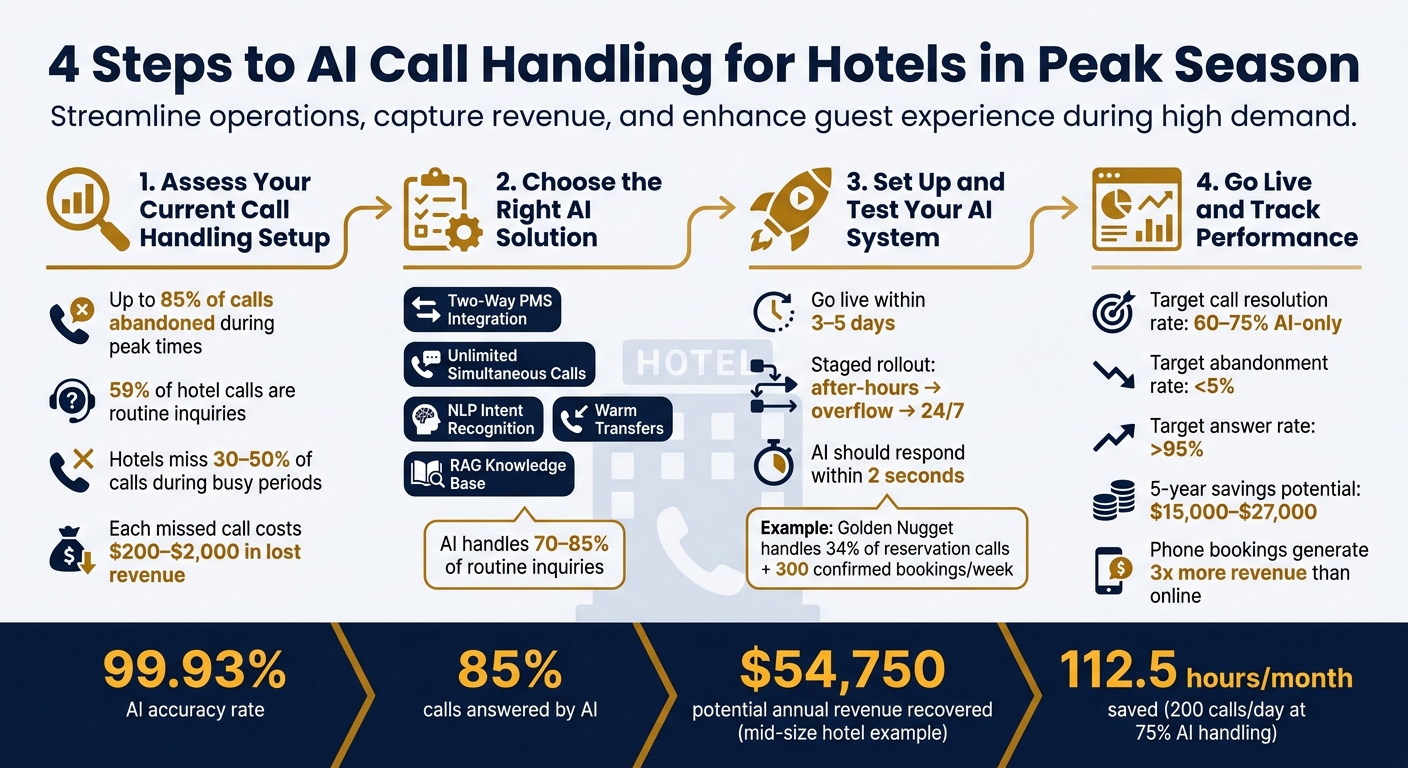
4-Step AI Call Handling Setup for Hotels During Peak Season
How AI Is Revolutionizing the Hotel Front Desk | with Anthony Melchiorri & Ryan Daniel
sbb-itb-abfc69c
Step 1: Assess Your Current Call Handling Setup
Before diving into solutions, it’s important to pinpoint where your current system isn’t meeting expectations. Many hotels discover deeper issues than anticipated once they dig into the data.
Review Your Call Log Data
Start by gathering call records from the past 30 days. Look for trends in call volume. Peak hour calls often fall between 8–11 AM, 12–2 PM, and 5–8 PM, but there may also be spikes tied to marketing campaigns, local events, or travel disruptions.
Next, categorize why people are calling. A study from a 5-star hotel chain revealed that 59% of calls were routine inquiries about services like hours or amenities, 16.6% were delivery requests, and 5.31% involved complaints needing human attention. This means around 77% of calls are repetitive and could be handled by automation.
"It's a remarkable number of people who call to confirm... Thousands of calls a day from people who just want to make sure their reservations are still there." - Josh Dow, VP of Hotel Technology Strategy & Services, Wyndham Hotels & Resorts
Also, track your answer rate (calls answered within three rings) and call abandonment rate (calls disconnected by guests before being answered). During busy periods, hotels can miss 30–50% of incoming calls. If your numbers fall in this range, you’re likely losing revenue.
By analyzing these patterns, you can calculate the financial toll of unanswered calls. Following a checklist for implementing AI phone answering can help streamline this transition.
Calculate the Cost of Missed Calls
Unanswered calls can translate into significant revenue loss. Use this formula to estimate the daily impact:
(Missed Calls per Day) × (50% average voice conversion rate) × (Your Average Daily Rate) = Daily Revenue Loss
For example, a mid-sized hotel missing 5 calls per day with an average daily rate of $150 could lose $54,750 annually. And the stakes are even higher when considering lifetime value - each missed call could cost between $200 and $2,000.
Don’t overlook after-hours calls either. Voice bookings still account for about 18% of all hotel reservations. If these calls go unanswered, potential guests may turn to online travel agencies (OTAs), which charge hefty commissions of 15–25%.
Metric to Track Why It Matters Target Benchmark Answer Rate Calls answered within 3 rings >95% Call Abandonment Rate Guests hanging up before staff answers <5% Routine Inquiry % Calls suitable for automation ~70–77% Missed Call Revenue Financial loss from unanswered calls $0
Armed with this data, you’ll be better prepared to choose an AI solution that aligns with your needs. A thorough assessment like this ensures you’re making informed decisions for improving call handling.
Step 2: Choose the Right AI Call Handling Solution
Once you've analyzed your peak season call metrics, the next step is to find an AI solution that aligns with your hotel's needs during high-demand periods.
What to Look for in an AI Provider
A key feature to prioritize is native two-way PMS integration. This ensures seamless communication with systems like Opera, Mews, or Cloudbeds, allowing real-time updates on availability and bookings. With this, you can avoid manual message handling and minimize errors like double-bookings.
Look for AI powered by Natural Language Processing (NLP). Unlike basic keyword matching, NLP can interpret complex guest requests, such as rescheduling or special accommodations. This capability is especially important when dealing with stressed or hurried guests.
The system should also handle unlimited simultaneous calls to prevent busy signals or dropped calls during peak times. Additionally, confirm it supports warm transfers, so if a call requires human intervention, your staff receives a detailed summary of the conversation rather than starting from scratch.
Feature Why It Matters for Peak Season Two-Way PMS Integration Avoids double-bookings and captures after-hours revenue seamlessly Unlimited Simultaneous Calls Prevents missed calls during high-volume surges NLP Intent Recognition Accurately manages nuanced guest requests Warm Transfers Provides staff with full context for smoother handoffs RAG Knowledge Base Instantly updates policies or schedules without retraining
These features are crucial for selecting a solution that can handle the demands of your busiest times.
Hotel-grade AI systems with full PMS integration typically range from a few hundred to several thousand dollars per month, depending on your call volume and property size. This cost is significantly lower than maintaining a staffed call center, especially when factoring in after-hours surcharges, which can add 35–50% to traditional call center expenses.
Why Answering Agent Stands Out
Answering Agent is a standout option for hotels seeking proven performance. With data from 17,724+ scored calls, it has achieved an impressive 99.93% accuracy rate and a minimal hallucination rate of just 0.07%. Such reliability is critical for handling guest inquiries about room rates, availability, or policies.
The platform can manage unlimited simultaneous calls with a natural, conversational tone. This means even during a holiday weekend surge, you won't miss a single call. Beyond answering calls, it can book appointments, capture leads, and operate 24/7, all at a fraction of the cost of a human receptionist. For hotels where labor accounts for up to 95% of contact center costs, this can significantly reduce expenses while maintaining service quality.
"Conversational AI makes agents more efficient and effective, while also improving the customer experience." - Daniel O'Connell, VP Analyst, Gartner
Step 3: Set Up and Test Your AI System
With your call log insights and cost analysis in hand, the next step is configuring your AI system for peak season. Aim to deploy your solution, including PMS integration, within 3–5 days. Avoid rushing this process to ensure a smooth setup.
Write Scripts for Peak Season Calls
Start by creating a knowledge base using call logs, FAQs, and front desk SOPs. Break down lengthy policies into simple Q&A pairs. Since 59% of hotel calls are service-related - covering topics like hours, amenities, and room types - prioritize scripting these common inquiries.
Write scripts in the language your guests use. For example, use "crib" instead of "baby cot" or "elevator" instead of "lift." Pre-load key details like holiday pricing, blackout dates, minimum stay rules, and any temporary facility changes. Always include validity dates for seasonal promotions so outdated rates aren’t quoted. Using a RAG (Retrieval-Augmented Generation) setup allows instant updates for things like pool hours or holiday menus without needing to retrain the AI model.
Define a tone guide for your AI - such as warm, concise, and confident - and specify phrases to avoid. This ensures the AI reflects your brand’s hospitality standards.
Once your scripts are ready, move to a staged pilot to test and refine the system.
Run a Pilot and Fix Issues
After finalizing your scripts, launch a pilot program to identify and address any system gaps. A staged rollout works best: begin with after-hours calls, then add overflow coverage during busy times, and eventually transition to full 24/7 availability. This gradual approach allows your team to catch and resolve issues before they impact high-value guests.
Simulate challenging scenarios like rate comparisons, group bookings, or multi-language inquiries to stress-test the system. Review 20–50 escalated calls weekly to spot missing FAQs or unclear responses. During the pilot, monitor response times - your AI should reply within 2 seconds - and ensure warm transfers include a complete summary of the conversation. For instance, the Golden Nugget introduced an AI reservation assistant that now handles 34% of reservation calls and completes over 300 confirmed bookings weekly. These results stemmed from thorough pre-launch testing, not a rushed implementation.
"The technology does not replace hospitality - it protects the space where hospitality actually happens." - Divyang Mandani, CEO, OnDial
Double-check your warm transfer logic to ensure that escalated calls are handed off with a full summary. This prevents guests from having to repeat themselves and maintains the consistent guest experience you’ve worked to build.
Step 4: Go Live and Track Performance
After a successful pilot, it’s time to fully launch and keep a close eye on how the system performs. Aim to go live 2–4 weeks before your peak season. This extra time allows you to iron out any remaining issues, update your knowledge base, and ensure the system is running smoothly before handling a surge in volume.
Monitor Calls and Make Adjustments
Once the system is live, use your dashboard for real-time AI call monitoring to track performance metrics. Pay attention to key indicators like call resolution rates (targeting 60–75% AI-only), abandonment rates, and wait times. A noticeable drop in abandonment rates is often one of the first signs that the system is doing its job effectively.
Set up a weekly review process to stay on top of performance. Review 20–50 escalated call transcripts every week to identify missteps, such as false recognitions or gaps in the knowledge base. Equip your front desk staff with a simple way to flag incorrect AI responses - this allows for quick corrections. This continuous feedback loop ensures the system stays accurate and reliable throughout the season.
Additionally, double-check that your PMS integration is functioning properly. It’s crucial that bookings are recorded in real time to avoid issues like double-bookings or incorrect rates. These ongoing tweaks not only improve the system but also provide valuable data for analyzing your return on investment.
"Many organizations are challenged by agent staff shortages and the need to curtail labor expenses, which can represent up to 95% of contact center costs. Conversational AI makes agents more efficient and effective, while also improving the customer experience." - Daniel O'Connell, VP Analyst, Gartner
Measure Cost Savings and Revenue Gains
With improved call handling evident on your dashboard, it’s time to measure the financial impact. Start by calculating the time saved. Multiply the number of AI-handled calls by the average human handle time (approximately 90 seconds per call). For example, if your hotel manages 200 calls daily and AI handles 75% of them, you’re saving about 112.5 hours per month.
On the revenue side, focus on metrics like your booking conversion rate and average booking value. Phone bookings often generate up to three times more revenue than online bookings due to upselling opportunities. Even a small increase in your answer rate can lead to significant gains.
Once the peak season ends, conduct a thorough review. Compare metrics like answer rates, missed calls, booking volumes, and labor costs from before and after implementing AI. This analysis will help fine-tune your strategy for the next busy period.
Conclusion: Getting More from Your Hotel's Phone System with AI
By taking these four steps - evaluating your AI call routing system, selecting the right AI tool, running a pilot program, and actively monitoring once live - hotels can turn peak season hurdles into opportunities to improve efficiency and boost revenue. This approach ensures high call volumes are managed smoothly, staff burnout is minimized, and no potential bookings are lost to a busy signal.
The numbers speak for themselves. AI-powered systems help recover lost revenue, capture after-hours inquiries, and improve guest data collection. These insights provide actionable ways to enhance operations during every busy season.
If you're ready to address these challenges, consider Answering Agent, a solution built to handle peak season demands. With 99.93% accuracy across 17,724+ scored calls, unlimited simultaneous call handling, and 24/7 availability - all at a fraction of the cost of a human receptionist - it’s a dependable option for hotels year-round. Over five years, switching to AI could save your property between $15,000 and $27,000 compared to traditional call center services.
Every AI-managed call generates valuable insights, helping you fine-tune operations even further.
FAQs
Will AI sound natural to guests on the phone?
AI technology is capable of using a human-like voice to handle calls, making interactions feel natural for guests. It can accurately interpret their requests, ensuring clear communication. This is especially helpful during busy times, as it allows for smooth and efficient service, improving the overall guest experience.
Can AI take reservations and update my PMS in real time?
Absolutely. AI-powered booking systems are designed to take care of the entire reservation process while syncing directly with your Property Management System (PMS). These systems handle tasks like managing bookings, updating availability, and processing changes in real time.
This kind of automation ensures that reservations are processed quickly and accurately, even during the busiest times of the year. By integrating seamlessly with hotel systems, AI reduces manual work and minimizes errors, making it easier to keep everything running smoothly.
How do I keep the AI accurate during peak-season policy changes?
To ensure your AI performs well during busy periods, it's crucial to keep it aligned with the latest information. Regularly update the system with current policies, scripts, and FAQs so it stays relevant. Alongside this, provide fresh training data and closely monitor interactions to catch and fix any errors that might arise.
Clear communication about updates is key. Make sure everyone involved understands the changes, and maintain consistent oversight to guarantee that responses remain accurate and helpful for guests during peak times.
Related Blog Posts
Book a walkthrough
See it handle your calls.
Book 20 minutes, or hear a sample call first.
Ready to see it handle your calls?
Book a walkthrough, or hear a short sample call first.
Related Articles

How to Handle Car Wash Membership Transfer Calls
Handle car wash membership transfer calls. Fork five paths before promising yes, then follow wash transfer rules.

How to Handle Lost or Stolen Car Wash Membership Tag Calls
Handle lost or stolen car wash membership tag calls. Check five tag paths before promising a free replacement, then follow wash rules.
How to Handle Pickleball After-Hours and Door Access Calls
Handle pickleball after-hours door access calls by forking member fob, guest, hours, and booking asks before you promise entry.