
Missed calls can derail your customer experience (CX) strategy, costing you sales, trust, and revenue. Here’s why it matters:
- 62% of calls to small businesses go unanswered during business hours.
- 85% of callers won’t try again if their call isn’t answered.
- Customers hang up after just 4 rings, and 67% will call a competitor immediately.
Phone calls often represent a customer’s highest intent to act, making missed calls a critical weak spot in multichannel systems. They disrupt customer journeys, waste marketing efforts, and create frustration when customers have to repeat themselves across channels.
AI answering services, like Answering Agent, solve this by providing 24/7 call handling, syncing customer data across platforms, and ensuring no call is missed. Businesses using these tools reduce missed-call rates, recover lost revenue, and improve customer retention without adding staff. (See our answering service FAQ for more details.)
The bottom line: Fixing missed calls isn’t just about better service - it’s about protecting your bottom line and keeping customers loyal.
Missed Calls: Breaking Channel Continuity
How Missed Calls Create Gaps in Customer Journeys
Customers don’t think about your business in terms of channels. For them, it’s all one continuous conversation - whether it begins on your website, shifts to an email, or ends with a phone call. Unfortunately, many businesses rely on disconnected tools, teams, and systems for each channel. When a call goes unanswered, the gap in that conversation becomes glaringly obvious, disrupting the seamless experience customers expect from a multichannel approach.
"Customers don't see channels - they see a conversation with your company. But your systems see five separate interactions with no shared context." - Ming Xu, Chief Information Officer, Trillet
When a call is missed, customers often pivot to other channels like text or email. But here’s the problem: disjointed systems mean customers have to repeat their story, frustrating 77% of them. Agents, meanwhile, lose access to critical context, creating a breakdown in continuity. This is where AI answering services, like Answering Agent, can make a difference. By integrating phone interactions with other communication channels, these tools eliminate the gaps that cost businesses time, trust, and revenue.
In industries that move quickly, like home services, the stakes are even higher. A missed call can lead to a customer dialing a competitor within just 60 seconds. And here’s the kicker: the business that answers first wins the job about 78% of the time. That small window can mean the difference between securing a customer or losing them altogether.
Immediate Effects on Customer Experience
Missed calls don’t just disrupt the customer journey - they also leave a lasting impression. And not in a good way.
The fallout goes beyond losing a single sale. A missed call often forces customers to wait, repeat themselves on another platform, or give up entirely. Consider this: 67% of callers who hit a voicemail or busy signal will hang up and call a competitor instead. Even worse, 86% of callers sent to voicemail don’t bother leaving a message. That’s a lot of lost opportunities slipping through the cracks.
Timing is everything. Customers who successfully reach a business on their first try are 28% more likely to become loyal to that brand. On the flip side, a single missed call can jeopardize not just one transaction but the potential for a long-term relationship. As Stephanie, Marketing Director at Talkroute, puts it:
"To the customer, a callback 48 hours later feels the same as no callback at all." - Stephanie, Marketing Director, Talkroute
The numbers don’t lie: every second of delay in answering reduces conversion chances by 15%. And with customers hanging up after an average of just four rings, most businesses don’t even realize they’ve missed the boat until it’s too late. By then, the customer has already moved on to someone else.
sbb-itb-abfc69c
Missed Calls Costing You Business? Here’s the Solution | AI Answers Instantly
The Business Cost of Missed Calls
Missed calls aren't just an inconvenience - they can lead to serious financial setbacks for businesses.
Lost Revenue from High-Intent Leads
Missed calls directly translate to lost money. For example, a service-based business handling 30 calls weekly, with an average transaction value of $500, could lose $156,000 annually if they miss 62% of those calls. This isn't just a customer service issue; it's a major revenue drain.
"A 22% missed-call rate in a business where the average call is worth $200 to $400 is a revenue line item, not a customer service problem." - Omri Matityahu
The customers behind these missed calls are often ready to buy. Live answers convert at a rate of 30–40%, but if you wait until the next day to return the call, conversion rates plummet to just 1–4%. The opportunity to close the deal is fleeting - mere minutes can make all the difference.
Higher Costs for Acquisition and Recovery
Every missed call wastes money already spent on marketing efforts like ads, local SEO, or referral programs. This inefficiency disrupts the entire customer acquisition process.
"If you're paying for leads through advertising, SEO, or referral programs, every missed call is money you spent to generate an opportunity that you then failed to capture." - Doug Moser
On top of that, trying to recover from missed calls adds another layer of expense. Businesses often spend $18–$25 per hour on managerial time to review and return voicemails. This not only eats into operational focus but also rarely yields results, as most follow-up efforts fail to reconnect with potential customers.
How Missed Calls Erode Customer Trust
The damage doesn't stop at lost revenue. Missed calls also chip away at customer trust, creating a perception of unreliability.
"Customers associate responsiveness with reliability. When a call isn't answered, customers assume the business doesn't value their time or that getting help will be difficult." - Frontdesk Team
Statistics show that 33% of customers will abandon a brand after just one missed call. After two poor experiences, that number jumps to 92%, with customers switching to competitors. Additionally, 23% of consumers who encounter a voicemail or long wait leave negative reviews. Each of these reviews can deter around 30 future customers.
The real kicker? Most businesses don't even realize the full extent of the trust erosion. Dissatisfied customers rarely voice their frustrations - they simply move on to someone else, leaving a silent but costly impact.
Why Multichannel Systems Fall Short on Phone Calls
Outdated multichannel systems often fail to include phone calls effectively, leading to revenue loss and diminished trust. Businesses today rely on a variety of communication channels like email, chat, social media, and SMS. Yet, phone calls remain a glaring weak spot. The issue isn’t that companies neglect phone calls; it’s that their systems aren’t designed to integrate them seamlessly with other channels.
Siloed Tools and Disconnected Workflows
Sales teams typically juggle about 10 separate tools - from dialers to CRMs to SMS platforms - that don’t communicate with each other. For instance, when a customer makes a call after clicking on an ad or submitting a web form, agents often have no visibility into the customer’s prior actions. This forces customers to repeat their information, a common frustration. In fact, a significant number of customers have to restate their details across platforms. Companies with siloed systems retain only 33% of their customers, compared to 89% for those using fully integrated setups.
"A multichannel approach, where channels operate in disconnected silos, is no longer sufficient." - Aloware
This lack of integration doesn’t just frustrate customers; it also hurts productivity. Switching between unconnected tools can cost businesses as much as $500,000 annually. Phone calls, in particular, often highlight these inefficiencies.
Phone Calls as the Least Integrated Channel
Among the various channels in a multichannel system, phone calls are almost always the least integrated. While chat logs and email threads are often synced to CRMs, phone calls frequently remain isolated in separate systems, creating significant blind spots in the customer journey. This is a major issue because 80% of business communications still happen over the phone.
"Context is the missing infrastructure in most contact centers... unless the systems that captured those steps speak to each other in real-time, the agent sees none of it." - Afiniti
Without integration, phone calls rely heavily on manual handling, which introduces its own set of challenges.
The Limits of Manual Call Coverage
Even with a receptionist or dedicated call handler, manual systems have clear limits. A human can only manage one call at a time, and during lunch breaks, shift changes, or unexpected surges in call volume, calls often go unanswered. In fact, 60% of calls to small and medium-sized businesses are missed. This is a serious problem: 85% of callers who don’t get an answer won’t call back, and 67% will immediately look for a competitor.
Take, for example, a suburban medical practice with three receptionists. During peak hours, they still missed 30% of incoming calls, losing nearly 50 potential patients each month. This added up to over $94,000 in annual revenue loss. And since 22% to 28% of calls happen outside regular business hours, simply hiring more staff doesn’t solve the issue.
These challenges underline the need for scalable solutions that can integrate phone calls into the broader communication system, ensuring no opportunity is lost by comparing missed calls vs. 24/7 answering to see the revenue impact.
How AI Answering Services Fix Missed-Call Problems
Unanswered calls, disconnected tools, and the limitations of manual call handling often leave businesses struggling to keep up with customer expectations. These gaps can lead to missed opportunities and frustrated customers. AI answering services step in to fill this void, ensuring every call is handled efficiently and seamlessly integrated into your customer experience.
24/7 Call Handling and Lead Capture
AI-powered systems operate nonstop, ensuring no call goes unanswered - whether it’s during lunch breaks, after business hours, or during unexpected call spikes. Here’s a striking statistic: 42% of high-intent calls happen after 6 PM, and many businesses face about 59 "dead hours" of inactivity every week.
These systems are not only available around the clock but are also incredibly efficient. While manual call handling can take 10–15 minutes per appointment, automated solutions complete the same task in just about 3 minutes. They also keep hold times under 60 seconds, a significant improvement compared to the industry average of up to 11 minutes in some sectors. By covering these unattended periods, businesses have seen their missed-call rates drop from 19% to as low as 4% within just 90 days.
"After-hours is where the credit-card-in-hand customer lives. If you're not answering those calls, you're paying to acquire leads and then refusing to take them." - ClearCall AI Benchmarks Report
What’s more, these systems don’t just answer calls; they actively integrate with other tools to enhance the customer journey.
Connecting Phone Calls to Other Channels
AI answering services go beyond simply picking up the phone. They integrate seamlessly with your CRM, calendar, and follow-up workflows. Every call is automatically logged, with transcripts and lead details synced to major platforms in real time. This automation enables immediate actions, such as sending appointment confirmations, intake forms, or relevant links via SMS or email.
When a call requires escalation to a human agent, the system provides a detailed transcript and summary, ensuring smooth handoffs without manual effort. This level of integration creates a unified and consistent customer experience, saving time and reducing errors.
Why Answering Agent Stands Out
Answering Agent is specifically designed for service-oriented businesses like home services, medical practices, law firms, staffing agencies, and even car washes. Its performance speaks for itself: 99.93% accuracy across 17,724+ scored calls, with a hallucination rate of just 0.07%. Out of 20,375 offers pitched by the AI, 6,820 were accepted.
Unlike a human receptionist who can only handle one call at a time, Answering Agent manages unlimited simultaneous calls. This eliminates delays, missed opportunities, and long hold times. It efficiently books appointments, captures leads, and maintains a natural conversational tone, all at a fraction of the cost of hiring a full-time receptionist. By ensuring every call is handled consistently, Answering Agent strengthens the overall customer experience across multiple channels. For businesses that rely heavily on phone interactions to drive revenue, this combination of accuracy, availability, and scalability is a game-changer.
What Scalable Multichannel CX Requires
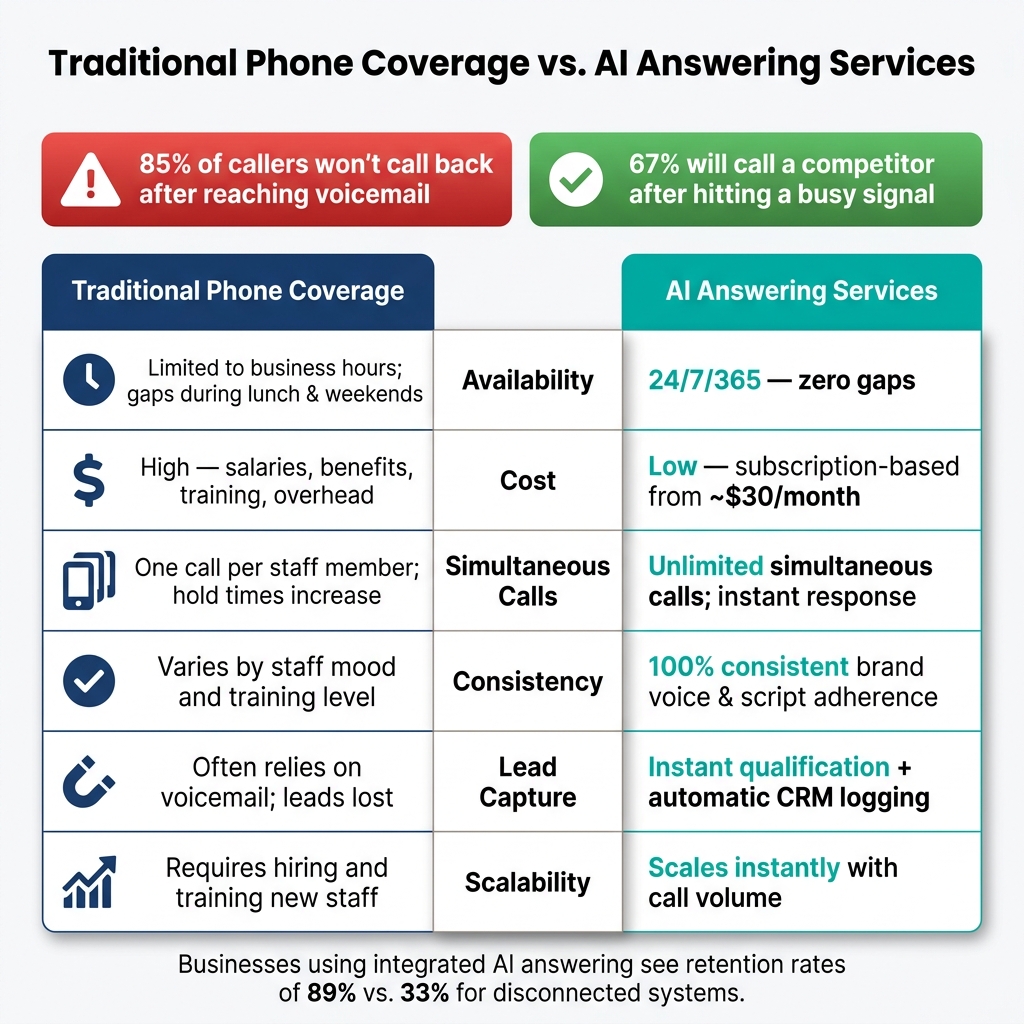
Traditional Phone Coverage vs. AI Answering Services: Key Differences
After resolving missed-call problems, building a scalable multichannel customer experience hinges on maintaining consistent and efficient processes.
Consistency Across All Channels
Offering multiple channels isn’t enough - they need to work in harmony. Customers expect a smooth transition between channels without having to repeat themselves. For instance, if a customer calls after sending an email, they anticipate that the agent or system already knows their context. Without integrated data, this expectation goes unmet.
Key elements include quick response times, accessible customer history, and AI call routing. Speed is especially critical: 77% of customers expect an immediate response when they call, and 60% consider waiting more than a minute unacceptable. Intelligent routing, which directs calls based on customer intent or history, reduces unnecessary transfers and frustration. Additionally, syncing conversation data across voice, SMS, and email ensures customers won’t need to start over.
"77% of customers say having to repeat themselves when dealing with multiple touchpoints is their biggest frustration." - Ming Xu, CIO, Trillet
Businesses that implement strong omnichannel strategies see retention rates soar to 89%, compared to just 33% for those using disconnected channels.
Scaling Without Adding Headcount
Maintaining consistency at scale requires more than good intentions; it demands a scalable staffing model that doesn’t inflate costs. Traditionally, growth means more customers, which leads to more calls - and the typical solution is hiring more staff. But simply increasing headcount often amplifies inefficiencies instead of addressing underlying system issues.
AI answering services solve this problem by managing unlimited simultaneous calls without adding personnel. Many successful companies already route about 60% of FAQ inquiries to AI agents, freeing up staff to focus on complex tasks. This approach not only absorbs call surges during peak times, like seasonal spikes or after marketing campaigns, but also cuts service costs by 20–30% while boosting revenue by 5–8%.
This efficiency highlights the stark differences between traditional phone coverage and AI-powered solutions.
Traditional Phone Coverage vs. AI Answering: A Side-by-Side Look
Addressing missed-call issues and inefficiencies requires a clear comparison of traditional phone systems and AI-driven answering services.
Feature Traditional Phone Coverage AI Answering Service Availability Limited to business hours; gaps during lunch and weekends 24/7/365, no gaps Cost High - salaries, benefits, training, overhead Low - subscription-based, starting at ~$30/month Number of Calls Handled Simultaneously One call per staff member, leading to hold times Unlimited simultaneous calls; instant response Consistency Dependent on staff mood and training 100% consistent brand voice and script adherence Lead Capture Often reliant on voicemail Instant qualification and automatic CRM logging Scalability Requires hiring and training new staff Scales instantly with call volume
The impact of these differences is clear: 85% of callers won’t call back after reaching voicemail, and 67% will immediately look for a competitor after hitting a busy signal. Traditional systems simply can’t close these gaps without significant costs, but AI answering services can.
For businesses aiming to deliver a scalable, seamless multichannel customer experience, AI solutions like Answering Agent provide a reliable option. They offer 24/7 availability, intelligent call handling, and smooth integration - all without the need for additional staff.
Conclusion: Fixing Missed Calls to Strengthen Multichannel CX
Missed calls are a glaring issue in any multichannel strategy. When a customer transitions from browsing your website to making a call, that moment represents their highest level of intent. Missing that call doesn’t just cost a sale - it wastes every dollar spent guiding them to that point. The numbers speak for themselves: 85% of callers won’t try again, and 67% will contact a competitor immediately.
The root of the problem lies in how phone calls are often treated as a standalone channel, disconnected from the rest of the customer journey. Without tools like CRM integration, real-time availability, and consistent call handling, the phone line becomes a weak link - even if other channels are performing well. To fix this, businesses must ensure their phone systems are seamlessly integrated with other customer touchpoints.
For service-based businesses, every call carries weight. They need solutions that offer 24/7 live coverage, handle unlimited simultaneous calls, and sync conversation data across channels to preserve context. Whether it’s a home services provider, a medical office, or a law firm, ensuring customers connect with a live response on their first attempt is crucial. Customers who get through on the first try are 28% more likely to stay loyal to the brand. This is where tools like Answering Agent come into play.
Answering Agent is built to close this gap. With 99.93% accuracy across 17,724+ scored calls and 6,820 offers accepted out of 20,375 pitched, it delivers results that directly improve customer retention and revenue recovery - all at a reasonable cost. For businesses looking to bridge the divide between their digital platforms and phone lines, reliability like this isn’t optional; it’s essential to remain competitive.
"Every missed call is a conversation that never happened, and for most local businesses, a phone call is the highest-intent lead you can possibly receive." - CallSphere Team, CallSphere.ai
FAQs
How many missed calls is too many?
Missing over 30% of calls is usually a red flag. It can result in lost revenue and frustrated customers. Research indicates that businesses tend to miss between 40% and 62% of inbound calls, making it clear how crucial it is to tackle this problem to keep customers happy and hold onto valuable leads.
What should an AI answering service do beyond taking messages?
An AI answering service can step in to ensure missed calls don’t turn into missed opportunities. With features like lead qualification, appointment scheduling, and real-time routing, it works around the clock to engage with callers. By maintaining a natural and professional tone, the service can capture leads, book appointments, and handle FAQs effortlessly. This not only eliminates missed calls but also improves customer satisfaction while supporting a smooth, multichannel communication experience.
How does call data sync with my CRM and other channels?
AI-powered answering services, such as Answering Agent, seamlessly connect call data with CRMs and other platforms. This integration ensures that every interaction is logged and accessible instantly. By doing so, businesses can effortlessly capture leads, schedule appointments, and update records without the risk of manual errors.
This synchronization also plays a key role in analytics, allowing companies to track crucial call details like duration and outcomes. The result? Improved follow-ups and a more unified customer experience across multiple channels.
Related Blog Posts
Book a walkthrough
See it handle your calls.
Book 20 minutes, or hear a sample call first.
Ready to see it handle your calls?
Book a walkthrough, or hear a short sample call first.
Related Articles

How to Handle Car Wash Membership Reactivation Calls
Handle car wash membership reactivation calls. Fork five paths before promising the old rate, then follow wash rejoin rules.

How to Handle Car Wash Membership Transfer Calls
Handle car wash membership transfer calls. Fork five paths before promising yes, then follow wash transfer rules.
How to Handle Lost or Stolen Car Wash Membership Tag Calls
Handle lost or stolen car wash membership tag calls. Check five tag paths before promising a free replacement, then follow wash rules.