
Missed calls cost small businesses an average of Missed calls cost small businesses an average of $126,000 annually.26,000 annually. With only 37.8% of incoming calls answered, the opportunity loss is staggering. AI call analytics offers a solution by turning call data into actionable insights that help businesses optimize staffing, reduce labor costs, and improve customer satisfaction.
Key Takeaways:
- AI Forecasting: Predicts call volume based on historical data, holidays, and even weather patterns, reducing staffing costs by up to 30%.
- Cost Efficiency: AI reception services start at $30/month, compared to $3,750–$4,000/month for a human receptionist.
- 24/7 Coverage: AI handles unlimited simultaneous calls, ensuring no lead is lost during peak hours or off-hours.
- Improved Metrics: Businesses using AI report up to a 20% boost in customer satisfaction and a 68% reduction in cost per customer interaction.
AI call systems like Answering Agent provide real-time insights into peak call times, staffing gaps, and customer sentiment, allowing businesses to adjust their workforce with precision. This approach ensures fewer missed calls, better resource allocation, and higher revenue retention.
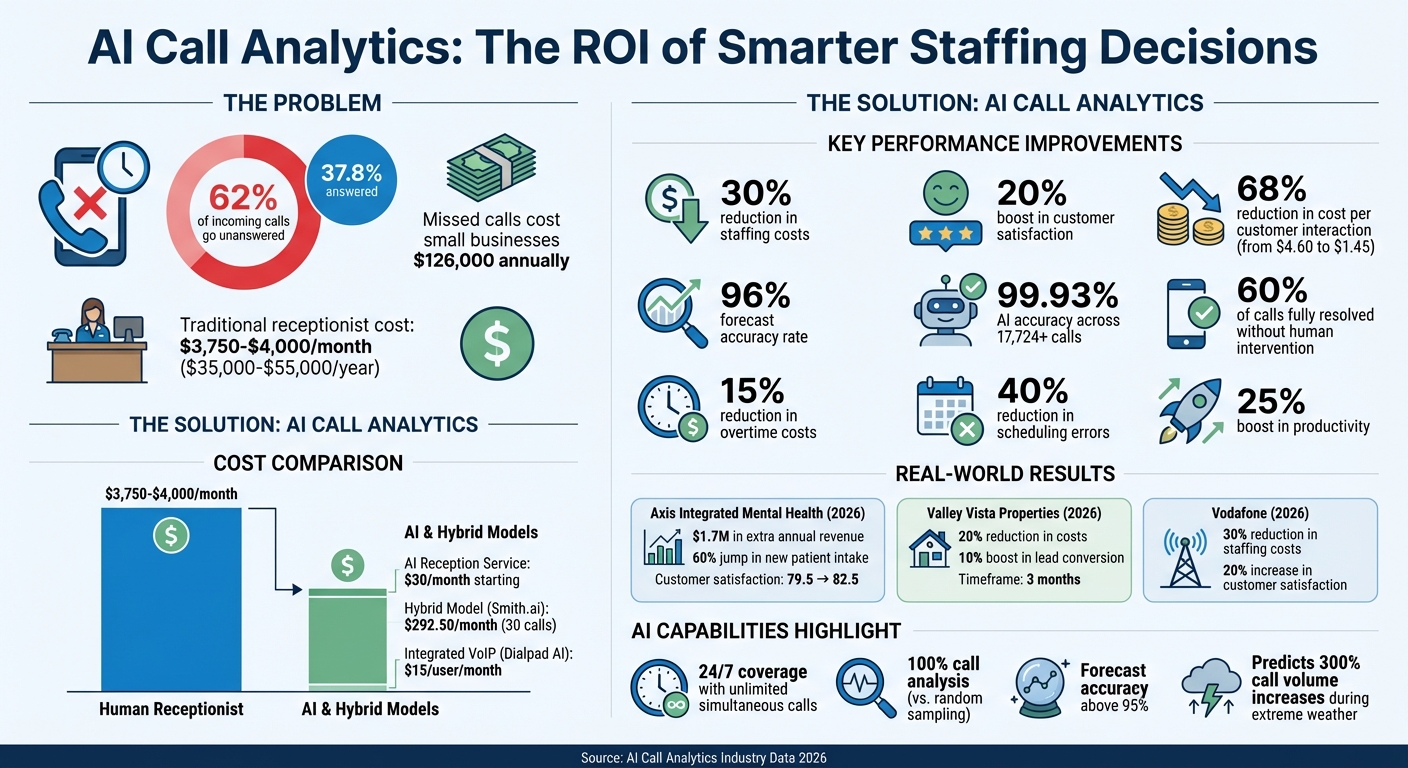
AI Call Analytics ROI: Cost Savings and Performance Metrics for Small Businesses
Setting Up AI Call Tracking and Identifying Key Metrics
Choosing the Right AI Call Analytics Tools
Start by defining your objectives. Are you looking to analyze peak-hour trends, monitor compliance, or assess agent performance? Having clear goals from the outset helps you avoid getting overwhelmed by unnecessary data and keeps your implementation focused.
Next, ensure your system can record high-quality audio and provide essential metadata like timestamps and agent IDs. These features are critical for accurate transcription, and modern AI speech-to-text tools can reach over 90% accuracy with clear recordings. However, poor audio quality can derail even the most advanced analytics systems, so this step is essential for reliable results.
When selecting tools, businesses generally have three main options:
- Pure AI receptionists: Tools like Answering Agent, which start at around $30/month, are ideal for handling routine calls. They can handle high-volume calls with real-time speech recognition, making them great for businesses with significant traffic or 24/7 needs without overnight staffing costs.
- Hybrid models: Services like Smith.ai (approximately $292.50/month for 30 calls) combine AI with human agents to handle more complex interactions, offering a balance between automation and human support.
- Integrated VoIP systems: Platforms like Dialpad AI (about $15/user/month) enhance existing phone systems with analytics, making them a practical choice for businesses already using VoIP.
Whichever tool you choose, integration with your CRM (like HubSpot or Salesforce) is crucial. This ensures that call data automatically links to customer records and triggers follow-up tasks, creating a centralized system for managing staffing and customer interactions. With these integrations in place, you can shift your focus to tracking the metrics that matter most.
Key Metrics to Monitor
Once your AI call analytics system is up and running, monitoring the right metrics is key to optimizing staffing and improving operations. Start with call volume heat maps, which show when your phones are busiest. These insights help you allocate staff effectively, reducing coverage during slow periods and ensuring adequate support during peak hours.
Another critical metric is Average Handle Time (AHT), which measures the time spent on each call. Understanding AHT allows you to estimate how many agents are needed to manage specific call volumes without creating bottlenecks.
First Contact Resolution (FCR) is another important metric, as it tracks whether issues are resolved in a single interaction. A higher FCR means fewer follow-up calls, reducing the overall workload on your team. Additionally, monitor Average Speed of Answer (ASA) and abandonment rates. If callers frequently hang up before their call is answered, it’s a clear sign of understaffing that needs immediate attention.
For businesses using AI systems, escalation rates are crucial. This metric shows how often the AI transfers calls to human agents, helping you determine the number of staff required for handling complex issues.
Some advanced platforms even track sentiment trajectories, which analyze customer emotions during calls. For instance, long wait times or inadequate staffing can lead to frustration, and tracking these trends helps you address issues before they escalate. Set up dashboards to flag these key metrics on a weekly basis so you can adjust staffing as needed.
sbb-itb-abfc69c
Analyzing Call Data Patterns to Forecast Staffing Demand
Identifying Peak Hours and Trends
Historical call data holds the key to predicting staffing needs. By leveraging advanced AI systems, businesses can achieve forecast accuracy rates above 95%. A standout example comes from Arpit Agarwal, Senior Director of Data Analytics at Zinnia, who implemented a hybrid AI model combining Prophet and XGBoost. This model analyzed two years of historical data, excluding U.S. holidays and weekends, to forecast staffing demand for 2025. The result? A 96% accuracy rate, cutting forecast deviations from 10–20% down to less than 5% for major clients. These insights specifically target staffing needs based on call volume patterns.
To ensure predictions stay reliable, it’s crucial to remove outliers like system outages or one-off events. AI can then dive deeper, examining AI analytics for call data alongside external factors such as weather forecasts, marketing campaigns, and social media sentiment to anticipate spikes. For example, service industries like HVAC and plumbing now use AI to correlate multi-day weather forecasts with historical data, predicting 300% increases in call volume during extreme weather events like heat waves or cold snaps.
"The company that had 15 technicians available on Monday needs 45 by Wednesday... The revenue walks out the door not because the demand did not exist but because the organization could not respond fast enough." - Domo
Advanced AI systems even send "demand surge" alerts to managers days in advance, giving businesses time to arrange overtime or bring in contract workers before the rush begins. To measure the effectiveness of these forecasts, businesses use volume-weighted Mean Absolute Percentage Error (MAPE), ensuring the model focuses on high-impact peak hours rather than less critical low-volume times. With these precise forecasts, AI's ability to handle unlimited simultaneous calls becomes an invaluable tool for fine-tuning your staffing strategy.
Using Simultaneous Call Handling
AI phone systems have revolutionized how businesses handle call volume, offering the ability to manage unlimited simultaneous calls. Traditional call centers often struggle with fixed labor capacity, leading to delays when demand exceeds available agents. This forces businesses to overstaff for peak times, just to avoid losing potential leads to abandoned calls.
Platforms like Answering Agent eliminate this bottleneck entirely. With 99.93% accuracy across 17,724+ scored calls, this AI-powered system handles overflow calls seamlessly, ensuring no lead is lost during unexpected surges. A major telecommunications company using this technology reported a 20% boost in customer satisfaction by drastically reducing wait times. During peak periods, the AI managed routine inquiries, freeing up human agents to focus on more complex customer issues.
This strategy is particularly effective for service-based businesses that face unpredictable call surges. Instead of maintaining a large standby team "just in case", companies can operate with leaner staffing models, confident that AI will handle overflow calls efficiently. This not only prevents lost leads but also keeps customers happy by avoiding frustrating wait times.
Simple Intelligence the AI-Powered Call Analytics Platform
Optimizing Schedules and Reducing Labor Costs
By analyzing call data, AI can fine-tune daily schedules and ensure continuous coverage, ultimately cutting labor costs while improving service quality.
Adjusting Shifts Based on Call Patterns
Once peak call trends are identified, AI transforms that data into actionable shift adjustments. Using historical call metrics like duration, frequency, and timing, AI creates detailed demand curves - broken down into 15-minute, hourly, or daily intervals. This approach takes the guesswork out of planning. Instead of assuming "Thursdays are busy", AI shows that next Thursday might be 40% busier than usual, allowing you to adjust the schedule before it's even finalized.
AI also handles complex variables like employee availability, qualifications, labor budgets, overtime limits, and compliance with labor laws. What might take a manager hours to plan is completed in moments, with real-time projections of labor costs. If the schedule exceeds budget constraints, adjustments can be made instantly.
For example, Valley Vista Properties saw a 20% reduction in costs and a 10% boost in lead conversion within just three months in 2026 by using AI to manage routine inquiries during slow periods. This allowed them to minimize staffing levels without sacrificing service quality.
According to Gartner, automated workforce scheduling reduces errors by 40% and boosts productivity by 25%. Self-service AI portals also let employees swap shifts or request time off, cutting administrative tasks and improving job satisfaction. By eliminating overstaffing by 30% and understaffing by 25%, AI scheduling directly impacts profitability.
These enhancements in scheduling naturally extend to maintaining high service standards around the clock.
Using AI for 24/7 Coverage
While optimized scheduling ensures efficiency during regular hours, AI extends its benefits to after-hours operations. Traditionally, covering nights, weekends, or holidays has been expensive, either requiring additional staff or paying overtime. Missing calls during these periods, however, can mean lost revenue. AI eliminates this dilemma.
Take Answering Agent, for instance. Their AI system manages unlimited calls 24/7, without needing human staff during off-hours. This ensures businesses capture potential leads that might otherwise be missed.
In 2026, Axis Integrated Mental Health implemented an AI receptionist system, generating $1.7 million in extra annual revenue. They saw a 60% jump in new patient intake and an improvement in customer satisfaction scores from 79.5 to 82.5. The AI handled routine tasks like appointment bookings and FAQs during off-hours, freeing human staff to focus on more complex patient needs during the day.
A hybrid approach works best: AI manages straightforward, predictable calls, while more complex or emotionally charged inquiries are escalated to human staff. For example, Iron Workers International used AI to handle member inquiries, with 60% of calls fully resolved without human involvement. This allowed their team to operate with fewer staff while maintaining service quality.
Tracking Labor Cost Savings
To measure the financial benefits of AI scheduling, track key metrics before and after implementation. Start by comparing the fully loaded cost of a human receptionist - approximately $3,750–$4,000 per month (including salary, benefits, and overhead) - against AI answering service costs.
Monitor overtime reductions, as AI ensures staffing aligns with real-time demand. AI scheduling can cut overtime costs by 15%. Use dashboards to categorize call outcomes (e.g., resolved, escalated, or lead captured) to identify where human labor is being saved. For instance, AI reduced cost per interaction by 68%, dropping from $4.60 to $1.45.
In 2026, Televero Health maintained a 97% customer satisfaction score after deploying an AI receptionist system. This proves that cost savings can coexist with high service quality. Tracking the percentage of calls handled entirely by AI can reveal reductions in required headcount. AI-powered call automation can lower operational costs by up to 60% and reduce manpower needs by 90%.
"Most small business owners don't realize they're losing six figures a year to missed calls until they actually run the numbers. At that point, the ROI case for AI reception isn't a debate - it's arithmetic." - Sarah Chen, Director of SMB Research, Resonateapp.com
To quantify recovered revenue, track calls answered by AI during off-hours or peak periods that would have otherwise gone unanswered. Weekly AI-generated call logs can also help identify new automation opportunities and refine scheduling strategies. Additionally, automated workforce scheduling improves employee retention by 20%, cutting down on recruitment and training expenses.
Implementing Staffing Changes and Monitoring Results
Once AI identifies staffing gaps and inefficiencies, the next step is turning those insights into action. Instead of overhauling everything at once, it’s smarter to implement changes gradually and monitor their effects over time.
Applying Data-Backed Staffing Adjustments
Start by testing AI-driven staffing changes during specific time frames before rolling them out across the entire organization. For example, if AI data shows that Tuesday afternoons are consistently slow, you could reduce staffing by one or two agents during that period. Then, monitor whether service quality remains consistent. This testing phase ensures smoother integration without unnecessary disruptions.
Before making changes, collaborate with your technical teams to address any AI integration or infrastructure challenges. This step avoids introducing entirely new systems and allows AI insights to work seamlessly with existing CRM platforms and employee coaching workflows.
A real-world example? Vodafone introduced an AI bot called "Zoey" in 2026 to predict call center volumes. Zoey helped forecast peak hours, enabling more efficient staff scheduling. The results were impressive: a 30% reduction in staffing costs and a 20% boost in customer satisfaction.
Additionally, configure AI to handle routine inquiries while automatically escalating complex or emotionally charged calls to human agents. This ensures that customers with sensitive concerns still receive a personal touch while maintaining operational efficiency.
Monitoring and Refining Workforce Strategies
After implementing staffing adjustments, continuous monitoring is key to ensuring these changes deliver the desired outcomes. Unlike traditional quality assurance methods that rely on random sampling, AI analytics can process 100% of calls, eliminating sampling bias and uncovering systemic issues. Live dashboards allow you to track metrics like agent performance, talk-to-listen ratios, response times, and hold durations in real time, rather than waiting for periodic reviews.
To maintain AI accuracy, compare sentiment scores and intent classifications generated by AI with human assessments. Regular calibration is essential as customer language and business needs evolve. Keep an eye on how often AI escalates calls to humans - frequent handoffs for certain intents may signal the need for better AI training or more specialized human agents.
Reviewing call logs weekly can highlight areas where AI performs well and where additional staffing or training adjustments might be needed. For instance, one online retailer saw a 25% drop in operational costs and a 15% increase in customer satisfaction by optimizing staff allocation through AI insights. Establish baseline metrics such as first-call resolution (FCR), wait times, and labor costs before implementing AI-driven changes. This way, you’ll have a clear benchmark to measure progress.
"AI call analytics processes every call automatically, applying consistent analysis criteria across the entire conversation volume without sampling limitations."
- Maddy Martin, SVP of Growth, Smith.ai
Set up sentiment or keyword triggers - like “cancel” or “frustrated” - to alert supervisors for immediate intervention during live calls. While AI can flag anomalies, it’s crucial to maintain human oversight for high-stakes issues like compliance violations or performance reviews. This human-in-the-loop approach ensures AI supports your team without replacing critical decision-making.
Why Answering Agent is the Best Solution for Staffing Insights
When it comes to data-driven staffing, precision is everything. Answering Agent provides a powerful platform that enhances workforce planning with accurate, real-time call analytics. By offering detailed insights, it empowers businesses to make informed staffing decisions that align with actual needs.
Precision and Scalable Features
Answering Agent boasts an impressive 99.93% accuracy rate across over 17,724 scored conversations. This level of precision is essential because even minor transcription errors can compromise critical staffing data. As Maddy Martin, SVP of Growth at Smith.ai, puts it:
"Transcription quality directly affects all downstream analysis. Misrecognized words create errors in sentiment scoring, keyword detection, and intent classification".
The platform analyzes 100% of your call volume automatically, shedding light on peak call times, caller intent, and sentiment trends - all vital for effective staffing adjustments. Whether you’re handling 5 or 50 calls simultaneously, Answering Agent ensures seamless operation with no hold music or missed calls, even during your busiest hours.
Its intuitive dashboard delivers real-time data, including talk-to-listen ratios, response times, and hold durations. These insights help businesses identify staffing gaps instantly. Considering that small businesses typically miss 62% of incoming calls due to inadequate coverage, this level of scalability offers a significant edge.
In addition to its analytical power, Answering Agent provides a cost-effective alternative to traditional staffing solutions.
Affordable AI for Service Businesses
Hiring a full-time receptionist can cost between $35,000 and $55,000 annually - before factoring in benefits. In contrast, Answering Agent offers 24/7 availability at a fraction of the cost, delivering consistent service without the challenges of sick days, vacations, or overtime.
This makes it an ideal solution for industries like home services, medical practices, law firms, staffing agencies, and even car washes. By combining cost savings with actionable insights, Answering Agent helps businesses shift from reactive scheduling to proactive, data-informed planning. It’s a smart way to scale operations efficiently while maintaining the high-quality service that customers expect.
Conclusion
AI call analytics has transformed workforce planning from educated guesses to precise, data-driven decisions. By evaluating 100% of your call volume, you gain critical insights into peak demand times and busy periods. This approach eliminates the costly pitfalls of overstaffing during slow times and understaffing when call volume surges.
The results speak for themselves: businesses using AI forecasting have reported a 30% reduction in staffing costs while also improving customer satisfaction by 20%.
Getting started is simple. Integrate AI call tools with your existing CRM and calendar systems to streamline scheduling and qualify leads automatically. Keep an eye on essential metrics - like first-call resolution rates, average handle times, and sentiment trends - to spot training needs and fine-tune your operations. With AI managing up to 82% of routine inquiries automatically, your team can dedicate their time to solving more complex, high-value customer issues.
For example, Answering Agent takes this concept further by offering 99.93% accuracy, unlimited simultaneous call handling, and 24/7 availability - all at a fraction of the cost of traditional receptionists. This reliability is a game-changer for service businesses, where 62% of incoming calls risk being missed due to insufficient coverage. The result? Increased revenue and stronger customer loyalty.
Incorporating AI into call center operations is no longer just an option - it’s a necessity to remain competitive. Businesses that embrace these tools today are setting themselves up to scale efficiently, cut labor costs, and consistently deliver better customer experiences, all without the added expense of growing their workforce.
FAQs
What call metrics should I track to decide how many staff I need?
To figure out staffing requirements, keep an eye on important metrics like call volume, average call duration, call outcomes (such as successful hires or conversions), and call quality scores. These details provide the data needed to fine-tune schedules and manage labor costs more efficiently.
How do I forecast call volume for holidays or sudden demand spikes?
AI-driven tools for call volume forecasting take historical call data and use it to predict demand trends, helping businesses prepare staffing levels for busy periods. By leveraging machine learning and predictive analytics, these tools deliver precise estimates. For example, platforms like Answering Agent offer real-time monitoring and seasonal insights. This allows businesses to fine-tune staffing strategies during high-demand times, like the holiday season, ensuring they avoid overstaffing or being caught unprepared.
How can I measure the ROI of adding an AI call answering system?
To figure out ROI, weigh the total benefits - such as higher revenue, lower labor expenses, and better efficiency - against the system's overall costs. The formula is straightforward: (Total Benefits – Total Costs) / Total Costs × 100.
Key metrics to focus on include:
- Answered calls: How many calls are successfully handled.
- Missed calls prevented: Calls that would have been missed without the system.
- Recovered revenue: Income gained from addressing previously missed opportunities.
- Customer satisfaction: Improvements in client experience.
By analyzing call data - like call volume and conversion rates - you can track performance changes before and after the system is in place, giving you clear, measurable results.
Related Blog Posts
Book a walkthrough
See it handle your calls.
Book 20 minutes, or hear a sample call first.
Ready to see it handle your calls?
Book a walkthrough, or hear a short sample call first.
Related Articles

How to Handle Car Wash Membership Reactivation Calls
Handle car wash membership reactivation calls. Fork five paths before promising the old rate, then follow wash rejoin rules.

How to Handle Car Wash Membership Transfer Calls
Handle car wash membership transfer calls. Fork five paths before promising yes, then follow wash transfer rules.

How to Handle Lost or Stolen Car Wash Membership Tag Calls
Handle lost or stolen car wash membership tag calls. Check five tag paths before promising a free replacement, then follow wash rules.