
Looking for the best AI receptionist for your law firm in 2026? Here’s the bottom line:
- Ruby: Human receptionists supported by AI. Great for personal touch but expensive with unpredictable costs due to per-minute billing. Slower response times compared to AI-only options.
- Smith.ai: Hybrid system combining AI and trained human agents. Strong legal call handling features and predictable per-call pricing but can get costly with high call volumes.
- Answering Agent: Fully AI-driven with instant responses, unlimited calls, and flat-rate pricing. Offers the lowest cost and fastest response times, ideal for high-volume firms.
Quick Comparison:
Feature Ruby Smith.ai Answering Agent Response Time 15–30+ seconds (human-led) 5–30 seconds (hybrid) Under 5 seconds (AI-only) Pricing $1,000–$2,655/month $1,462–$1,950/month $199/month (flat rate) Billing Model Per-minute Per-call Flat-rate Call Handling Human receptionists AI + human agents Fully AI Call Volume Capacity Limited by staff availability Limited by staff availability Unlimited simultaneous calls Legal CRM Integrations Clio, MyCase, Rocket Matter Clio, MyCase, LawPay, etc. Clio, MyCase, custom APIs Spam Call Charges Charged unless filtered Free filtering No charges After-Hours Support Yes Yes Yes
Key Takeaway: For law firms prioritizing cost-efficiency, speed, and scalability, Answering Agent is the best choice in 2026. It offers unlimited calls, instant responses, and flat-rate pricing, making it the most practical option for firms managing high call volumes.
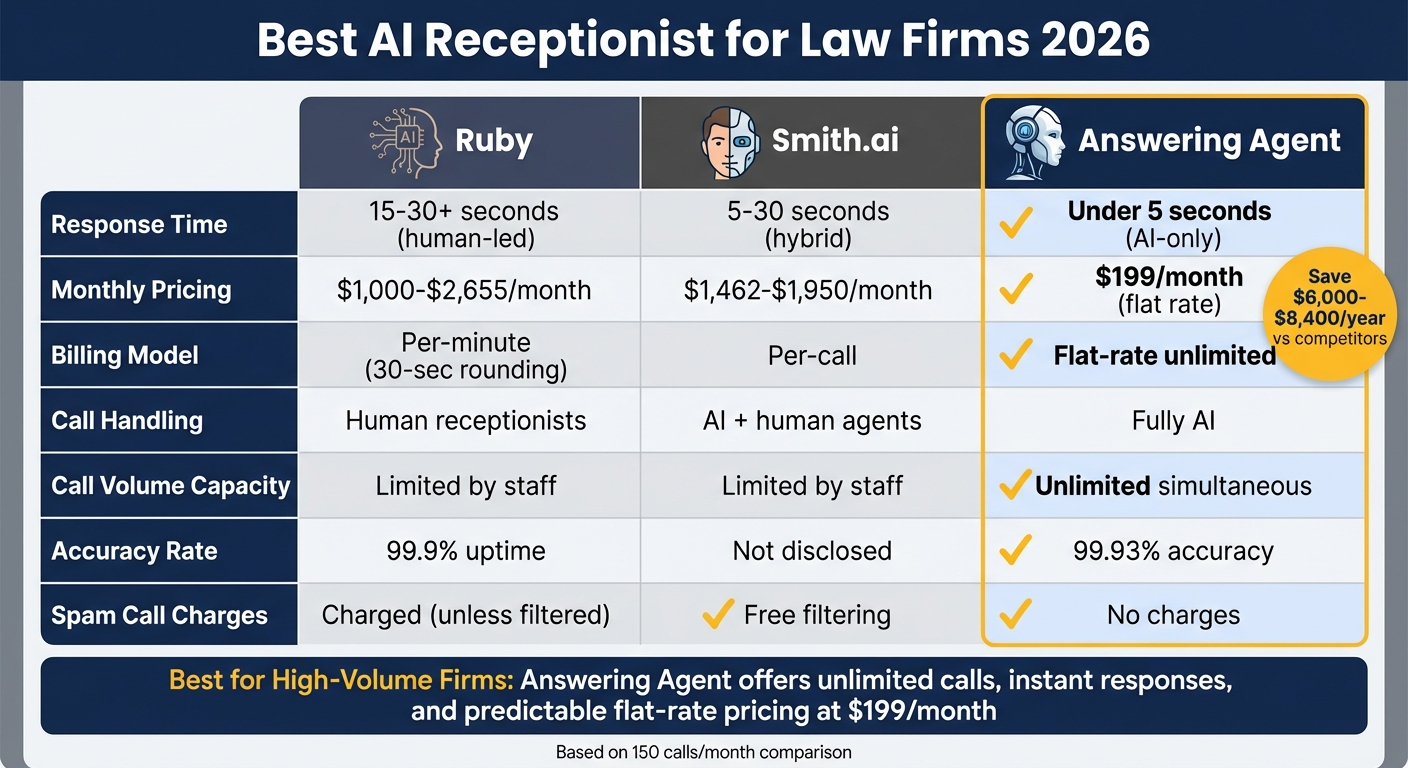
AI Receptionist Comparison for Law Firms 2026: Ruby vs Smith.ai vs Answering Agent
AI Answering Service for Lawyers (Full Setup + Sample Call)
sbb-itb-abfc69c
Ruby Receptionists for Law Firms
Ruby ensures that every call is answered by a US-based, human receptionist. While AI tools provide real-time support through instructions and FAQs, the actual handling of calls is always done by a person. This "human-in-the-loop" approach means AI works behind the scenes, but your clients will never interact directly with it.
Handling an impressive 1.1 million conversations monthly and capturing 1.6 million leads annually, Ruby serves law firms with features like custom call scripts, conflict checks, and legal intake forms to help pre-qualify leads. It also integrates seamlessly with popular practice management systems such as Clio, MyCase, and Rocket Matter, enabling real-time consultation booking. These integrations are a game-changer for improving communication and streamlining workflows in legal practices.
Ruby Features for Law Firms
Ruby offers 24/7/365 live answering with bilingual support included, ensuring no client call goes unanswered. Features like warm transfers to attorneys, outbound appointment confirmations, and unified business texting via a mobile app make it easy to stay connected. Ruby also ensures HIPAA compliance with signed BAAs and allows attorneys to update their call routing status directly through the app. These tailored features are designed to meet the specific needs of law firms.
Ruby Pros and Cons
Ruby’s cheerful and professional tone - referred to as the "Ruby Tone" - is ideal for handling sensitive legal calls. This is particularly important, as 80% of callers hang up if their call isn’t answered immediately. Additionally, Ruby’s Expand plan, priced at approximately $8,640 annually, offers considerable savings compared to the $61,500 yearly cost of hiring a full-time receptionist.
However, Ruby’s per-minute pricing model, with 30-second rounding, can lead to unpredictable monthly bills for firms with high call volumes. Spam and sales calls are also charged unless you opt into a robocall filtering feature. During peak times, such as Monday mornings, response times can stretch from 15 to over 30 seconds, which is slower than the sub-5-second response times of AI-only systems. Another limitation is that Ruby’s receptionists, who serve multiple industries, may not have the deep legal expertise that specialized AI solutions can provide.
Ruby Strengths Ruby Limitations 100% US-based human agents with a personal touch Premium per-minute pricing ($3.39–$4.90/min) HIPAA compliance with signed BAA agreements 30-second billing increments can increase costs Integrates with Clio, MyCase, and Rocket Matter Charges for spam calls unless filtering is enabled Bilingual support included at no extra charge Slower response times (15–30+ seconds) compared to AI Outbound calling and warm transfers available Less suited for high-volume practices
Smith.ai for Law Firms
Smith.ai takes inspiration from Ruby's approach but adds its own twist with a hybrid system that combines AI efficiency with human expertise. This setup is particularly useful for legal practices, where AI handles routine tasks while trained North American receptionists step in for more complex calls. These receptionists are well-versed in legal terminology, case types, and the urgency tied to statutes of limitations. For straightforward queries, AI provides quick responses, while sensitive cases - like family law or criminal defense - are routed to human agents who can offer the empathy and judgment required.
Smith.ai operates 24/7 and supports both English and Spanish, serving over 5,000 businesses. The AI receptionist tier is impressively fast, answering calls in under 5 seconds. For more nuanced needs, the hybrid service ensures human intervention when necessary. This quick response time is vital, considering that 40% of callers hang up if they wait longer than 30 seconds. This blend of technology and human touch makes Smith.ai a standout option for legal call handling.
Smith.ai Features for Legal Practices
Smith.ai integrates seamlessly with major legal CRMs like Clio, MyCase, PracticePanther, Lawmatics, and Filevine - far surpassing Ruby's three-platform integration limit. Beyond that, it connects with over 7,000 apps through Zapier and Make, ensuring smooth data flow across your firm's tools. Receptionists can even perform preliminary conflict checks during intake to confirm client eligibility.
But Smith.ai doesn't stop at answering calls. It can collect consultation fees or retainers upfront via integrations with payment processors like LawPay. The platform also handles appointment scheduling through tools like Calendly, books court appearances, and sends automated follow-ups via SMS or email after each call. These features are especially important since 73% of calls to law firms occur outside standard business hours.
Smith.ai Pros and Cons
Now, let’s weigh the benefits and drawbacks of Smith.ai for legal practices.
Smith.ai uses a per-call pricing model instead of per-minute billing, which can be more predictable for firms with longer average call durations. Since legal calls typically last around 6 minutes, this pricing approach often proves more cost-effective. Plans start at $95/month for 50 AI-only calls or $300/month for 30 hybrid calls, with overage rates ranging from $8.50 to $11.50 per call. Spam and sales calls are filtered out for free, so they don’t eat into your quota.
On the downside, high call volumes can make the per-call pricing model expensive due to overage fees. The hybrid service also requires a 2–4 week onboarding process to develop custom scripts and train agents on your firm’s workflows. Despite these challenges, Smith.ai has earned glowing reviews - 4.8/5 stars on Trustpilot and 4.9/5 stars on Capterra. However, firms with heavy call traffic might feel financial pressure during busier periods.
Smith.ai Strengths Smith.ai Limitations Combines AI efficiency with human expertise for complex calls Per-call overages ($8.50–$11.50) can add up at high volumes Offers native integrations with Clio, MyCase, and more Onboarding for hybrid service takes 2–4 weeks Predictable per-call pricing, ideal for longer calls Response times may stretch to 15–30 seconds during peak hours Includes payment collection and conflict checks Less cost-effective compared to flat-rate AI-only services Free spam filtering and bilingual support Human involvement can sometimes introduce variability
Answering Agent for Law Firms
Answering Agent offers a fully AI-driven solution with no human handoffs, delivering responses in under five seconds, handling unlimited simultaneous calls, and featuring flat-rate pricing. For law firms managing after-hours inquiries or sudden spikes in call volume, this system removes the capacity limits that come with human-based services.
In tests involving 17,724 calls, Answering Agent achieved an impressive 99.93% accuracy rate, with a minimal error rate of just 0.07%. This level of precision is crucial in legal intake, where even minor errors in capturing case details can result in missed opportunities or revenue loss.
Answering Agent Features for Law Firms
Answering Agent is designed to seamlessly integrate with top legal CRMs, ensuring real-time syncing of client information and scheduling of consultations. The AI system is trained specifically for the legal field, understanding terminology, various practice areas, and intake procedures. It even handles tasks like conflict pre-screening and statute of limitations checks. Scripts can be customized to suit different practice areas, so an intake for personal injury cases feels distinct from family law inquiries.
The system operates around the clock without additional fees. Considering that 42% of legal inquiries occur outside standard hours and 62% of calls often go unanswered (with 85% of those callers not leaving messages), Answering Agent captures these leads by scheduling consultations or escalating urgent cases based on your firm's specific guidelines.
These capabilities ensure consistent accuracy and scalability for firms of any size.
Call Accuracy and Scalability Data
The performance data speaks for itself. Across 17,724 calls, Answering Agent made 20,375 proactive offers, securing 6,820 acceptances - a 33.4% conversion rate on those offers. Unlike human or hybrid systems, Answering Agent can handle unlimited calls simultaneously without compromising quality. Whether your firm gets 50 calls in an hour due to a marketing campaign or faces an unexpected surge, every call is answered immediately - no hold music, no voicemail delays.
Answering Agent Advantages for Legal Practices
Pricing starts at $199/month for small firms and scales up to $1,500/month for larger operations. Every plan includes unlimited calls, with no per-minute charges, overage fees, or hidden costs. For full 24/7 coverage, traditional answering services typically cost between $12,000 and $24,000 per year. In contrast, Answering Agent costs between $4,788 and $8,388 annually, potentially saving firms up to $15,600.
Beyond cost savings, Answering Agent adheres to legal standards for client confidentiality by offering encrypted transcripts and secure CRM data transfers. In a 90-day case study, a family law firm using Answering Agent instead of voicemail experienced remarkable results: after-hours lead capture jumped from 35% to 95%, consultation scheduling increased from 22% to 58%, and monthly new clients grew from 8 to 19. All of this came at a monthly cost of $399, delivering a 36% higher conversion rate at 39% less cost compared to traditional human-based services.
Feature Comparison: Ruby vs Smith.ai vs Answering Agent
When comparing AI receptionist platforms, their underlying setups and capabilities reveal how they handle tasks and calls differently. Ruby uses a human-in-the-loop system, where live agents receive real-time guidance from AI prompts to assist callers effectively. Smith.ai takes a hybrid route, with AI handling routine tasks like intake and qualification before passing complex or sensitive legal issues to legally trained, North American agents. On the other hand, Answering Agent relies entirely on conversational AI, with no human involvement, responding to calls in under five seconds and managing unlimited simultaneous interactions.
Call Volume Management
Call handling varies significantly across these platforms. Ruby’s human-focused model can lead to hold times during busy periods. Smith.ai’s AI-first system, however, streamlines the process by managing multiple calls simultaneously before escalating to live agents when necessary. Meanwhile, Answering Agent completely avoids delays by answering all calls instantly, with no hold music or voicemail interruptions.
Legal CRM Integrations
All three platforms offer seamless connections with legal practice management tools. Ruby integrates directly with systems like Clio, Rocket Matter, and MyCase. Smith.ai supports similar legal-specific integrations. Answering Agent also connects with platforms like Clio and MyCase, going a step further by logging call transcripts and creating contact profiles automatically in real time.
Security and Confidentiality
Client confidentiality is a top priority for these services. Ruby ensures compliance with HIPAA regulations and signs Business Associate Agreements to safeguard sensitive information. Smith.ai and Answering Agent both use encryption and secure data transfer practices to maintain attorney-client privilege.
Appointment Scheduling
The way these platforms handle appointment scheduling highlights their differences. Ruby offers a personalized, human-led scheduling experience. Smith.ai combines AI-assisted booking with human support as needed. Answering Agent takes a fully automated approach, booking consultations in real time and eliminating the back-and-forth of phone tag. This ability to respond immediately is critical, as 79% of inquiries are converted through prompt replies.
Pricing Comparison: Ruby vs Smith.ai vs Answering Agent
After examining features, pricing stands out as a critical factor for law firms deciding on an AI receptionist service.
The pricing models for Ruby, Smith.ai, and Answering Agent differ significantly, potentially impacting annual costs by thousands of dollars. Ruby's plans range from $245 to $319 per month, using a per-minute billing system that rounds calls to the nearest 30 seconds. For example, a 65-second call is billed as 1.5 minutes, increasing costs by 15–30%. Their high-volume plan costs $1,695 per month for 500 minutes, with overage fees between $3.95 and $5.40 per minute.
Smith.ai adopts a per-call pricing structure, starting at $292.50 per month for 30 calls. Its Pro plan, priced at $975 monthly for 100 calls, charges $9.75 for each additional call. While this model provides predictable costs for longer calls, high call volumes can quickly escalate monthly expenses, impacting ROI. For instance, a firm handling 200 calls per month could face charges of about $1,950.
Answering Agent, on the other hand, offers a flat-rate plan at $199 per month, covering unlimited calls with no overage fees or charges for spam calls.
For a firm receiving 150 calls each month, estimated costs would be around $1,000 to $1,500 for Ruby, $1,462.50 for Smith.ai, and a consistent $199 with Answering Agent. At 200 calls per month, Ruby’s costs could rise to approximately $2,655, Smith.ai to $1,950, while Answering Agent remains steady at $199.
Provider 150 Calls/Month 200 Calls/Month Billing Model Overage Cost Ruby $1,000–$1,500+ ~$2,655 Per-minute $3.95–$5.40/min Smith.ai $1,462.50 $1,950 Per-call $9.75/call Answering Agent $199 $199 Flat-rate $0
These figures emphasize how call volume significantly affects costs for Ruby and Smith.ai, while Answering Agent maintains affordability. Additionally, Ruby charges for spam calls, unlike the other two providers. For firms managing over 100 calls per month, transitioning to a flat-rate model like Answering Agent could result in annual savings of $4,800 to $9,300 compared to per-minute services.
Call Accuracy and Performance Data
When it comes to client calls, accuracy and response speed can make or break the first impression. Potential clients won’t hesitate to hang up and try a competitor if they experience delays or errors.
Answering Agent stands out by processing 17,724 scored calls with an impressive 99.93% accuracy rate (just a 0.07% error rate) and delivering responses in under 5 seconds. This ensures callers experience instant connections without hold music or delays. On the other hand, Ruby achieves a 99.9% uptime through redundant systems but relies on a human-driven approach, which can lead to varying response times, especially during busy periods like Monday mornings. Smith.ai uses a hybrid model, blending AI screening with North America–based agents. However, response times can stretch to 15–30+ seconds during high-traffic periods. For legal practices, these differences highlight the importance of seamless and immediate call handling.
Even short delays can hurt conversion rates. Calls delayed by more than 30 seconds see a 40% hang-up rate, with each additional second costing 1–2% in conversions. This is especially concerning for law firms, where around 6.2% of calls involve emergencies. A delayed response in such cases could mean losing a client in urgent need.
The gap becomes even more apparent during simultaneous calls. Answering Agent can handle unlimited concurrent calls without compromising quality, while services like Ruby and Smith.ai are limited by the number of available staff [7,8]. This is especially critical after hours, as 73% of client calls happen outside the standard 9-to-5 window. Unlike human-based systems that may struggle with staffing, AI-driven systems maintain consistent performance regardless of call volume [7,8].
Consider this: the average legal intake call lasts 6 minutes, but a single interruption can disrupt an attorney's focus for an average of 23 minutes. By ensuring every call is handled instantly and accurately, firms not only improve client satisfaction but also protect attorney productivity. These numbers make it clear - consistent, immediate call handling is essential for capturing every potential client and maximizing revenue opportunities.
CRM Integrations and Legal Compliance
Streamlined integrations and adherence to legal compliance are key to running a law firm efficiently. A well-integrated CRM system ensures smooth lead capture and accurate client record updates. Smith.ai supports native integrations with legal CRMs like Clio, MyCase, PracticePanther, and LawPay, as well as broader platforms like Salesforce and HubSpot, offering real-time data synchronization. Ruby, on the other hand, also integrates natively with major legal CRMs but is limited to three platforms, which might necessitate manual workarounds for firms using other systems. Answering Agent provides universal HTTP webhooks, allowing firms to tailor data flows to their specific needs.
The speed and ease of integration vary significantly across these services. Ruby can go live within 24–48 hours using pre-configured templates, while Smith.ai requires 2–4 weeks for agent training. Answering Agent stands out with a setup time of just 15–30 minutes. Additionally, when it comes to making changes, Ruby and Smith.ai typically depend on support tickets, whereas Answering Agent provides a self-service dashboard for instant integration updates.
Legal compliance and data logging are equally critical for law firms. Smith.ai offers optional HIPAA compliance, which is essential for handling sensitive health information. Ruby and Answering Agent, however, do not provide HIPAA compliance options. Smith.ai also excels in automatically syncing call data, while Answering Agent logs detailed transcripts and recordings, creating a robust audit trail. Ruby’s logging capabilities are more limited and may require manual intervention. For firms that deal with protected health information, ensuring the provider signs a Business Associate Agreement (BAA) is non-negotiable.
Ultimately, your choice will depend on your firm's CRM setup. Practices heavily reliant on Clio or MyCase will benefit from Smith.ai's seamless native integrations. Those using custom or general CRMs like Salesforce or HubSpot might prefer the flexibility of Answering Agent’s webhooks. Meanwhile, Ruby is best suited for firms sticking to its supported platforms and prioritizing human-driven call handling.
"Every time a potential client calls your firm and encounters a voicemail... you are actively leaking potential billable hours and lifetime client value (CLV) to your competitors." - Raghav Arora, Authencio
ROI and Law Firm Case Studies
Looking at the numbers, the return on investment (ROI) for law firms using AI receptionists is hard to ignore. Let’s dive into some real-world examples that highlight how these tools can transform operations and boost revenue.
Take Martinez & Associates, a three-attorney personal injury firm in Chicago. Before switching to Answering Agent, they were missing 51 calls per week - a 43% miss rate. After adopting the AI receptionist, they achieved 100% call coverage. The results? An additional 47 consultations booked each month, leading to 28 new cases. With an average case value of $35,000, this translated to a jaw-dropping $11,760,000 in annual revenue growth.
Another success story comes from Thompson & Partners, a five-attorney estate planning firm in Austin, TX. By implementing Answering Agent, they freed up their administrative staff to focus on billable tasks. This shift resulted in 340 extra billable hours every month. At a billing rate of $150 per hour, the firm saw an additional $51,000 in monthly revenue - or $612,000 annually.
Anderson Family Law in Seattle also saw impressive results. Over 90 days, their AI receptionist captured 76 after-hours calls, converting 31 of them into signed retainer agreements. With an average retainer value of $5,000, this amounted to $155,000 in new revenue in just three months.
"We've signed almost $12 million in cases that we would have lost to faster-answering competitors."
– Managing Partner, Martinez & Associates
Even firms using traditional services have noted improvements after switching to AI-driven solutions. For example, Buchanan Law Firm in Albuquerque adopted Smith.ai in February 2021 to handle sensitive personal injury and employment law intake. By integrating it with Lawmatics, attorney Deena Buchanan secured 24/7 coverage, allowing her legal team to focus on billable work. While specific revenue figures weren’t disclosed, the operational benefits were clear. Similarly, Tyra Law Firm in Rockville, MD replaced their in-house receptionist with Ruby Receptionists, saving approximately $55,860 annually.
The cost savings with AI solutions are even more striking over time. A small firm managing 150 calls per month would spend around $18,000 annually with Ruby, $17,550 with Smith.ai, but only $2,388 with a flat-rate AI service. Over five years, this adds up to over $75,000 in savings. In another comparison, a family law firm using an AI receptionist captured 95% of after-hours leads in 90 days, compared to just 78% with a traditional service. This improvement increased their monthly client acquisitions from 14 to 19 while reducing costs from $650 to $399 - resulting in 36% more clients at 39% lower costs.
These examples make one thing clear: Answering Agent doesn’t just improve call accuracy and response times - it drives real revenue growth and operational efficiency for law firms.
Why Answering Agent Is the Best Choice for Law Firms in 2026
Answering Agent stands out in speed, accuracy, and cost-effectiveness, boasting an impressive 99.93% accuracy rate and answering calls in just 0.6 seconds. To put it into perspective, this is up to three times faster than the typical 15–30-second delays seen with traditional services. Such efficiency not only improves client satisfaction but also translates into considerable savings.
For example, at 150 calls per month, Answering Agent costs just $199 compared to the $700–$900 charged by competitors. As noted in the NextPhone Comparison Guide:
"At 150 calls/month, you're paying $700-900/month vs $199 unlimited AI. That's $6,000-8,400/year extra for 'premium' service that's indistinguishable from AI."
Answering Agent isn't just about speed and affordability - it’s built with features tailored specifically for law firms. The platform handles unlimited simultaneous calls, eliminating busy signals or hold times. This is especially crucial considering 42% of legal leads come in after hours, and 67% of callers won’t leave a voicemail. Additionally, Answering Agent offers legal-specific tools like real-time conflict checks and specialized call handling, including jail call acceptance - capabilities that competitors like Ruby and Smith.ai don’t provide.
The flat-rate pricing model ensures predictable costs, avoiding overage fees during call spikes. With true 24/7 support, Answering Agent also includes multilingual capabilities in over 20 languages at no extra charge. In contrast, competitors often tack on $6–$8 per call for bilingual support. This combination allows law firms to capture every potential lead while keeping costs under control.
When comparing performance and pricing, it's clear that Answering Agent outshines its competitors. For law firms looking to boost revenue and efficiency, Answering Agent delivers the best mix of advanced technology, reliability, and value in 2026.
FAQs
How does an AI receptionist protect attorney-client confidentiality?
AI receptionists play a crucial role in protecting attorney-client confidentiality by securely managing call data and adhering to strict legal privacy standards. They work seamlessly with practice management and CRM systems, which come equipped with robust security measures like encryption and restricted access. Features such as call screening, transcription, and secure data transfers are specifically designed to block unauthorized access, ensuring sensitive information stays protected while meeting industry standards for data security.
What call volume makes flat-rate unlimited pricing worth it?
For law firms managing over 100 calls each month, flat-rate unlimited pricing for AI receptionists can be a game-changer. Services offering unlimited calls at a fixed rate - such as $199 per month - often prove more affordable than per-call or per-minute billing models.
High-volume practices, in particular, stand to gain the most. They can avoid unexpected overage fees and enjoy consistent, predictable monthly expenses. This is especially appealing when compared to traditional live receptionist services, which can cost more than $235 per month. For firms with heavy call traffic, this approach delivers a much better return on investment.
Can an AI receptionist schedule consultations and sync with my legal CRM automatically?
Modern AI receptionists for law firms can handle tasks like scheduling consultations and syncing seamlessly with legal CRMs such as Clio and MyCase. These tools are built to manage appointments, update client details automatically, and ensure smooth communication. They also maintain the professionalism and context required in legal settings, helping firms save time and stay organized.
Related Blog Posts
Book a walkthrough
See it handle your calls.
Book 20 minutes, or hear a sample call first.
Ready to see it handle your calls?
Book a walkthrough, or hear a short sample call first.
Related Articles

Car Wash Membership Phone Calls: A Desk Guide
A desk guide to the membership phone calls car washes take, with links to the deep how-tos.

How to Handle Pickleball Guest Fee Calls
Handle pickleball guest fee calls by identifying the visit type, quoting the written fee sheet, and confirming payment, court access, and check-in requirements.

How to Handle Car Wash Membership Pause Calls
Handle car wash membership pause calls with written hold rules, clear dates, billing and plate status, and a reopen note the next shift can use.