
Field service dispatch is complex and often inefficient. Manual scheduling struggles to keep up with real-world disruptions like traffic, technician availability, or job complexities. The result? Missed appointments, wasted resources, and customer dissatisfaction.
AI solves these issues by automating scheduling, optimizing routes, and adapting to changes in seconds. Key benefits include:
- Reduced Drive Time: AI cuts technician travel time by 25–35%.
- Increased Productivity: Teams complete 15–20% more jobs daily without extra staff.
- Higher On-Time Rates: Arrival rates improve to 96% or more.
- Less Dispatcher Workload: Routine rescheduling work drops by 60–70%.
AI uses real-time data, predictive analytics, and skill-based matching to optimize dispatching. This ensures the right technician, with the right skills, arrives on time - saving time, cutting costs, and improving customer satisfaction.
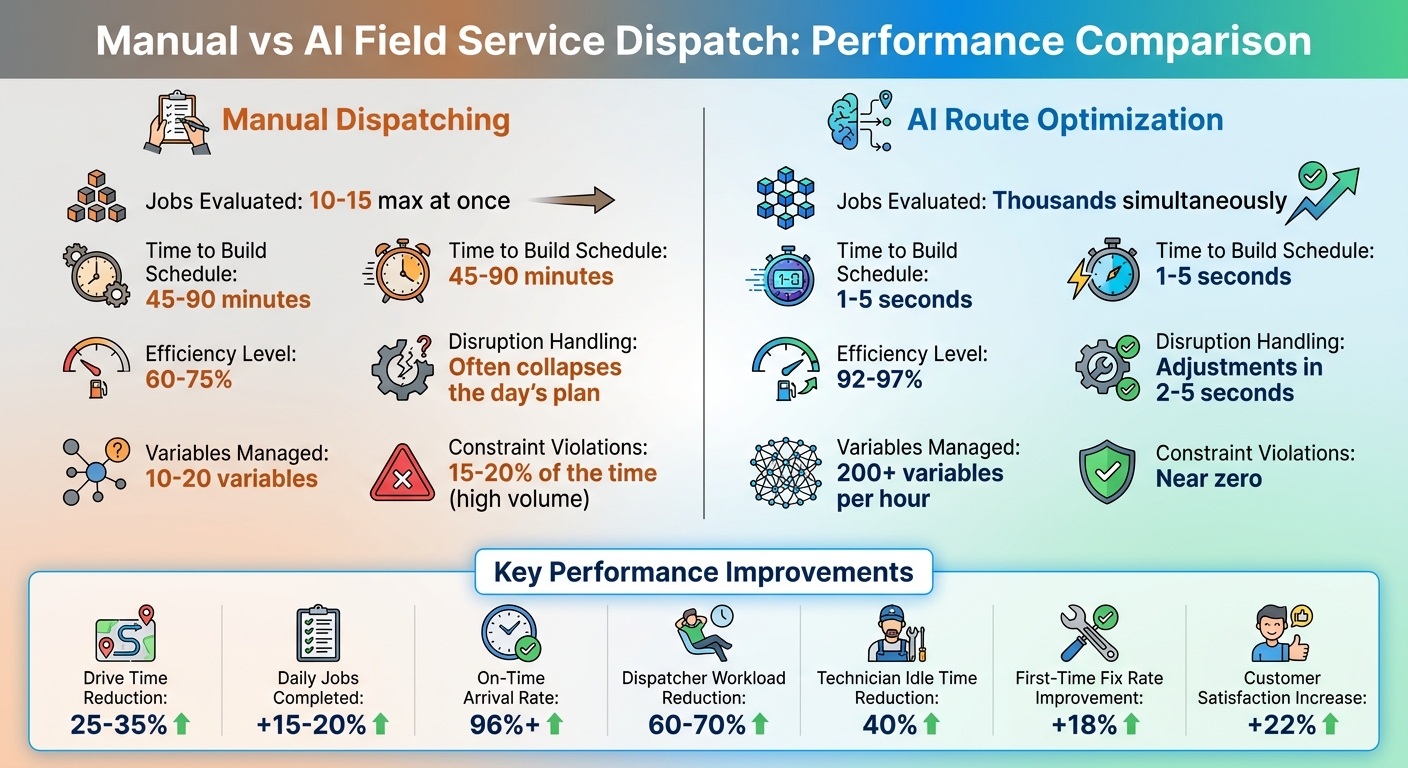
Manual vs AI Field Service Dispatch Performance Comparison
AI Dispatching in Action: Automate Scheduling & Save 10+ Hours/Week
sbb-itb-abfc69c
Key Benefits of AI in Field Service Dispatch
AI has reshaped the way field service dispatch operates, delivering significant improvements in efficiency and cost savings. The transition from manual to AI-powered dispatch isn't just a small step forward - it's a game-changer. For example, companies using AI routing report a 25% to 35% reduction in drive time. For a team of 100 technicians, this translates to reclaiming about 60 technician-hours daily - the equivalent of adding 7–8 technicians without hiring anyone new. These gains directly cut operational costs while boosting service reliability.
Better Schedule Optimization
AI can create a daily schedule in just 1–5 seconds and adjust disrupted appointments within 2–5 seconds, taking into account over 50 factors like certifications, traffic, job complexity, and equipment availability. Compare this to human dispatchers, who typically manage only 10–15 jobs at a time and require 45–90 minutes for manual scheduling.
"Route planning answers 'how do I get from A to B?' Routing optimization answers 'who should go where, in what order, given all the constraints we operate under?'"
- Emiel Sercu, Timefold
AI systems also distinguish between hard constraints (e.g., required certifications) and soft constraints (e.g., reducing fuel costs).
Less Downtime and Higher Productivity
AI-driven scheduling slashes technician idle time by 40% and reduces dispatcher workload for routine rescheduling by 60–70%. Teams can complete 15–20% more jobs daily without adding staff. For instance, in January 2026, EnergyAid, a solar operations company, scaled its workload from 20 work orders per week to over 500 - a fivefold increase - after adopting automated work order management. Similarly, Toyota implemented predictive maintenance, achieving a 15% boost in equipment effectiveness, a 25% reduction in downtime, and a 300% return on investment.
AI also helps balance workloads and prevent overtime, addressing technician burnout - a problem for 66% of technicians. High-performing field service teams are 2.6 times more likely to use intelligent scheduling tools. These advancements elevate operational efficiency from the typical 60–75% achieved through manual dispatching to an impressive 92–97% with AI.
Better Customer Satisfaction
AI-powered routing recalculates ETAs in real time, ensuring on-time arrivals 96% of the time or better, which strengthens customer trust. Skill-based matching ensures that the dispatched technician has the right expertise to resolve the issue on the first visit, cutting down on costly callbacks. As Komal Gurbani from FieldCamp puts it:
"The technician 22 minutes away isn't the 'wrong' choice. It's the choice that accounts for certification, workload, customer history, and downstream impact."
When emergencies arise, AI seamlessly integrates urgent jobs into existing schedules, identifying the technician best positioned to respond quickly without disrupting other appointments.
How AI Optimizes Dispatch Processes
AI is reshaping dispatch operations by moving beyond the old "closest-technician" rule. Instead, it uses multi-objective optimization, analyzing over 200 variables every hour - far more than the 10–20 variables a human dispatcher can manage. When managing high volumes, manual dispatchers often breach operational constraints 15–20% of the time simply because the calculations become too complex to track.
Real-Time Data and Predictive Analytics
AI taps into live GPS and traffic data to calculate actual drive times, avoiding the inaccuracies of static maps. If a job runs over by 30+ minutes or traffic delays exceed 15 minutes, the system triggers dynamic re-optimization (DVRP), reshuffling only the affected parts of the schedule in just 2–5 seconds.
Using machine learning, AI also predicts job durations by analyzing factors like historical performance, equipment age, maintenance records, and technician experience. Within 60 days, these predictions reach 70–80% accuracy, climbing above 90% as the system learns a company's specific patterns.
AI even estimates no-show risks, flagging appointments booked far in advance or involving first-time customers. Since field service operations lose 15–20% of appointments to no-shows or late cancellations, AI mitigates these losses by allowing dispatchers to double-book high-risk slots with lower-priority tasks in the same area. This ensures technicians' time isn’t wasted.
Skill-Based Technician Matching
AI prioritizes skill alignment to avoid compliance risks and costly second truck rolls. It uses a 3-rule skill hierarchy:
- Jobs without specific skill requirements can be assigned to any technician.
- Technicians without certifications are limited to jobs with no special requirements.
- Jobs requiring specific skills must be matched with technicians who meet all those requirements - partial matches are automatically excluded.
Hard constraints, such as EPA 608 certification or gas-line licenses, are non-negotiable. If a technician lacks these, they’re removed from consideration. For softer constraints, the system scores candidates - for example, assigning a "Master" technician to a complex repair versus a "Junior" technician for routine maintenance.
"AI doesn't replace judgment. It replaces invisible math."
- FieldCamp
This precise matching process ensures compliance while optimizing efficiency.
Dynamic Rescheduling and Flexibility
Emergencies can throw schedules into chaos, but AI handles them with targeted re-optimization, adjusting only the impacted jobs and technicians while keeping the rest of the schedule intact. Confirmed appointments remain locked in their promised time slots, even if upstream delays occur. After a reschedule, the system updates technician routes and sends revised ETAs to customers automatically, requiring no dispatcher input.
Teams using AI report a 60–70% drop in dispatcher workload related to routine schedule changes. AI dispatchers finalize schedules once incremental improvements fall below 2%, achieving a 96% optimized schedule in seconds - no need to spend extra time chasing perfection.
Integration of AI Phone Answering in Field Service Dispatch
AI isn't just reshaping scheduling - it’s transforming how service requests are handled from the very first customer call. AI phone answering systems, like Answering Agent, integrate directly with dispatch platforms, creating a streamlined flow of information. These systems gather structured data during customer interactions and feed it straight into the scheduling engine. The result? A smoother handoff between the initial call and assigning the right technician, paving the way for faster and more efficient service.
Capturing and Managing Service Requests
AI answering agents are available 24/7, engaging customers in natural conversations to gather key details like the urgency of the issue, equipment type, and service history. Whether it’s “my AC isn’t cooling” or “I need someone with EPA 608 certification,” the system captures this information and queues it directly for scheduling.
Data shows that top-performing field service teams are 2.6 times more likely to rely on intelligent scheduling tools, and that advantage begins with automated call intake. Imagine a customer calling late on a Saturday night - the AI evaluates thousands of possible scenarios in seconds, considering technician skills, location, traffic, and job priority to recommend the best appointment slot.
Automated Appointment Booking
AI-powered scheduling slashes booking times from an average of 17 minutes to under 5. It works by instantly checking technician availability and matching required skills. Instead of waiting for office hours or endless back-and-forth calls, customers can confirm their appointment on the spot. The system ensures technicians meet specific requirements, such as HVAC certifications or gas-line licenses, before locking in the booking.
These systems also integrate with AI dispatch tools, allowing for automatic rescheduling when disruptions arise. This keeps the rest of the schedule intact and lets dispatchers focus on more complex issues rather than routine adjustments. Beyond speed, these solutions emphasize precision, ensuring every booking is accurate and efficient.
Accuracy and Cost Efficiency
The numbers speak for themselves: Answering Agent has handled over 17,724 scored calls with an impressive 99.93% accuracy rate, leaving just a 0.07% margin for error. This level of precision ensures that the right technician is dispatched the first time, avoiding costly mistakes. Plus, the system handles unlimited calls during peak times at a fraction of the cost of human receptionists.
No-shows and late cancellations are a constant challenge in field service, typically accounting for 15–20% of lost appointments. Automated confirmations and reminders have been shown to reduce no-show rates by 30–40%. Paired with optimized dispatching, this significantly reduces wasted trips and improves technician productivity. Every answered call becomes an opportunity to turn idle time into billable work.
Steps to Implement AI Dispatch Optimization
Assessing Business Needs and Data Readiness
Start by identifying the pain points in your operations. The tipping point often comes when you have 6–10 technicians - at this stage, manual routing becomes too complex to handle effectively. As job numbers increase, the possible routing combinations grow exponentially, making manual dispatching unsustainable.
Next, audit your asset data. Many field service companies struggle to pinpoint details like make, model, or serial number for half of their installed equipment. This lack of accurate data can severely limit the effectiveness of AI. Before moving forward, consolidate fragmented systems into a unified database. As the Geotab Team explains:
"Successful organizations build robust operational field service data foundations before targeting specific AI in field service applications for fast, measurable results".
Clean, organized data is the backbone of AI success. When done right, AI dispatching can achieve 92–97% efficiency. Focus on areas with the most room for improvement, such as scheduling and appointment management, route optimization, or predictive maintenance. Compare your current performance to your service level agreements (SLAs) to identify where AI can make the biggest impact. Consider this: 30% of contractors cite outdated technology as a growth barrier, and 80% believe AI will be critical to staying competitive within three years.
Once you've built a strong data foundation and identified your operational priorities, the next step is selecting the right AI tool for your specific needs.
Selecting the Right AI Tools
AI tools vary widely in their capabilities, so choosing one that fits your business requirements is crucial. The system should handle complex routing challenges (like CVRPTW+), taking into account factors like technician availability, shift hours, and appointment slots. It’s essential the tool distinguishes between hard constraints (e.g., certifications or legal requirements) and soft constraints (e.g., minimizing travel time).
Real-time re-optimization is another must-have feature. If a job runs late or traffic conditions change, the system should adjust only the affected routes within seconds, without disrupting the entire schedule. Machine learning is also key - AI systems that analyze historical data can predict job durations, flag potential no-shows, and improve technician performance by tracking metrics like first-time fix rates.
Adopting AI-based routing often results in a 25–35% reduction in technician drive time. In contrast, manual dispatchers tend to violate operational constraints 15–20% of the time when managing high volumes. AI eliminates these errors while managing thousands of jobs simultaneously.
Feature Manual Dispatcher AI Route Optimization Jobs Evaluated 10–15 max at once Thousands simultaneously Time to Build Schedule 45–90 minutes 1–5 seconds Efficiency Level 60–75% 92–97% Disruption Handling Often collapses the day's plan Adjustments in 2–5 seconds
After identifying the right tool, rigorous testing and training are essential to ensure a smooth implementation.
Training, Testing, and Measuring Success
Begin with a pilot project to test the AI system’s potential before committing to a full-scale rollout. For instance, you could start with AI-powered knowledge base searches for technicians. These smaller projects help validate the benefits and demonstrate AI's impact. Involve your field teams from the start - their input is critical to making the system practical and easy to use.
Fine-tune the system by adjusting soft constraint penalty weights. Start with industry-standard settings, then tweak them by 50–100% based on test results. Avoid hard-coding preferences like "same-day service." Instead, assign a high penalty weight (5,000–10,000) to allow the system to prioritize flexibility when same-day slots aren’t realistic.
Track key performance indicators (KPIs) such as first-time fix rates, total drive time, jobs per technician, and SLA compliance. Machine learning systems typically achieve 70–80% accuracy within the first 60 days, improving to 90% or more after 7–12 months. Companies that adopt AI in field service report an 18% boost in first-time fix rates and a 22% increase in customer satisfaction. During the initial rollout, review assignments that seem off and adjust penalty weights quarterly to account for seasonal changes.
Conclusion
Key Takeaways
AI has revolutionized field service dispatch, shifting it from manual, experience-driven methods to a precise, mathematical process capable of managing hundreds of variables at once - like technician expertise, traffic conditions, and service level agreements. The results? Technician drive time can drop by as much as 35%, and daily job completions can increase by nearly 20%. For a team of 100 technicians, cutting drive time by 30% recovers about 60 technician-hours per day - essentially adding the output of 7–8 extra technicians without hiring anyone new. On-time arrival rates soar to 96% or higher, while dispatcher workloads for routine adjustments shrink by 60–70%.
Real-time re-optimization is another standout feature. If a technician is delayed or an emergency job arises, AI recalibrates only the necessary routes in just 2–5 seconds. Over time, machine learning accuracy improves significantly, climbing from 70–80% within the first 60 days to over 90% after a year, constantly refining dispatch efficiency.
These advancements highlight AI’s ability to not only streamline operations but also give businesses a strategic edge in competitive markets.
AI as a Competitive Advantage
The efficiency gains delivered by AI have turned it into a critical tool for field service operations. As Grant Mercer, a Field Service Manager, explains:
"AI is no longer a futuristic tool for companies that rely on field teams; rather, it is an operational necessity that transforms data into decisions and decisions into value".
Manual dispatching becomes impractical once a team grows beyond 6–10 technicians, as the number of possible routing combinations quickly surpasses what humans can handle. At this scale, AI isn’t just helpful - it’s essential for maintaining profitability and keeping customers happy.
Solutions like Answering Agent take this even further by ensuring every customer call is captured and seamlessly integrated into your AI dispatch system. With the ability to handle unlimited calls 24/7, Answering Agent automatically books appointments and feeds them into your AI-optimized system, creating a smooth and efficient customer journey from the initial call to job completion. These improvements in scheduling and responsiveness not only enhance service reliability but also position your business to scale effectively while meeting the high expectations of today’s customers.
FAQs
What data do I need before using AI dispatch?
To make the most of AI dispatch systems, start by collecting key data points. These include technician skills, real-time GPS locations, availability, current workloads, and job specifics like location, urgency, expected duration, and customer preferences. It’s also important to account for constraints such as required skill sets, time windows, and operational rules.
Keeping your data accurate and up-to-date is crucial. Clean data allows the AI to excel at tasks like scheduling, routing, and capacity planning. The result? Better productivity, lower costs, and happier customers - all thanks to smarter, more efficient dispatch decisions.
How quickly can AI reschedule when plans change?
AI-powered dispatch systems excel at quickly adapting to changes. For instance, if there's a sudden traffic jam or a technician becomes unavailable, these systems can modify schedules in seconds. This fast rescheduling helps reduce downtime and keeps operations running smoothly.
How does AI phone answering support dispatch?
AI-powered phone answering systems are transforming dispatch operations by improving communication and ensuring real-time updates for better scheduling. These systems work around the clock, handling tasks like capturing leads, booking appointments, and providing timely updates to dispatchers and technicians with impressive precision.
By connecting seamlessly with scheduling systems, AI can assign jobs dynamically. It considers factors such as a technician's skill set, current location, and the urgency of the task. This approach not only optimizes routes but also minimizes downtime, leading to quicker and more dependable service.
Related Blog Posts
Book a walkthrough
See it handle your calls.
Book 20 minutes, or hear a sample call first.
Ready to see it handle your calls?
Book a walkthrough, or hear a short sample call first.
Related Articles

Car Wash Membership Phone Calls: A Desk Guide
A desk guide to the membership phone calls car washes take, with links to the deep how-tos.

How to Handle Pickleball Guest Fee Calls
Handle pickleball guest fee calls by identifying the visit type, quoting the written fee sheet, and confirming payment, court access, and check-in requirements.

How to Handle Car Wash Membership Pause Calls
Handle car wash membership pause calls with written hold rules, clear dates, billing and plate status, and a reopen note the next shift can use.