A white-label AI phone agent answers calls under your brand or your client's brand. It qualifies the caller, books the appointment, pushes the record into the CRM, and hands anything urgent to a person. If you're choosing a platform to run yourself or resell, judge it on how well it does those jobs.
Here is what to check:
- Call handling: fast pickup, context carried across voice and text, and escalation when a caller is upset.
- Lead qualification: a few targeted questions, an urgency flag, and clean data sent to the CRM.
- Appointment scheduling: live calendar checks, for example against Google Calendar, so nothing gets double-booked.
- Concurrency: every call gets answered during peaks, with no busy signal.
- Brand fit: voice choice and custom AI phone scripts that match the business.
- Integrations and telephony: native CRM connectors, a way to keep your existing number, and compliant data handling.
Core Features of White-Label AI Phone Agents
Each turn in the conversation runs through three steps. Speech-to-text transcribes the caller. A large language model such as GPT-4 or Claude works out the reply. Text-to-speech then speaks it. Well-built systems finish that loop in under a second, which keeps the call feeling like a normal conversation.
The agent answers from a knowledge base built from the business's website and uploaded documents. Some platforms also pass a call between specialized agents, such as from general intake to technical support, without the caller noticing the handoff.
AI Call Handling
The agent should pick up within a few seconds and remember context across channels. A customer who calls about an estimate and later texts about price should not have to start over.
Sentiment detection decides when to hand the call to a person. When frustration or confusion shows up, the agent should escalate. Tone matters on the calls it keeps, too. For more on that, see how AI adapts tone for customer calls.
Lead Capture and Qualification
Good qualification takes three to five questions: budget, timeline, decision-maker, and service area. The agent also listens for urgency. A caller who says "I need this fixed today" should be flagged as high priority and routed straight to dispatch.
The captured fields should land in HubSpot or Salesforce within seconds through webhooks or an API. Examples include name, service type, and urgency. The agent should also filter out spam calls so they never reach staff.
Appointment Booking and Scheduling
The agent books against live availability in Google Calendar, Microsoft Outlook, Calendly, or Acuity Scheduling. It then sends the confirmation by SMS or email and updates the CRM.
Many service calls come in after hours, and most callers who reach voicemail hang up. A 24/7 agent books those calls instead of losing them. For teams with several technicians, it can book against everyone's combined availability. For emergencies, it should skip the booking flow and connect the caller to a technician.
Unlimited Simultaneous Call Handling
A person handles one call at a time. The agent takes every call at once, so there are no busy signals and no hold queue at peak times. That matters because callers left on hold for more than a minute tend to hang up, and each hang-up is a job that may go to a competitor. Answering Agent is built on this model.
Customizable Voice and Scripting
Match the voice and script to the business. A law firm usually wants formal. A car wash can be casual. Many platforms offer regional accents or voice cloning.
Use phonetic spelling for product names and local place names so the agent pronounces them correctly. A mispronounced brand name makes a call sound automated faster than anything else.
Scalability and 24/7 Availability
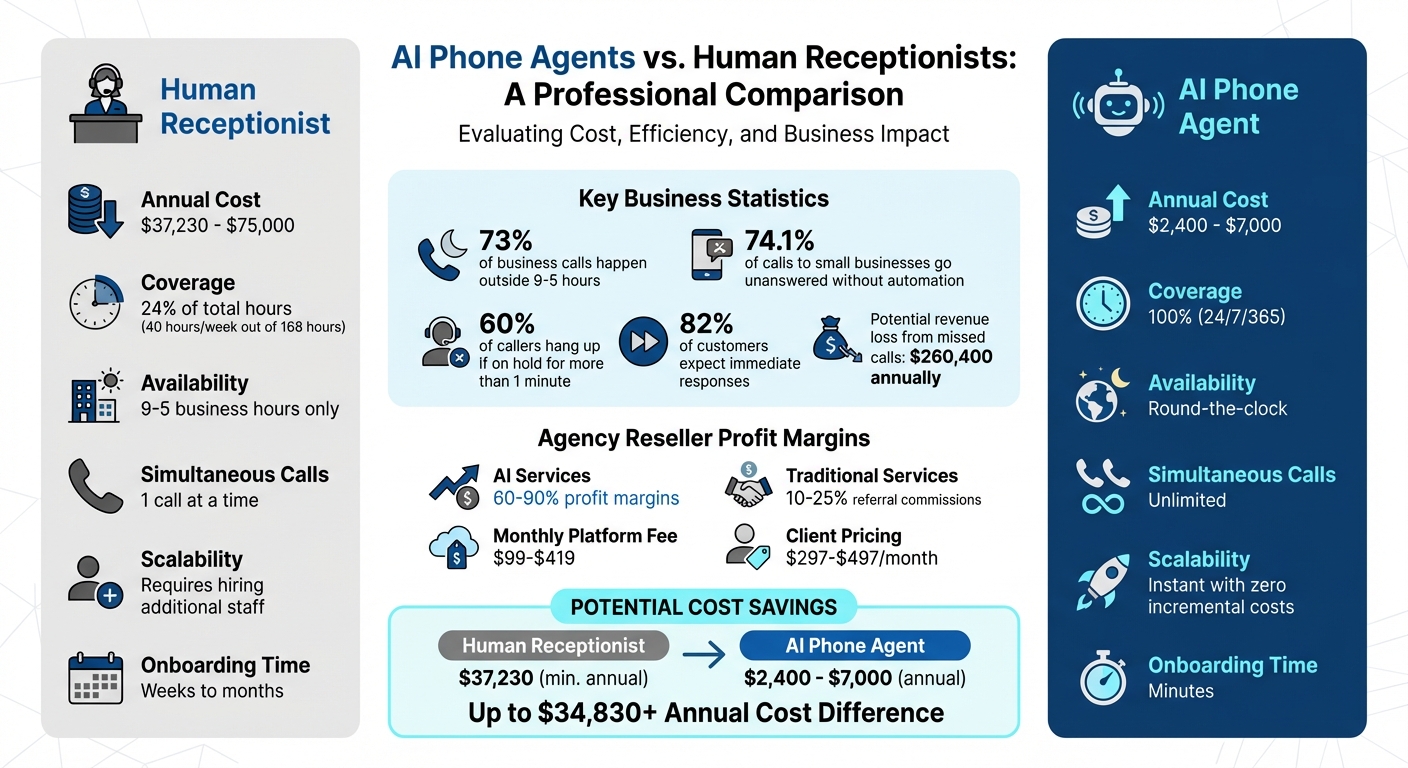
AI Phone Agents vs Human Receptionists: Cost and Coverage Comparison
A large share of business calls arrive outside 9-to-5, and small businesses without automation leave many calls unanswered. Round-the-clock coverage closes that gap. It also costs less than staffing the phones, which is covered in substantial cost savings. For global and after-hours setups, see 24/7 call coverage.
Cost Savings vs. Human Receptionists
| Human receptionist | AI phone agent | |
|---|---|---|
| Annual cost | About $37,230 (40-hour week) | $2,400–$6,000 |
| Weekly coverage | 40 of 168 hours (24%) | 168 of 168 hours |
| Calls at once | 1 | Unlimited |
For resellers, platform fees usually run $99–$419 a month plus about $0.09 per minute of usage. Agencies typically charge clients $297–$497 a month for basic call answering, which leaves margins of 60–90%. Referral commissions from traditional answering services pay 10–25%.
Scaling with Business Growth
Before you commit, check how the platform prices growth. Some charge a flat fee, such as $299 a month, whether you run 5 client accounts or 60. Capped plans push you into upgrades or custom enterprise pricing. Platforms that run their own voice stack scale with usage. Platforms that wrap third-party APIs can hit those providers' rate limits.
Onboarding speed matters as much as price. Platforms that scrape a client's website can stand up a new account in minutes. That keeps you from losing calls while a client waits to go live, and missed calls are where the potential revenue loss from unanswered calls adds up.
Integration with Business Tools
Integrations decide whether call outcomes reach your systems on their own or someone re-types them. Built-in connectors also shorten client onboarding noticeably. Telephony integrations follow the same rule: the fewer manual steps, the fewer failures.
CRM and Automation Integration
Look for native connectors to HubSpot and GoHighLevel. They create contacts and log each call automatically. After the call, the agent can send an SMS, enroll the lead in an email sequence, or update the lead score without anyone touching it. For Meta ad campaigns, the same connection lets the agent call a new lead within seconds. For the full setup, see the guide to AI and CRM integration.
| Integration method | Setup | Extra cost | Risk |
|---|---|---|---|
| Built-in connector | Simplest | None | Low |
| REST API | Needs development work | Dev time | Depends on the build |
| Zapier / Make | Easy | $20–$50 per client per month | More points of failure |
Telephony Options and Flexibility
Three options cover most setups:
- SIP trunk support connects the agent to an existing enterprise PBX.
- Bring Your Own Number (BYON) keeps the business's published number.
- Conditional call forwarding sends overflow or after-hours calls to the agent, and the original number stays visible to callers.
Emergency routing should catch phrases like "pipe burst" and transfer the caller to a person right away. Healthcare and legal clients need HIPAA and GDPR-compliant data handling with PII redaction included. Some vendors charge up to $200 a month extra for compliance features that should be standard.
Industry Applications and Use Cases
Home Services and Medical Practices
For plumbing, HVAC, and medical offices, the after-hours call is the one that gets lost. Most people who reach voicemail call a competitor. A plumber who misses three to five calls a day can lose thousands of dollars a month.
Train the agent on the service list and pricing. Then integrate it with platforms like ServiceTitan, Housecall Pro, Calendly, or GoHighLevel so it can book the job during the call. Medical offices should confirm the vendor holds ISO 27001 and SOC 2 certifications and supports HIPAA. Urgency keywords should transfer the call to staff immediately.
Law Firms and Staffing Agencies
Legal clients often hire the first firm that responds, and a large share of legal leads call after hours. An agent that answers in one or two rings keeps the firm in the running. Train it to identify the case type, check statute-of-limitations timing, and run a conflict pre-screen before booking the consultation.
Staffing agencies can handle hundreds of calls a day. The agent asks three to five screening questions, passes qualified candidates to a recruiter, and books interviews on the calendar in real time.
Car Washes and High-Volume Service Businesses
Car wash calls spike at peak hours and come in all day. The agent answers each one without a hold queue and can pitch unlimited wash plans around the clock. Connected to systems like Sonny's or NXT Wash, it can look up a license plate, verify membership, and handle billing and cancellation calls. On cancellation calls, it can offer a win-back promotion before the member leaves.
Answering Agent has scored 17,724 calls at 99.93% accuracy.
"Answering Agent has helped us cut costs while actively generating new revenue. It promotes our special offers and even signs customers up for our text club... something a traditional service can't match." – Jacksons Car Wash
FAQs
How does an AI phone agent connect to my CRM and calendar?
Through native connectors or API connections. Once connected, the agent writes call data and leads to the CRM and books against live calendar availability in real time, so records stay current without manual entry.
What happens when the AI detects an emergency or an angry caller?
It collects the essential details and transfers the call to the right person right away. Urgency keywords such as "pipe burst" and signs of frustration both trigger the handoff.
Can I keep my current business number with a white-label AI agent?
Yes. Platforms like Answering Agent support bringing your own number or forwarding calls from it, so callers keep dialing the number they already know.
Related Blog Posts
Book a walkthrough
See it handle your calls.
Book 20 minutes, or hear a sample call first.