
Missed calls are costing pest control businesses thousands in lost revenue. When potential customers call and don’t get an answer, 85% move on to a competitor immediately. This issue is worsened by high advertising costs - each missed call wastes an average of $70 in ad spend. For companies in this industry, where customer urgency is critical, every unanswered call represents lost income and wasted opportunities.
Key Takeaways:
- Pest control businesses miss 22% to 74% of calls, leading to lost revenue between $1,200 and $15,000 per customer over their lifetime.
- Seasonal spikes in call volume, especially in spring and summer, make missed calls even more expensive.
- Traditional call handling systems, like voicemail, fail to meet customer expectations, with 80% of callers hanging up without leaving a message.
Solution: AI-powered answering systems ensure every call is answered promptly, even after hours. These services cost as little as $149 per month, handle unlimited calls, and integrate with scheduling software to secure leads efficiently. With features like natural language processing and 24/7 availability, AI solutions help businesses recover lost revenue and stay competitive.
Missed calls are no longer just an inconvenience - they’re a major financial drain. AI call management offers a reliable way to address this issue and improve customer satisfaction.
This AI Raccoon Answers Calls for a Pest Control Company (AI Voice Agent Demo)
sbb-itb-abfc69c
The Revenue Impact of Missed Calls
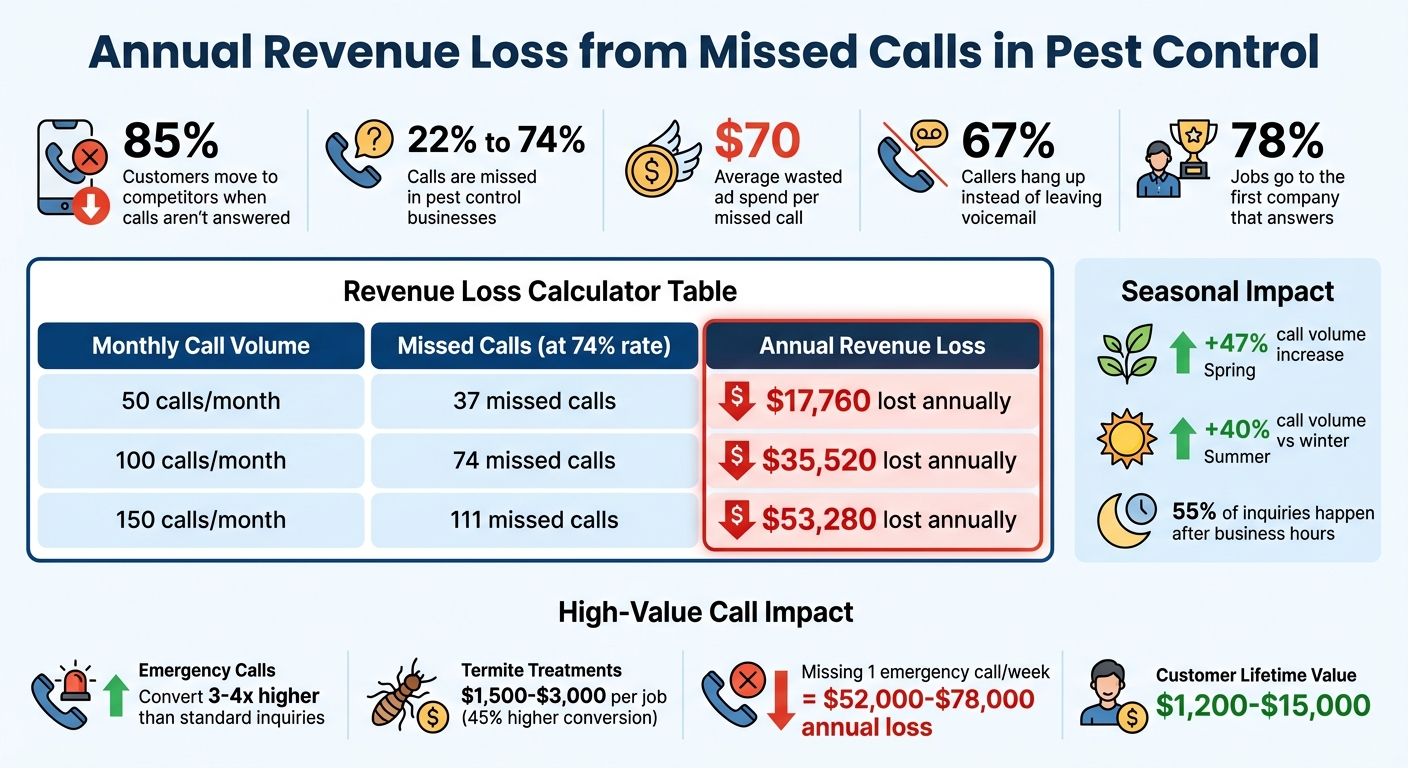
The Cost of Missed Calls in Pest Control: Revenue Loss Calculator
Missed calls in the pest control industry aren't just minor inconveniences - they can lead to significant financial losses. Here's a closer look at how these missed opportunities translate into lost revenue.
Revenue Lost Per Missed Call
Every missed call represents a potential loss of revenue, ranging from $150 to $350 depending on the type of service. For urgent situations like wasp removals or rodent infestations, the stakes - and the potential losses - are even higher.
Take a small pest control business receiving 50 calls a month with a missed call rate of 74.1%. Even if just 20% of those missed calls would have converted into actual jobs, the business stands to lose $1,480 monthly - or $17,760 annually. And that’s just the immediate job value. These missed opportunities also eliminate the chance to secure long-term contracts, which can range in value from $1,200 to $15,000 over a customer’s lifetime. The financial impact only grows during periods of high demand.
Seasonal Demand and Emergency Calls
Seasonal spikes in pest activity make missed calls even more costly. For example, call volumes jump by 47% in spring as termites and ants become active, and summer sees a 40% increase compared to winter. When phone lines are overwhelmed during these peak times, the cost of every missed call rises.
Emergency calls, typically priced at a premium, are especially valuable. They also convert at rates 3 to 4 times higher than standard inquiries. Consider termite treatments, which average between $1,500 and $3,000 per job and convert at a 45% higher rate. Missing just one high-value call per week during busy seasons could result in over $78,000 in lost annual revenue.
Annual Revenue Loss Projections
When you look at the big picture, the yearly losses from missed calls can be staggering. For instance, a single location missing just one emergency call per week, with an average value of $250, could lose around $12,000 annually. For mid-sized businesses with higher call volumes and the added value of recurring customers, annual losses can easily exceed $50,000.
Monthly Call Volume Missed Calls (74% Rate) Average Job Value Loss (Monthly) Loss (Annual) 50 calls 37 calls $200 $1,480 $17,760 100 calls 74 calls $200 $2,960 $35,520 150 calls 111 calls $200 $4,440 $53,280
Missed calls aren’t just a minor issue - they’re a direct hit to your bottom line. Addressing this challenge could mean the difference between stagnant growth and thriving success.
Why Traditional Call Handling Falls Short
Traditional call handling methods, while once reliable, are struggling to keep up with the fast-paced demands of today's customers. Imagine discovering bed bugs late at night or spotting a wasp nest on a weekend morning - waiting until the next business day for help isn’t an option. Yet, this is precisely where traditional systems fall short. A staggering 67% of pest control callers hang up instead of leaving a voicemail, and of those who do, 80% never bother to call back. This leaves businesses missing out on a huge chunk of potential revenue.
Voicemail and After-Hours Services
Voicemail is a major weak spot for handling urgent calls. Many pest control emergencies happen outside regular business hours, but voicemail doesn’t cut it for customers who need immediate assistance. With 67% of callers hanging up when sent to voicemail, and 78% of jobs going to the first company that answers the phone, every missed call becomes an opportunity for competitors.
Even outsourced answering services often fall short. These services typically rely on generic responses, which fail to address the specific concerns of someone dealing with a pest emergency. For example, a homeowner dealing with a wasp infestation doesn’t want a scripted reply - they want reassurance and actionable help. This lack of personalization highlights the need for a more effective approach to call management.
The Limits of Human Staff
Human staff, while essential, have their own limitations that make it hard to keep up with fluctuating call volumes. During peak seasons, like spring termite swarms (which cause a 47% spike in inquiries) or summer months when calls can triple, even the best teams struggle to keep up. The result? Long wait times and dropped calls.
Adding to the challenge, hiring a full-time receptionist costs between $35,000 and $42,450 per year, yet they can only cover 40 hours a week. With 53% of pest control companies reporting labor shortages, staffing for seasonal surges becomes a logistical and financial headache.
Pest Control Industry Challenges
The pest control industry faces unique hurdles that make traditional call handling even more problematic. Technicians are often in crawl spaces, wearing respirators, or handling hazardous chemicals, making it impossible to answer calls during the workday. This is particularly costly when you consider that emergency calls - like those for bed bugs or termites - are worth $1,000 to $3,000 and convert at rates 3 to 4 times higher than standard inquiries. Missing just one of these high-value calls each week could lead to an annual revenue loss of around $52,000.
These challenges show why traditional methods are no longer enough. Businesses need smarter, faster solutions to meet customer demands and stay competitive. Implementing AI phone scheduling can bridge these gaps by ensuring every lead is captured and booked immediately. Up next, we’ll dive into how AI call management can address these critical gaps.
How AI Phone Answering Solves These Problems
AI phone answering systems revolutionize the way calls are handled by ensuring every call is answered quickly and efficiently. Instead of relying on voicemail or overworked staff, these systems pick up calls in under 5 seconds. This speed is crucial, especially since 55% of pest control inquiries happen outside regular business hours. For instance, if someone reports a termite swarm late on a Saturday night, the AI immediately responds, guaranteeing uninterrupted service. This quick response isn’t just about answering calls - it’s the foundation for advanced features that help secure appointments and streamline operations.
Core AI Answering Features
Modern AI systems leverage natural language processing to differentiate between routine questions and urgent situations. Take a termite swarm call, for example. With treatment costs ranging from $1,500 to $3,000 on average, the AI recognizes the urgency and forwards the call directly to a technician’s phone. Meanwhile, routine appointment requests are automatically scheduled, keeping field teams focused on their work.
These systems also qualify leads by gathering essential details like the type of pest, the address, and any special instructions. This ensures technicians are fully prepared when they arrive. Plus, AI can handle an unlimited number of calls at once, which is a game-changer during the busy spring season when call volumes can increase by 47%.
CRM Integration for Pest Control
AI phone systems integrate effortlessly with popular pest control software like PestRoutes, PestPac, Jobber, ServiceTitan, and ServSuite. This eliminates the need for manual data entry. Once the AI books an appointment, it automatically syncs with calendars, sends SMS confirmations, and updates customer information in the CRM. This reduces no-shows, improves follow-ups, and allows technicians to focus on their jobs rather than administrative tasks. Such seamless integration underscores the efficiency AI brings to pest control businesses.
Cost Savings and Call Capacity
Hiring a full-time receptionist costs between $35,000 and $42,450 annually, and they can only handle one call at a time during a standard 40-hour workweek. In contrast, AI services cost just $149 to $199 per month, which totals about $1,788 to $2,388 annually - and they’re available 24/7.
For example, Marcus T., owner of Marcus Heating & Air, shared his experience:
"I was missing 8-10 calls a week and didn't even know it. CallJolt fixed that in one afternoon. It's the best $149 I spend every month."
For businesses looking to save money while handling calls more effectively, AI phone answering provides a powerful solution.
Answering Agent for Pest Control Businesses
Answering Agent is an AI-driven solution tailored specifically for pest control businesses. Its results speak volumes: 99.93% accuracy across 17,724 calls and 6,820 accepted offers from 20,375 pitches. This platform is designed to help businesses minimize lost revenue by ensuring every customer interaction is handled efficiently.
Accuracy and Performance Data
Answering Agent boasts a 0.07% hallucination rate, meaning it rarely misinterprets or fabricates information. This level of precision is invaluable, particularly in urgent situations like a homeowner reporting termite swarmers or a wasp nest near a child’s play area. The AI captures critical details such as the type of property, pest issue, and urgency, ensuring technicians are well-prepared before arriving on-site. The result? Faster response times and higher conversion rates. This accuracy ensures the smooth handling of pest emergencies, keeping businesses operational around the clock.
24/7 Availability and Unlimited Call Handling
One of Answering Agent’s standout features is its 24/7 availability and unlimited simultaneous call capacity. Customers never encounter a busy signal or voicemail, even during peak seasons when call volumes can spike by 47%. The system answers calls in under 5 seconds, which is crucial because 78% of customers go with the first company to respond. This constant availability not only improves customer satisfaction but also provides a significant edge over competitors.
Answering Agent vs. Competitors
When compared to other industry solutions, Answering Agent clearly stands out:
Feature Answering Agent Smith.ai Goodcall Accuracy 99.93% (17,724 calls) Varies by agent Less natural Call Capacity Unlimited simultaneous calls Limited by staff count Unlimited simultaneous Pricing Model Usage-based (no contracts) Per-call/per-minute bundles Subscription-based CRM Integration 70+ apps including PestRoutes, ServiceTitan, and FieldRoutes Strong CRM & calendar integrations Limited integrations Availability 24/7/365 Extra fees for after-hours 24/7
Answering Agent’s seamless integration with pest control platforms like PestRoutes, ServiceTitan, and FieldRoutes is a game-changer. By automating data entry, it ensures technicians receive all the necessary job details before arriving, streamlining the entire process from the initial call to service completion. This efficiency not only saves time but also enhances overall operations for pest control businesses.
Conclusion
Missed calls are more than just a nuisance - they're a direct hit to your revenue. With 85% of potential customers turning to competitors if they can't reach you right away, every missed call could mean losing thousands in immediate revenue and future business opportunities.
AI answering services solve this issue by ensuring no call goes unanswered, even after hours. Unlike voicemail - where 80% of callers hang up - AI systems provide instant, human-like responses that are especially critical during pest emergencies. These systems can handle an unlimited number of calls during peak seasons, solve common scheduling problems by booking directly into your calendar, and route urgent calls to technicians in the field.
The benefits are clear: 78% of customers go with the first company that answers. By guaranteeing you're always the first to respond, AI transforms missed calls into confirmed bookings. With Answering Agent, you get all this at a fraction of the cost of a human receptionist, along with a 99.93% accuracy rate over 17,724+ calls. This allows your team to focus on delivering exceptional service.
For pest control businesses tired of losing leads to more available competitors, AI call management isn't just helpful - it’s essential. Every captured call adds to your bottom line and strengthens your position in the market, setting you up for long-term growth.
FAQs
How many missed calls does my pest control business have?
Missed calls might seem like a small issue, but they can have a big impact on your pest control business’s revenue. Every unanswered call could mean a lost customer or an untapped lead. That’s where AI answering services like Answering Agent step in. By operating 24/7, they ensure no call goes unanswered, helping you capture leads and keep potential customers engaged - even when you’re unavailable.
What’s the easiest way to estimate revenue lost from missed calls?
To figure out how much revenue you're losing due to missed calls, just follow this formula: Missed Calls × Close Rate × Job Value. It’s a straightforward way to see how much potential income could be slipping through the cracks.
Will an AI answering service book jobs in my scheduling software?
Yes, an AI answering service can directly schedule jobs in your booking software. These systems connect with your CRM and scheduling tools to take care of tasks like lead qualification and automated appointment setting. This integration helps minimize missed calls and boosts revenue by streamlining the scheduling process without requiring manual input.
Related Blog Posts
Book a walkthrough
See it handle your calls.
Book 20 minutes, or hear a sample call first.
Ready to see it handle your calls?
Book a walkthrough, or hear a short sample call first.
Related Articles

How to Handle Pickleball Guest Fee Calls
Handle pickleball guest fee calls by identifying the visit type, quoting the written fee sheet, and confirming payment, court access, and check-in requirements.

How to Handle Car Wash Membership Pause Calls
Handle car wash membership pause calls with written hold rules, clear dates, billing and plate status, and a reopen note the next shift can use.

How to Handle Car Wash Damage Claim Calls
Handle car wash damage claim calls with a clear intake: capture plate, visit time, and claimed damage, then hand the record to the claims owner without promising a settlement.