
If your AI voice agent takes calls from people in the EU, GDPR applies, wherever your business is based. Compliance comes down to a few habits. The agent says it is automated. You have a lawful basis for every piece of data it collects. It asks only for what the task needs. You delete data on a schedule and can prove all of it on paper.
Call recordings and transcripts are personal data. Voiceprints used to identify a caller are biometric special-category data, which in practice means explicit consent. Serious violations can cost up to €20 million or 4% of global annual turnover, whichever is higher.
Core GDPR Principles for AI Voice Agents
Lawfulness, Fairness, and Transparency
The agent should say it is automated in the first seconds of the call and explain why it is collecting information. An agent that passes itself off as human fails the fairness and transparency test, and the EU AI Act makes the disclosure an explicit requirement.
Every processing activity needs a lawful basis. Consent is one option, but it is not the only one. Booking a job the caller asked for usually rests on contract. Call quality review often rests on legitimate interest. Biometric identification needs explicit consent.
Data Minimization and Purpose Limitation
Collect only what the task needs. An agent scheduling appointments needs a name, contact details, and a time slot. It does not need a birth date or ID number. Ask for personal details at the point the call requires them, not upfront.
Data collected for one purpose stays with that purpose. A phone number taken for appointment reminders cannot go into a marketing list unless the caller separately agrees.
For card numbers and other sensitive details, use DTMF masking. The caller types digits on the keypad, and the digits never reach the recording or transcript.
Set a retention period for each data category and tie it to a lawful basis:
| Data Category | Typical Retention | Legal Basis |
|---|---|---|
| Anonymous conversation logs | 30–90 days | Legitimate interest |
| Support conversations (ticketed) | 1–3 years | Contract performance |
| Sensitive data (health/finance) | Delete after resolution | Explicit consent / legal obligation |
| Marketing leads | Until consent is withdrawn | Consent |
These periods are starting points. Your own legal obligations may require longer or shorter retention.
Accountability and Security
Article 30 requires a Record of Processing Activities (ROPA). It lists what data you collect, why you collect it, who can access it, and how long you keep it.
Encrypt data in transit with TLS 1.3 and at rest with AES-256. Restrict access to recordings with role-based access control and multi-factor authentication. If you run a multi-tenant platform, use row-level security so one client can never see another client's calls.
Automate deletion against the retention table. Manual cleanup gets skipped.
How to Achieve GDPR Compliance
Getting User Consent
When consent is your lawful basis, it has to be an affirmative act, such as the caller saying "yes" or pressing a key. Silence does not count, and staying on the line does not count either.
Open every call with a short script, for example: "This is an AI assistant. This call is recorded and handled under our privacy policy." Then do three things:
- Let callers withdraw consent as easily as they gave it, including by voice during the call.
- Log every consent event with date, time, and purpose.
- Collect separate consent for each new purpose, such as marketing.
Building Privacy into Your System
Privacy by design means the controls above ship with the agent, not after launch. Configure the minimal intake flow for your appointment scheduler, DTMF masking for payments, encryption and access controls, and automated retention before the agent takes its first live call.
Make sure you can also serve data subject rights. You should be able to find, export, correct, and delete everything tied to one caller within the one-month deadline.
Running Data Protection Impact Assessments
Article 35 requires a DPIA when processing is likely to pose a high risk to individuals. Voice agents that use biometrics, handle health or financial data, or feed significant decisions usually qualify. A DPIA covers four things:
- What data you process and why.
- Why that processing is necessary and proportionate.
- The risks to callers.
- The controls that reduce those risks, such as encryption, access limits, and retention.
Run the DPIA during design, alongside a checklist for implementing AI phone answering. Revisit it at least once a year and whenever your data flows change. Regulators ask for this document first.
Selecting GDPR-Compliant AI Voice Agent Providers
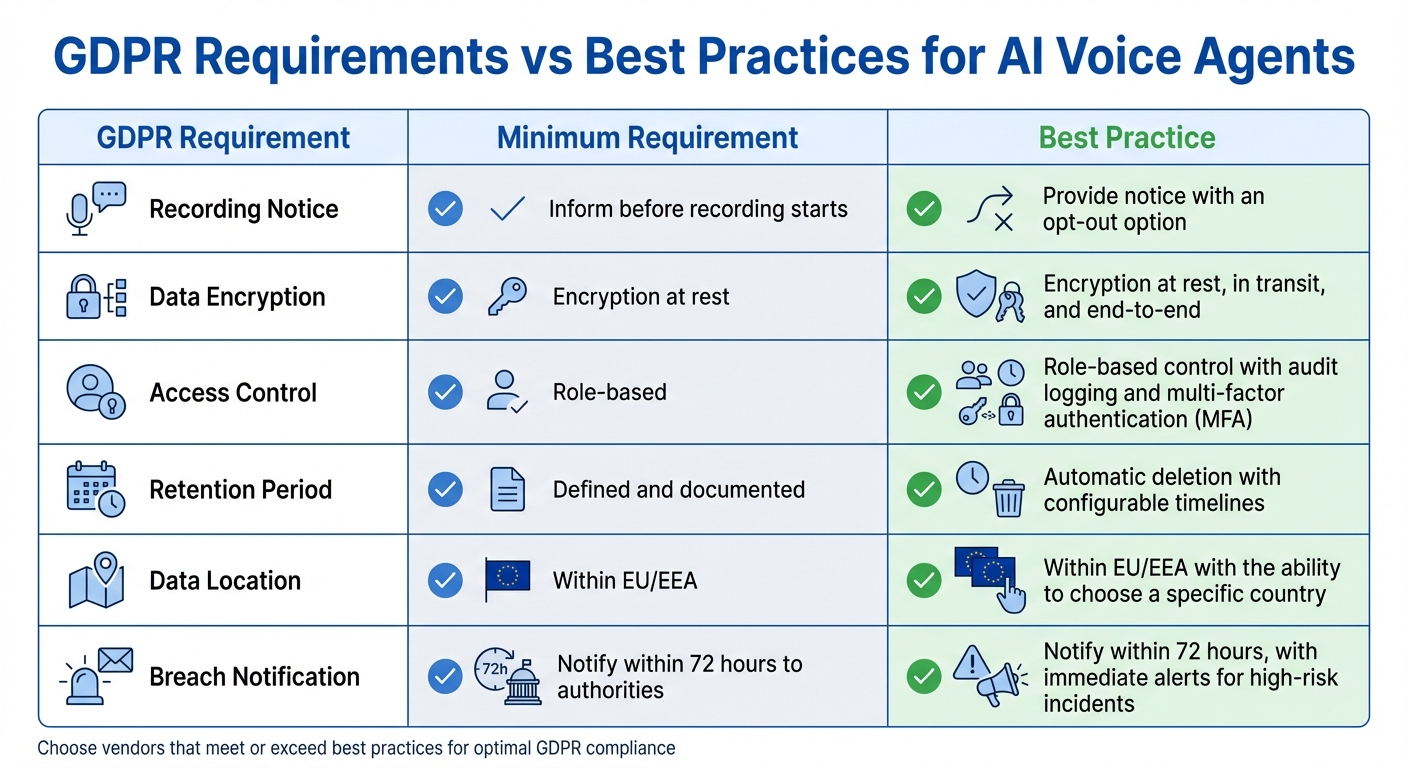
GDPR Compliance Requirements vs Best Practices for AI Voice Agents
Your vendor is a processor, so Article 28 requires a Data Processing Agreement. If a vendor won't sign one, walk away.
Vendor Evaluation Checklist
- Data location: Find out where data is stored and processed. Transfers outside the EU/EEA need an adequacy decision or Standard Contractual Clauses.
- Security evidence: Ask for a SOC 2 Type II report or ISO 27001 certificate. A security page is not evidence.
- Sub-processors: Get the full list, covering cloud hosting, telephony, and language model APIs.
- Model training: Confirm you can opt out of your calls being used for training, or that the data is anonymized first.
- Data subject rights: Confirm you can export and delete one caller's data on request.
| Area | Minimum | Best Practice |
|---|---|---|
| Recording notice | Inform before recording starts | Notice plus an opt-out |
| Encryption | Appropriate to the risk (Art. 32) | At rest and in transit, end-to-end where possible |
| Access control | Role-based | Role-based with audit logs and MFA |
| Retention | Defined and documented | Automatic deletion with configurable timelines |
| Data location | EU/EEA or a valid transfer mechanism | EU/EEA with a choice of country |
| Breach notification | Tell the authority within 72 hours; tell affected people without undue delay if the risk is high | Vendor alerts you immediately so you can meet your own deadline |
Answering Agent: Where It Fits
Answering Agent answers calls for service businesses, including home services, medical practices, law firms, staffing agencies, and car washes. Run it through the same checklist as any other vendor. Ask for the DPA, the sub-processor list, and the retention and recording-notice settings before you route EU callers to it.
Maintaining GDPR Compliance Over Time
Every prompt change, new feature, or model upgrade can change what data the agent collects and where that data goes. Review the agent on a fixed schedule:
| Activity | Frequency | Goal |
|---|---|---|
| Vulnerability scans | Quarterly | Find and fix infrastructure weaknesses |
| Red teaming | Quarterly | Test for prompt injection and data leakage |
| DPIA review | Annually | Reassess risk, especially for biometrics |
| Tabletop exercises | Semi-annually | Rehearse breach response |
| Knowledge base audit | Periodic | Remove personal data from indexed content |
During the quarterly review, confirm that the disclosure still plays, consent logs are being written, encryption is on, and deletion jobs actually ran. Before shipping any new feature, run a short privacy check against the ROPA.
Audit the knowledge base closely. A single customer record indexed by mistake can surface on a stranger's call and become a reportable breach.
Preparing for Regulatory Changes
The EU AI Act's transparency obligations apply from August 2, 2026. Most customer service agents only need to tell callers they are talking to AI. Agents involved in decisions such as hiring or credit are high-risk and need much heavier documentation.
Keep an inventory of every AI agent you run. For each one, record what it does, its AI Act risk class, and the person accountable for it. When the rules change, the inventory tells you which systems to update.
Outside the EU, biometric rules can be stricter still. Illinois' BIPA is the usual example. If you use voiceprints anywhere, design to the strictest regime you operate under.
Make your audit logs tamper-evident, for example with hash-chained entries. Route high-stakes or emotionally difficult calls to a person using human-in-the-loop protocols. GDPR's rules on automated decision-making already expect human review when a decision significantly affects someone.
Conclusion
The working checklist:
- Choose a lawful basis for each purpose.
- Disclose the AI at the start of every call.
- Collect the minimum and mask payment details.
- Automate deletion.
- Sign a DPA with your vendor.
- Serve access and erasure requests within a month.
- Keep a human on consequential decisions.
Then keep the ROPA, DPIA, and agent inventory current as the agent and the regulations change.
FAQs
Do AI voice calls always need explicit consent under GDPR?
No. You need a lawful basis, and consent is only one option. Contract or legitimate interest often covers routine calls, such as booking a job the caller asked for. You must still tell callers they are speaking with AI and that the call is recorded. Explicit consent is required for biometric voiceprints and usually for health or other special-category data.
How can I handle payments or sensitive info without recording it?
Use DTMF masking so callers enter card numbers on the keypad and the digits never reach the recording or transcript. Alternatively, pause recording or redact during the sensitive part of the call, or hand off to a secure payment line. Collect only the fields the task requires and delete them once the task is done.
What should I ask for in a vendor's GDPR Data Processing Agreement (DPA)?
Make sure the DPA spells out:
- Purpose and scope: what data the vendor processes and why.
- Security and sub-processors: how data is protected and which third parties touch it.
- Retention, deletion, and transfers: how long data is kept, how it is deleted, and the safeguards for any processing outside the EU/EEA.
- Support for your obligations: breach notification, audit rights, and help with data subject requests.
Related Blog Posts
Book a walkthrough
See it handle your calls.
Book 20 minutes, or hear a sample call first.
Ready to see it handle your calls?
Book a walkthrough, or hear a short sample call first.
Related Articles

Car Wash Membership Retention Phone Calls: A Desk Guide
Desk guide for car wash membership retention calls: fork failed payment, pause, plan change, reactivation, transfer, and cancel intent before you process.

How to Handle Car Wash Membership Reactivation Calls
Handle car wash membership reactivation calls. Fork five paths before promising the old rate, then follow wash rejoin rules.

How to Handle Car Wash Membership Transfer Calls
Handle car wash membership transfer calls. Fork five paths before promising yes, then follow wash transfer rules.