Guide to AI Dispatch for Field Services

AI dispatch transforms field service by automating routing, skill-based matching, and real-time schedule adjustments to boost productivity and cut costs.

Guide to AI Dispatch for Field Services

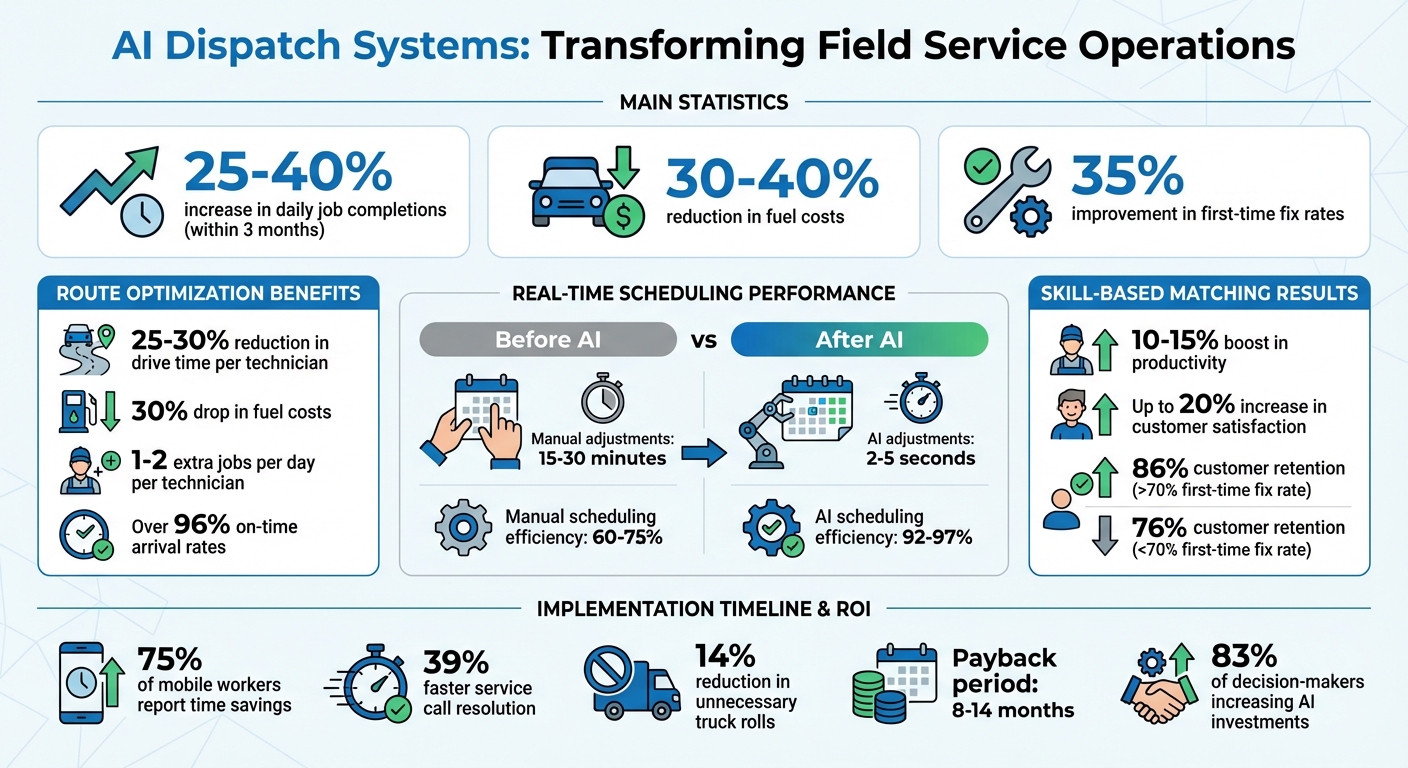
AI dispatch systems are transforming field service management by automating technician scheduling, routing, and job prioritization. These systems analyze vast amounts of data - such as technician skills, GPS locations, and job urgency - in seconds, outperforming manual methods. Businesses adopting AI dispatch report:

  • 25–40% increase in daily job completions within three months.
  • 30–40% reduction in fuel costs due to optimized routes.
  • 35% improvement in first-time fix rates by matching technicians to jobs more effectively.

AI dispatch adapts to real-time changes, like traffic or emergencies, ensuring high-priority tasks are handled promptly. Companies like Electrolux have saved millions annually by cutting travel time and improving efficiency. Whether you're addressing technician shortages, reducing costs, or meeting customer expectations, improving call handling, AI dispatch offers a faster, smarter way to manage field operations.

Want to implement AI dispatch? Start by evaluating your needs, ensuring clean data, and launching a small pilot project. With proper training and performance tracking, AI dispatch can significantly enhance your operations and customer satisfaction.

AI Dispatch Systems Impact on Field Service Operations: Key Performance Metrics

AI Dispatch Systems Impact on Field Service Operations: Key Performance Metrics

AI vs Manual Dispatching: Traditional Dispatch vs AI Dispatch Explained

Core Features of AI Dispatch Systems

AI dispatch systems are designed to tackle three key challenges in field service management: route optimization, real-time schedule adjustments, and skill-based technician matching. These features work together to cut down on travel time, improve response speed, and ensure the right technician is assigned to each job. The result? A streamlined and efficient field service operation.

Route Optimization and Cutting Travel Time

Route optimization goes beyond simply finding the shortest path. It solves the Vehicle Routing Problem (VRP) by calculating the most efficient sequence of stops. This includes factoring in technician skills, job duration, traffic conditions, customer time windows, and even vehicle capacity.

Companies utilizing AI for route optimization often see significant benefits:

  • A 25–30% reduction in average drive time per technician.
  • A 30% drop in fuel costs.
  • The ability for technicians to handle 1–2 extra jobs per day without extending their shifts.

Additionally, AI-powered scheduling can achieve on-time arrival rates of over 96%.

"AI route optimization determines the most efficient order for your technicians to visit jobs, not just the shortest path, but the sequence that saves the most time, fuel, and headaches." - Fieldcamp

Real-Time Scheduling with Automatic Adjustments

Unexpected disruptions, like traffic jams, emergency requests, or technician absences, can throw a wrench into any schedule. AI dispatch systems handle these challenges by recalculating routes in just 2–5 seconds - far faster than the 15–30 minutes it typically takes to make manual adjustments.

The system continuously tracks real-world conditions, including technician locations, current workloads, and unforeseen delays, making dynamic adjustments as needed. This level of agility boosts scheduling efficiency from 60–75% with manual processes to an impressive 92–97% with AI.

Skill-Based Technician Matching

AI dispatch systems create detailed technician profiles, incorporating certifications, training, communication skills, and performance history. When a job request comes in, the system applies strict "hard filters" to ensure the assigned technician meets all required qualifications. If no match is found, the job remains unassigned to avoid service failures.

The system also considers specific equipment needs, like assigning technicians with access to a bucket truck or crane when necessary. This meticulous approach leads to:

  • A 10–15% boost in productivity.
  • Up to a 20% increase in customer satisfaction.

Moreover, companies with a first-time fix rate above 70% retain 86% of their customers, compared to just 76% for those with lower rates.

Factor Manual Dispatching AI-Powered Dispatching
Matching Logic Relies on memory; may overlook technician skills Algorithmic matching ensures the best fit
Emergency Handling Time-consuming manual rescheduling Quickly assigns the nearest qualified technician
Workload Distribution Often uneven, leading to overwork or idle time Effectively balances workloads
Accuracy Prone to scheduling conflicts and errors Automation minimizes mistakes

How to Implement AI Dispatch in Your Business

Ready to bring AI dispatch into your operations? Here's a step-by-step guide to help you integrate it effectively.

Evaluate Your Current Dispatch Needs

Start by pinpointing your biggest challenges. Are you dealing with high-friction tasks like managing after-hours calls, appointment reminders, or service requests? These are prime candidates for automation. Your dispatch team can also provide valuable insights into recurring system issues or complex exceptions that might be tricky for AI to handle.

Next, take a hard look at your data. AI thrives on clean, well-organized information. Assess whether you have accurate data on technician locations, job durations, required skills, and parts inventory. As ServicePower warns:

"Feeding the system biased or incomplete data will yield faulty results, putting a layer of doubt on all reports and conclusions".

To avoid this, consolidate information from IoT sensors, repair logs, and work orders into a centralized system.

You’ll also want to categorize your tasks. Separate repetitive jobs - like standard inspections - that AI can fully automate from complex scenarios that still require human intervention. Finally, ensure any potential AI solution integrates seamlessly with your existing systems, such as FSM, ERP, or CRM platforms, for real-time data syncing. With AI adoption accelerating - 83% of decision-makers plan to boost AI investments next year, and by 2025, over two-thirds of field service tasks will likely be scheduled using machine-learning algorithms - there’s no better time to prepare.

Select Your Implementation Method

Once you’ve clarified your needs and ensured your data is ready, it’s time to choose an implementation strategy. Start small with a pilot project. This allows you to test the waters, gather feedback, and refine the system before scaling up. For instance, you could begin with AI-powered scheduling for a single service line or use an AI knowledge base to assist technicians. A water system installation company in 2025 used this approach, cutting technician training time from months to just two weeks.

Your implementation method will depend on the size and complexity of your business:

  • AI-assisted manual dispatch: Ideal for smaller teams where dispatchers rely on AI recommendations but make the final decisions.
  • Hybrid systems: AI handles routine scheduling, while human dispatchers focus on emergencies or complex tasks.
  • Full automation: Best suited for larger operations with standardized workflows, where AI can manage most dispatch decisions independently.

For quick results, focus your initial efforts on route optimization. Many companies using AI for this purpose report a 30–40% drop in fuel costs and the ability to complete 1–2 extra jobs per technician daily.

Train Your Team on the New System

With your implementation plan in place, it’s time to prepare your team. Start by defining clear roles for AI and human dispatchers. Spell out which tasks the AI will handle - like routine scheduling - and when humans need to step in, such as during emergencies. As BCG emphasizes:

"Transparency drives trust, and trust drives usage".

Encourage a data-driven mindset within your team. Shift from traditional methods to decisions based on data insights. Build in human oversight so technicians can flag inaccurate AI recommendations, helping the system improve over time. Also, ensure the AI explains its decisions - people are far more likely to trust tools when they understand the reasoning behind them.

A great example comes from a European rail operator that implemented AI-optimized task sequencing and XR glasses in July 2025. Experienced technicians boosted efficiency by 20%, while new hires improved by nearly 30%. Over five years, the company expects to save $200 million - all thanks to structured training and clear communication about how the AI works.

Finally, standardize your intake processes. Use checklists to ensure the data entered into the system is accurate and complete. Platforms like Trailhead can provide structured training to get your team up to speed. With over 75% of mobile workers already reporting time savings from AI, proper training will ensure your team benefits too.

How to Measure AI Dispatch Performance

Implementing AI dispatch is just the beginning - measuring its performance consistently is what ensures you’re making real progress. Once integrated, it’s crucial to track specific metrics to confirm the system is delivering tangible improvements.

Key Metrics to Track

To gauge operational efficiency, keep an eye on metrics like jobs completed per day and technician utilization. These figures help you understand how effectively your team is working, showing how much of a technician’s shift is spent on billable tasks versus downtime.

Time-related metrics are another important category. Metrics such as average travel time and time to site provide insight into how well the system is optimizing routes and predicting ETAs. Additionally, tracking mean time to repair (MTTR) and mean time to complete a job reveals how quickly your service cycle operates overall.

Quality-focused metrics shed light on whether the AI is assigning the right technician to the right job. First-time fix rate (FTFR) is a key indicator here, as it reflects proper technician-job alignment. Monitoring repeat visit rates can also highlight where further adjustments are needed.

Customer satisfaction (CSAT) and average response time are essential for understanding the customer experience. These metrics indicate how well your AI dispatch system is meeting customer expectations. Lastly, track SLA compliance to ensure high-value service agreements are being prioritized, and monitor average ticket price to see if the system is identifying upselling opportunities.

Metric Category What to Track Why It Matters
Efficiency Jobs per day, technician utilization Maximizes workforce productivity
Response Time to site, average travel time Measures the impact of route optimization
Quality First-time fix rate, repeat visit rate Ensures proper technician-job matching
Financial Job profitability, SLA compliance Evaluates revenue impact and contract adherence
Customer CSAT score, average response time Tracks improvements in customer experience

By tracking these metrics, you can use analytics to identify and address operational challenges.

Leveraging Analytics for Operational Improvements

AI dispatch systems come equipped with powerful analytics tools that can pinpoint where your operations might be falling short. For example, these tools can identify delays, whether they occur during travel or on-site work.

Real-time dashboards are another valuable feature. They flag at-risk jobs, allowing you to reassign tasks quickly and prevent minor setbacks from turning into major customer complaints. Analytics can also reveal workload imbalances, helping you adjust assignments to prevent burnout among your technicians. Companies that have adopted AI dispatch systems report resolving service calls 39% faster on average.

Predictive maintenance is another area where analytics shine. By analyzing sensor data and historical trends, AI can forecast equipment failures before they happen. This proactive approach reduces emergency calls and enhances customer satisfaction.

Additionally, AI dispatch systems can cut down on unnecessary truck rolls by about 14%, leading to cost savings and greater efficiency.

Calculating Your Return on Investment

The improvements in efficiency and quality brought by AI dispatch systems often translate into financial gains. Calculating your return on investment (ROI) will help you confirm the value of your investment. Start by establishing baseline metrics from before implementation, such as case volume, labor costs (including overtime), fuel expenses, and first-time fix rates.

Next, quantify the benefits. These could include reduced overtime costs (typically 20% to 35% savings with AI), improved first-time fix rates (which often rise from 70–75% to 85–92%), and lower fuel consumption through route optimization (usually a 15% to 25% reduction in drive time). AI dispatch systems also enable technicians to complete an additional 2 to 3 jobs per day.

Factor in the costs of licensing, implementation, migration, subscription fees, and training. Then, use the standard ROI formula: (Total Benefits - Total Costs) / Total Costs.

Most organizations see a payback period of 8 to 14 months. For instance, a $50,000 system generating $6,000 in monthly savings would pay for itself in just over eight months.

"A well-thought-out ROI model helps quantify the tangible savings, efficiency improvements, and potential revenue gains that can result from these technology implementations." – Circuitry.AI

It’s wise to be conservative with your projections. Use a ramp-up model that assumes you’ll capture 80% of projected benefits in Year 1, 85% in Year 2, and 90% in Year 3 to account for the learning curve and system fine-tuning. Don’t forget to consider intangible benefits like improved customer retention and reduced technician turnover, which can have a major impact on long-term ROI.

Conclusion: Getting Started with AI Dispatch

AI dispatch systems can completely reshape field service operations, offering measurable gains across the board. Businesses often report a 25–40% boost in job completion rates within just three months, alongside 30–40% reductions in fuel costs and a 35% increase in first-time fix rates. These systems don’t just improve efficiency - they redefine it.

To get started, consider launching a pilot project. Begin with accurate and complete data, and test the system in a single territory or service line. Use the results to fine-tune the setup before rolling it out on a larger scale.

Transitioning to AI dispatch requires supporting your team through the learning process. Focus on training them to trust AI recommendations, understand when manual overrides are necessary, and use mobile apps for real-time updates. While the adjustment period is real, 75% of mobile workers report saving time once they’ve adapted to AI tools.

With 83% of decision-makers planning to increase AI investments next year, waiting to implement AI dispatch could mean falling behind in efficiency and customer satisfaction. The real question isn’t whether to adopt AI - it’s how quickly you can make it work for your business.

Looking to take it a step further? Integrate tools that complement your AI dispatch system. For example, AI-powered phone answering services like Answering Agent can handle customer calls 24/7, book appointments directly into your calendar, and automatically capture lead information. This not only reduces your team’s administrative workload but ensures no customer call goes unanswered, creating a seamless experience from the first contact to job completion.

FAQs

How can AI dispatch systems increase first-time fix rates in field service operations?

AI-powered dispatch systems take efficiency to the next level by ensuring the right technician is sent to the right job at the right time. These systems use advanced algorithms to evaluate key factors such as technician expertise, available tools, inventory, location, traffic conditions, and the urgency of the task. The result? The most qualified technician is assigned to each job, reducing the risk of arriving unprepared or missing essential parts. This leads to fewer repeat visits and less downtime.

What’s more, AI dispatch systems are dynamic. They adapt in real time to unexpected changes like traffic delays or last-minute cancellations, updating routes and schedules on the fly. This means technicians spend more time on the job and less time stuck in transit, boosting overall productivity. For businesses, this streamlined approach not only enhances first-time fix rates and customer satisfaction but also helps cut operational costs.

What are the key steps for implementing AI-powered dispatch in a field service business?

To implement an AI-powered dispatch system in your field service business, start by reviewing your current workflow to pinpoint inefficiencies and identify where automation can make a difference. Then, centralize essential data - like customer profiles, service history, and technician skill sets - into a single, easily accessible platform.

With your data organized, set clear job prioritization rules based on factors like urgency, location, or the expertise required. Choose an AI dispatch platform that integrates smoothly with your existing systems. Begin with a pilot program on a smaller scale, tracking metrics such as response times and first-time fix rates. Use the insights gathered to refine the system before rolling it out company-wide.

Once fully implemented, establish a process for ongoing monitoring to keep improving efficiency. These steps can help streamline your operations, boost technician productivity, and deliver a better experience for your customers.

How can businesses evaluate the ROI of AI-powered dispatch systems?

To evaluate the ROI of an AI-powered dispatch system, start by identifying key metrics that reflect your current operations. These might include average dispatch time, travel mileage, technician labor costs, first-time fix rates, and customer satisfaction (CSAT) scores. These benchmarks will help you gauge the system's impact once it's in place.

Next, track measurable improvements such as shorter travel times, reduced overtime expenses, more jobs completed daily, or higher revenue per service call. Don’t overlook indirect advantages like improved CSAT scores, lower customer churn, and new opportunities for upselling, as these can drive long-term growth.

To calculate ROI, use this formula: (Net Benefit ÷ Total Investment) × 100. Start by subtracting the total costs - like software, training, and maintenance - from the financial gains the system delivers. Regularly review your performance data, refine your metrics, and optimize the system to ensure it continues delivering value over time.

Related Blog Posts

Answering Agent