
Missed calls are a hidden revenue drain for businesses. 74.1% of calls to home service providers go unanswered, costing contractors up to $260,400 annually. Worse, 85% of customers don’t call back, and 80% hang up without leaving a message, often turning to competitors instead. For small businesses, limited staff and after-hours gaps amplify these losses.
AI CRM systems solve this by answering calls instantly, qualifying leads, and syncing data to your CRM in real time. Businesses using AI tools report recovering hundreds of thousands in lost revenue annually. For example, an HVAC company reduced missed calls from 61% to 4%, recovering $856,000 in a year.
Key takeaways:
- Missed calls cost businesses $30,000–$60,000 annually on average.
- AI-powered systems answer calls in under 5 seconds and handle unlimited simultaneous inquiries.
- These tools cost as little as cost as little as $199/month, significantly less than hiring staff99/month, offering a favorable cost-benefit breakdown compared to hiring staff or using live answering services.
- Real-world examples show businesses recovering up to 40% of lost revenue within months.
Conclusion: AI CRM systems ensure you never lose a lead to unanswered calls, turning missed opportunities into growth.
Stop Bleeding $86K/Year: How AI Captures Missed Calls for Service Businesses
sbb-itb-abfc69c
What Missed Calls Cost Your Business
The True Cost of Missed Calls: Revenue Loss by Industry
Lost Revenue from Unanswered Calls
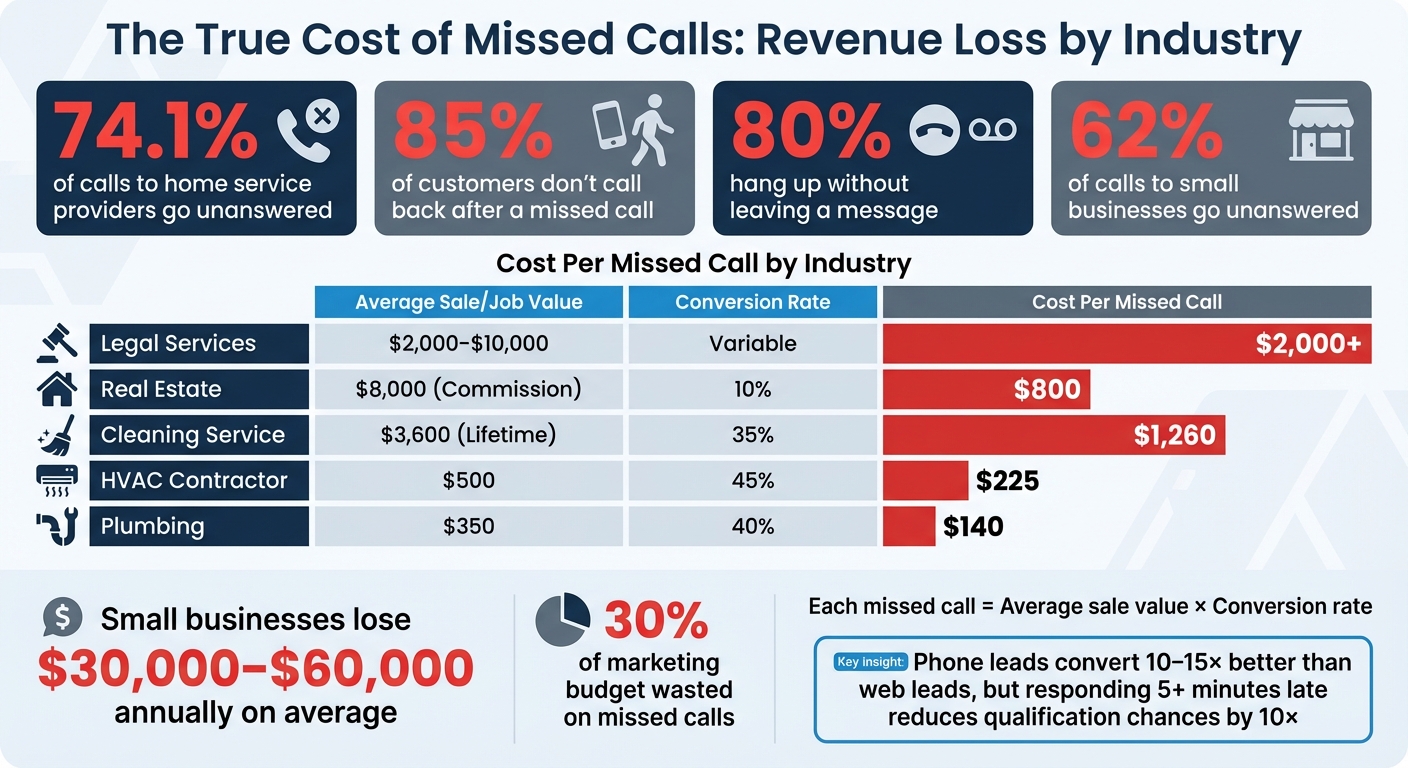
Every missed call comes with a price tag: average sale value × conversion rate. Take a plumbing company as an example - if their average job is $350 and their conversion rate is 40%, they lose $140 for each missed call.
The numbers are staggering: 62% of calls to small businesses go unanswered, and 85% of those callers won't bother calling back. Instead, they go straight to a competitor. This creates a "leaky bucket" scenario, where about 30% of your marketing budget goes down the drain when calls are missed. For many small businesses, this translates to $30,000 to $60,000 in lost revenue every year.
Now, add in the concept of Customer Lifetime Value, and the losses multiply. In March 2024, Dr. Sarah Chen, who owns a dental practice in Austin, TX, discovered her practice was missing 42% of calls during business hours and 100% of after-hours calls. With each patient worth $800–$1,200 annually, this added up to $327,600 in lost revenue per year. After introducing an AI receptionist, she reduced her missed call rate to 3% and recovered $316,000 in revenue within the first year.
Here’s a look at the cost of missed calls across different industries:
Industry Average Sale/Job Value Conversion Rate Cost Per Missed Call Legal Services $2,000–$10,000 Variable $2,000+ Real Estate $8,000 (Commission) 10% $800 Cleaning Service $3,600 (Lifetime) 35% $1,260 HVAC Contractor $500 45% $225 Plumbing $350 40% $140
Phone leads are gold - they convert 10–15 times better than web leads. But there’s a catch: if you delay responding by more than five minutes, your chances of qualifying that lead drop tenfold. Mike Torres, an HVAC company owner in Phoenix, AZ, learned this the hard way. During peak summer months, his business had a 61% missed call rate, leading to $892,000 in lost revenue annually. After switching to 24/7 AI answering, his missed call rate dropped to 4%, and same-day bookings jumped by 156%, allowing him to recover $856,000 in the first year.
While the financial losses are alarming, the damage to customer trust can be even more costly.
How Missed Calls Damage Customer Relationships
Missed calls don’t just hurt your bottom line - they erode trust with your customers. When people can’t reach you, they often assume you’re either too busy to care or that you’ve gone out of business. Here’s the reality:
- 67% of customers hang up in frustration when they can’t reach a live person.
- 70% will abandon your brand entirely due to poor customer service, including unresponsiveness.
And it doesn’t stop there. 95% of people who experience bad customer service will tell at least one other person about it, while 54% will share their frustration with five or more people. That means losing one customer could cost you 3–5 potential referrals. Worse, 32% of dissatisfied customers will leave a negative online review, and it takes a whopping 40 positive reviews to offset the damage from just one bad one-star review.
"A missed call is not just a missed conversation. It is a missed opportunity with a real dollar value attached to it."
– PreCallAI
Speed matters too - 78% of consumers choose the company that responds to them first. Rebecca Morrison, a Managing Partner at a Denver-based law firm, saw this play out firsthand. Her firm had a 29% missed call rate during business hours, with 100% of after-hours inquiries going unanswered. The result? A staggering $573,000 in lost revenue annually. As she put it: "Missing that initial call meant losing the case entirely. Now we never miss an opportunity." After implementing AI answering, her firm recovered $547,000 in the first year.
The combined impact of lost revenue and damaged reputation makes how AI receptionists boost revenue a no-brainer for businesses that want to grow and thrive.
How AI CRM Systems Capture Missed Call Leads
Turning missed calls into opportunities is no longer a challenge with modern AI-driven CRM systems. These tools ensure that missed calls don’t mean missed revenue by instantly responding to callers, qualifying leads in real time, and feeding structured data directly into your sales pipeline - all without any manual effort.
AI Phone Answering Converts Calls into Leads
AI-powered systems answer calls in less than five seconds, using natural, conversational tones to engage callers. This quick response is crucial since 78% of customers prefer businesses that reply the fastest. Unlike traditional voicemail services, these systems don’t just record messages - they interact with callers, asking about their needs, budget, and timeline while keeping the conversation alive.
Take Answering Agent as an example. This system operates 24/7 with an impressive 99.93% accuracy rate across over 17,700 scored calls, ensuring reliable and accurate information delivery. Beyond answering questions, it handles FAQs, shares pricing details, and even promotes special offers during the conversation.
"Answering Agent has helped us cut costs while actively generating new revenue. It promotes our special offers and even signs customers up for our text club, following up instantly with links - something a traditional service can't match."
– Jacksons Car Wash
Unlike human receptionists who can only handle one call at a time, AI systems manage unlimited simultaneous calls. This eliminates busy signals, even during peak hours.
Automatic Lead Qualification and CRM Data Entry
AI systems don’t just pick up the phone - they qualify leads on the spot. By analyzing factors like the caller’s needs, location, and urgency, they ensure your sales team receives warm leads that are ready to close, saving time and effort.
Details like the caller’s name, contact information, call transcripts, and AI-generated summaries are automatically synced to popular CRMs like Salesforce, HubSpot, or Zoho within seconds. This eliminates the need for manual data entry, streamlining your workflow.
"The AI summary allows me to review the customer information before calling back the customer, minimizing call time."
– Waves Car Wash
Speed matters here: conversion rates are 8x higher when you respond within five minutes rather than ten. AI systems can even detect urgency keywords like “emergency” or “ASAP,” instantly routing critical calls to a live technician’s mobile phone. This instant data flow not only improves response times but also drives better results for your business.
Handle More Calls at Lower Cost
When it comes to cost, the numbers speak for themselves. A human receptionist costs approximately $35,000 annually (or $2,900 per month) for 40 hours of weekly coverage. Traditional answering services, on the other hand, charge $500–$800 per month for 100–200 calls, with overage fees of $1.50–$2.50 per minute.
AI systems like Answering Agent provide 24/7/365 coverage for just $199 per month, handling unlimited calls. That’s a 93% savings compared to hiring an in-house receptionist.
Feature AI Phone Answering Human Receptionist Traditional Answering Service Availability 24/7/365 (168 hrs/week) 9-5 (40 hrs/week) 24/7 (Live agents) Simultaneous Calls Unlimited One at a time Limited by staff Response Time Under 5 seconds 15–30+ seconds 30+ seconds Data Entry Instant CRM sync Manual entry Manual notes/messages Cost ~$199/month ~$2,900/month $500–$800/month + overages
AI systems handle up to 85% of routine inquiries, freeing your team to focus on more complex sales and customer service tasks. All of this happens without breaks, delays, or added costs.
Metrics That Show If Your AI CRM Is Working
Tracking the right metrics is essential to ensure your AI-powered CRM isn't just answering missed calls but is actively transforming them into revenue. Here are three key metrics to focus on for assessing performance.
Call Answer Rates and Conversion Improvements
The call answer rate reflects the percentage of inbound calls answered, and top systems aim to handle 80% of calls within 20 seconds. Before AI, many businesses struggle to meet this benchmark, especially during peak times like lunch hours or after 5:00 PM. AI can change the game, enabling near-perfect answer rates by managing unlimited simultaneous calls without busy signals.
Another critical metric is the call-to-consultation rate, which measures how many answered calls turn into appointments or leads. In industries like home services, this rate typically sits around 37%. Acting fast makes a huge difference - responding within five minutes increases your chances of qualifying a lead by 21 times compared to waiting 30 minutes.
Reducing abandoned calls is another way to boost engagement and conversions.
Fewer Abandoned Calls
The abandonment rate tracks how often callers hang up before reaching someone. High-performing systems keep this rate between 3% and 5%. Traditional staffing struggles to handle peak call volumes, leading to higher abandonment rates. AI systems, however, answer calls in under five seconds, significantly reducing this issue.
Here’s why this matters: 93% of callers won’t try again after encountering a busy signal, and 67% are unlikely to call back after being sent to voicemail. Each abandoned call can cost a business around $450. By monitoring and addressing abandonment trends, you can fine-tune your AI system for even better results.
Calculating Your Return on Investment
Improved call handling and fewer abandoned calls directly impact your bottom line. To calculate your AI receptionist ROI, estimate your monthly revenue loss by multiplying the number of missed calls by the average customer value. For instance, if a business loses 50 calls per month and each call is worth $450, that’s $22,500 in lost revenue.
Subtract your AI system’s monthly cost from this figure to determine ROI. AI solutions are often much cheaper than hiring additional staff, and converting even one missed call into a lead can justify the expense. Businesses using Voice AI have reported revenue increases of up to 40% within the first month, with annual ROI typically ranging between 300% and 400%. Most systems see payback within three to six months.
Metric Target/Benchmark What It Measures Call Answer Rate 80% within 20 seconds Responsiveness and accessibility Abandonment Rate 3%–5% Leads lost to wait times Lead Response Time Under 5 minutes Speed advantage for qualification Annual ROI 300%–400% Financial gain vs. system cost
Review these metrics monthly to ensure your system is on track. If your answer rate isn’t nearing 100%, consider tweaking your AI setup. Similarly, flat conversion rates may indicate your AI’s intent recognition needs improvement - it should achieve 85%–90% accuracy in understanding caller needs. The best-performing systems consistently use call data to refine and optimize their intake processes.
What to Consider Before Choosing an AI CRM Solution
When selecting an AI CRM, focus on how well it aligns with your business needs, integrates with your existing systems, and delivers reliable data. Here’s a closer look at the factors that set effective AI CRM solutions apart.
Customization for Your Industry
A one-size-fits-all approach rarely works for specialized industries. For example, a car wash might need workflows tailored to handle membership cancellations, while an HVAC company must prioritize emergency calls during extreme weather. The best AI CRM solutions allow you to train the system using industry-specific resources - like FAQs, pricing sheets, and promotional schedules - so it accurately reflects your business.
Take Answering Agent, for instance. It offers a white-glove setup to fine-tune business rules, messaging, and lead qualification processes for industries like home services, legal practices, medical offices, staffing agencies, and car washes. Companies like Jacksons Car Wash have successfully used this tool to improve lead conversion rates.
You can also customize lead qualification by setting specific questions about budget, timelines, locations, and decision-making authority. This ensures high-value leads are routed directly to your team. Additionally, you can map CRM fields such as "Urgency Level", "Service Interest", and "Callback Requested" to prioritize leads automatically. For example, urgency keywords like "emergency" appear in about 15.9% of calls, potentially increasing revenue by up to 20%.
Connecting with Your Current CRM
Seamless integration is essential for maintaining an efficient workflow. If your AI CRM doesn’t sync appointment details or caller histories automatically, you risk losing key opportunities. Look for solutions that offer bi-directional data flow with popular platforms like Salesforce, HubSpot, and Zoho.
Integration methods can range from simple to complex. Native integrations often feature a straightforward "click-to-connect" setup and take around 30–60 minutes to configure. Middleware tools like Zapier can manage more intricate workflows, such as routing calls to your CRM while triggering Slack notifications, typically within 1–2 hours. For businesses needing custom solutions, APIs and HTTP webhooks offer maximum flexibility, though these setups may require 1–2 weeks of technical work. (Salesforce Professional Edition users should note that API access may cost an extra $25 per user per month.)
Always test integrations with sample data to ensure everything works as expected. For example, confirm that webhooks trigger correctly and CRM fields populate accurately. Setting up automated SMS or email confirmations immediately after a call is logged can also drive conversions. Studies show that 78% of customers choose the first vendor to respond, and responding within five minutes can boost conversion rates by up to eight times.
Accuracy Rates and Clear Pricing
Accuracy is a non-negotiable feature in an AI CRM. Leading solutions achieve over 99% accuracy when logging structured lead data, whereas human agents often have a 5–10% error rate. Answering Agent, for example, records a 99.93% accuracy rate across more than 17,700 scored calls, with a minimal 0.07% hallucination rate. This ensures that critical details - like lead information, appointment times, and service requests - are captured correctly on the first attempt.
Pricing transparency is equally important. Traditional live services typically cost $500–$800 per month, plus additional per-minute charges. In contrast, AI-powered solutions like Answering Agent offer flat-rate pricing, usually around $199 per month, for unlimited calls and 24/7 availability. This pricing model not only simplifies budgeting but also eliminates surprise costs during busy periods.
Here’s a quick comparison:
Feature AI CRM Solution Traditional Live Service Cost ~$199/month flat $500–$800+ per month Data Accuracy 99%+ (Structured) 5–10% error rate Answer Speed <5 seconds 15–30+ seconds Scalability Unlimited concurrent calls Limited by agent count
Ensure your provider offers a clear process for escalating complex cases. In fields like legal or medical, a hybrid model - where AI handles routine tasks and human agents manage more nuanced conversations - can provide an optimal balance of efficiency and expertise.
Conclusion
Missed calls can quietly drain revenue, pushing potential customers toward competitors. But with AI CRM solutions, this issue becomes entirely avoidable. These tools answer calls in under 5 seconds, qualify leads automatically, and sync directly with your CRM - turning a common business headache into an opportunity for growth.
AI-powered systems offer round-the-clock availability, lightning-fast response times, and cost savings compared to traditional methods. They handle every inquiry, whether during business hours or after, freeing your team to focus on delivering exceptional service.
Take Answering Agent, for example. This platform has shown impressive accuracy and conversion rates. Businesses like Jacksons Car Wash have used it to sell memberships and gather text club leads, achieving results far beyond what traditional answering services can provide. And with the ability to manage unlimited calls simultaneously, there's no risk of losing customers during peak times - whether it's a storm season surge for contractors or a weekend rush for car washes.
The numbers speak for themselves: 78% of customers choose the first business to respond, and conversion rates jump 8x when you respond within 5 minutes. AI CRM solutions ensure you're always the first to answer, transforming missed calls into leads, appointments, and sales. For businesses aiming to grow, the real question isn't whether to adopt AI - it’s how quickly you can get started.
FAQs
How do I calculate what a missed call is worth for my business?
To figure out how much missed calls are costing you, use this simple formula: Missed Calls × Close Rate × Job Value = Lost Revenue. By plugging in your numbers, you can see the potential revenue slipping through the cracks. This insight highlights the financial impact of missed calls and shows where you can step up your lead capture efforts.
Can an AI phone answering CRM work with my current CRM and scheduling tools?
Yes, AI-powered phone answering CRM solutions can connect with your current CRM and scheduling tools. This integration enables smooth handling of tasks like call logging, capturing leads, scheduling appointments, and automating workflows, helping to simplify operations and boost productivity.
How do I know the AI is accurate and when to route calls to a human?
Answering Agent delivers an impressive 99.93% accuracy rate over 17,724 calls, showcasing consistent and dependable performance. When the AI encounters uncertainty or more intricate problems, it seamlessly transfers the call to a human agent, ensuring users receive the support they need without interruptions.
Related Blog Posts
Book a walkthrough
See it handle your calls.
Book 20 minutes, or hear a sample call first.
Ready to see it handle your calls?
Book a walkthrough, or hear a short sample call first.
Related Articles
AI Call Routing Integration with Medical CRMs
AI call routing tied to medical CRMs cuts missed calls, automates scheduling and documentation, and enforces HIPAA-secure data flows.
AI Answering and CRM Sync: Setup Tips
Turn missed calls into tracked leads by integrating AI answering with your CRM—audit data, map fields, test, and monitor sync.
How To Measure Lead Conversion From Calls
Measure phone call lead conversions: define conversion criteria, track qualified calls, analyze post-call outcomes, and calculate conversion rate.