Scaling Service Businesses with AI Answering
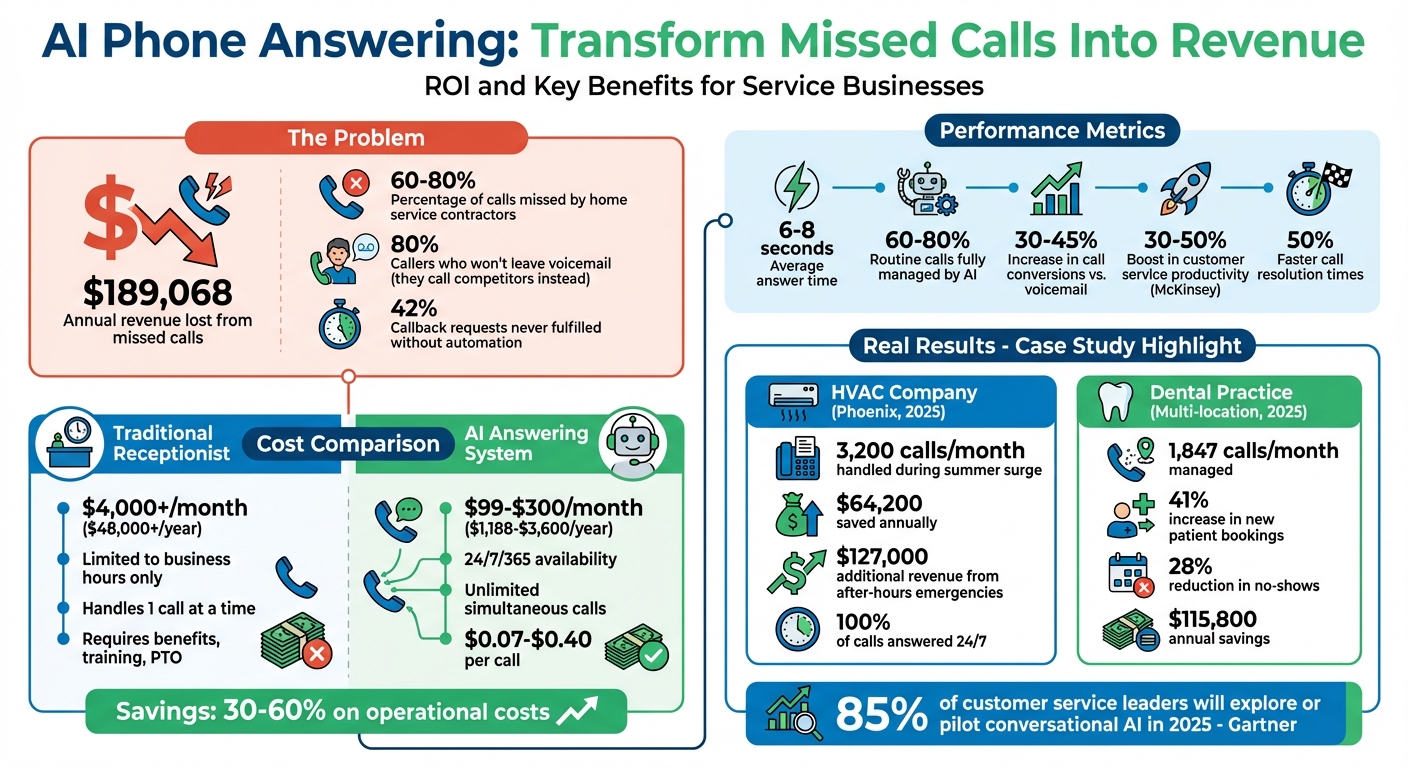
Missed calls cost service businesses thousands annually - up to $189,068 per year. AI phone answering systems solve this by handling calls instantly, 24/7, at a fraction of the cost of human receptionists. These systems manage routine calls, book appointments, and escalate emergencies, saving money and boosting revenue. For example, an HVAC company saved $64,200 annually and increased revenue by $127,000 after switching to AI.
Key Benefits:
- Cost Savings: $99–$300/month vs. $4,000+/month for human staff.
- Efficiency: Handles 60–80% of routine calls and reduces costs per call to $0.07–$0.40.
- Revenue Growth: Captures after-hours leads, increasing conversions by 30–45%.
- Scalability: Manages unlimited calls simultaneously, even during peak seasons.
AI answering systems are a simple, effective way to reduce missed calls, lower expenses, and increase customer satisfaction. With tools like Answering Agent, businesses can scale without hiring additional staff, ensuring every call turns into an opportunity.
AI Phone Answering ROI: Cost Savings and Revenue Impact for Service Businesses
AI Phone Agents 101 For Business Owners (2025)
sbb-itb-abfc69c
How AI Helps Service Businesses Scale
Rising call volumes put service businesses in a tough spot: hire more staff at a high cost or risk losing revenue. AI phone answering systems, powered by Automatic Speech Recognition (ASR) and Natural Language Processing (NLP), offer a smarter solution. These systems convert speech to text, understand the intent and urgency behind calls, and even detect emotions like frustration or stress. This means urgent calls are flagged and prioritized, ensuring no critical issues slip through the cracks. By handling large volumes of calls consistently, AI allows businesses to scale without sacrificing service quality.
Unlike human receptionists who can only manage one call at a time, AI systems can handle dozens - or even thousands - simultaneously. Plus, when integrated with tools like CRMs and calendars via APIs, these systems can automatically book appointments, update customer records, and capture lead details. This eliminates the need for manual data entry and ensures smoother operations, tackling the common challenges associated with high call volumes.
Common Call Volume Problems for Service Businesses
The numbers paint a clear picture of the challenges service businesses face. Home service contractors, for instance, miss 60% to 80% of incoming calls. Imagine a business receiving 1,500 calls a month but missing 70% - that’s 1,050 potential bookings lost. Other industries face similar struggles. Medical practices often deal with overwhelmed front desks during peak hours, law firms risk losing clients to faster competitors, and electricians waste time fielding spam calls, which make up 15.5% of their total calls.
Urgent calls add another layer of complexity. Research shows that 15.9% of service calls include urgency-related language like "ASAP" or "emergency", but only 6.2% are actual emergencies. When these high-priority calls go to voicemail, 80% of callers won’t leave a message - they’ll just move on to the next business.
The situation gets worse with callbacks. About 25.4% of callers specifically ask for a callback, but 42% of these requests are never fulfilled without automated systems in place. Traditional fixes, like hiring more receptionists, aren’t scalable. Each additional receptionist costs $40,000–$50,000 annually and is only available during business hours. This leaves after-hours emergencies - worth an average of $1,200 for home service businesses - unanswered, compared to $400 for routine jobs.
How AI Phone Answering Fixes These Problems
AI phone answering systems turn these challenges into opportunities. Tools like Answering Agent can pick up calls in just 6 to 8 seconds, engaging in natural, conversational interactions. Using intent recognition, the AI categorizes calls and takes appropriate actions - whether that’s scheduling an appointment or escalating an emergency. For example, if a plumber’s AI hears terms like "burst pipe" or "flooding", it can immediately connect the caller to an on-call technician while logging the issue in the dispatch system.
Available 24/7 without concerns about overtime or shifts, AI systems can handle unlimited calls at once. During peak hours, they ensure your lines stay open by integrating with tools like Google Calendar, Outlook, and CRMs to book appointments in real time. This approach can convert 30–45% more calls compared to voicemail alone. For more nuanced situations, advanced hybrid escalation allows the AI to transfer complex or emotionally charged calls to a human agent, complete with a detailed summary of the interaction.
AI can fully manage 60% to 80% of routine calls, freeing human staff to focus on more complicated issues. According to McKinsey, this technology boosts customer service productivity by 30% to 50%. And the cost savings are hard to ignore: AI answering services typically cost $99 to $300 per month, far less than the $600–$1,200 monthly price tag for live vs automated phone services or the $4,000+ needed for a full-time receptionist. Gartner highlights the growing adoption of this technology, noting that "85% of customer service leaders will explore or pilot conversational AI in 2025".
How to Scale Your Business with AI Answering
Use AI phone answering to manage calls more efficiently, reduce missed opportunities, and increase revenue. Here's how to get started in five steps.
Step 1: Review Your Current Call Volume and Gaps
Start by analyzing the past 30 days of call logs to spot patterns in missed opportunities. Routine tasks like answering questions about business hours, pricing, or scheduling make up 60% to 80% of calls - perfect for AI to handle. Look for words like "emergency" or "ASAP" in your logs to gauge urgency. Interestingly, while 15.9% of calls include urgency-related language, only 6.2% are actual emergencies.
To measure revenue loss, multiply the number of missed calls by your average close rate and project value. Once you understand where you're losing out, you can set up an AI answering agent to fill those gaps.
Step 2: Set Up Answering Agent

Choose a plan that fits your business size and call volume. Here’s a quick comparison:
| Feature | Basic Plan | Enterprise Plan |
|---|---|---|
| Availability | 24/7 coverage | 24/7/365 coverage |
| Call Capacity | Standard volume handling | Unlimited simultaneous calls |
| Integrations | Basic calendar sync | Full CRM integration with API access |
| Voice Options | Standard AI voices | Custom brand voice training |
| Analytics | Standard call logs | Advanced dashboards with sentiment analysis |
| Support | Email and web support | Dedicated account manager |
| Best For | Small teams or solopreneurs | Multi-location or high-volume businesses |
Setup is quick - choose a new number or port your existing one. Input your business hours, department structure, and call preferences. Start small by using AI for peak-hour overflow, then expand to full 24/7 coverage. This gradual rollout minimizes disruptions while testing the system.
Once the basics are in place, focus on customizing the AI to match your brand.
Step 3: Customize Scripts and Voices
Pick a voice that aligns with your brand's personality. For instance, a legal firm might prefer a calm, professional tone, while a home repair service might go for something more approachable.
Design decision trees for common scenarios like scheduling, billing questions, or emergencies. Use visual editors to map out logical conversation paths. Upload key documents - FAQs, pricing, and policies - so the AI can provide accurate answers.
To maintain consistency, define words or phrases the AI should always use (or avoid). Test edge cases like background noise or accents to fine-tune performance. With these adjustments, your AI will sound natural and handle inquiries more effectively.
Step 4: Set Up Lead Capture and Appointment Booking
Integrate the AI with tools like Google Calendar, Outlook, Salesforce, or HubSpot. This allows the system to book appointments in real time and log lead details automatically. By eliminating the back-and-forth of callbacks, you can avoid losing 42% of potential customers.
For complex inquiries, set up fallback procedures. If the AI can't handle a question - like one about a custom project - it should seamlessly transfer the call to a human agent, providing a summary of the conversation so far.
Review CRM and calendar syncs weekly to prevent errors. A great example: Green Hill Fence Company in South Carolina doubled its revenue by capturing leads during busy times that would have been missed otherwise.
Step 5: Track Performance with Analytics
Use your dashboard to monitor metrics like leads captured, appointments booked, and call completion rates. Businesses often see 30% to 45% more conversions when switching from voicemail to AI answering.
Dive into AI-generated transcripts and sentiment analysis to spot areas for improvement. Many businesses report faster call resolutions - up to 50% quicker - and double their first-contact resolution rates after implementing AI answering.
To calculate ROI, divide the monthly cost (typically $99 to $299) by the average value of a captured lead. For most service businesses, just one extra job covers the expense. Use seasonal trends to refine your strategy - for example, HVAC companies might adjust for higher call volumes in summer and winter.
Managing High Call Volumes at Scale
Traditional call-handling systems often struggle when faced with the demands of multi-location businesses or significant spikes in call volume. Franchise networks, multi-unit operators, and seasonal businesses require solutions that ensure consistent service while managing an unlimited number of simultaneous calls.
Using Custom Dashboards for Multiple Locations
A centralized dashboard is a game-changer for managing operations across multiple locations. It allows you to oversee call volumes, appointment bookings, and performance metrics for every site in real time. Each location can have its own AI agent tailored to specific details like business hours, parking instructions, staff names, and available services - all while maintaining a unified brand voice. This setup ensures consistent service quality across your entire network.
Customizing AI configurations for each location, such as using local area codes or enabling multilingual options, enhances both customer comfort and local SEO. If one branch is overwhelmed, the system can redirect calls to nearby locations with availability. Multilingual capabilities also cater to local demographics; for instance, a branch in a predominantly Spanish-speaking area can handle calls in Spanish, while another manages English inquiries - all through the same dashboard.
Take the example of a multi-location dental practice in 2025. Handling 1,847 calls per month, they implemented an AI system integrated with Dentrix. The results? A 41% increase in new patient bookings, a 28% drop in no-shows, and $115,800 in annual savings.
This centralized and adaptable approach also handles seasonal fluctuations with ease.
Handling Seasonal Call Increases
Seasonal surges no longer mean hiring extra temporary staff. AI systems can handle unlimited simultaneous calls, effectively eliminating hold times during peak periods. For example, a Phoenix-based HVAC company faced a summer surge of 3,200 calls in 2025. Their AI system managed 100% of the calls 24/7, booked emergency appointments instantly, and brought in an additional $127,000 in revenue from after-hours emergencies.
AI call routing logic can also be configured to prioritize urgent keywords. For instance, in July, the system might flag "AC repair", while in January, it would prioritize "furnace failure". Callback functionality ensures customers keep their place in line without waiting on hold during peak times. The system can even scale its computing resources dynamically in response to increased traffic from marketing campaigns or unexpected weather events.
To prepare for these busy periods, test your setup during quieter times. Integrate the AI with scheduling tools like ServiceTitan or Dentrix via direct APIs, and regularly monitor the dashboard to address any issues before they impact customers. Businesses using this strategy have reported a 50% to 70% reduction in call queues and a 31.5% boost in customer satisfaction. By combining custom dashboards with seasonal routing, your AI system can turn every call into an opportunity for growth.
Conclusion
Missed calls can take a serious toll on revenue. Contractors stand to lose as much as $189,068 annually when 74.1% of calls go unanswered and only 25.4% of those missed calls get callbacks. Many of these potential customers simply turn to competitors instead.
This is where Answering Agent steps in to eliminate the problem. It answers every call within a single ring, manages unlimited simultaneous conversations, and operates 24/7. This ensures no lead is missed - even during after-hours, when conversion rates are 10–15% higher.
And it’s cost-effective. At under $0.20 per minute, it’s far more affordable than live operators (typically $0.80 to $1.50 per minute) or in-house staff (which can cost $2.70 to $5.60 per call). This translates to 30–60% savings on operational costs, all while maintaining high service standards.
The impact on business growth is immediate. By capturing more calls, businesses see a noticeable boost in leads and customer satisfaction. Take Green Hill Fence Company, for example - they doubled their revenue after adopting 24/7 AI answering:
"We instantly were able to grow our revenue because we were able to serve more customers."
In short, AI answering turns call management into a powerful tool for growth. Scaling no longer requires adding more staff - it requires smarter systems. With Answering Agent automating tasks like routine bookings, resolving scheduling conflicts, FAQs, and lead qualification, your team can focus on high-value activities while the system handles the rest. Whether you’re dealing with seasonal call volume or expanding to new locations, every call can translate into revenue - without the added overhead.
The question is: How much longer can your business afford to lose leads to missed calls?
FAQs
Will AI answering sound natural to my callers?
AI answering systems are crafted to deliver a natural and seamless experience. By leveraging advanced Natural Language Processing (NLP) and incorporating human-like voice technology, these systems create smooth, conversational interactions. The result? A professional and almost human-like experience for your callers.
How does it handle real emergencies vs. urgent-sounding calls?
AI phone systems are designed to differentiate genuine emergencies from calls that might sound urgent but aren't critical. They achieve this through specialized protocols and well-defined escalation procedures. For truly critical situations, these systems can trigger direct human intervention to ensure swift and appropriate action. Meanwhile, less critical but urgent-sounding calls are handled efficiently by the system, maintaining seamless call management while ensuring genuine emergencies get top priority.
What does it take to connect it to my calendar and CRM?
Connecting your AI phone answering service to tools like your calendar or CRM is a simple process. Popular platforms, such as Google Calendar or widely used CRMs, typically offer native integrations that can be set up in just 30 minutes to 2 hours. For more customized needs, API integrations might take a bit longer - usually around 1 to 2 weeks. Once connected, these integrations allow for automatic call logging, lead capture, and appointment scheduling, streamlining your workflow and keeping your data organized.
Related Blog Posts
Related Articles
Reducing Missed Calls in Appliance Repair with AI
AI phone systems significantly reduce missed calls in appliance repair, enhancing customer satisfaction and boosting revenue for businesses.
AI vs. Manual Call Routing: Key Differences
AI routing outperforms manual systems in speed, cost, availability, and customer experience — making manual routing impractical for growing businesses.
Law Firm Success With AI: 24/7 Call Handling Stories
Missed calls cost firms clients; 24/7 AI answering captures every lead, automates intake and scheduling, and boosts revenue.