If you run phones for several locations, your job is to answer every call, give each caller the right location's hours and policies, and get leads and bookings into one system. A white-label AI phone platform does that under your brand, so you don't build the technology yourself.
You'll know it's working when no location has a busy signal at peak, after-hours calls turn into booked appointments, and a policy change goes live everywhere in a single edit.
Core Features of White-Label AI Solutions
Automated Call Handling
The AI answers calls in parallel, so a rush at one site never sends callers to voicemail. It works out what the caller wants, answers from that location's information, and books, routes, or takes a message. See how this improves call handling for service businesses and how it removes busy signals and hold times.
Lead Capture and CRM Integration
Every call should end as a record in the CRM your team already uses, such as Salesforce, HubSpot, or GoHighLevel, or in other tools through Zapier. The AI can also book, reschedule, and cancel in Google, Apple, or Calendly calendars. Read the CRM integration guide and how AI keeps appointments in sync across locations.
Customization and Branding Options
White-label means callers hear your brand. You set the voice and tone, such as formal for a law firm or relaxed for retail, and the dashboard can carry your logo, colors, and domain.
Subaccounts let each branch manage its own settings and users. Headquarters still sees usage and results across all branches.
| Feature | What it does for multi-location teams |
|---|---|
| Subaccounts per location | Branches control their own settings, and HQ keeps oversight. |
| Parallel call handling | Peak-hour surges don't produce busy signals. |
| Centralized billing | One bill and one subscription view for every branch. |
| Custom voice persona | Callers hear the same brand voice at every location. |
AI Phone Answering Services for Multi-Location Businesses
24/7 Availability at All Locations
Nights, weekends, and holidays get covered without adding shifts. Callers get answered when they call, not the next morning.
Each location needs its own knowledge: hours, parking, services, and local rules. A caller to the downtown site hears downtown details, and a caller to the suburban site hears the suburban ones. Because the AI takes unlimited simultaneous calls, adding a site doesn't add hold time. This is what makes growth easier for multi-unit operators.
Lower Costs and Easy Scaling
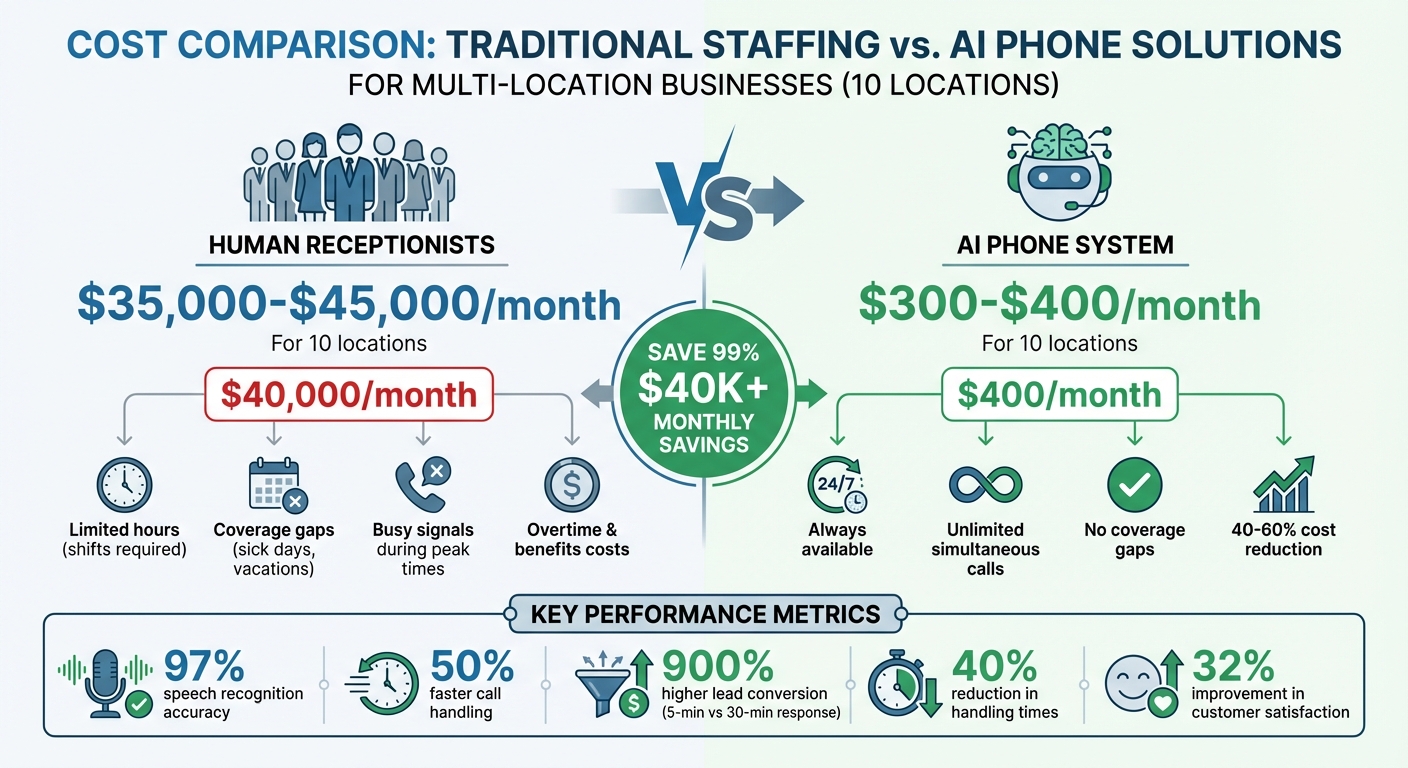
Covering phones at every location with staff means wages, overtime, benefits, and turnover, and those costs grow with each new site. AI coverage scales without new hires or training, and it doesn't leave gaps when someone calls out. For the full comparison, see AI vs. human front desk costs.
Answering Agent's AI Phone Services
Answering Agent answers every call in your brand's tone, books into your calendar, and logs leads to your CRM. You can push global updates while keeping location-specific details.
How to Implement White-Label AI Solutions
Rolling Out Across Locations
- Pilot one or two locations. Test conversation flows and integrations on real calls, and fix what breaks.
- Template the setup. Turn the pilot configuration into a template for the remaining sites.
- Centralize knowledge. Push hours, pricing, and policy changes from one place so no location gives out stale answers.
Connecting with Existing Systems
Connect the AI to your CRM, calendars, and POS with two-way sync. The AI can then check real availability, log each call, and create follow-up tasks without anyone typing them in.
Test every connection before launch. Book a test appointment and confirm it appears in every system right away, because that check is what prevents double-bookings. Also set a fallback so any question the AI can't handle goes to a person.
Tracking ROI and Performance
Track call volume, answer rate, lead conversion, and bookings per location. Also watch first-call resolution, the share of calls the AI resolves without a human.
Review transcripts against your custom AI phone scripts, and A/B test greetings and booking prompts to find what converts.
Conclusion
White-label AI takes routine calls off your team: scheduling, lead capture, and location questions, all in your brand's voice. Your staff keep the calls that need judgment. Start with a pilot, connect your systems, and measure by location. With the AI answering after hours and at peak, fewer missed calls cost you leads.
FAQs
Will it work for multiple locations with different hours and policies?
Yes. Each location gets its own hours, services, and rules. In Answering Agent, you manage them all from one dashboard and configure each site separately.
How does it hand off calls to my team when needed?
When a call needs a person, either because a rule triggers or the caller asks, the AI transfers it to the right team member or extension. It passes along the context so your team doesn't have to start over.
What do I need to connect it to my CRM and calendar?
You need API credentials or a native integration for each tool. Configure the connection, turn on scheduling and lead capture, then run a test booking to confirm that calls, appointments, and leads sync.
Related Blog Posts
Book a walkthrough
See it handle your calls.
Book 20 minutes, or hear a sample call first.