AI Call Handling ROI: Productivity Metrics Explained
Switching to AI for call handling can save businesses thousands annually while boosting efficiency. Missed calls cost small businesses an average of $126,360 yearly, with 85% of unanswered callers turning to competitors. AI ensures 24/7 availability and no hold times, reduces average call handling time by up to 50%, and improves first contact resolution rates to as high as 80%.
Here’s why this matters:
- Cost Savings: AI services cost $2,400–$3,600 annually, compared to $41,000–$65,000 for a full-time receptionist.
- Revenue Recovery: One captured lead, such as a $500 plumbing job, can pay for a year of AI service.
- Efficiency Gains: AI handles calls in 2–3 minutes versus 6–8 minutes for humans, freeing staff for higher-value tasks.
- Lead Conversion: Fast responses (under 5 minutes) increase conversion rates by up to 400%.
Businesses like Rodriguez Plumbing saw revenue jump by $4,000 monthly after implementing AI, while others saved hours weekly by automating routine tasks. Whether it’s answering after-hours calls or filtering spam, AI transforms call handling into a revenue-generating asset.
Measuring the ROI of AI Voice Agents in Service Businesses | Real Numbers That Matter
sbb-itb-abfc69c
Core Productivity Metrics for AI Call Handling
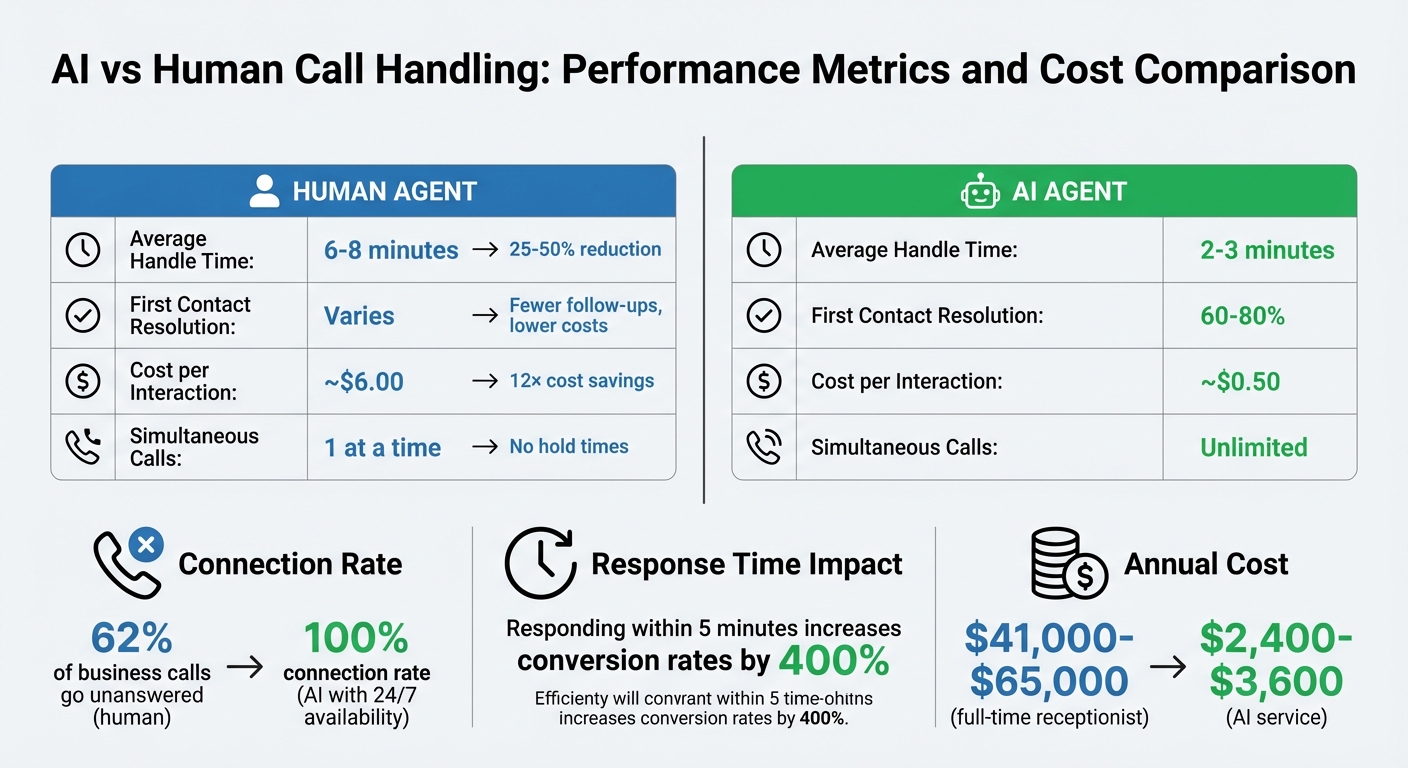
AI vs Human Call Handling: Performance Metrics and Cost Comparison
When evaluating the ROI of AI call handling, three key metrics come into play: connection rate, average handle time (AHT), and first contact resolution (FCR). Each of these highlights a different aspect of productivity, from the ability to capture opportunities to resolving issues efficiently.
Connection Rate and Missed Call Reduction
The connection rate measures how many incoming calls are answered. For many small businesses, this is a major pain point. Shockingly, about 62% of business calls go unanswered, and in industries like home services, the miss rate can climb to 74.1%. Electricians, for example, face a staggering 91% miss rate. The financial impact is massive - small businesses lose around $126,360 annually due to missed calls, while contractors may lose as much as $189,068 per year.
AI steps in to solve this problem with 24/7 availability and the ability to manage unlimited simultaneous calls. This ensures nearly a 100% connection rate. The timing of responses also matters: responding within five minutes can increase conversion rates by 400% compared to waiting 30 minutes to respond.
Now, let’s dig into how AI improves call efficiency by reducing the average handle time.
Average Handle Time (AHT)
AHT refers to the total time spent on a call, from start to finish. While human agents typically take 6–8 minutes per call, AI can resolve issues in just 2–3 minutes - a reduction of 25–50%. This efficiency comes from automating tasks like data entry and retrieving information.
Consider this: if a receptionist handles 60 calls per day at 8 minutes per call, reducing the AHT to 3 minutes could allow them to manage up to 160 calls per day, freeing up time for more strategic tasks. A real-world example is Klarna's AI assistant, which reduced resolution time from 11 minutes to under 2 minutes in 2024, handling the workload of 700 full-time agents across 2.3 million conversations.
Interestingly, as AI takes on routine queries, human agents may spend more time on complex cases, potentially increasing their AHT by up to 30%.
Shorter call durations naturally lead to better cost efficiency, which is further enhanced by improvements in first contact resolution.
First Contact Resolution (FCR)
FCR measures the percentage of calls resolved on the first attempt, with no need for follow-ups or escalation. High FCR rates directly reduce labor costs and improve customer satisfaction. Traditional systems often fall short here, but AI achieves FCR rates of 60–80%, with some implementations reaching 80–85%.
Take Vodafone’s AI chatbot TOBi, for instance. It achieved a 70% self-resolution rate, cutting cost-per-chat by 70%. In Portugal, an upgraded version boosted first-time resolution from 15% to 60%. Similarly, NIB Health Insurance saved $22 million, slashing customer service costs by 60% with AI-driven digital assistants.
The cost difference between missed calls and AI answering is striking: a human interaction costs about $6.00, while an AI interaction costs just $0.50 - a 12× savings.
| Metric | Human Agent | AI Agent | Impact |
|---|---|---|---|
| Average Handle Time | 6–8 minutes | 2–3 minutes | 25–50% reduction |
| First Contact Resolution | Varies | 60–80% | Fewer follow-ups, lower costs |
| Cost per Interaction | ~$6.00 | ~$0.50 | 12× cost savings |
| Simultaneous Calls | 1 at a time | Unlimited | No hold times |
ROI Calculations with Real Business Examples
The ROI formula - Monthly ROI = (Calls per month × Miss rate × Capture rate × Close rate × Average job value) - AI Service Cost - provides a clear way to measure the financial impact of AI call handling solutions.
Take Rodriguez Plumbing in Texas as an example. Before adopting an AI receptionist, they missed 74.1% of incoming calls. After implementing 24/7 AI coverage, their call capture rate jumped to 100%. Emergency call conversions rose from 1–2 per month to 8–10 per month, resulting in an additional $4,000 in monthly revenue. With AI services costing $199–$299 per month when using the top AI receptionist services, their net monthly profit increased by approximately $3,700.
Mike's Plumbing & Heating saw similar benefits. By automating tasks like scheduling and answering FAQs, they boosted revenue by $6,500 per month within just 90 days, allowing the owner to focus on billable work. In another case, a specialty repair business gained 20 new leads in its first week of using AI, including three conversions worth over $1,000 each - paying for an entire year of service in just seven days.
Even small improvements in call handling can lead to big gains. For instance, a plumbing business with a $500 average job value only needs to capture one missed call to cover the monthly AI cost. Similarly, for a roofing company with an average job value of $3,500, just one captured job pays for nearly 18 months of AI service. Services like Answering Agent demonstrate how AI can deliver these results by ensuring round-the-clock call coverage and cost efficiency.
Before AI vs. After AI: A Comparison
The difference AI makes becomes even clearer when you compare key metrics before and after implementation. Here's a look at how performance changes for a mid-sized service business managing 10,000 monthly calls:
| Metric | Pre-AI (Human/Answering Service) | After AI Implementation |
|---|---|---|
| Call Answer Rate | 40–73% | 95–100% |
| Response Time | Minutes to hours | <5 seconds |
| After-Hours Capture | 0–10% | 100% |
| Monthly Missed Calls | 2,700–6,000 | 0–500 |
| Cost Per Minute | $0.75–$1.50 | ~$0.50 |
| Staff Productivity | Frequently interrupted | Focused on billable work |
| Annual Cost | $6,900–$65,000 | $2,400–$3,600 |
Labor Efficiency and Savings
Another way to measure the impact of AI is through labor efficiency. The formula is:
Monthly Savings = (Hours spent on calls × Hourly rate × 0.85) + Recovered Revenue - AI Cost.
For example, if your team spends 20 hours per week on routine calls at $25 per hour, that adds up to $1,700 in monthly labor costs. With AI handling 85% of those calls, you could save $1,445 in labor costs while also recovering lost revenue. This frees up your team to focus on higher-value tasks, making the investment in AI even more worthwhile.
Answering Agent Case Study: Measured Results
Answering Agent has processed over 17,724 scored calls with an impressive 99.93% accuracy rate - that’s a mere 0.07% hallucination rate. This level of precision has a direct impact on revenue. With 74.1% of calls to home service businesses going unanswered, ensuring every call is handled correctly is critical. A single mistake, like missing a detail on a $15,000 roofing job, can result in significant revenue loss. This is why accuracy matters - not just for capturing leads but for protecting high-value opportunities.
The system has generated 20,375 offers, with 6,820 accepted, proving its ability to drive revenue. Since 85% of callers who hit voicemail won’t call back, capturing leads on the first ring is crucial. Plus, responding quickly - within five minutes - can increase conversions by up to 400%.
Answering Agent operates 24/7/365 with unlimited simultaneous call handling, eliminating bottlenecks during peak periods. For example, a pool service company saw bookings triple during the busy spring season compared to the previous year. This means businesses can handle seasonal demand without hiring additional staff.
By offloading routine calls, Answering Agent saves business owners 5–10 billable hours weekly. Interruptions from these calls can take up to 23 minutes to recover from, so redirecting this time to revenue-generating work makes a noticeable difference.
Key Benefits for Service Businesses
The efficiency and cost savings provided by Answering Agent are game-changers for service businesses.
Priced at $2,400–$3,600 annually for 24/7 coverage, it’s a fraction of what a human receptionist would cost. Traditional answering services often charge $0.75–$1.50 per minute, with additional fees for after-hours support. In contrast, Answering Agent offers a flat rate, free from surge pricing, and pays for itself quickly by preventing missed opportunities.
For example, a plumbing business with an average job value of $500 only needs to capture one missed call to cover the monthly cost. With 40% of calls happening outside standard business hours, the 24/7 availability ensures that potential revenue isn’t lost to voicemail.
The system’s 99.93% accuracy ensures reliable capture of appointment details, lead qualifications, and emergency calls. This reliability is especially critical in industries where 6.2% of calls are true emergencies, often commanding premium rates and achieving 100% close rates when answered immediately. Whether it’s scheduling appointments or handling urgent situations, Answering Agent delivers consistent results that keep businesses running smoothly.
Advanced ROI Strategies and Industry Benchmarks
An AI-first strategy goes beyond just cutting costs - it actively drives revenue by recovering lost leads, accelerating responses to high-intent customers, and providing 24/7 availability through smart call forwarding. By managing 60–80% of routine inquiries while passing complex calls to human experts, this approach optimizes both efficiency and revenue generation. This builds on earlier discussions about AI-powered productivity and sets the stage for comparing industry benchmarks.
Emergency detection and routing is a game-changer for revenue. By programming AI to recognize urgent keywords like "burst pipe", "AC died", or "ASAP", businesses can instantly route these calls to mobile phones. Around 6.2% of calls are emergencies, and providing immediate responses can lead to nearly 100% close rates. These emergency jobs often come with premium pricing, making them some of the most lucrative opportunities for service-based businesses.
Industry benchmarks further emphasize AI's revenue potential. For instance:
- Financial services firms often achieve a 412% ROI within 12 months.
- Healthcare practices report a 368% ROI within 14 months.
- Home services businesses see returns as high as 2,967% ROI, largely due to high missed-call rates - on average, 74.1% of calls in this sector go unanswered.
Building on earlier productivity metrics, integrating AI with tools like CRM systems and calendars takes ROI even further. These integrations eliminate manual data entry and reduce lead losses. Businesses using these systems report sales increases of up to 29%. Additionally, they ensure that the 25.4% of callers requesting callbacks are promptly addressed. This is critical, as 42% of callback requests often go unreturned in manual setups.
The financial benefits are clear when you calculate AI receptionist ROI. For a service costing $199 per month, with an average job value of $3,500, capturing just one extra job every 3.5 months results in a positive ROI. Considering that 40% of calls occur outside regular business hours, the potential to reclaim these missed leads far outweighs the investment required.
Conclusion: Measuring ROI from AI Call Handling
The numbers speak for themselves when it comes to the ROI of AI call handling. Capturing just one or two missed jobs each year is often enough to offset the entire cost of implementing AI call handling systems. And with 85% of voicemail callers turning to competitors instead, the stakes couldn’t be higher.
Consider this: businesses lose an average of businesses lose an average of $126,360 annually due to unanswered calls26,360 annually due to unanswered calls. By converting just one additional job every 3.5 months - at an average job value of $3,500 - the ROI turns positive. These savings are further amplified by the efficiency gains. AI systems handle calls in just 2–3 minutes compared to the 6–8 minutes it takes human staff, reclaiming around 23 minutes per call. That’s time employees can redirect toward higher-priority tasks.
The cost-benefit balance is clear-cut. As the SkipCalls team aptly puts it:
Trying to save money by not having an answering service is a false economy. You aren't saving $199 a year; you are losing tens of thousands in missed business.
For industries where speed-to-lead is critical, AI call handling isn’t just a tool - it’s a game-changer. It reduces missed opportunities, improves response times, and transforms how businesses engage with potential customers. The question isn’t whether it delivers ROI but how soon businesses can adopt it to stay competitive.
Take the example of Answering Agent. Their AI system has handled over 17,724 scored calls with an astounding 99.93% accuracy. Operating 24/7, it manages unlimited simultaneous calls, books appointments, and captures leads that would otherwise slip through the cracks. The results set a high standard for what’s possible, making a compelling case for industry-wide adoption.
FAQs
How do I estimate ROI for my business?
To figure out the ROI of using AI for call handling, you’ll need to weigh the potential benefits against the costs. Some of the main advantages include reducing missed calls, cutting labor costs, and boosting overall efficiency.
Start by gathering key data points like your call volume, the percentage of missed calls, and the average value of a customer. This information helps you estimate savings and potential revenue increases. Once you have those numbers, subtract the costs of implementing the AI solution, such as subscription fees or other related expenses, to see how profitable the investment could be.
If you want to streamline this process, ROI calculators can be a helpful tool to break down the numbers and give you a clearer picture of the financial impact.
What call metrics should I track first?
To get a clear sense of how well your call handling system is working, start monitoring essential metrics such as call volume, response time, first call resolution (FCR), missed call rate, and customer satisfaction scores. These indicators highlight both strengths and areas that need attention.
When should AI transfer to a human?
AI is great at managing repetitive, high-volume tasks efficiently. However, when situations demand careful judgment, empathy, or specialized expertise, it's better for a human to step in. Complex or sensitive issues often require the kind of understanding and emotional intelligence that AI simply can't replicate.
Related Blog Posts
See how AI handles calls for your business
Enter your business name and we'll build a personalized AI receptionist demo in under 2 minutes. Talk to it right in your browser.
No signup required · Free to try · Works for any business
Related Articles
Best AI Systems for High-Volume Calls
AI phone systems can eliminate missed calls, scale to thousands of simultaneous conversations, and reduce call-handling costs.
AI Call Handling ROI for Restaurants: Key Metrics
How AI phone systems recover missed calls, cut labor costs, boost order value, and deliver fast ROI for restaurants.
Speech Analytics Setup for AI Call Monitoring
Guide to choosing tools, configuring audio, setting KPIs, building dashboards, and validating speech analytics for AI call monitoring.