AI Call Routing: Dynamic Distribution Explained
AI call routing is transforming how businesses handle customer calls by using advanced technologies like machine learning and natural language processing. Unlike outdated systems that rely on rigid rules, AI dynamically prioritizes and routes calls based on factors like caller history, urgency, agent expertise, and sentiment. This ensures faster resolutions, improved customer satisfaction, and better resource allocation. This is especially critical when learning how to handle peak hour calls effectively.
Key takeaways:
- Reduces call connection times by 35% and improves first-call resolution rates by 40%.
- Prioritizes high-value or urgent calls, such as VIP customers or emergency situations.
- Uses real-time data and sentiment analysis to optimize call distribution and de-escalate frustration.
- Works across industries like legal, healthcare, and SaaS to match callers with the right agents.
AI call routing not only streamlines operations but also enhances the customer experience by connecting people to the right help efficiently.
Intelligent Call Routing (ICR) Explained | Smarter Call Center Efficiency with AI
sbb-itb-abfc69c
How AI Call Routing Works
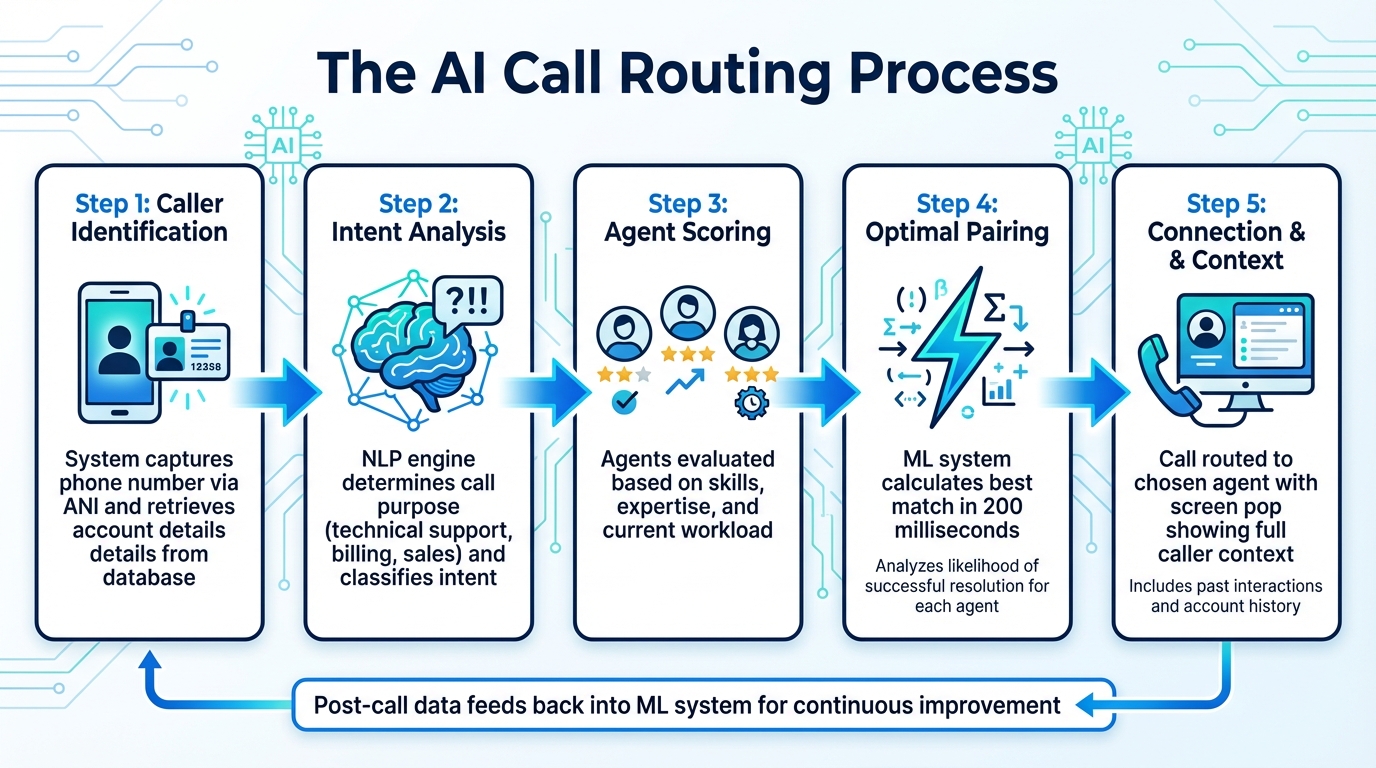
AI Call Routing Process: 5 Steps from Caller to Agent Connection
AI call routing operates behind the scenes with lightning speed, combining various technologies to analyze caller intent, gather data, and connect calls to the right resource - all before the second ring.
Core Components of AI Call Routing Systems
At its heart, AI call routing depends on four main technologies working together seamlessly:
- Automatic Call Distributor (ACD): This system acts as the backbone, receiving incoming calls and applying routing logic based on agent availability and status.
- Interactive Voice Response (IVR): Through voice or keypad inputs, this system collects essential details like account numbers and caller intent.
- Natural Language Processing (NLP): NLP interprets spoken language in real time, identifying keywords, urgency, and even the caller's mood.
- Machine Learning (ML): By analyzing historical data such as resolution rates and satisfaction scores, ML predicts the best agent-caller match for optimal outcomes.
"Intelligent routing logic replaces binary decision trees with multi-variable algorithms that weigh numerous factors simultaneously: Who is calling? Why are they calling? Which agents possess relevant expertise?" - Maddy Martin, SVP of Growth, Smith.ai
These systems also integrate with CRM platforms, adding context such as purchase history, VIP status, and past support tickets to every routing decision. Together, these technologies create a highly efficient call-routing process.
The AI Call Routing Process
Here’s how the process unfolds step by step:
- Caller Identification: When a call comes in, the system captures the caller's phone number using Automatic Number Identification (ANI) and retrieves relevant account details from databases.
- Intent Analysis: The NLP engine determines the purpose of the call - whether it’s for technical support, billing, or sales - and classifies the intent.
- Agent Scoring: Agents are evaluated based on skills, expertise, and current workload.
- Optimal Pairing: Within 200 milliseconds, the ML system calculates the likelihood of a successful resolution for each agent and selects the best match.
- Connection and Context: The call is routed to the chosen agent, who receives a screen pop with the caller’s full context, including details like past interactions and account history.
After the call, data such as resolution status and customer satisfaction is fed back into the ML system, ensuring continuous improvement for future interactions.
Real-Time Adjustments and Monitoring
AI systems don’t just follow a set path - they adapt in real time. For example, sentiment analysis can detect frustration or stress in a caller's voice, triggering an immediate escalation to a specialist trained in de-escalation. Dynamic queue management steps in to redistribute calls if wait times grow too long or specific queues become overloaded. To further enhance the customer experience, the system offers callbacks that maintain the caller’s place in line or redirects overflow calls to backup teams.
This constant monitoring ensures the system remains responsive, even during unexpected surges in call volume or fluctuating agent availability.
Dynamic Distribution Strategies
Dynamic distribution strategies build on core technologies to refine call routing, aiming for greater efficiency and faster issue resolution.
AI-powered call routing outperforms traditional systems by using several approaches to match callers with agents based on factors like expertise, urgency, workload, and predicted outcomes.
Skill-Based Routing
Skill-based routing ensures callers are connected to agents with the exact skills needed to solve their issues. By using skill tags and proficiency levels (e.g., expert, proficient, basic), the system identifies the best match. For example, an agent fluent in Spanish with advanced technical certifications can assist a Spanish-speaking customer with a complex product issue, while a billing specialist handles payment-related inquiries.
The system identifies a caller's intent through voice or menu inputs and routes them to the appropriate expert. This method can improve first-call resolution rates by up to 40% and allow agents to handle 20% more calls.
Skill-based routing doesn't stop at expertise - it also considers customer value and urgency to determine priority.
Priority-Based Routing
Priority-based routing assigns a numerical score to each caller based on factors like account value, urgency, or purchase history. For instance, high-value customers - those with accounts exceeding $50,000 or premium service contracts - can skip the standard queue and receive faster assistance. The system translates VIP status or service terms into weighted scores that determine queue placement.
This approach strengthens relationships with key customers. For example, an enterprise client experiencing a service outage is immediately connected to a senior specialist, while routine inquiries follow standard procedures. To ensure fairness, the system also tracks wait times, gradually moving lower-priority callers up the queue to reduce call abandonment.
Sentiment-based routing adds another layer by analyzing a caller's emotional state in real time. If frustration is detected, the system escalates the call to an agent skilled in de-escalation techniques.
Load Balancing and Predictive Routing
Advanced methods like load balancing and predictive routing further streamline call management.
Load balancing evenly distributes calls to prevent agent burnout and improve efficiency. By monitoring real-time agent statuses (e.g., available, busy, or wrapping up after-call work), the system uses strategies like round-robin or least-occupied routing to maintain fair workloads.
Predictive routing takes things a step further by using machine learning to forecast the best agent–caller match. It analyzes historical data, such as resolution rates, satisfaction scores, and past interactions, to predict the likelihood of success. Within just 200 milliseconds, it pairs the caller with the agent most likely to resolve the issue on the first attempt, boosting customer satisfaction scores by an average of 25%.
| Strategy | Primary Goal | Key Data Inputs |
|---|---|---|
| Skill-Based | High Resolution Quality | Agent expertise, language, certifications |
| Priority-Based | VIP/Urgent Handling | Account value, SLA tier, issue urgency |
| Load Balancing | Agent Wellness/Efficiency | Idle time, call counts, occupancy rates |
| Predictive | Outcome Optimization | Historical success rates, caller behavior |
When integrated with CRM systems, these strategies gain even more power by providing instant access to customer lifetime value and interaction history. Together, they ensure every connection is optimized for both customer satisfaction and operational efficiency.
Benefits of AI Call Routing
AI call routing transforms how businesses handle customer interactions, boosting satisfaction, streamlining operations, and uncovering new revenue opportunities.
Better Customer Experience
AI call routing connects customers to the right person faster than traditional systems. By analyzing a caller's intent in milliseconds, it reduces average call connection times by 35%. This means less waiting and quicker resolutions.
When customers are matched with agents who have the right expertise and access to full CRM data, satisfaction scores often climb by 10–15 points, and in some cases, they increase by up to 25% [4, 17]. Wait times drop significantly - by 25–35% - and 90% of customers expecting a response within 10 minutes get it.
The system also uses sentiment detection to identify frustration or urgency in a caller's tone. For example, if a veterinary clinic receives a call mentioning "difficulty breathing", the system routes it immediately to an available veterinarian. This kind of responsiveness ensures that customers feel heard and valued, while businesses operate more efficiently.
Improved Operational Efficiency
AI routing doesn't just benefit customers - it also makes operations smoother. By matching calls to agents with the right skills, agents can handle 20% more calls. This targeted approach reduces average call handling times by 30–40 seconds, speeding up overall response times by as much as 30%.
The system also uses real-time data to balance workloads effectively. It tracks agent statuses - whether they're available, busy, or finishing up a call - and distributes calls dynamically to avoid bottlenecks. This approach cuts operational costs by up to 30%. For growing businesses, this scalability means they can handle more calls without needing to hire additional staff [1, 5].
Increased Revenue Opportunities
Missed calls can be costly. Studies show that 85% of callers who don't reach someone live never try again, and the average missed call represents about $1,200 in potential revenue. AI call routing minimizes these losses by ensuring high-intent callers are immediately connected to available agents.
In industries like HVAC or plumbing, where speed often determines who gets the job, AI systems recognize urgent phrases like "water everywhere" and bypass standard queues to connect the caller with a technician right away. Similarly, legal firms use AI call routing for law firms to prioritize high-value cases - such as a $2M breach of contract claim - by routing them to senior partners while routine matters go to associates.
With first-call resolution rates improving by 20–25% and handle times dropping by up to 30%, businesses can serve more customers without increasing their resources. AI-powered services like Answering Agent ensure no calls are missed, offering 24/7 support to capture leads, book appointments, and handle inquiries - even outside regular hours - turning every call into a revenue opportunity.
Implementation and Best Practices
Rolling out AI call routing successfully requires a structured approach and implementation checklist. The most effective implementations follow a three-phase strategy. Phase 1 lays the groundwork by setting up IVR systems, establishing basic time and geographic rules, and defining initial agent skill profiles. Phase 2 integrates your CRM, segments customers, and enables screen pops that provide agents with caller context. Finally, Phase 3 unlocks advanced AI features like sentiment analysis and predictive intent recognition.
Preparing for AI Call Routing
Start by analyzing your current call patterns. Track call volumes, peak times, and average handle times to identify routing inefficiencies - like technical queries being sent to less qualified agents. Map out existing decision trees to find areas where high-value customers may not be receiving the attention they need.
Develop a comprehensive skills matrix for your agents. This should include categories such as technical expertise, language proficiency, and product knowledge, with proficiency levels ranging from novice to expert. For example, Wyze Labs achieved a 98% improvement in first-call resolution by piloting a well-structured routing system. Candace Marshall, Vice President of Product Marketing at Zendesk, emphasizes:
"The 'intelligence' of your ICR system will be limited if you treat every agent as an interchangeable part of the machine".
Scalability and Flexibility
Opt for a cloud-based infrastructure that can grow alongside your business. Cloud platforms offer flexible, usage-based pricing, making it easier to adjust capacity without hefty upfront investments. Additionally, network-based routing - where rules are applied at the carrier level - can reduce latency, especially for distributed teams.
To ensure seamless operations, design your system with cascading logic and well-defined fallback paths. If the primary agent or queue isn’t available, the system should automatically reroute calls to secondary options or offer callbacks. Netwealth used this strategy to cut its first reply time to just 40–60 seconds by monitoring response times and making real-time adjustments. Regularly updating agent skill profiles as employees complete training or earn certifications ensures the AI can adapt and assign calls effectively as team capabilities evolve.
Once your system is scalable and flexible, the focus shifts to managing the transition without disrupting daily operations.
Managing the Transition
Begin with a pilot program that handles 20–30% of your call volume or focuses on a single product line. This allows you to test the system’s routing accuracy and gather feedback before expanding further. Simulate edge cases, such as sudden call surges, shift changes, or scenarios where specialized agents are unavailable, to stress test the system.
Train your team thoroughly on the new workflows. Ensure agents understand how to use disposition codes and interpret screen pops that provide customer context. Transparency is key - explaining the routing logic helps build trust and reduces resistance to the new system. Establish escalation procedures so supervisors are alerted when a caller’s sentiment score drops below a set threshold. For businesses needing 24/7 support without increasing headcount, services like Answering Agent can handle after-hours calls, ensuring no opportunities are missed during or after the transition.
Measuring Success and Continuous Improvement
The real strength of AI call routing lies in its ability to evolve through ongoing tracking of outcome-based metrics. These metrics not only measure success but also guide continuous improvements to enhance system performance and accuracy over time.
Key Performance Metrics
To truly assess the impact of AI call routing, it’s essential to focus on measurable results.
First Contact Resolution (FCR) is one of the most critical indicators of routing success. It measures the percentage of issues resolved in a single interaction without requiring transfers or follow-ups. For example, Wyze Labs implemented AI-powered routing through Zendesk and saw a 98% improvement in FCR while managing over 300 daily calls. This highlights how precise agent-to-caller matching can drastically improve resolution rates.
Average Handling Time (AHT) is another key metric, reflecting how quickly calls are resolved. AI routing can cut AHT by up to 30% by ensuring calls are directed to the right agent without unnecessary transfers.
Tracking AI-specific metrics, like transfer rates and agent overrides, is also crucial. If agents frequently override or reroute calls, it signals weaknesses in the AI's logic. A simple one-click justification for overrides can help capture these edge cases, which can then be used to retrain the AI monthly. Additionally, metrics like Customer Effort Score (CES) can pinpoint areas of friction in the IVR system, while sentiment analysis can flag frustrated callers who may need immediate attention.
| Metric Category | Key KPIs to Track | Purpose for AI Optimization |
|---|---|---|
| Customer Experience | FCR, CSAT, NPS, CES | Evaluates if AI is effectively matching intent to resolution |
| Operational Efficiency | AHT, Average Speed of Answer, Abandonment Rate | Assesses if AI is reducing wait times and improving call flow |
| AI Precision | Transfer Rate, Agent Override Rate, IVR Containment | Measures AI's accuracy in intent detection and routing decisions |
| Productivity | Agent Occupancy, Cost Per Call | Tracks workload balance and cost reduction through AI |
Using Data for Optimization
Once you’ve identified the key metrics, the next step is refining your strategy through controlled testing and feedback.
Start by running your AI routing system in shadow mode for three weeks before rolling it out fully. This allows you to compare the AI’s decisions against your current rules without disrupting live calls. Use A/B testing to experiment with different IVR menus and routing flows, then measure which configurations lead to better outcomes, such as higher resolution rates and fewer abandoned calls.
Set sentiment thresholds to automatically escalate calls when needed. For instance, if a caller’s sentiment score drops below -0.7, the system can route them to a senior agent or supervisor immediately. Monitoring "sentiment drift" - how AI adapts tone and how a caller’s tone changes during the interaction - can also help evaluate the AI's ability to de-escalate frustration.
AI-powered call scoring offers another layer of insight. This is particularly effective when using real-time AI call monitoring to maintain quality across various sites. Unlike traditional quality assurance, which typically reviews only 2% of calls, AI can analyze 100% of interactions. By 2025, it was predicted that 80% of call centers globally would rely on AI scoring for consistent and objective performance evaluations. These insights not only help coach agents but also highlight areas where the AI may need adjustments. For instance, if the containment rate is high but FCR remains low, it could mean the AI is prematurely closing calls without resolving issues. In such cases, refining the AI’s logic is essential.
For businesses using hybrid models, such as Answering Agent for after-hours calls, it’s important to track performance metrics across both in-house teams and AI systems. This ensures consistent service quality around the clock. Regular retraining of AI models - at least once a month - based on transfer patterns and override logs is critical to maintaining and improving accuracy.
Conclusion
AI call routing with dynamic distribution transforms outdated systems into smarter, adaptable solutions. By analyzing factors like caller identity, intent, sentiment, and agent expertise, it ensures the best possible match on the first attempt.
The results speak for themselves: a 35% reduction in call connection times, a 40% improvement in first-call resolution rates, and a 25% boost in customer satisfaction. Companies such as Wyze Labs and Netwealth have reported even more impressive outcomes, including a 98% improvement in first-call resolution and reply times dropping to just 40–60 seconds.
But the benefits go beyond immediate efficiency. AI routing creates long-term revenue opportunities by integrating with CRM systems to prioritize high-value accounts and leveraging sentiment analysis to uncover upsell potential. This approach not only increases conversion rates but also lowers operational costs. Agents benefit too, becoming 20% more productive when paired with tasks that match their expertise. These combined advantages help businesses achieve sustainable growth.
To maintain this momentum, businesses must treat AI routing as an evolving system. Regularly monitoring performance metrics and refining algorithms ensures the system keeps pace with changing demands. For companies operating 24/7, tools like Answering Agent extend intelligent routing to after-hours support, delivering consistent service quality and ensuring no opportunities slip through the cracks.
At its core, AI call routing is about collaboration between technology and human expertise. As Stanford University's Diyi Yang puts it:
"Identifying the best ways for AI and humans to work together to achieve collective intelligence will become increasingly important".
Rather than replacing human agents, AI empowers them with the context and tools they need to deliver outstanding service on a larger scale.
FAQs
How does AI call routing help resolve customer issues on the first call?
AI call routing improves first-call resolution rates by smartly connecting callers with the most qualified agents in real time. It uses data like caller history, the nature of the issue, and the expertise of agents to ensure each call reaches the right person. This reduces unnecessary transfers and callbacks, resulting in quicker and more precise problem-solving, which boosts customer satisfaction.
The system also prioritizes urgent or high-value calls and adjusts to changing conditions on the fly. This means less waiting and fewer routing errors, ensuring that critical problems are handled quickly and businesses provide efficient, effective support.
What key technologies power AI-driven call routing systems?
AI-powered call routing systems use a mix of cutting-edge technologies to ensure calls are distributed efficiently and accurately. At the heart of these systems are real-time data analysis, machine learning algorithms, and data integration tools. Together, these evaluate factors like the caller's needs, the agent's skill set, and the company's priorities to make smart routing decisions.
Key features like Interactive Voice Response (IVR), skills-based routing, and predictive algorithms take things a step further. They help connect callers to the right agents faster and more effectively. By integrating smoothly with existing communication platforms, these systems ensure data flows effortlessly, cutting down wait times and boosting both customer satisfaction and operational performance.
What steps can businesses take to successfully implement AI call routing?
To make AI call routing work effectively, businesses need to focus on a few essential steps. First, ensure the AI system integrates seamlessly with your current communication tools and data sources. This allows the system to analyze caller information and business context in real-time, making sure calls are routed accurately and efficiently.
Next, prepare your team by training them on how the AI system operates and the logic behind its decisions. This helps employees feel comfortable with the technology and equips them to handle routed calls with confidence. A well-thought-out change management plan can also help ease the transition by addressing concerns, answering questions, and showcasing the benefits of the system to your team.
Lastly, opt for an AI solution that can scale as your business grows. Keep a close eye on its performance by tracking key metrics. Use these insights to fine-tune the system, which can lead to happier customers, shorter wait times, and better overall efficiency. Following these steps can help businesses streamline operations and provide a smoother customer experience.
Related Blog Posts
Related Articles
Reducing Missed Calls in Appliance Repair with AI
AI phone systems significantly reduce missed calls in appliance repair, enhancing customer satisfaction and boosting revenue for businesses.
AI vs. Manual Call Routing: Key Differences
AI routing outperforms manual systems in speed, cost, availability, and customer experience — making manual routing impractical for growing businesses.
Law Firm Success With AI: 24/7 Call Handling Stories
Missed calls cost firms clients; 24/7 AI answering captures every lead, automates intake and scheduling, and boosts revenue.