How AI Improves First Call Resolution for Service Businesses
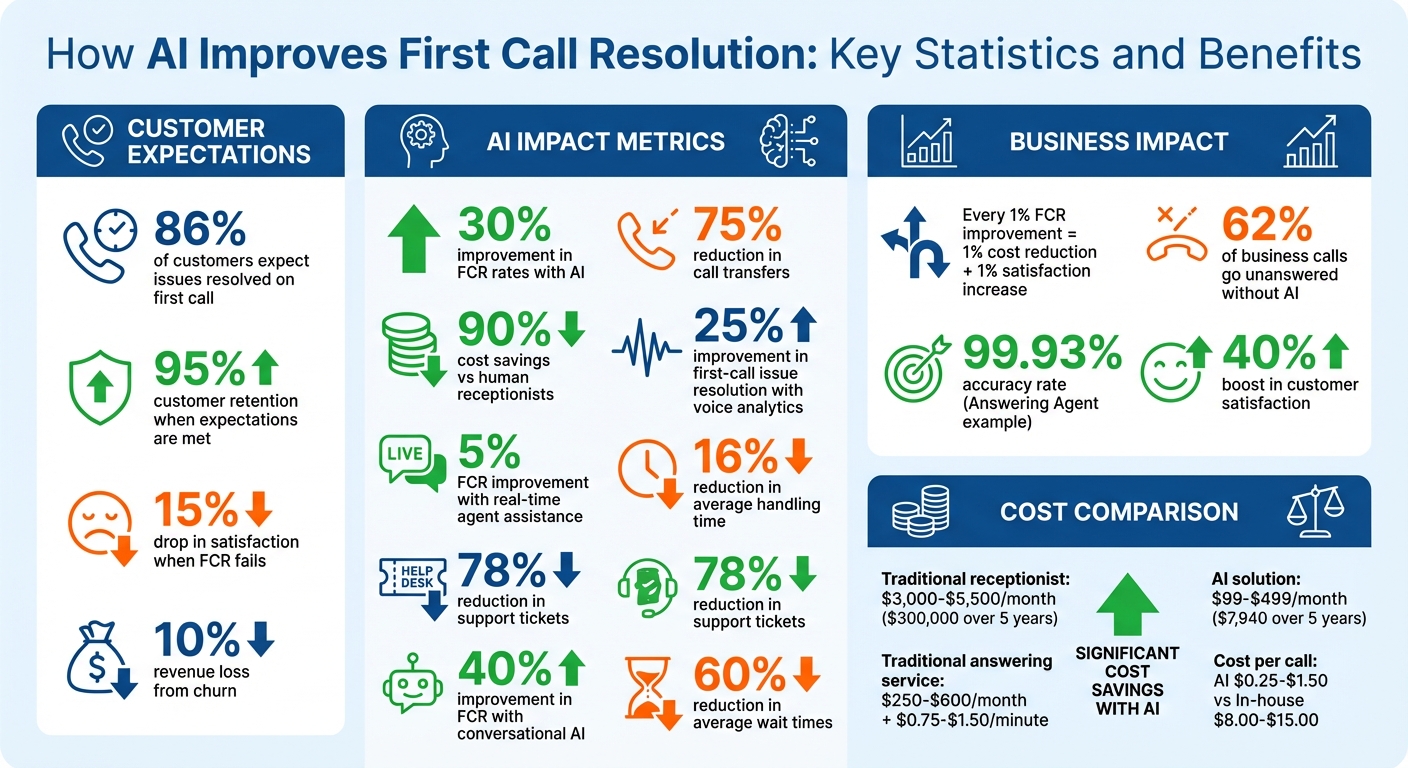
86% of customers expect their issues to be resolved on the first call. Meeting this expectation leads to 95% customer retention, while failing to do so can result in a 15% drop in satisfaction and a 10% revenue loss from churn. AI-powered phone answering systems are helping businesses tackle this challenge by resolving issues faster, reducing transfers, and improving customer experiences.
Here’s what AI brings to the table:
- Natural Conversations: AI uses advanced language processing to understand intent, urgency, and emotions, enabling smoother interactions.
- Real-Time Data Access: Instant integration with CRMs and tools allows quick resolutions without delays.
- Fewer Transfers: AI can handle tasks end-to-end, cutting call transfers by 75%.
- Cost Savings: AI reduces operational costs by up to 90% compared to human receptionists.
AI-driven systems are helping businesses improve First Call Resolution rates by up to 30%, saving costs, and boosting customer satisfaction. By integrating AI with existing tools and tracking performance, companies can turn every customer interaction into a win.
How AI Improves First Call Resolution: Key Statistics and Benefits
New Way Now: SIGNAL IDUNA boosts first-call resolution rates and doubles NPS with Google Cloud AI

sbb-itb-abfc69c
How AI Improves First Call Resolution for Service Businesses
AI phone answering systems tackle common challenges in achieving First Call Resolution (FCR) by addressing poor routing, delayed access to information, and multiple handoffs. Instead of relying on outdated, rigid menus, modern AI leverages Natural Language Processing (NLP) to quickly understand a caller's intent. For example, if a customer says, "I need to reschedule my appointment", the system not only identifies the request but can either route the call appropriately or handle the task entirely on its own.
Natural, Human-like Conversations
One of the key factors in resolving issues during the first call is the ability of AI systems to engage in natural, conversational interactions. Thanks to Natural Language Understanding (NLU), these systems interpret not just the words being spoken but also intent, urgency, and emotional cues in real time. They mimic human conversational patterns with natural pauses, a smooth rhythm, and low-latency responses, making the experience feel seamless rather than robotic.
A standout feature is sentiment analysis, which detects frustration or confusion in a caller's tone. When this happens, the AI can adjust its responses or provide real-time guidance to human agents to de-escalate the situation immediately. Another game-changer is "session persistence." This capability allows the system to retain context across different channels - whether the interaction starts via IVR, chat, or voice - so customers never have to repeat their information. This is crucial, as repeated explanations are a leading cause of unresolved calls. Businesses using advanced voice analytics have seen a 25% improvement in first-call issue resolution.
Instant Access to Real-time Data
The difference between telling a customer, "Let me check and call you back", versus, "I can see that right now", often determines whether an issue is resolved on the first call. AI systems integrate seamlessly with CRMs, knowledge bases, and other business tools to instantly retrieve customer history, account details, and past interactions. This eliminates hold times, prevents the need for repeated explanations, and enables agents to verify or update information on the spot.
Real-time agent assistance powered by AI can improve FCR rates by about 5% and cut average handling time by 16%. For instance, when AI suggests the right knowledge base article or troubleshooting step at the perfect moment, agents can resolve issues without escalating to a supervisor or promising a callback. By providing these real-time insights, AI reduces the need for transfers and follow-ups, ensuring a smoother experience for both customers and agents.
Fewer Transfers and Follow-ups
AI's ability to handle inquiries from start to finish significantly reduces call transfers. Instead of shuffling customers between departments, AI voice agents can independently verify data, check statuses, update records, and even complete transactions like scheduling or payments. Companies using advanced AI voice agents have reported a 75% drop in call transfers.
When transfers are unavoidable, AI ensures a seamless handoff by maintaining a single session identifier. This allows the next agent to see the full conversation history and CRM context, eliminating the frustrating "Can you repeat that for me?" scenario. AI also uses conversation intelligence to identify patterns that often lead to follow-up calls. By coaching agents to address these issues during the first interaction, AI helps prevent repeat contacts, which not only reduces costs but also enhances customer satisfaction. In fact, AI-powered systems have been shown to cut support tickets by as much as 78% by resolving issues during the initial contact.
These capabilities lay the groundwork for even more advanced tools that further improve first-call resolution rates.
Key Features of AI Phone Answering Systems That Improve FCR
What sets high-performing AI phone answering systems apart from basic IVR menus boils down to three key strengths: availability, customization, and proven accuracy. These features directly tackle common issues that lead to customers calling back.
24/7 Availability and Unlimited Simultaneous Calls
Unlike human receptionists who can only handle one call at a time, AI systems answer every call instantly - no matter how many come in. This is a game-changer, especially when you consider that 62% of business calls go unanswered due to capacity limits. With AI, wait times vanish, and no call is ever missed.
This instant response is crucial for boosting first call resolution (FCR). Long hold times or reaching voicemail often frustrate customers, leading them to hang up and call back later. AI voice agents help solve this by reducing average wait times by up to 60%. Businesses using conversational AI have reported as much as a 40% improvement in FCR. Plus, with 24/7 availability, customers can handle routine tasks - like booking appointments or checking prices - whenever it’s convenient for them, even in the middle of the night.
Customizable Scripts and Industry-Specific Solutions
One-size-fits-all scripts often lead to what’s called "scripted deflection", where calls end without actually resolving the customer’s issue. AI systems tailored to specific industries avoid this problem by understanding the unique language and challenges of each sector. For example, AI designed for medical offices knows how to handle insurance verifications and prior authorizations, while AI for home services can differentiate between emergency calls and routine maintenance requests.
Customization also allows businesses to create deterministic resolution paths, which are workflows designed to fully resolve an issue. These paths ensure that tasks like CRM updates or appointment confirmations are completed during the call, rather than leaving loose ends. For instance, Answering Agent enables businesses to fine-tune scripts and even adjust the AI’s voice to fit their industry’s needs. This prevents predictable follow-up calls and directly improves FCR by addressing secondary issues upfront.
By tailoring solutions to specific needs, businesses can achieve measurable improvements in performance, as highlighted by accuracy metrics.
Proven Accuracy and Efficiency Metrics
Accuracy is the backbone of an effective AI system. If the system provides incorrect answers or fails to resolve issues, customers are forced to call back, defeating the purpose. Answering Agent, for example, processed 17,724 scored calls with an impressive 99.93% accuracy rate (just a 0.07% hallucination rate). This ensures customers get the right information on the first call, significantly reducing the need for follow-ups.
But AI doesn’t just answer questions - it can also drive results. For instance, the system pitched 20,375 offers, of which 6,820 were accepted. This demonstrates its ability to not only resolve issues but also convert calls into business opportunities. The impact is clear: every 1% improvement in FCR leads to a 1% drop in operational costs and a 1% increase in customer satisfaction. Unlike human agents, who may be affected by fatigue, mood, or inconsistent training, AI provides reliable and consistent performance, delivering tangible business outcomes.
Steps to Implement AI for Improved FCR in Your Business
Improving First Call Resolution (FCR) with AI involves four key steps: measuring your current FCR, customizing your AI system, integrating it with your tools, and tracking its performance.
Step 1: Measure Your Current FCR Rate
Before anything else, you need to understand where you stand. Start by calculating your baseline FCR using this formula:
(Total issues resolved on the first call ÷ Total eligible calls) × 100.
To ensure accuracy, clearly define what counts as an "eligible" call. Exclude non-resolvable interactions like wrong numbers, abandoned calls, or disconnected calls. Pull data from sources such as CRM logs, call center records, agent notes, and post-call surveys. For a thorough analysis, audit at least 200 calls over two weeks. This will highlight patterns that automated tools might miss - like repeated verification requests or overlooked customer needs. Industry standards suggest that a strong FCR rate falls between 70% and 79%, with top performers exceeding 80%. Even a 1% improvement in FCR can translate into significant cost savings.
"FCR is not just about operational efficiency, it's a proxy for customer confidence." – Joe Huffnagle, VP Solution Engineering & Delivery, Parloa
Step 2: Select and Customize Your AI System
Choose an AI platform that works seamlessly with your current tools and understands your industry’s specific needs. For instance, a plumbing business might need AI capable of distinguishing between an urgent "burst pipe" call and a routine maintenance inquiry. Train the AI with your business’s key content to ensure it reflects your expertise and brand identity. Also, establish clear guidelines for when the AI should escalate a call to a human agent.
Start with a Minimum Viable Product (MVP) that handles basic tasks like FAQs and business phone automation. Use real call data to fine-tune the system over time. Tools like Answering Agent allow for customization, enabling adjustments to voice tone, script sensitivity, and more to match your brand’s voice and customer expectations.
Step 3: Connect AI with Your Business Tools
Integrating your AI with essential business tools is crucial. Link it to your CRM (e.g., Jobber or Pipedrive), calendar systems like Google Calendar, and payment processors. This allows the AI to access customer histories, schedule appointments, and even process payments - all during the first call. Enable CRM pre-fetching for instant context and set up automated post-call actions, such as updating records or sending follow-up emails.
To streamline the customer experience, use a single session identifier to track interactions across all channels - phone, chat, or email - so customers don’t have to repeat themselves. Businesses that implement these integrations have reported up to a 25% improvement in FCR rates.
Step 4: Track Performance and Make Adjustments
After launching your AI system, monitor its performance closely. Keep an eye on FCR rates, call accuracy, and reasons for repeat contacts. Use these insights to refine scripts and workflows. Categorize reopened calls into 6–8 groups (like billing, technical issues, or authentication) to pinpoint recurring problems.
Measure FCR alongside metrics like Average Handle Time to balance efficiency with quality. Post-call surveys can offer customer-verified FCR data. With these insights, you can continuously tweak your AI system, ensuring it remains effective and aligned with your goals for improving first-call resolution.
Scaling AI for High Call Volumes and Cost Efficiency
Unlimited Call Handling During Peak Times
Did you know service businesses miss out on 27–28% of incoming calls? That’s roughly $450 in lost revenue per missed call. Even worse, 80% of people who reach voicemail hang up without leaving a message. The problem lies in human receptionists’ limitations - they can only handle one call at a time. When calls flood in during busy periods, customers often face busy signals or voicemail, leading to lost opportunities.
AI phone answering systems solve this issue by using cloud infrastructure to manage unlimited simultaneous calls. This capability is particularly crucial during peak hours and after-hours, which account for about 40% of service calls. By ensuring no call goes unanswered, these systems not only boost first-call resolution (FCR) rates but also significantly cut operational expenses.
Cost Savings Compared to Human Receptionists
Let’s talk numbers. Hiring a traditional receptionist costs between $3,000 and $5,500 per month, adding up to around $300,000 over five years. If you opt for traditional answering services, you’ll pay $250–$600 monthly, plus $0.75–$1.50 per minute, which can easily exceed $1,000 per month during busy periods.
AI solutions like Answering Agent offer a much more budget-friendly alternative, with flat rates ranging from $99 to $499 per month. Over five years, this totals just $7,940 - a 90% reduction in employment costs. The cost per call also drops dramatically to $0.25–$1.50, compared to $8.00–$15.00 for in-house staff and $3.00–$6.00 for traditional services.
Here’s the kicker: if your average job brings in $3,500, capturing just one extra job through AI covers about 17.6 months of service. Businesses managing calls in-house miss an average of 74.1% of calls, while AI systems recover 60–80% of those missed opportunities. The result? A tangible and immediate return on investment.
Conclusion
Boosting first call resolution (FCR) turns every customer interaction into a chance to leave a lasting, positive impression. Even a 1% improvement in FCR can lead to a 1% reduction in costs and a 1% increase in customer satisfaction. For service-based businesses, this means tangible savings and stronger customer loyalty.
AI phone answering systems like Answering Agent make achieving high FCR rates more accessible than ever. With an impressive 99.93% accuracy across 17,724 calls and the ability to handle unlimited simultaneous conversations around the clock, these systems eliminate capacity limits and ensure calls are addressed without delay.
Businesses adopting AI automation have seen a 30% rise in FCR and a 40% boost in customer satisfaction. Considering that 86% of customers expect their issues to be resolved on the first call, meeting this expectation is no longer optional - it's critical.
To get started, measure your current FCR, follow a checklist for implementing AI phone answering to handle common call types, integrate it with your existing tools, and monitor its performance. This strategy improves efficiency, increases revenue, and strengthens customer loyalty.
AI doesn’t replace the human element - it enhances it. By instantly resolving routine issues and seamlessly routing complex ones to the right person with all the necessary context, AI ensures every caller gets the resolution they need, the very first time.
FAQs
Which calls should AI handle vs. a human agent?
AI works best for handling routine and repetitive calls - things like answering questions about business hours, pricing, or service availability. It’s also great for tasks like scheduling, collecting leads, or managing after-hours inquiries. On the other hand, human agents are better suited for complex, sensitive, or emotionally charged interactions, such as complaints or escalations. By letting AI take care of simpler tasks, human agents can focus on more meaningful conversations, which can lead to better first-call resolutions and happier customers.
What tools should the AI integrate with first?
The AI should focus on working smoothly with Customer Relationship Management (CRM) systems and scheduling software. These integrations make it easier to pull up customer data during calls, simplify appointment scheduling, and boost first-call resolution rates. CRMs provide real-time access to customer details and allow updates on the spot, cutting down on repetitive conversations. Meanwhile, scheduling tools make booking appointments and managing follow-ups effortless, leading to better efficiency and happier customers.
How do I measure and improve my FCR after launch?
To keep tabs on First Call Resolution (FCR), focus on tracking the percentage of issues resolved during that all-important first interaction. You can do this by analyzing call logs, gathering feedback through customer surveys, or reviewing agent reports. Each method offers insight into how effectively customer concerns are being addressed upfront.
AI tools can be a game-changer here. They can dig into call data, pinpoint the reasons behind repeat calls, and uncover trends in unresolved issues. This kind of analysis helps you understand where things might be falling through the cracks.
Boosting FCR often involves smarter strategies like intelligent call routing, real-time support for agents, and automation to handle repetitive tasks. But it doesn’t stop there - keeping an eye on FCR metrics, setting clear benchmarks, and acting on insights are key to making steady progress.
Related Blog Posts
Related Articles
Missed Calls Solved: White-Label AI Case Study
Missed calls are revenue leaks—white-label AI answers every call, cuts missed calls to under 2%, and increases service-business revenue by streamlining bookings.
Missed Calls vs. AI: Revenue Impact Analysis
Explore how AI phone answering services can reduce costs, enhance customer service, and significantly boost revenue compared to traditional receptionists.
AI vs. Traditional Legal Answering Services
Compare AI and human legal answering services on cost, speed, accuracy, and after-hours coverage for law firms.